Showing posts with label mallard. Show all posts

Tuesday, March 31, 2026

In the woods, on the water, in the grass

Birds everywhere! Saturday, I walked down Baikie Island, then stopped in briefly at Brown's Bay. So many birds out enjoying the sunshine! Yesterday, Tyee Spit; more birds. Here's the first installment.

Chestnut-backed chickadee, Poecile rufescens. This is the only chickadee found on the island.

Canada geese and a mallard couple resting in a backwater.

Mallard male and Bufflehead female.

More Canada geese, at Brown's Bay.

Distant bufflehead female. The females are recognizable, even at a distance, by the white cheek spot. (Goldeneye males have one, too, but they're larger and dramatically coloured.)

Common merganser couple, Brown's Bay.

Robin, Brown's Bay.

And a shy Song Sparrow. Tyee Spit.

I missed a couple of Towhees hopping through the understory, too fast for me, some juncos ... Other birds tomorrow.

~~~~~~~~~~~~~

¡Pájaros por todas partes! El sábado, di la vuelta a la isla Baikie, y luego pasé por Brown's Bay. ¡Tantos pájaros había, disfrutando de los rayos solares! Y ayer, fui a Tyee Spit, donde vi otros tantos. Estos son algunos de ellos.

  1. Carbonero dorsicastaño, Poecile rufescens. Este es el único carbonero que se encuentra en la isla Vancouver.
  2. Gansos canadienses, Branta canadensis, y una pareja de patos ánades,  Anas platyrhynchos.
  3. Un pato ánade macho, y una porrón coronado, Bucephala albeola, hembra.
  4. Otros gansos canadienses, en Brown's Bay.
  5. Una Bucephala albeola hembra. Las hembras se pueden distinguir facilmente, aun a una distancia, por el círculo blanco que tienen en el cachete. (Los machos de las especies Bucephala islandica y B. clangula también tienen manchas blancas en la cara, pero estos pájaros son más grandes y sus colores son algo dramáticos.)
  6. Una pareja de serretas grandes, Merus merganser. Brown's Bay.
  7. Petirrojo, Brown's Bay.
  8. Y un gorrión cantor, Melospiza melodia. Tyee Spit.
Se me escaparon unos toquíes y juncos que saltaban en el sotobosque. Y para mañana, hay otros pájaros.

Friday, December 05, 2025

Clouds, water, birds.

A brief stop at the mouth of the Campbell River estuary on a winter afternoon. Daylight colours at this time of year are subdued, leaning heavily towards the blues, mixed with grey. As I arrived at the Tyee Spit bird blind, a couple stopped to tell me a pair of swans had been there a few minutes earlier. "They're gone now." the woman said. But there were sleepy mallards and hurrying gulls, so that was ok.

3:15 PM. Sunset is just after 4.

Against the light. Mallard male, not quite a silhouette.

The far shore, with the tail end of a flock of gulls heading back to their evening roosts.

The same gulls, 20 seconds later, overhead.

The gulls crossed the Spit, 150 m. across at this point and headed out over the strait. Next stop, Quadra Island, 3 km. away. Is this where they spend the night, or do they veer south to Mitlenatch Island, 20 km. over empty water, where thousands of them breed? I wonder.

Another Skywatch post.

~~~~~~~~~~~~~~~~
Mientras no llovía, hice una parada breve en el estuario del rio Campbell. Eran las 3 de la tarde, una tarde invernal; los colores en esta temporada del año se inclinan hacia los azules, siempre mezclados con gris. A brief stop at the mouth of the Campbell River estuary on a winter afternoon. Daylight colours at this time of year are subdued, leaning heavily towards the blues, mixed with grey. Cuando iba llegando al observatorio de aves, una pareja se detuvo para decirme que habían visto allí, hace unos minutos, dos cisnes. "Pero ya se fueron," añadió la señora. Pero había patos durmientes y gaviotas; era suficiente.
  1. La vista desde el observatorio. El sol se pondría en una hora, un poco después de las 4.
  2. La luz sobre el agua, con un pato ánade macho, casi en silueta.
  3. La orilla opuesta, con las últimas gaviotas de su bandada, camino a donde pasarían la noche.
  4. 20 segundos más tarde, las mismas gaviotas cruzaron la lengua de tierra. Aquí solo hay 150 metros de tierra firme; siguieron adelante, cruzando el estrecho. La próxima tierra en esa dirección es la isla Quadra, a 3 km. de distancia. ¿Será aquí donde pasan las noches? ¿O se desviarán hacia el sur, para llegar a la isla Mitlenatch, a unos 20 km, donde miles de gaviotas pasan el verano y hacen sus nidos? No lo sé, y las gaviotas no nos dicen.


Thursday, December 12, 2024

In her blue circle

 Another mallard.

Female, repeated.

~~~~~~~~~~~~
Otra ánade real. Hembra, reflejada.


Wednesday, December 11, 2024

Staying dry

 I watched a mallard taking a bath.

Churning the water

Digging a hole

Making it rain

The guide books list the mallards under "Waterfowl". A misnomer, sort of; his whole life is spent keeping the water at bay. No matter how much water he splashes around, no matter how often he upends, digging a hole in the water, he stays dry. 

He preens his outer feathers, cleaning them and coating them with oil from a preen gland (the uropygial gland) near his tail, making them waterproof, as well as keeping the feather barbules interlocked, leak-proof. The inner feathers then retain air, keeping him warm even in near-freezing water, and reducing the weight/volume ratio, which gives him buoyancy. So much so, that he is forced to forage in shallow water, where his beak can reach the vegetation on the bottom without him leaving the surface. If he does manage to dive, he bounces up again in fewer than 5 seconds.

So why does he indulge in these energetic baths? To rinse off outer dust? To keep himself cool? To brighten the colours of his coat? Because it feels good? He's not telling.

~~~~~~~~~~~~
Observaba un pato ánade real bañándose.
  1. Agitando el agua.
  2. Haciendo un pozo en el agua.
  3. Salpicando.
Los libros guía clasifican estos patos como Aves Acuáticas. Que en ciertos sentidos, parece ser un error, pues pasan su vida entera protegiéndose del agua. A pesar de chapotear, salpicando abundantemente sus alrededores, a pesar de excavar pozos en el agua, sumergiendo la cabeza, se mantiene completamente seco. Acicala sus plumas exteriores, limpiándolas y cubriéndolas de aceites y ceras producidos por la glándula uropígea que se encuentra cerca de su cola; estos aceites mantienen las plumas resistentes al agua, y la acción de acicalarlas arregla las plumas, intercalando las bárbulas, evitando la filtración de agua. 

De esta manera, las plumas interiores retienen aire, ayudando a mantener la temperatura del cuerpo dentro de límites cómodos, aun cuando el agua que le rodea llega a congelarse. Además, este aire disminuye la densidad del cuerpo, aumentando la flotabilidad del pato. Tanto la aumenta, que el pato se halla obligado a buscar su alimento en aguas de poca profundidad, sumergiendo la cabeza sin poder dejar la superficie del agua. Si acaso logra bucear, solamente puede mantenerse bajo el agua por menos de 5 segundos.

¿Porqué, entonces, se divierte bañándose tan enérgicamente? ¿Para eliminar un poquito de polvo? ¿Para refrescarse? ¿Para hacer brillar los colores de sus plumas? ¿Por puro placer? No nos dice.


Friday, March 04, 2022

Four birds in the cold

 A few birds seen on a bright afternoon on Tyee Spit: the wind was brisk and chilly, and I zipped up my winter jacket and pulled the hood close around my head. How the birds, so tiny, so bare-legged, so exposed, handle it I never can comprehend.

Towhee among blackberry canes.

Through the windshield; a chilled gull.

Glorious colours of a male mallard.

Eagles love to perch on the topmost branches of tall trees.

The same eagle from a different angle.

The rest: loons and wigeons, cormorants and sparrows and crows, pigeons and more mallards, were all too fast for my frozen shutter finger.

~~~~~~~~~~~~~~~~~~~~~~
Cuatro pájaros vistos en una vuelta a la lengua de tierra Tyee; hacía sol, pero el viento era fuerte y helado; yo subí el cierre de mi chaqueta de invierno y até el capuchón alrededor de mi cara; como es que estos pajaritos, tan pequeños, con las patas al descubierto, tan expuestos, se mantienen activos y felices, nunca podré comprender.

Fotos:
  1. Un toquí moteado entre cañas de mora.
  2. Una gaviota algo hinchado por el frio, vista por mi parabrisas.
  3. Los patos machos mallard lucen sus plumaje de colores vívidos, sobre todo en esta temporada.
  4. y 5. A los águilas les gusta posarse en las ramas más altas de los árboles.
Los demás, los colimbos, los wigeons, los cormoranes y los gorriones y cuervos, las palomas y muchos patos mallard, todos se movían demasiado rápido para mi dedo casi congelado en el obturador de la cámara.

Saturday, January 19, 2019

Winter greys and tans, with a spot of purple

The sun came out and dried up the morning's rain. The wind died down; the waves forgot to pound the shores. Mallards chattered among the grasses at the edge of the Campbell River estuary.

At the bird blind, I met a couple of gulls.

Looking towards the city, hidden between the wetlands and the hills.

This gull allowed me to come up close. Gull guano feeds the abundant lichen on the rail.

And this gull kept his distance. He seemed to think I might try to steal his delicious crabmeat. I got the shell, and gave it to a duck.

Distant mergansers, against the light.

Beautiful purple-headed mallard.


Wednesday, February 01, 2017

Valentine's Day coming up

At this time of year, our birds are decked out in their brightest, showiest colours, getting ready for the spring parties. These were hanging out at the Campbell River estuary.

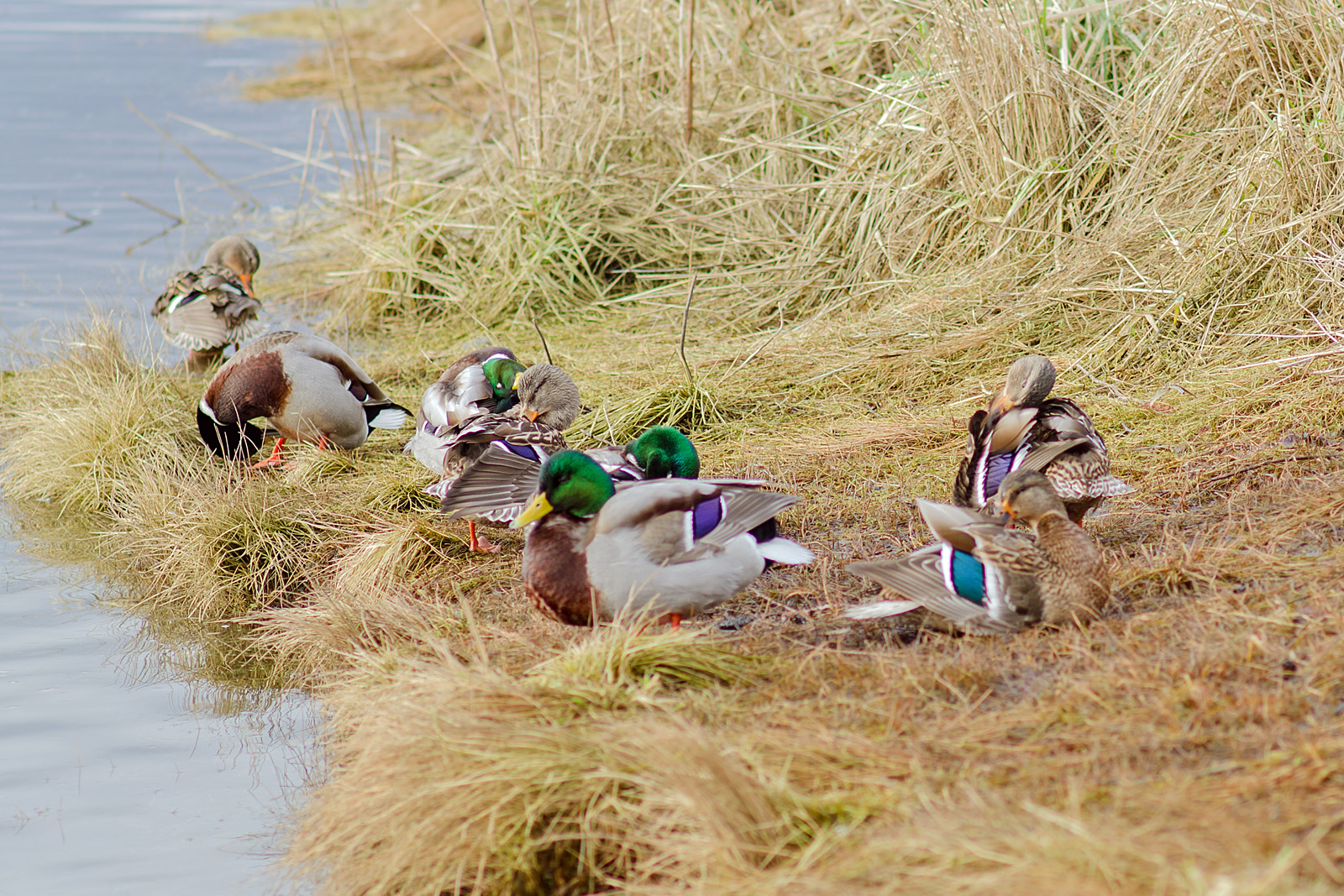
Mallards resplendent in green, purple, turquoise and chestnut, busily grooming. Gotta look good!

Quieter tones; female wigeons. The male shows off with a bright green stripe down the side of his face.

Mallards pair off in the fall.
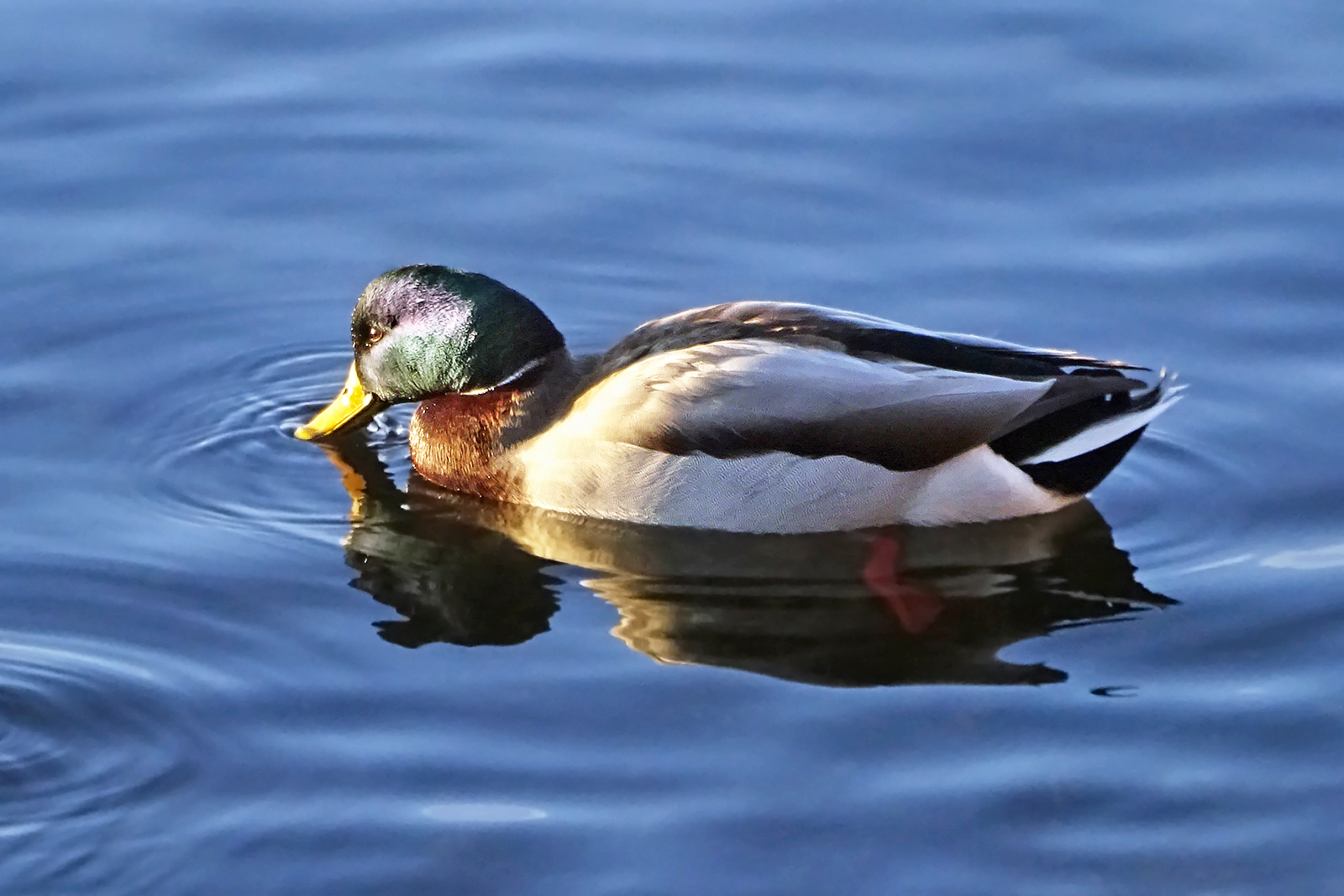
A couple of female mallards, hiding their blue/turquoise speculums.

Goldeneye in the distance. I like the stripy water.

Red-breasted merganser, with her spiked hairdo. Her mate will have a dark green head and red eyes. Both their bills are orangey red; here, the colour is too dark to be seen against the light.

Up in the parking lot, the pigeons were hanging out, the males strutting, puffing out their chests: "Look at me! Me! I'm coo-coo-cool!"

Iridescent purple and green scarf, grey wings.

No two pigeons are alike. This one has an interesting wing pattern.

Suddenly, the whole flock takes off at once with a rustle and clap of wings, flies around and around swiftly, then peacefully settles a few metres away from the starting point.

Thursday, January 12, 2017

Purple or green?

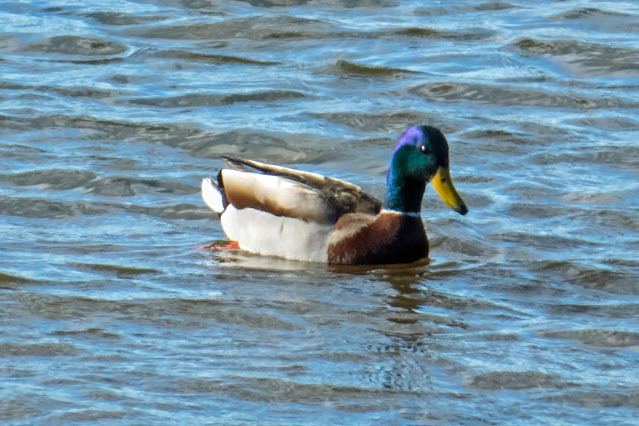
The male mallard has an iridescent green head.

Mallard, Campbell River estuary. Against the light, so the glow of the head is muted.

And sometimes, a purple head.

This one is half purple, half green.

I looked for an explanation of the colour shift, and found various theories:
  1. It's due to interbreeding with other species. And mallards are notorious for this.
  2. It's really just green, but it looks purple because of light interference and diffraction.
  3. Some mallards are just purple-headed. That's it. And why not? Just enjoy!
  4. The colour depends on the structure of the feathers.
An interesting discussion follows this photo of a strongly purple-headed mallard on Flickr. I have no theory, other than #3 above.

While we're on that shore, here's a sparrow, not shiny, not showy, but just happy, bouncing around in the weeds along the bank, finding goodies to eat.


Lots of yummy seeds among that broken, dried grass!


Saturday, August 09, 2014

Messy!

Life is messy. Sometimes, in some places, the mess is hidden. It's underwater, or too small to see, or too big, too far away. And sometimes, it's everywhere you look.

Reifel Island is a good place to find it.

Tree, without the leaves to disguise the disorderly branches.

Unidentified plant, gone to seed, half fallen over the bank. The purple flowers are purple nightshade.

Mallard, daisies, and pond scum.

Bee on thistle, with pollen dust, and a tangle of assorted plants as background.

Windborne seed, on goldenrod. With assorted flies and ants, all tied together with spider webs.

Ripening crabapples, with spotty, dying leaves. And spider web, of course.

Blackberries, green, red, spotty, black, and purple. With dead flowers. And spider webs.

More pond scum, rotting weeds, and a neat little brown sparrow.

Busy bee on thistle, skipper waiting his turn, and more spider webs.

Black-crowned night heron, in his favourite spot. 

I'm sure there were spider webs around the heron, too.


Powered By Blogger