Showing posts with label common merganser. Show all posts

Saturday, May 02, 2026

Buttle Lake, again.

I made a quick run out to Buttle Lake to see if last year's pink grass was pink again. Last year, it was the 21st of May that I found it, but it was an average of several degrees cooler all last spring. And wetter. (The sample I brought home grew up green as soon as it got used to the warmth on my windowsill.)

No pink grass this year; the water in the lake is high. And maybe it's too warm. Still, it was a good visit.

View from the campground at the northern tip of the long, narrow (23 km. by 1.5 km. wide) lake.

Hills on the southern shore, and brand-new alder leaves.

Where the pink grass was last year. Underwater now. Looking north.

The water is crystal clear. Shallow along the edges, the lake quickly drops to 120 metres deep. I love the colour! 

Merganser pair on new-leaf-green reflections .

Wild strawberries along the shore. There were red-backed bumblebees zipping around them, too fast for me. Bombus sp., possibly B. vancouverensis or B. melanopygus.

Dogwoods were blooming up and down the slopes. Cornus nutalli.

On a trail along the shore, I found a log to sit on. This was my view. All dry and scratchy, even the moss. It's unseasonably warm; the moss is crunchy underfoot.

There were geese. Photos tomorrow.

A Skywatch post. 

~~~~~~~~~~~~~~~

Hice una visita rápida al lago Buttle, para ver si el pasto color de rosa que vi allí el año pasado estaba del mismo color otra vez. Era el 21 de mayo cuando lo encontré, pero la temperatura promedia toda la primavera pasada estaba menos que la de ahora. Y había llovido algo más. (La muestra que me traje a casa se volvió verde en cuanto se acostumbró al calorcito de mi ventana.)

Y este año, no hubo pasto color de rosa; el nivel del agua está cerca de su máximo. Y tal vez menos frío. De todas maneras, estuve contenta de haber venido.

  1. La vista desde los sitios de acampar en el extremo norte del lago. (Mide 23 km. de largo, apenas 1.5 km. en su punto más ancho.)
  2. Cerros al sur del lago, contrastando con el color amarillo/verde de las nuevas hojas de aliso rojo.
  3. Aquí es donde encontré el pasto color de rosa el año pasado. Ahora está inundado.
  4. El agua es muy claro, y el fondo baja hasta los 120 metros en el centro. Me encanta el color.
  5. Una pareja de serretas, Mergus merganser, y el color de los alisos reflejado.
  6. Fresa silvestre, Fragaria virginiana. Abejorros con un abdomen rojo iban y venían alrededor de estas flores, pero se me escapaban antes de poder sacar una foto buena. Bombus sp., o B. vancouverensis o B. melanopygus.
  7. Las flores de cornejo, Cornus nutalli, ya se ven por las laderas.
  8. En un senderito al lado del agua, encontré un tronco caído que servía de asiento. Esta es la vista que se me presentaba. Todo estaba seco y áspero, hasta el musgo. Hace un calor inusitado; el musgo, al pisarlo, cruje.
Tengo unos gansos para mañana.


Tuesday, March 31, 2026

In the woods, on the water, in the grass

Birds everywhere! Saturday, I walked down Baikie Island, then stopped in briefly at Brown's Bay. So many birds out enjoying the sunshine! Yesterday, Tyee Spit; more birds. Here's the first installment.

Chestnut-backed chickadee, Poecile rufescens. This is the only chickadee found on the island.

Canada geese and a mallard couple resting in a backwater.

Mallard male and Bufflehead female.

More Canada geese, at Brown's Bay.

Distant bufflehead female. The females are recognizable, even at a distance, by the white cheek spot. (Goldeneye males have one, too, but they're larger and dramatically coloured.)

Common merganser couple, Brown's Bay.

Robin, Brown's Bay.

And a shy Song Sparrow. Tyee Spit.

I missed a couple of Towhees hopping through the understory, too fast for me, some juncos ... Other birds tomorrow.

~~~~~~~~~~~~~

¡Pájaros por todas partes! El sábado, di la vuelta a la isla Baikie, y luego pasé por Brown's Bay. ¡Tantos pájaros había, disfrutando de los rayos solares! Y ayer, fui a Tyee Spit, donde vi otros tantos. Estos son algunos de ellos.

  1. Carbonero dorsicastaño, Poecile rufescens. Este es el único carbonero que se encuentra en la isla Vancouver.
  2. Gansos canadienses, Branta canadensis, y una pareja de patos ánades,  Anas platyrhynchos.
  3. Un pato ánade macho, y una porrón coronado, Bucephala albeola, hembra.
  4. Otros gansos canadienses, en Brown's Bay.
  5. Una Bucephala albeola hembra. Las hembras se pueden distinguir facilmente, aun a una distancia, por el círculo blanco que tienen en el cachete. (Los machos de las especies Bucephala islandica y B. clangula también tienen manchas blancas en la cara, pero estos pájaros son más grandes y sus colores son algo dramáticos.)
  6. Una pareja de serretas grandes, Merus merganser. Brown's Bay.
  7. Petirrojo, Brown's Bay.
  8. Y un gorrión cantor, Melospiza melodia. Tyee Spit.
Se me escaparon unos toquíes y juncos que saltaban en el sotobosque. Y para mañana, hay otros pájaros.

Tuesday, November 18, 2025

Flirty swimmers

 In a quiet pool beside the main flow of the river, I came across these hooded mergansers:

Male hooded merganser, Lophodytes cucullatus.

This little guy was swimming in circles, alone, with his crest raised. He was raising his head, then pumping it jerkily up and down, sometimes bending backward to rest his head on his back. I tried to get a video, but I was peering at him between branches of the evergreens; I got several nice videos of the intervening branches.

Double-header.

"When aroused by danger or passion, the male flares his white head crest, looking about as good as a duck can look." So says my bird guide book. This guy wasn't in any danger, so it must be passion.

I walked around a pumphouse to get at the pool from the far side, without trees in the way. By the time I got there, the hoodie had acquired the beginnings of a harem:

Male and a pair of females, swimming in sync. He's got his crest down now; the females are displaying  theirs.

 And from this side, I got a short video, but without the head pumps.


A female common merganser joined the hoodies for a minute. Usually I see these in the current, fishing. She is larger than the hoodies, about 64 cm. to their 46.

She is also crested, like the hoodies, but her crest is a bit ragged. Her mate has a sleek, green head.

~~~~~~~~~~~~~~~
En una lagunita tranquila, separada de la corriente rápida del rio, vi estos patitos, Lophodytes cucullatus (Serretas capuchonas). Vi el macho primero, nadando a solas, haciendo círculos en el agua con su cresta alzada. Levantaba la cabeza, luego la subía y bajaba como de golpe, a veces doblándola hacia atrás hasta reposar la cabeza sobre su espalda. Traté de hacer un video, pero lo estaba observando entre ramas, y logré solo sacar videos de ramas.

    1. El macho, exhibiendo su cresta inflada.

    2. Tranquilo, con su reflejo.

"Cuando está estimulado o por el peligro, o por la pasión, el macho infla su cresta blanca, mostrándose tan guapo como lo puede ser un pato." Así dice mi libro guía sobre estos pajaritos. Aquí no había ningún peligro; le inspiraba, pues, la pasión.

De allí di la vuelta a una instalación de BCHydro, para llegar a la laguna desde el extremo opuesto, con acceso sin árboles. Cuando llegué, el patito macho ya había atraido dos hembras:

    3: El macho con sus dos hembras. Ahora él no trae la cresta levantada, pero sus amigas sí.

    4: Desde este lado de la laguna, logré hacer un video, pero sin las posturas coquetas.

    5: Una Serreta Grande, hembra, entró por unos momentos a la laguna. Normalmente, veo estas en la corriente, pescando. Estos patos son más grandes que las Serretas Capuchonas, midiendo 64 cm, mientras las Capuchonas miden hasta 46 cm. Las hembras de esta especie tienen la cresta, aunque no tan arreglada como la de las Capuchonas; la cabeza de los machos (Grandes) es lisa y verde.

Saturday, July 19, 2025

Birds from here and there

This is just a collection of the birds I've been seeing recently. In no particular order (I let the blogger program choose.)

Harlequin duck, female. The male was hiding behind the rock.

Great blue heron waiting for low tide in a tree.

I stopped to look at fireweed and saw this hummingbird.

Mergansers. They would sit still in a group, then suddenly, all together, dash along the surface for a few seconds. As if they were attacking something invisible. Then they'd rest quietly again. Repeat. No apparent reason.

Red winged blackbird, male, singing for his mate in the rushes.

Showing off his red patch.

White-crowned sparrow, with goodies for the nestlings.

All fluffed out after an energetic bath.

Gull on seaweed, at low tide.

There were more; there are always more, but they don't often wait for me.

~~~~~~~~~~~

Estos son unos de los pájaros que he visto recientemente.

  1. Una pata arlequín. El macho se escondió tras la roca.
  2. Una garza azul, esperando a que baje la marea, en la rama de un árbol.
  3. Me detuve para mirar las flores y sorprendí un colibrí.
  4. Serretas grandes. Descansaban, quietecitas, y luego de repente todas se echaron a acelerar sobre la superficie del agua por unos pocos segundos, como si atacara algo. Pero no había nada. Después, ahi se sentaron tranquilamente hasta que, quien sabe por que razón, otra vez atacaron al objeto invisible. Y otra vez, y otra ...
  5. Un sargento alirrojo, cantando para su hembra, ocupada con la cria entre las juncáceas.
  6. Aquí nos muestra su mancha roja.
  7. Un gorrioncito de corona blanca con el desayuno para sus polluelos.
  8. Otro, recién bañado.
  9. Y una gaviota en una roca cubierta de algas marinas variadas.
Había otros; siempre hay otros, pero tienen poca paciencia, y no se quedan quietos.

Monday, April 28, 2025

Peaceful

Just a few birds from Brown's Bay. Without much commentary; I'm watching the election results.

Canada goose. Male or female? They know; I can't tell the difference.

The swimmer's mate.

Common merganser, male.

And here he is with his red-headed mate.

A distant pair of sleepy buffleheads.

Swallow's nest. This year's, I think. No sign of chicks; it's early yet.

I'm wondering; many of the swallow's nests I see around buildings are perched on top of electrical fittings. Do they choose these spots because they're warmer? Or just because they're handy? This nest is up under the peak of a shelter over a bench and a chainsaw carving.

~~~~~~~~~~~~
Aquí hay unos pájaros vistos en Brown's Bay. Casi sin comentarios, porque estoy siguiendo los resultados de nuestra elección.

  1. Ganso canadá, Branta canadensis.  No sé si es macho o hembra; ellos saben.
  2. Y su pareja.
  3. Una serreta grande macho, Mergus merganser.
  4. Y la pareja, ella con su cabeza rojiza.
  5. Dos porrones coronados, Bucephala albeola, en la distancia.
  6. Nido de golondrinas. Creo que es nuevo, pero es muy temprano para que haya polluelos.
Me pregunto: muchos de los nidos de golondrinas que encuentro alrededor de edificios se han construido encima de instalaciones eléctricas. ¿Será que escogen estos sitios porque son más calientitos? ¿O simplemente porque son convenientes? Este nido se encuentra bajo una estructura que protege un banquito y una escultura hecho con motosierra.

Sunday, March 09, 2025

Catch of the day

In the lower reaches of the Campbell River, on any halfway sunny day, you can find fisher folk, maybe standing on a high bank casting their lines into the water, more often out in the current in their hip waders, sometimes striding contentedly back along the trail carrying the catch of the day.

The other day, walking along the river bank, I passed another of the fisher folk, this one needing no rod and line; the hook, she wears it on the end of her beak. A Common Merganser, fishing a sunny stretch of the river. 

The water is shallow here, ankle-deep in this branch of the river; the main stream runs down on the far side of an island. She never had to dive, just ducked her head under the water to probe the stones on the riverbed. She mainly eats fish, but also likes crayfish, which she can find here.

Mergus merganser, female.

The light was strange: just under the riverbank on my side, the water was blue, but out from under the deepest shade of the trees, the colours went from brown to yellow to green. The water, in my photos, looks solid, congealed in place; it wasn't. The camera was doing its best to freeze the action.

As I first saw her, in mid-stream.

Zooming 'way in and then cropping the photo; she's on the far side, in the only quiet patch of water.

This is how I mainly saw her; bill poking at the stones underwater, crest pointing at the sky.

More "solid" water.

She caught something a good size, fish or crayfish, I couldn't tell, paused to gulp it down, then went back to work.

~~~~~~~~~~~~~~~

Donde el rio Campbell llega a tierras bajas, en cada dia cuando haya un poco de sol, podrás encontrar pescadores, tal vez parados en un banco elevado sobre el rio, lanzando sus lineas al agua, o más comunmente a medio rio, con sus cañas de pescar y sus pantalones impermeables (waders), y a veces los encuentras en el sendero, regresando a casa muy contentos con su captura del dia.

El otro dia, caminando al lado del rio, encontré otra de los pescadores.Esta no traía caña ni linea; el anzuelo, lo trae en el extremo del pico. Una serreta grande, pescando en un tramo asoleado del rio. 

El agua en este tramo es de poca profundidad; la corriente principal pasa por el otro lado de una pequeña isla. La serreta nunca tuvo que bucear, y solamente hundía la cabeza para buscar entre las piedras en el fondo del rio. Come, por lo general, pescado, pero también le gustan los cangrejos Señal, Pacifastacus leniusculus, que se encuentran en estas aguas.

  1. Mergus merganser, hembra
  2. Como la vi al principio, a medio rio. La luz pintaba todo de colores distintos. En la sombra bajo los árboles donde yo estaba, el agua estaba de un azul vívido, pero ya fuera de esa sombra, los colores variaban desde café hasta amarillo o verde, según el color del fondo y la intensidad de la luz. El agua, tan turbulenta, parece en mis fotos como si estuviera congelada, sólida. Cosa de la cámara.
  3. Haciendo zoom con la cámara, y luego cortando la foto; la serreta ahora estaba del lado opuesto del rio, en un poco de agua casi quieta.
  4. Así es como la veía por la mayor parte; con el pico explorando las piedras bajo el agua y las plumas de la cabeza apuntando hacia el cielo.
  5. Otra foto con agua "congelada" y de colores.
Pescó algo, no vi si era pescado o cangrejo Señal. Se detuvo un rato para tragárselo y luego volvió a la pesca.

Monday, April 25, 2022

Red head, green head, round heads

Brown's Bay is quiet at this time of year; the restaurant is closed, the docks deserted. I had gone to look for birds along the road, without luck this time. But in the quiet bay, a pair of mergansers and three seals swam and paddled about undisturbed.

Common mergansers, Mergus merganser.

The breeding male has the iridescent green head; the female's head is rusty red and she wears a crest. They are happy both on salt and fresh water; when I first saw this pair, they were in the creek; by the time I'd found a good vantage point on the shore, they were out near the seals.

He was such a blinding white!

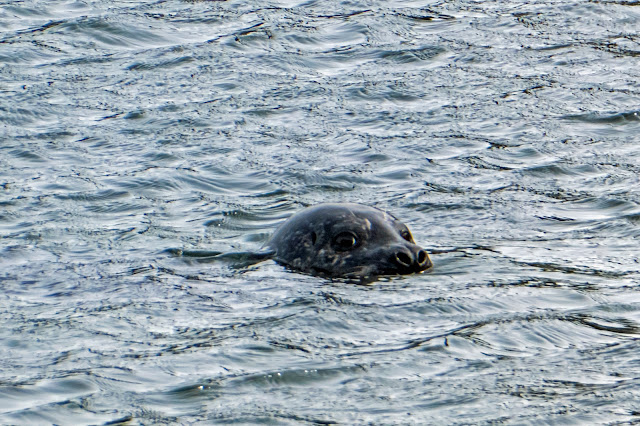
The seals — I think there were three; there could have been more, but I saw three heads up at the same time — kept bobbing up and down, coming over to look at me, but never getting too close.

Harbour seal, Phoca vitulina

Getting a good look at me.

~~~~~~~~~~~~~~~~~~~~~~~~~~
La bahía "Brown's Bay" espera en silencio en esta temporada; el restaurante no abre hasta junio, no hay nadie en los muelles ni en la tienda. Yo había ido a buscar pájaros al lado del camino, sin suerte esta vuelta. Pero en la bahía desierta, una pareja de serretas grandes, Mergus merganser, y tres focas daban vueltas sin que nadie los estrobara.

Fotos: Los serretas: el macho en época de reproducción tiene la cabeza de un color verde fuerte, iridiscente. La hembra, y los juveniles tienen la cabeza de un rojo de ladrillo, con una cresta.

Estos patos se encuentran en agua salada o fresca. Cuando vi esta pareja por primera vez, estaban en el riachuelo; para cuando logré establecerme en el muelle, estaban en la bahía cerca de las focas.

Las focas: son focas comunes, o sea focas de puerto. Había por lo menos tres — pudo haber más, pero por lo menos vi tres cabezas asomándose a la vez.  Se hundían y volvían a salir, acercándose para verme, pero con cuidado.
Powered By Blogger