Showing posts with label Western Flowering dogwood. Show all posts

Saturday, May 02, 2026

Buttle Lake, again.

I made a quick run out to Buttle Lake to see if last year's pink grass was pink again. Last year, it was the 21st of May that I found it, but it was an average of several degrees cooler all last spring. And wetter. (The sample I brought home grew up green as soon as it got used to the warmth on my windowsill.)

No pink grass this year; the water in the lake is high. And maybe it's too warm. Still, it was a good visit.

View from the campground at the northern tip of the long, narrow (23 km. by 1.5 km. wide) lake.

Hills on the southern shore, and brand-new alder leaves.

Where the pink grass was last year. Underwater now. Looking north.

The water is crystal clear. Shallow along the edges, the lake quickly drops to 120 metres deep. I love the colour! 

Merganser pair on new-leaf-green reflections .

Wild strawberries along the shore. There were red-backed bumblebees zipping around them, too fast for me. Bombus sp., possibly B. vancouverensis or B. melanopygus.

Dogwoods were blooming up and down the slopes. Cornus nutalli.

On a trail along the shore, I found a log to sit on. This was my view. All dry and scratchy, even the moss. It's unseasonably warm; the moss is crunchy underfoot.

There were geese. Photos tomorrow.

A Skywatch post. 

~~~~~~~~~~~~~~~

Hice una visita rápida al lago Buttle, para ver si el pasto color de rosa que vi allí el año pasado estaba del mismo color otra vez. Era el 21 de mayo cuando lo encontré, pero la temperatura promedia toda la primavera pasada estaba menos que la de ahora. Y había llovido algo más. (La muestra que me traje a casa se volvió verde en cuanto se acostumbró al calorcito de mi ventana.)

Y este año, no hubo pasto color de rosa; el nivel del agua está cerca de su máximo. Y tal vez menos frío. De todas maneras, estuve contenta de haber venido.

  1. La vista desde los sitios de acampar en el extremo norte del lago. (Mide 23 km. de largo, apenas 1.5 km. en su punto más ancho.)
  2. Cerros al sur del lago, contrastando con el color amarillo/verde de las nuevas hojas de aliso rojo.
  3. Aquí es donde encontré el pasto color de rosa el año pasado. Ahora está inundado.
  4. El agua es muy claro, y el fondo baja hasta los 120 metros en el centro. Me encanta el color.
  5. Una pareja de serretas, Mergus merganser, y el color de los alisos reflejado.
  6. Fresa silvestre, Fragaria virginiana. Abejorros con un abdomen rojo iban y venían alrededor de estas flores, pero se me escapaban antes de poder sacar una foto buena. Bombus sp., o B. vancouverensis o B. melanopygus.
  7. Las flores de cornejo, Cornus nutalli, ya se ven por las laderas.
  8. En un senderito al lado del agua, encontré un tronco caído que servía de asiento. Esta es la vista que se me presentaba. Todo estaba seco y áspero, hasta el musgo. Hace un calor inusitado; el musgo, al pisarlo, cruje.
Tengo unos gansos para mañana.


Tuesday, May 14, 2024

Deceptive dogwood

 It's dogwood flowering time. The spring edition; dogwood also flowers in the fall. In between times, it makes red berries.

Western Flowering Dogwood, Cornus nuttallii. With beetle.

A tree full of blooms.

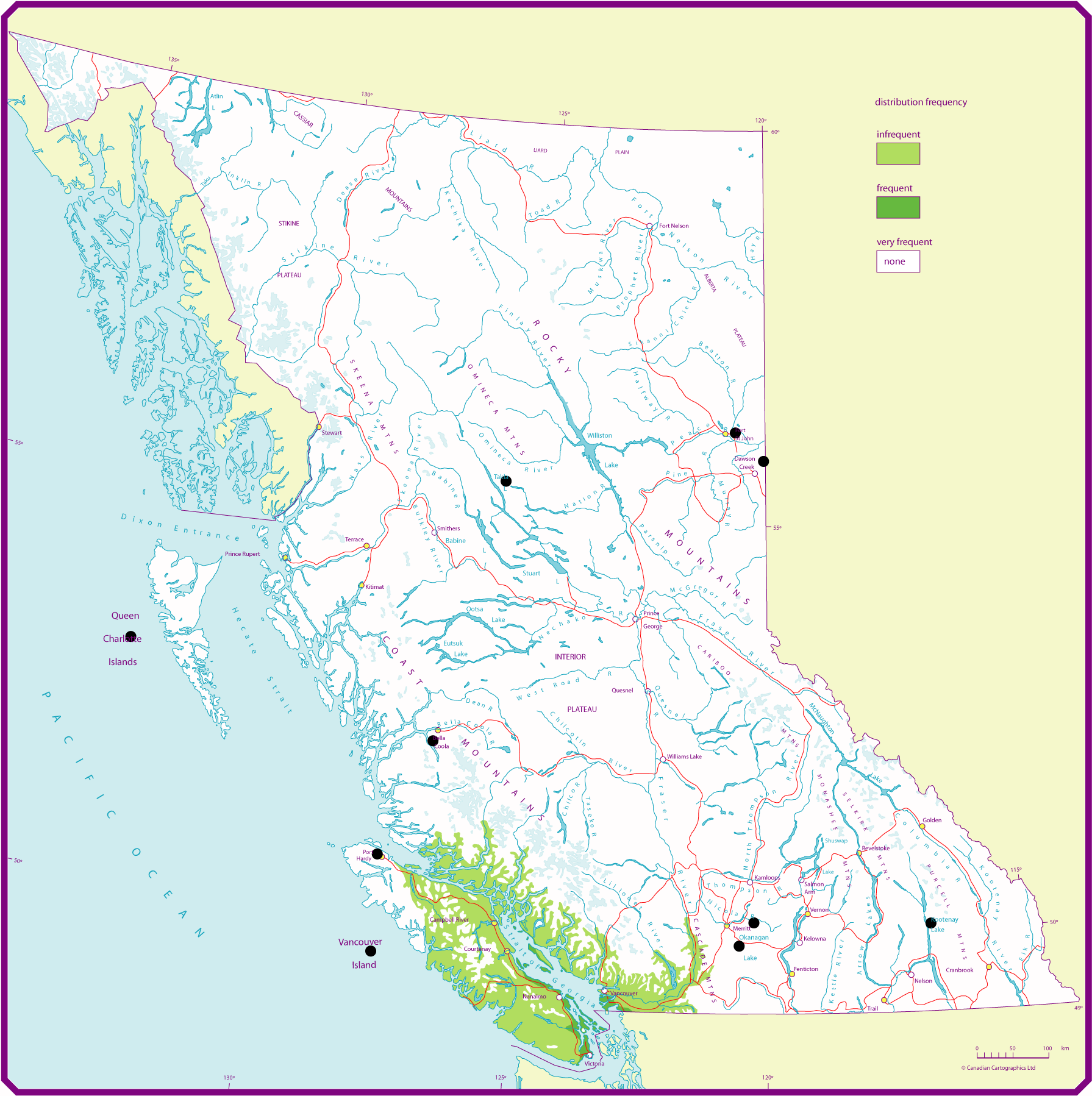
The native dogwood is BC's Provincial flower, although it is found mainly on Vancouver Island and the edges of the fjords on the southwestern coast of the mainland, with a small extension along the lower Fraser River. (See entire BC Forestry map, here.) Its range also includes the western coast of the US.

Cropped portion of BC Forestry map. Green areas are the dogwood's range.

The trees, short, almost shrubby at times, grow along the edges of the forest, liking semi-open spaces. This one is growing beside the road in an area barely recovering from logging.

The flowers range from white to pale yellow, sometimes greenish, often with purple markings. And they're tiny, up to 2 cm. wide, fully open. What we see, unless we're a few inches from the tree, are the wide, showy bracts, white to cream, sometimes pinkish, that surround the cluster of true flowers in the centre.

The central flower head of a dogwood, some flowers open, with 4 petals. A few purplish marks.

This one has only one flower open so far.
 
~~~~~~~~~~~~
Es la temporada de flores del Cornejo del Pacífico (Cornus nuttallii). La primera temporada, la de la primavera, pues vuelve a producir flores en el otoño. En el verano, llevará sus bayas rojas.

Fotos:
    1: Flor de Cornus nuttallii. Con un escarabajo.

    2: Una sección del árbol con muchas flores.

Es un árbol nativo a la región y ha sido nombrado la flor provincial de Columbia Británica, aunque se encuentra principalmente en la isla de Vancouver, y en las laderas de los fiordos de la costa sudoeste de la provincia; también se encuentra en el rio Fraser, y la costa occidental de los Estados Unidos.
    
3: Parte del mapa dando la distribución del cornejo, por BCForestry.  (Véase el mapa de la provincia entera, aquí.)

Los árboles, no muy grandes, casi como arbustos a veces, crecen en los bordes de los bosques; les gustan los sitios medio abiertos. Este, lo encontré al lado del camino en una parcela apenas recúperandose después de la tala.

Las flores van desde blancas a un amarillo claro, a veces verdes, a veces con marcas moradas en los pétalos. Y son muy pequeñas, midiendo a lo más hasta  cm. completamente abiertas. Lo que vemos, a menos de que nos acerquemos mucho, son las brácteas, grandes y llamativas, blancas o color crema, o a veces con un dejo de color de rosa. Estas brácteas rodean el racimo de las verdaderas flores en el centro.

    4: El capítulo del cornejo, con algunas de las flores abiertas. Tienen 4 pétalos, y se ven unas manchas oscuras.

    5: Esta "flor" tiene solo una de las florecitas abiertas.


Powered By Blogger