Showing posts with label Cornus nutallii. Show all posts

Saturday, May 23, 2026

Roadside flowers

Everywhere there are tiny flowers these days; these were beside the road at Brown's Bay.

Fringe cups, Tellima grandiflora. 

Fringecup was said to be eaten by woodland elves to improve night vision. (Plants of Coastal BC)

Vanilla leaf, Achlys tripylla. The dried leaves smell like vanilla.

Fairy bells, Disporum sp. Flowers hang in pairs from the tips of the branches.

And some are tiny but look big.

Pacific dogwood, Cornus nutallii. The flowers are small, greenish-white, clustered in the central mound, which is surrounded by the showy, white bracts.

Monday, (I hope; my computer is acting up); under the docks at Brown's Bay.

~~~~~~~~~~~~~~~
Ahora por dondequiera hay florecitas miniaturas. Estas las vi al lado del camino en Brown's Bay.

    1. Tellima grandiflora.
 Decían que hadas silvestres comían esta planta para mejorar su visión nocturna. (Plants of Coastal BC)
    2. Achlys triphylla. Las hojas secas huelen a vainilla.

    3. "Campanitas de hadas", Disporum sp. Flores gemelas cuelgan desde las puntas de las ramas.

    4. Cornus nutallii. Estas son flores miniaturas, aunque no lo parecen. Las flores, verdes con blanco,  se encuentran en el botón central, rodeado de las brácteas blancas.

El lunes tendré fotos de lo que vi debajo de los muelles. (Eso si me lo permite esta computadora, que se está portando muy mal.)


Tuesday, May 14, 2024

Deceptive dogwood

 It's dogwood flowering time. The spring edition; dogwood also flowers in the fall. In between times, it makes red berries.

Western Flowering Dogwood, Cornus nuttallii. With beetle.

A tree full of blooms.

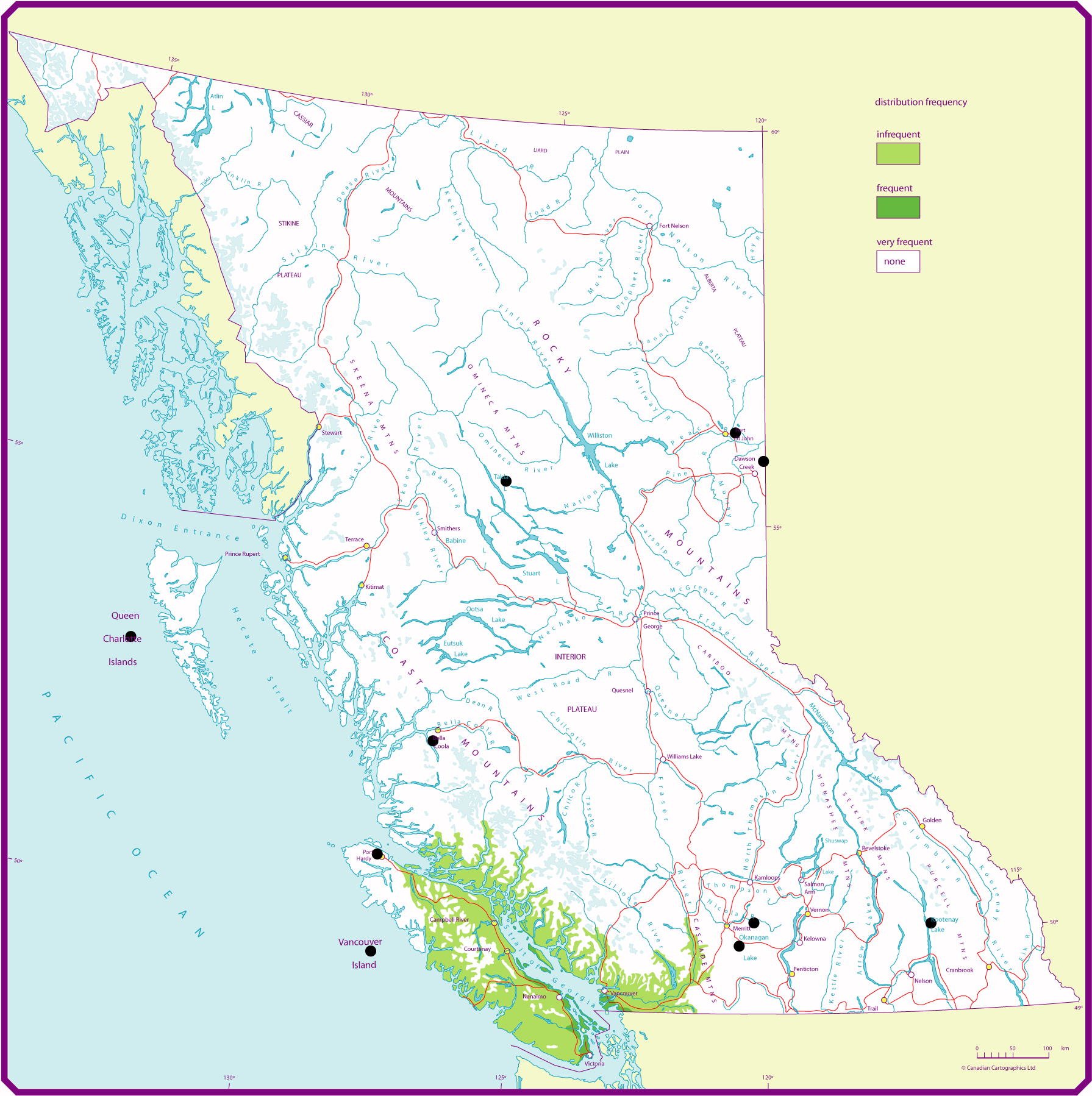
The native dogwood is BC's Provincial flower, although it is found mainly on Vancouver Island and the edges of the fjords on the southwestern coast of the mainland, with a small extension along the lower Fraser River. (See entire BC Forestry map, here.) Its range also includes the western coast of the US.

Cropped portion of BC Forestry map. Green areas are the dogwood's range.

The trees, short, almost shrubby at times, grow along the edges of the forest, liking semi-open spaces. This one is growing beside the road in an area barely recovering from logging.

The flowers range from white to pale yellow, sometimes greenish, often with purple markings. And they're tiny, up to 2 cm. wide, fully open. What we see, unless we're a few inches from the tree, are the wide, showy bracts, white to cream, sometimes pinkish, that surround the cluster of true flowers in the centre.

The central flower head of a dogwood, some flowers open, with 4 petals. A few purplish marks.

This one has only one flower open so far.
 
~~~~~~~~~~~~
Es la temporada de flores del Cornejo del Pacífico (Cornus nuttallii). La primera temporada, la de la primavera, pues vuelve a producir flores en el otoño. En el verano, llevará sus bayas rojas.

Fotos:
    1: Flor de Cornus nuttallii. Con un escarabajo.

    2: Una sección del árbol con muchas flores.

Es un árbol nativo a la región y ha sido nombrado la flor provincial de Columbia Británica, aunque se encuentra principalmente en la isla de Vancouver, y en las laderas de los fiordos de la costa sudoeste de la provincia; también se encuentra en el rio Fraser, y la costa occidental de los Estados Unidos.
    
3: Parte del mapa dando la distribución del cornejo, por BCForestry.  (Véase el mapa de la provincia entera, aquí.)

Los árboles, no muy grandes, casi como arbustos a veces, crecen en los bordes de los bosques; les gustan los sitios medio abiertos. Este, lo encontré al lado del camino en una parcela apenas recúperandose después de la tala.

Las flores van desde blancas a un amarillo claro, a veces verdes, a veces con marcas moradas en los pétalos. Y son muy pequeñas, midiendo a lo más hasta  cm. completamente abiertas. Lo que vemos, a menos de que nos acerquemos mucho, son las brácteas, grandes y llamativas, blancas o color crema, o a veces con un dejo de color de rosa. Estas brácteas rodean el racimo de las verdaderas flores en el centro.

    4: El capítulo del cornejo, con algunas de las flores abiertas. Tienen 4 pétalos, y se ven unas manchas oscuras.

    5: Esta "flor" tiene solo una de las florecitas abiertas.


Powered By Blogger