Showing posts with label bald eagles. Show all posts

Saturday, January 03, 2026

Grey morning, with framed eagle youngsters.

 I saw this pair of young eagles on the edge of the wetlands, as I passed on the far side of the estuary, and drove around, then up and down residential streets until I found the house where their trees stood. They waited, unmoving. As I stood in the driveway a few metres from their trees, one turned his head, slightly, to look at me. No other reaction, no interest. I'm not edible.

They are young, probably this year's nestmates.

Youngster #1. The green on the trees is mostly lichen.

Youngster #2, a bit farther away. Ignoring me, watching the shoreline at the foot of his tree where there may be yummy ducks, fish, maybe rabbits in the grass.

~~~~~~~~~~~~~~~

Vi estos dos águilas jóvenes en la orilla de los humedales. Iba pasando en el lado opuesto del estuario; regresé y di vueltas por la zona residencial hasta que encontré la casa debajo de sus árboles. Ellos esperaban, sin moverse. Cuando llegué a unos pocos metros, uno volvió la cabeza, pero muy poco, apenas lo suficiente para mirarme. Sin mayor interés; no soy comestible.

Son jóvenes, y probablemente hermanos, compañeros de nido de este año pasado.

  1. El primero. Lo verde del árbol es liquen.
  2. El segundo, un poco más lejos. No me miró; más bien se ocupa en examinar la orilla del estuario al pie de su árbol, donde espera ver presa: patos, peces, tal vez algún conejito entre la hierba.


Monday, December 16, 2024

The watchers

 Big birds ...

Tyee Spit, and the water surrounding it, the Campbell River estuary and the northern tip of the Georgia Strait, are home to many birds, mostly small, mostly distant, mostly (except for sleepy mallards) extremely active. And then there are the eagles, content to just sit and watch.

They were there when I arrived, they were there when I left, an hour later.

An inventory of the birds of Tyee Spit is never complete without at least one of these:

Cessna 185 Skywagon. Content to just watch for now.

~~~~~~~~~~~~~~~

Pájaros grandes ...

Tyee Spit, la lengueta de tierra que separa el estuario del Rio Campbell del extremo norte del Estrecho de Georgia, junto con sus aguas vecinas, provee hábitat a muchísimos pájaros, por la mayor parte pequeños, casi siempre allá en la distancia, y normalmente (aparte de los ánades reales, los dormilones) muy activos. Esta pareja de águilas, en cambio, se dedican a quedarse quietos, vigilantes.

  1. Dos águilas adultas. Estaban allí en su rama cuando lleguá, seguían en la misma rama cuando me fui, una hora más tarde.
  2. Ningún inventario de las aves de Tyee Spit se puede considerar completo si no incluye por lo menos uno de estos: esta avioneta flotante es un Cessna 185 Skywagon. Por ahora, se dedica a esperar.

Tuesday, July 09, 2024

How do they do it?

 Just wondering ...

Eagle in the bush

Canada geese like to rest and feed in open spaces, where they have room to spread their wings to take off. Their wingspan goes from 127 to 170 cm.

So, why do eagles rest happily among sturdy trees? When their wingspan is 'way more, reaching to 204 cm.?

And turkey vultures? Wingspan, 170 - 178 cm.

The turkey vulture is really a beautiful bird. If you don't count the naked head. But then again, tastes differ. Maybe, if we listened in on a vulture conversation, we'd hear this:

"Hey, isn't that new youngster's head absolutely gorgeous! So bare, so warty! And those bulgy eyes! Swoon!"

Another turkey vulture among branches.

When I arrived and parked by the side of the road, a half-dozen or more vultures and two eagles flew out of this dark spot. These were the last two to go.

All of 178 cm. wide!

For comparison, my "wingspan", fingertip to fingertip, is 160 cm.

And the eagle looked me in the eye, spread his 2 metres and then some of wings, and left. Without touching even a leaf on the way.

~~~~~~~~~~~~~~~~~
Me pregunto ...
  1. Un águila entre troncos y ramas.

    Los gansos de Canadá (Branta canadensis) escojen sitios donde descansar o comer con espacio libre alrededor, permitiéndoles abrir sus alas y lanzarse al aire sin estorbos. Sus alas tienen una extensión de punta a punta (envergadura) desde 127 a 170 cm.

    Entonces, ¿porqué es que las águilas descansan, muy contentas, entre árboles? ¿Cuando la envergaduar del águila calva (Haliaeetus leucocephalus) abarca 2,04 metros?

  2. El buitre pavo (Cathartes aura). Envergadura 170 a 178 cm. (El zopilote mexicano es otra especie, Coragyps atratus; tiene la cabeza negra.)

    Este buitre es, de veras, un pájaro bello. Si no te fijas en la cabeza desnuda. Pero a cada quien su gusto. Si escucháramos una conversación entre  buitres, tal vez oiríamos:

    "Oye, ¿viste ese nuevo jovencito? ¡Qué lindo! ¡Esa cabeza pelada, llena de verrugas! ¡Una belleza! ¡Tan elegante! Y esos ojos saltones: ¡como para morirse!

  3. Otro buitre entre las ramas.

  4. Cuando me estacioné al lado de la carretera, media docena o más buitres y dos águilas se echaron a volar, saliendo de este sitio entre el bosque. Estos eran los últimos en largarse.

  5. ¡178 cm.! (Y yo alcanzo, bien estirada, solo a 160.)

  6. Y el águila me miró, desplegó sus 2 metros y pico de alas, y se fue. Sin tocar ni una hojita a la salida.
¿Cómo lo hacen?

Sunday, January 14, 2024

Chilly nest

More from the cold snap. From the hill where they've clearcut the forest, leaving a view over Seymour Narrows, the water looked strange, almost as if it were blue land, bumpy and solid-looking, almost as if you could walk on it. The smoother areas looked more like ice than like sea water. The temperature had dropped to 12 below zero Celsius, and the wind was vicious, especially in this area, creating a wind chill in the vicinity of -20°.

Looking northeast. The photo doesn't show the cross-hatching in the lighter areas.

I looked back at January temperatures for Campbell River over the last 30 years. The lowest it ever got, one day in 2004, was 10 below zero; the usual range was between 10 above and 5 below zero.

And the eagle nest is still there, still in use.

Two eagles standing guard. One above, one below.

I once saw, in Bella Coola, an eagle whose talons had frozen around his perch in -20° weather, hanging upside-down from the branch. I wonder what these two think of the unaccustomed chill. No protection from the wind in this tree now that their forest is gone.

~~~~~~~~~~~~~~~~~
Hacía frio. Pasando por el sitio donde han cortado todo el bosque, dejando una vista sobre el Estrecho Seymour, vi que el agua, agua salada, se veía muy extraña, como si fuera tierra sólida, pero azul. Parecía que se pudiera caminar allí; hasta donde el agua se veía más clara, más bien parecía hielo. La temperatura había bajado a 12 grados bajo cero, y con el viento helado, muy fuerte en este sitio, daba un enfriamiento eólico de unos 20 grados bajo cero.

Foto: El Estrecho Seymour, viendo hacia el noroeste.

Revisé las temperaturas obtenidas en enero durante los últimos 30 años aquí en Campbell River. La temperatura más baja, un dia en 2004, fue de 10 grados bajo cero. La temperatura normal variaba entre 10 grados sobre cero, y 5 grados bajo cero.

Foto: Y el nido de águilas sigue en uso.

Una vez vi, en el norte, en Bella Coola, un águila cuyas garras se habían congelado sobre su rama, con la temperatura aproximadamente unos 20 grados bajo cero. El pobre pájaro colgaba cabeza abajo, fijado en su percha. Me pregunto qué pensarán estos dos águilas de este frio inusitado. En ese árbol, ahora sin bosque alrededor, nada les protege del viento.

Saturday, March 25, 2023

Birds on rocks

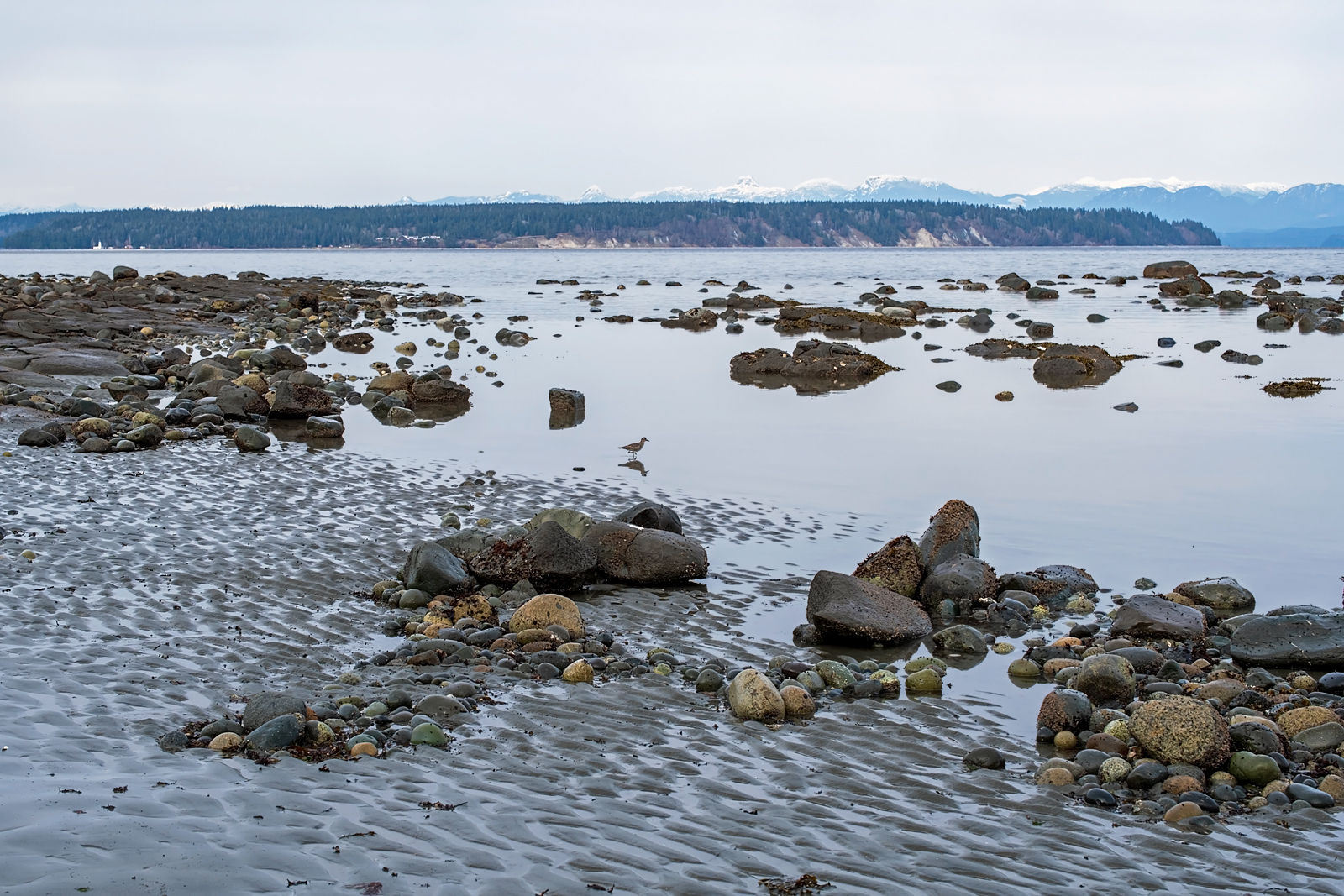
Three birds. On rocks. On a quiet beach.

The first, a yellow-legged gull. He stood there, watching me as I walked down the tide line. When I reached the edge of his comfort zone (unmarked, but he was definite about it), he removed himself to a more distant rock. And then another. When I approached too closely the third time, he flew off to sea, grumbling.

Probably a mew gull.

Then there was the sandpiper, hurrying, always hurrying, wading through the shallow water at the edge of the retreating tide, pecking at unseen goodies as he went.

One lone peep.

Crossing a rock.

And finally stopping on one, to look at me.

And off in the distance, an eagle had chosen the farthest rock for a dining table.

He kept moving about, bending down to work on his dinner, rising to look right, then left, guarding his find.

Zooming as far as the camera would go.

He had something white and pink, probably a gull. Not my shy yellow-legged gull, I hoped.

~~~~~~~~~~~~~~~~~~
Aquí tienen tres pájaros, encima de las rocas en una playa solitaria.

Primero, una gaviota con patas amarillas, una gaviota cana, Larus canus. Se quedó parado sobre una roca, mirándome mientras me acercaba, caminando al borde del agua. Cuando llegué al límite de su zona de confort, voló a otra roca, no muy lejos. Y cuando otra vez me acerqué, se levantó, quejándose y se largó.

Fotos:
  1. La gaviota, en la primera roca.
  2. Y luego había un "peep" a solas, uno de los Calidris spp. que corría y corría en el agua poco profundo, mientras bajaba la marea, buscando su alimento bajo el agua mientras iba.
  3. Aquí cruzando una roca con algas marinas.
  4. Y se detuvo en una roca para mirarme.
  5. Muy lejos, en la última piedra, un águila se ocupaba en desplomar su presa.
  6. Algo blanco, con partes color de rosa. Probablemente era una gaviota; ojalá no fuera mi gaviotita de patas amarillas.


Sunday, February 19, 2023

Eagles, right on schedule

There's an eagles' nest I've been watching for a few years. In winter only; in the summer it's hidden by the leaves. I went again today to see if the owners were back. And yes, they are.

It's a big, deep nest, built and repaired over many years. If you look closely, you can see a white head just above the rim.

Zooming in. She (or he) has come out to look at me.

Keeping an eye on the nest. Planning new work?

Introspective pose.

A brochure from our Campbell River City Hall gives nesting and breeding dates for this location. (It has a couple of photos of this same tree, from the same vantage point.)
  1. Mating: February to the first half of March. At this time, they also work on getting the nest ready, adding branches and moss.
  2. Egg Laying: First egg, March 25, plus or minus one week. Second egg 2 or 3 days later.
  3. Brooding: The male and female take turns sitting on the eggs for approximately 35 days.
  4. Chicks hatch: May 1, plus or minus one week.
  5. Chick development: Peeps heard June 10. Flapping wings, June 25. Flapping and jumping, July 10.
  6. First flight: 85 days after hatching, about July 25.
I won't be able to see this nest by June, when the chicks start sitting on the edge of the nest; the tree will be fully leafed out by then. 
In summer, Campbell River supports a few non-breeding adults, an assortment of young birds and ~25 nesting pairs. (CR City Hall brochure)
~~~~~~~~~~~~~~~~~
Hay un nido de águilas que he estado observando por algunos años. En el invierno nada más, pues en verano está totalmente escondido por las hojas. Pasé hoy para ver si los dueños han regresado. Y sí, allí están.

Fotos:
  1. El árbol y el nido. Es un nido grande y hondo, construido y arreglado durante muchos años. Se ve, apenas, la cabeza blanca de un águila asomándose.
  2. Más de cerca. El águila ha salido para mirarme.
  3. Y mantiene la observación del nido. ¿Estará haciendo planes para nuevos arreglos?
  4. Una postura introspectiva.
Un folleto publicado por la Alcadía de Campbell River, da las fechas de la cría para este lugar. (Y tiene fotos del mismo árbol, desde el mismo punto de vista.)
  1. Apareamiento: Desde febrero hasta la mitad de marzo. Durante este período, también se ocupan de la reparación del nido, añadiendo más ramas y musgo.
  2. Poniendo huevos: El primer huevo el 25 de marzo, con una semana más o menos. El segundo huevo se pone 2 o 3 dias más tarde.
  3. Incubación: El macho y la hembra se turnan cubriendo los huevos por aproximadamente 35 dias.
  4. Nacen los pollitos: El primero de mayo, con una semana más o menos.
  5. El desarrollo de la cría: Se puede oir los pios el 10 de junio. Agitan las alas el 25. Saltan agitando las alas el 10 de julio.
  6. El primer vuelo: 85 dias después de eclosionar.
No podré ver este nido para cuando los polluelos salen a sentarse en el borde del nido, en junio; el árbol va a tener todas sus hojas para entonces.
En el verano, la ciudad de Campbell River sostiene unos cuantos adultos no reproductores, un surtido de águilas juveniles y cerca de 25 parejas nidificadoras. (Del folleto de la Alcadía)


Friday, February 10, 2023

Observation post

 I'm seeing more eagles than I have for a while, mostly wheeling overhead, sometimes perched on a snag. This one was watching ducks and gulls from trees beside the beach.

A lopsided tree, shaped by weather, makes a good lookout.

Eagle-eyed.

Most of the ducks I could see were out in the deep water, most too far away to identify, but the eagle can see them clearly up to 5 km. away; from this vantage point he could see buffleheads that even my camera at its best only registers as dark dots.

Distant mallards, and behind them, half-hidden by the waves, 7 buffleheads.

Another Skywatch post.
~~~~~~~~~~~~~~~~~~~~
Por un tiempo no he visto más que uno u otro águila, pero en estas últimas semanas, han aparecido de nuevo, dando vueltas allá arriba, o sentados en la copa de los árboles. Éste observaba los patos y gaviotas desde su posición en un árbol a la orilla del mar.

Foto #1: Los árboles malformados por el viento forman un puesto de observación ideal.

#2: ¡Ese ojo!

La mayoría de los patos estaban bien lejos mar adentro, tan lejos que yo apenas pude identificar algunos, pero los ojos del águila los percibe claramente hasta 5 km. de distancia. Desde esta posición pudo ver los pequeños buffleheads que mi cámara apenas registra como puntitos negros.

#3: Patos "mallard" en la distancia, con 7 buffleheads entre las olas un poco más lejos.


Friday, February 03, 2023

"All I ask ..."

 "... to the lonely sea and the sky ..."

The line from John Masefield's poem* was running through my head as I backed out of my driveway and aimed the car to the north. I have been too long peering at small things at close distances; today, I wanted to see water and space, even if the weather wasn't really good for walking on the shore, with a chill wind blowing alternate rain and snow. I headed north, to the hillside where last spring a large section of forest had been clearcut, exposing the channel between the islands. The lonely sea.

Menzies Bay to the left, Discovery Passage, due north and southwest.

Not much has changed since last April; some more of the trees along the shore have been cut, and the logging slash has been cleared away. A light dusting of snow covers the denuded forest floor. And there's Seymour Narrows leading off into the north with the hills of Quadra Island on the east, Ripple Rock lookout on the west. And a lone tug hauling a barge with tankers chugging its way north.

But why was one tall tree left standing? And is that a white speck on top? I zoomed in with the camera as far as it would go.
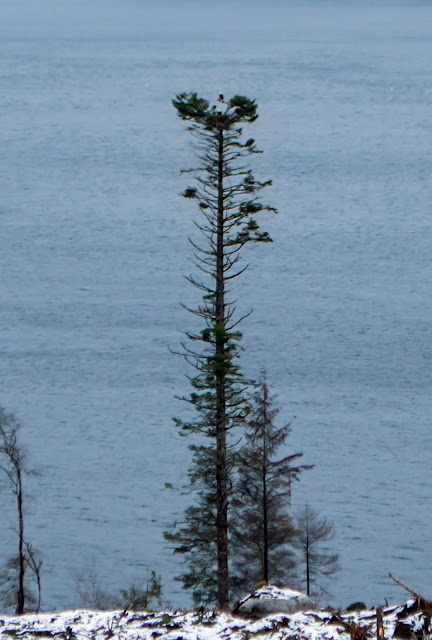
The white specs are two bald eagles. And there's a nest.

I went back to the car for the little pocket camera; it sees farther.
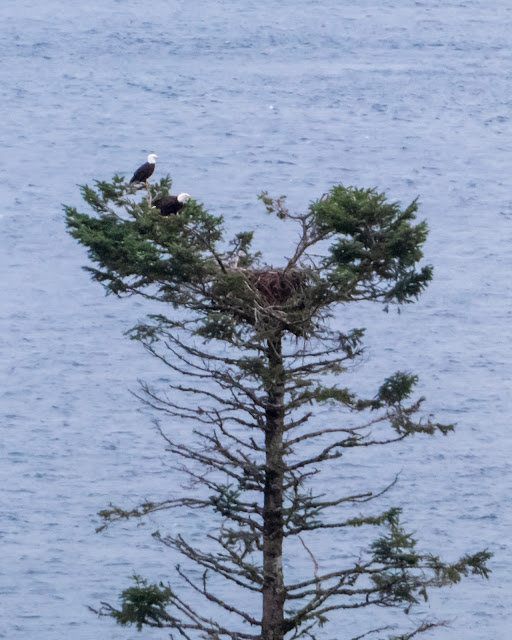
Two eagles and their nest.

So that was why the tree was left! Somehow, that makes me feel better about the rest of the devastation. Whoever cleared all this forest, whatever their plans for the space may be, at least they respected the eagles' prior claim.

I stood a long time on the side of the road, watching. One of the eagles left the nest and flew back and forth over the water, hunting for supper while his mate stood over the nest.

*Here's the entire poem:

Sea-Fever

I must go down to the seas again, to the lonely sea and the sky,
And all I ask is a tall ship and a star to steer her by;
And the wheel’s kick and the wind’s song and the white sail’s shaking,
And a grey mist on the sea’s face, and a grey dawn breaking.
 
I must go down to the seas again, for the call of the running tide
Is a wild call and a clear call that may not be denied;
And all I ask is a windy day with the white clouds flying,
And the flung spray and the blown spume, and the sea-gulls crying.
 
I must go down to the seas again, to the vagrant gypsy life,
To the gull’s way and the whale’s way where the wind’s like a whetted knife;
And all I ask is a merry yarn from a laughing fellow-rover,
And quiet sleep and a sweet dream when the long trick’s over.

JOHN MASEFIELD, 1878 - 1967

A Skywatch post.
~~~~~~~~~~~~~~~~~~~~~~~~
"... He de ir otra vez al mar, al mar solitario y al cielo ..."

Esta linea de un poema por John Masefield corría por mi mente mientras bajaba la entrada de mi casa y orientaba el coche hacia el norte. He pasado mucho tiempo mirando cosas pequeñitas, muy de cerca; hoy quería ver agua y distancias, aunque el dia no era propicio para caminar en la playa, con un viento helado trayendo lluvia, y a veces, nieve. Me dirigí hacia el norte, hacia el lugar donde, la primavera pasada, habían tumbado toda una sección grande de bosque, dejando a la vista el estrecho que va entre las islas. ... el mar solitario ...

Foto #1: La vista. La bahía de Menzies hacia el izquierdo, el estrecho de Seymour apuntando al norte, y al lado derecho, el pasaje hacia el sur.

No mucho ha cambiado desde abril del '22; han cortado algunos árboles en la costa, y han limpiado el terreno, quitándole los restos del bosque. Una capa ligera de nieve cubre el suelo desnudado. Y ahí se ve el estrecho yendo al norte, con los cerros de la isla Quadra al oriente, y el mirador de Ripple Rock al lado del oeste. Y un barquito remolcador llevando una barcaza llena de camiones cisterna.

Pero, ¿porqué han dejado un árbol solitario todavía en pie? Y ¿es que veo un puntito blanco allí? Empujé la lente de mi cámara a lo máximo.

Foto #2: Los puntos blancos son las cabezas de dos águilas. Y hay un nido.

Foto #3: Regresé al coche para traer la camarita de bolsillo. Ve mejor a grandes distancias. Sí, son dos águilas y su nido.

Así que eso era la razón! Y me hace sentirme mejor acerca de todo lo que ha pasado, por la pérdida del bosque y sus habitantes; por lo menos respetaron el derecho primordial de los águilas.

Me quedé por largo rato en el borde de la carretera, observando. Uno de los águilas dejó el árbol y voló sobre el mar, yendo y viniendo, cazando, buscando la cena, mientras su pareja montaba guardia sobre el nido.

~~~~~~~~~~~~~
Subí el poema entero, pero no me atrevo a traducirlo. En el, el autor (Masefield, 1878 - 1967) expresaba su deseo de estar en un barco en el mar solitario, "... un dia de viento con las nubes blancas volando ..."

Este fue un post de Skywatch. Haz clic para ver cielos alrededor del mundo.


Friday, March 04, 2022

Four birds in the cold

 A few birds seen on a bright afternoon on Tyee Spit: the wind was brisk and chilly, and I zipped up my winter jacket and pulled the hood close around my head. How the birds, so tiny, so bare-legged, so exposed, handle it I never can comprehend.

Towhee among blackberry canes.

Through the windshield; a chilled gull.

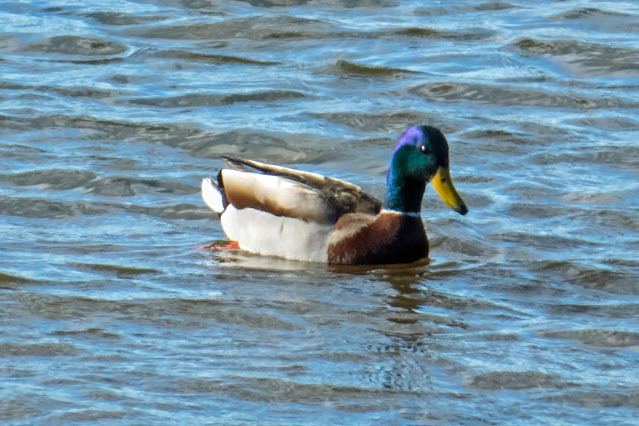
Glorious colours of a male mallard.

Eagles love to perch on the topmost branches of tall trees.

The same eagle from a different angle.

The rest: loons and wigeons, cormorants and sparrows and crows, pigeons and more mallards, were all too fast for my frozen shutter finger.

~~~~~~~~~~~~~~~~~~~~~~
Cuatro pájaros vistos en una vuelta a la lengua de tierra Tyee; hacía sol, pero el viento era fuerte y helado; yo subí el cierre de mi chaqueta de invierno y até el capuchón alrededor de mi cara; como es que estos pajaritos, tan pequeños, con las patas al descubierto, tan expuestos, se mantienen activos y felices, nunca podré comprender.

Fotos:
  1. Un toquí moteado entre cañas de mora.
  2. Una gaviota algo hinchado por el frio, vista por mi parabrisas.
  3. Los patos machos mallard lucen sus plumaje de colores vívidos, sobre todo en esta temporada.
  4. y 5. A los águilas les gusta posarse en las ramas más altas de los árboles.
Los demás, los colimbos, los wigeons, los cormoranes y los gorriones y cuervos, las palomas y muchos patos mallard, todos se movían demasiado rápido para mi dedo casi congelado en el obturador de la cámara.

Tuesday, June 25, 2019

Mixed flock

Something must have smelled rotten. (That's "delicious" in turkey vulture language.) A half-dozen or so turkey vultures and a pair of eagles were circling, circling, circling over a spot just beyond the trees bordering the highway north.

The highway shoulder where I parked was on the outer edge of their circle.

Cropped photo; the bald red head catches the light when he turns to look me over.

The underside of the wings is a pale grey. Wingspan: up to 70 inches, 178 cm, 1 3/4 metres. Wider than I am tall, by half a foot.

Turkey vultures can glide on the thermals for hours without flapping their wings, steering with those "finger" feathers, open in the first photo above, closed here.

And this I've never seen before: a pair of eagles was circling along with the vultures.

Off in the distance. The eagle is on the far outer edge of their circle.

The eagle is larger than the vultures, but not by much. The wingspan is up to 80 inches. And they do flap their wings as they turn. And even at a distance, the white head and tail are noticeable.

One last photo: a vulture as I mostly saw them, speeding away behind the power lines and trees.

I drove on up to the Sayward Junction and came back about an hour later. There were no vultures or eagles in the sky any more. They must have finally settled in to the feast.

Saturday, March 09, 2019

Tall, tiny, tiniest

Yesterday (Friday) was bright and sunny, if still chilly. I wandered through the tall, shadowy forest at Miracle Beach, poking through the moss, peering under logs and down crevices in bark.

A corner of the forest. Douglas-firs, mostly.

Old, moldy Douglas Fir cone, with "mouse tails".

I turned over a broken branch, half covered by moss, exposing a small community of critters and fungi.

White, feathery mold. And a large pupal case, also coated in mold.

I was looking at the pupal case, wondering if the mold would have killed the critter inside, when something reddish dashed out from underneath and ran away. I chased it with the camera.

A very tiny spider. The sowbug is about 1/2 cm. long. The spider, legs and all is less than that; her body is about 2 or 3 mm., fangs to spinnerets. She was panicking; running back and forth, not seeming to be able to decide where to hide.

What I didn't see, until I got home and blew up the photos, were a few tinier red mites, and possibly a much smaller spider. On the red mite just below the grass bits, I can just barely see a leg. In other photos, the mites show up, but never in the same location; they were moving fairly fast, because I was taking photos as fast as I could follow the spider.

And then there were those other things; hundreds of them.

Or thousands? Each one has a dark spot, maybe an indentation, in the centre. If the spider is 3 mm. long, these would be 1/2 a millimetre at most. A dusting of miniature cup or birds' nest fungi?

Another sowbug. And two mini-sowbugs (top left).

And this time, on the way home, I counted 18 eagles, all adults. (The immatures are harder to see; they lack the white head, and their feathers are brownish and mottled. They blend in to the scenery.)

Tomorrow; fungi, I think. Or tree trunks. Or ... I brought home over 200 photos to sort and process.

Friday, March 08, 2019

Tree lace with eagle

My pocket camera collects random photos, often taken through the windshield, then forgotten. I found this couple hidden there, taken I don't know when or exactly where, but obviously this winter.

Eagles seem to prefer broken branches

I wonder what he's thinking, sitting so quietly, watching the world turn.

On a short drive this Monday, I counted another 10 eagles in about 15 minutes, all but two in pairs, all but two just sitting, watching.

Thursday, February 21, 2019

Last gasp of winter

It snowed again Tuesday night. Then the rain returned, washing the roads clean. But today it was sunny and warm (ish). I grabbed the camera and went to Oyster Bay to look at the snow before it disappeared. I was almost too late.

Melting fast.

A frozen puddle atop an old log. With bleached kelp holdfast.

Mud, ice, snow.

On the beach, I found a frozen starfish.

The brown patch is a bit of frozen leaf.

I'm always on the lookout for starfish wasting disease, so even dead starfish get examined carefully. It looks like this one was healthy, but got stranded on shore, frozen, thawed, frozen again. Poor little guy!

On the way home, I counted 12 adult bald eagles, all but two of them in pairs high on the treetops. I may have missed some; I do have to watch the road, too. They like to perch on snags or trees with broken, twisted branches, or out in the bay, pilings; not so often on whole trees.

And I brought home a frozen kelp float for my tank. The crabs and hermits have been busy ever since, tearing it apart and wolfing down big mouthfuls.

Powered By Blogger