Showing posts with label turkey vulture. Show all posts

Saturday, October 05, 2024

Face-off

Who is watching whom? A couple of turkey vultures were busy with something beside the road to Roberts Lake. One flew away when I came by, but when I stopped the car and got out with the camera, the other came over to perch in a tree overhead to look me over.

"What's she stopping here for?This is our place!"

"Maybe if I make myself look big, she'll be scared away."

"No? Not getting back in her box with wheels?

"So I'll fluff myself out even more. Look! I'm big, I'm scary!"

"Scram! Go home!"

He won. I got back in the car and went on my way.

~~~~~~~~~~~~

¿Quién está observando a quién? Al lado del camino que da al lago Roberts, una pareja de buitres pavo (zopilote de cabeza roja, Cathartes aura) estaban ocupados con algo entre los arbustos. Cuando llegué, uno se fue, pero cuando detuve el coche y salí con la cámara, el otro vino a posarse en un árbol desde donde me pudo examinar.

  1. ¿Porqué se detiene aquí? ¡Este sitio es nuestro!
  2. Tal vez si me hago grande, se espantará.
  3. ¿No? ¿No se está metiendo en su cajita con ruedas?
  4. Pues me hago más grande aun. ¡Mira que grande soy! ¡Témeme!
  5. ¡Ya lárgate! ¡Vete a casa!
Me di por vencida. Me metí en mi cochecito y seguí camino hacia el lago.

Tuesday, July 09, 2024

How do they do it?

 Just wondering ...

Eagle in the bush

Canada geese like to rest and feed in open spaces, where they have room to spread their wings to take off. Their wingspan goes from 127 to 170 cm.

So, why do eagles rest happily among sturdy trees? When their wingspan is 'way more, reaching to 204 cm.?

And turkey vultures? Wingspan, 170 - 178 cm.

The turkey vulture is really a beautiful bird. If you don't count the naked head. But then again, tastes differ. Maybe, if we listened in on a vulture conversation, we'd hear this:

"Hey, isn't that new youngster's head absolutely gorgeous! So bare, so warty! And those bulgy eyes! Swoon!"

Another turkey vulture among branches.

When I arrived and parked by the side of the road, a half-dozen or more vultures and two eagles flew out of this dark spot. These were the last two to go.

All of 178 cm. wide!

For comparison, my "wingspan", fingertip to fingertip, is 160 cm.

And the eagle looked me in the eye, spread his 2 metres and then some of wings, and left. Without touching even a leaf on the way.

~~~~~~~~~~~~~~~~~
Me pregunto ...
  1. Un águila entre troncos y ramas.

    Los gansos de Canadá (Branta canadensis) escojen sitios donde descansar o comer con espacio libre alrededor, permitiéndoles abrir sus alas y lanzarse al aire sin estorbos. Sus alas tienen una extensión de punta a punta (envergadura) desde 127 a 170 cm.

    Entonces, ¿porqué es que las águilas descansan, muy contentas, entre árboles? ¿Cuando la envergaduar del águila calva (Haliaeetus leucocephalus) abarca 2,04 metros?

  2. El buitre pavo (Cathartes aura). Envergadura 170 a 178 cm. (El zopilote mexicano es otra especie, Coragyps atratus; tiene la cabeza negra.)

    Este buitre es, de veras, un pájaro bello. Si no te fijas en la cabeza desnuda. Pero a cada quien su gusto. Si escucháramos una conversación entre  buitres, tal vez oiríamos:

    "Oye, ¿viste ese nuevo jovencito? ¡Qué lindo! ¡Esa cabeza pelada, llena de verrugas! ¡Una belleza! ¡Tan elegante! Y esos ojos saltones: ¡como para morirse!

  3. Otro buitre entre las ramas.

  4. Cuando me estacioné al lado de la carretera, media docena o más buitres y dos águilas se echaron a volar, saliendo de este sitio entre el bosque. Estos eran los últimos en largarse.

  5. ¡178 cm.! (Y yo alcanzo, bien estirada, solo a 160.)

  6. Y el águila me miró, desplegó sus 2 metros y pico de alas, y se fue. Sin tocar ni una hojita a la salida.
¿Cómo lo hacen?

Saturday, May 20, 2023

Birding the beaver pond

 On a hot afternoon, a short walk is enough. From the road to the start of the path across the beaver lagoon and return. But there's always something to see.

Lily pads and reflections. With a few flower buds, still underwater.

Redwing blackbird, posed so as to hide his red shoulder decorations.

Hillside, dried broom (hope it doesn't recover), and clouds.

Circling, circling far overhead; a turkey vulture. Not hiding his red head.

A Skywatch post. 
~~~~~~~~~~~~~~~~
En una tarde con mucho sol un paseo cortito es lo mejor. Caminé desde la carretera hasta el borde de la laguna de los castores y regresé. Pero siempre hay algo ...

Fotos:
  1. Las hojas de los lirios de agua, con algunos botones todavía bajo el agua. Y reflejos.
  2. Un sargento alirrojo macho, escondiendo su emblema roja en el hombro.
  3. Una vista del cerro, con nubes. Y las plantas invasivas retama negra, resecas. Ojalá no revivan.
  4. Y dando vueltas y vueltas allá arriba, un buitre americano cabecirrojo.

Un post de Skywatch


Saturday, May 02, 2020

Blurding report

I posted this photo to the Facebook page, "The Worst Bird Photographs Ever". And then decided it was really the most representative photo from a few hours of bird-watching, so here it is.

Turkey vulture # 2, fleeing the scene.

I had taken a logging road leading off the highway, looking good, even paved for the first few curves, then wide and well-travelled. It led off through mostly logged-off country, abandoned and recovering. There were bogs and swamps and cliff-sides and cuts through bits of forest. I stopped often, just looking around.

Everywhere, there were birds. Little brown birds, just disappearing into the undergrowth, a flash of black wing among the reeds, a quick sliding behind a woodpecker snag, a spark of yellow just dropping into the shrubbery, a flock of distant ducks over a lily-pad pond. None slow enough, or near enough to bother with the camera.

But even with the motor running, and the tires crunching over loose gravel, I could hear them, chirping, calling, peeping.

I stood beside a cattail swamp for a while, hoping to see a flash of red or hear the red-wing blackbird call, but no; there was just a constant muted conversation going on among the stalks. Could be because of the hawk that had arrived just as I got out of the car, and was now perched on a branch overlooking the clearing. Oh, well.

On my way back to the highway, I came around a curve and saw a turkey vulture by the side of the road.

Turkey vulture # 1.

I stopped the car and rolled down the window. When the camera poked out, he took a brief look at me, and left, stage left. I was about to leave, when another barrelled out of the ditch and hurried away: that was photo #1, Turkey vulture #2.

I went to look; they'd been feasting on a well-aged deer carcass. Not photo quality, a bit stinky. You have to wonder about the vulture's taste buds.

 A totally successful birding outing clear photos or no. I came home happy.

~~~~~~~~~~~~~~~~~~~

Subí esta primera foto a la página Facebook, "Las peores fotos de pájaros". Y luego, pensándolo, decidí que era la foto más representativa de esta tarde de observación de aves. Así que, aquí está.

Había tomado un camino de madereros que salía de la carretera; un camino bien cuidado, amplio, hasta pavimentado durante las primeras vueltas. Cruzaba terrenos ya talados, pero recuperándose. Había pantanos, cerritos, pequeños precipicios, algunos pasajes por medio de bosquecitos de abetos y cedros. Me paraba frecuentemente, no más para mirar.

Donde quiera había pájaros. Pajaritos cafecitos, en el acto de desaparecer entre los arbustos, un vistazo a una ala negra entre los juncos, un movimiento lateral en el tronco de un árbol muerto (un pájaro carpintero, escondiéndose), una chispa amarilla, un grupo de patos distantes al otro lado de una laguna cubierta de lirios de agua. Ninguno suficientemente cerca o lento como para sacar la cámara.

Pero aún con el motor prendido, y sobre el crujir de llantas sobre grava, podía oir las voces; cantando, haciendo pío pío, conversando.

Me quedé parada al lado de un pantano por un rato, con las esperas de divisar las marcas rojas del ala de un tordo alirrojo, o de oir su canto primaveral. Nada. Solamente se oía la conversación en voz baja allá entre las raices. Tal vez se debía al halcón que había llegado apenas me salí del coche, y que ahora miraba el pantando desde una rama seca. Ni modo.

En camino de regreso, encontré un buitre parado al lado del camino. En cuanto apagué el motor y bajé la ventana, me miró por un segundo, y se largó. (La segunda foto.) Ya me iba, cuando otro salió de repente de la zanja, volando hacia el derecho. (La primera foto.)

Fui a investigar; habían  estado comiendo un venado, ya carroña vieja. Olía mal. No me imagino cómo funciona el sentido de gusto de estos buitres.

Un dia de gran éxito, me parece, con o sin fotos. Llegué a casa contentísima.


Tuesday, June 25, 2019

Mixed flock

Something must have smelled rotten. (That's "delicious" in turkey vulture language.) A half-dozen or so turkey vultures and a pair of eagles were circling, circling, circling over a spot just beyond the trees bordering the highway north.

The highway shoulder where I parked was on the outer edge of their circle.

Cropped photo; the bald red head catches the light when he turns to look me over.

The underside of the wings is a pale grey. Wingspan: up to 70 inches, 178 cm, 1 3/4 metres. Wider than I am tall, by half a foot.

Turkey vultures can glide on the thermals for hours without flapping their wings, steering with those "finger" feathers, open in the first photo above, closed here.

And this I've never seen before: a pair of eagles was circling along with the vultures.

Off in the distance. The eagle is on the far outer edge of their circle.

The eagle is larger than the vultures, but not by much. The wingspan is up to 80 inches. And they do flap their wings as they turn. And even at a distance, the white head and tail are noticeable.

One last photo: a vulture as I mostly saw them, speeding away behind the power lines and trees.

I drove on up to the Sayward Junction and came back about an hour later. There were no vultures or eagles in the sky any more. They must have finally settled in to the feast.

Sunday, June 11, 2017

Double take

The Ripple Rock trail brochure classifies the trail as "Easy to Moderate". It's 8 kilometres, round trip, and takes from 2.5 to 3 hours. Yesterday, I made a second attempt at it, this time with my energetic granddaughter. I made it halfway, and turned back, to rest at the first viewpoint while she went on to the bottom of the last hill.

It's not an easy hike, although it seems so at first, where a wide road leads down, down, down to the shore at Menzies Bay. There, the trail turns and clambers up a narrow rock staircase of sorts, steep, uneven, twisty and sometimes wobbly underfoot. After a couple of bridges and more hills, we come to a viewpoint; a wide, flattish rock at the top of a cliff, carpeted with moss, dotted with flowers. We went on. The trail drops and rises, drops again. I was starting to stumble.

By the time I had given up and returned to the viewpoint, I was out of breath and a bit dizzy. (I'm not as young as I used to be, but then, who is?) I lay flat on the moss, recovering, and watched the clouds.

The view from moss level.
Cottony clouds and the treetops.

Later, I sat on a rocky outcrop, snacking on nuts and apricots, watching flowers blow in the wind. And then a bird, a big bird, appeared between two trees, soared away off down the bay, came back with a couple of friends. They spiralled across the water, almost at my feet for a long while.

At first, I thought they were young eagles. But the wings weren't right.

Turkey vulture. The head is small, because it lacks feathers. When the light was right, I could see that it was red. And the wings are turkey vulture wings.

The wing itself is dark, but the flight feathers are pale. Against the bright sky, the light shines through them.

The red head is visible here. The bill is white, and hooked.

Later, while we had lunch on the rock, the birds joined the flock at the mouth of the bay. Too far away for photos, but I took a few anyhow; couldn't resist. And when I examined those photos at home, I discovered the imposters.

6 vultures here. But if you look closely (Click for a full-size photo), you'll discover three double-winged fliers joining the flock. Dragonflies!

Distances are deceptive; the dragonflies were probably just at the edge of our cliff.

(The trail hasn't beaten me; I'll tackle it another day, more slowly. There's no reason I have to go end to end without stopping to rest, is there?)

Another Skywatch post.

Monday, July 11, 2016

Turkey vulture party

6:40 PM. It was past supper time, but too beautiful an afternoon to waste it cooking. I was driving north on the highway out of Campbell River. Just driving; not going anywhere. And there, in the middle of the southbound lane, a turkey vulture stood. I parked and took photos through the window.

Looking me over; was I going to steal their dinner?

A half-dozen vultures were standing around something in the roadside weeds, while a few more stood guard in a tree and on the overhead wires. When I opened the car door, they all lifted off and moved to a more distant tree.

The underside of the flight feathers is paler than the rest of the bird.

I went over to look at their meal. A young deer; roadkill, rotting, oozing, stinking. Somehow it was difficult to imagine anything eating that. But there they were, a dozen or so big birds, just waiting for me to go away so they could get back to it.

I got back in the car and drove on for 15 minutes, then turned back, hoping to catch the vultures back at the deer. But they were smarter than I; the whole flock was perched in a bare tree behind the roadside alders.

Seven turkey vultures here. The rest were below the tree line.

Turkey Vultures eat carrion, which they find largely by their excellent sense of smell. ... They prefer freshly dead animals, but often have to wait for their meal to soften in order to pierce the skin. They are deft foragers, targeting the softest bits first ... Thankfully for them, vultures appear to have excellent immune systems, happily feasting on carcasses without contracting botulism, anthrax, cholera, or salmonella. (Cornell)

About the stink; driving back, with the window closed, I could smell the rotting carcass a couple of curves before I arrived. I wondered how far away the vultures were when they first sensed it.

All the birds I saw were adults; juveniles have a grey head, while the adults' heads are pink or red.

Sunday, July 10, 2016

Turkey vulture!

On guard.

"It's our supper. You're not invited!"

More photos, and the story, tomorrow.

Tuesday, December 21, 2010

Vultures in the winter?

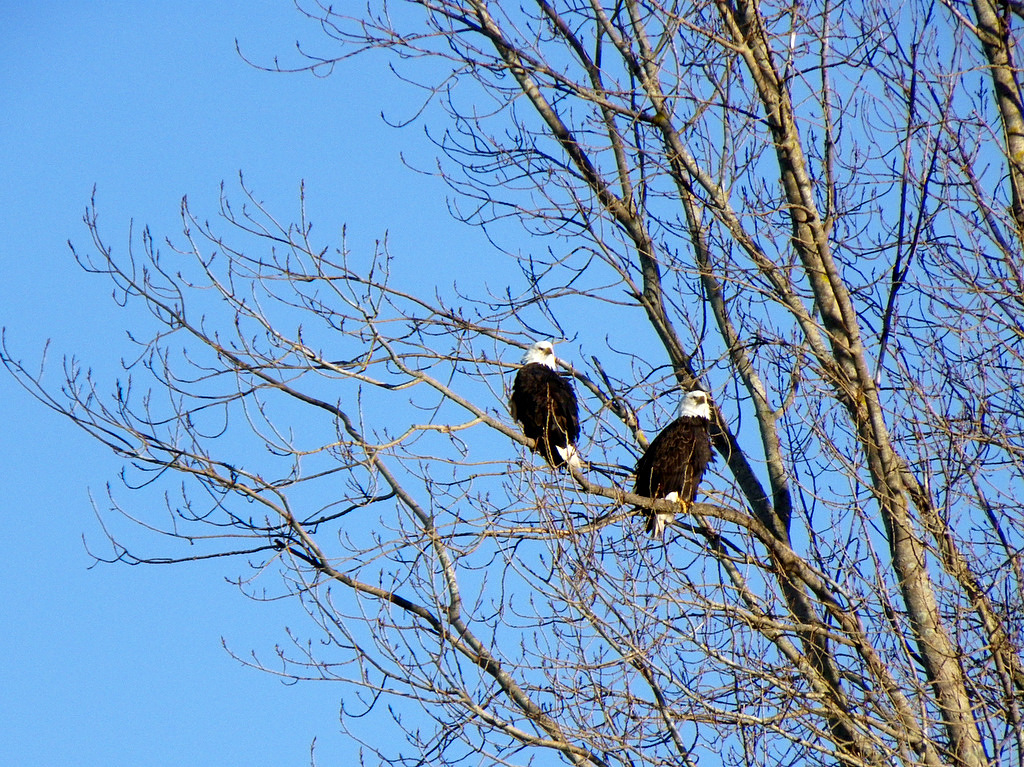
Sunday afternoon turned out bright and sunny, so we drove down for a short walk on Boundary Bay. As we neared the parking lots at Centennial Beach, we saw two mature eagles posed nicely in a tall tree. We stopped.

Two black specks with white heads

Walking closer and zooming in. Regal birds.

Before we were able to get much closer, the pair lifted off and flew across the field to a distant stand of trees.  As they went, they disturbed another large bird sitting alone; the three of them swung around and around the new chosen resting place for a while, like a dog turning three times in his bed before settling down for a nap.

Housing, bare trees, and just visible, three large flying objects.

At home, something about that third bird struck us as a bit odd, so we blew up our photos to the maximum.

Not an eagle. A turkey vulture.

This is an eagle. Big, puffy head, solid body.

Turkey vulture. Small, bare head, thinner body. Black wing linings, dark grey flight feathers. Splayed primaries.

There were at least a pair of these vultures; we saw two over the marshland, again, not recognizing them.

They're not supposed to be here; turkey vultures breed in BC, but winter from California on south, or on the east coast around Florida.  Maybe, as our local climate warms, the range may be shifting northwards. Or it may just be that Tsawwassen has always been hospitable; it's our banana belt, after all. Whatever the reason, we'll be looking for them in the future.

*UPDATE; Several of the commenters think they're immature bald eagles. They may be right.

Tuesday, June 22, 2010

Turkey vulture sighting

On the way down the Sunshine Coast, we passed this turkey vulture ripping at something on the yellow line. By the time I'd braked, it was far overhead.


I hadn't seen one before, at least, close enough to identify. But even at this distance, the distinguishing features are evident: the red, bald head, the two-toned underside of the wings; black wing linings and dark grey flight feathers. I noticed the way they hold the first four wing feathers (primaries) separated from the rest and each other. Later, I compared them with eagles' wings in flight: the eagles' primaries are separated, but blend into the others at the inner end.

There were two; one was waiting in the trees. After we had been stopped for a while, one of them returned to the road. We aimed the cameras, and a car came around the bend. Goodbye, vultures!

We would have waited more, but the pair circled a couple of times, then headed east, over the cliffs and out of sight.
Powered By Blogger