Showing posts with label redwing blackbirds. Show all posts

Tuesday, July 02, 2024

Wonky Bottle Pond

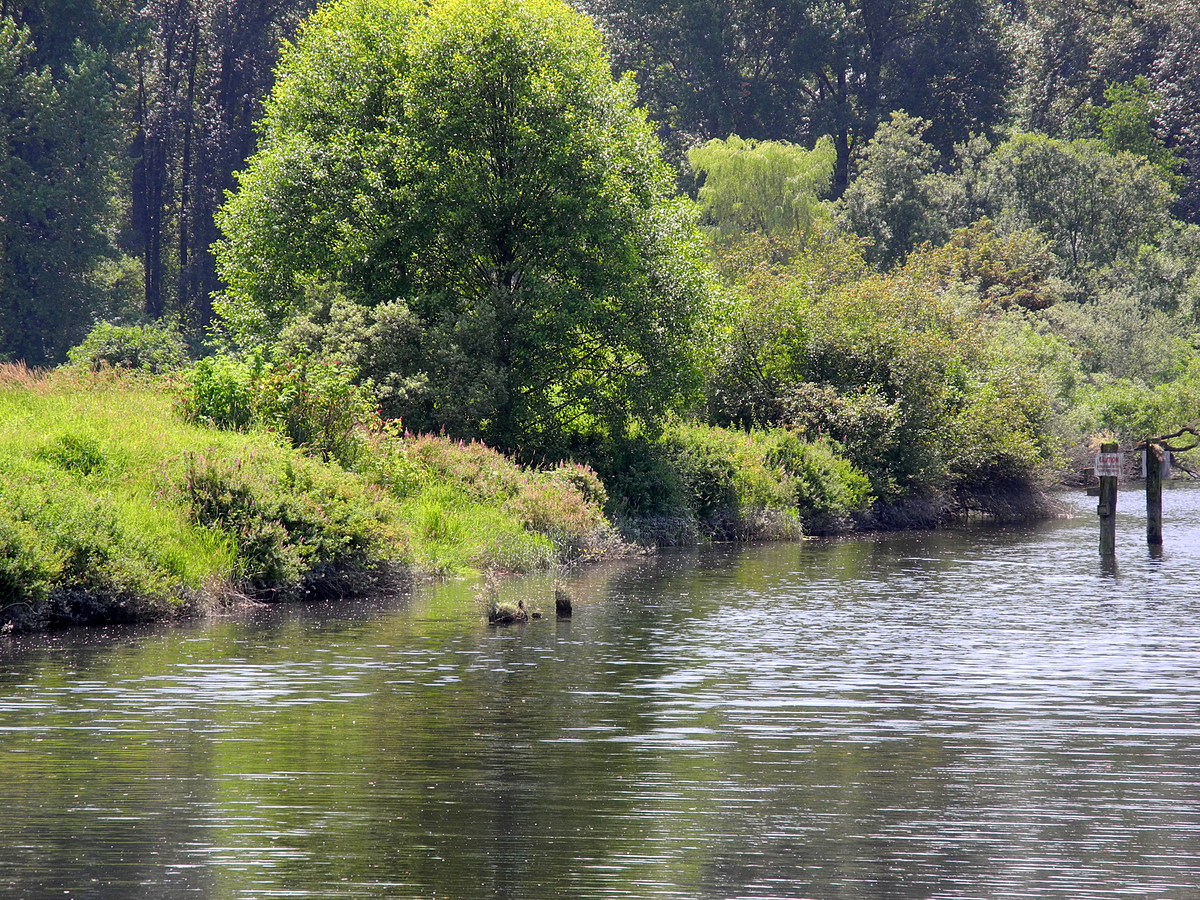
 After passing the cliffs at McCreight Lake, the road veers off, and makes a beeline (as much of a beeline as any of our roads make; a drunk bee, maybe) for Rock Bay. It crosses narrow bridges, just barely wide enough for a logging truck; looking over the edge, I see rushing water. McCreight Creek, maybe? And then the road levels out, running along the shore of a mirror-smooth pond.

Water lily leaves.

And dark green water.

Mount Kitchener in the background.

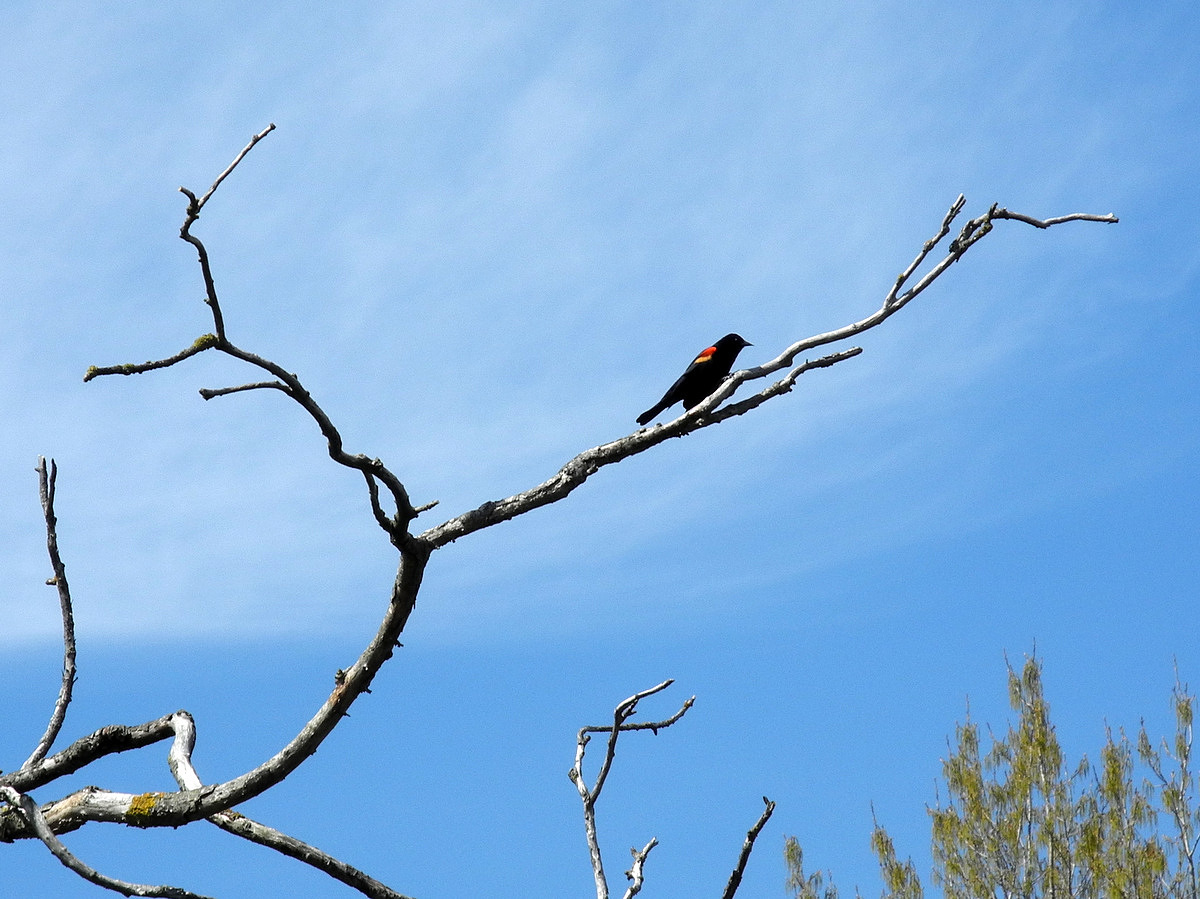
The edge of the road is lined with hardhack, just starting to flower, and twinberry shrubs, already setting fruit. I was standing as close as I could get to the water, when I heard a complaint: "chak chak chak", repeated quickly. When I turned and took a step in that direction, a male redwinged blackbird flew up from near water level and went to perch on the hardhack a ways down the road. I followed him, of course; that was probably what he intended, leading me away from his mate's nest down in the stems of the hardhack.

Redwinged blackbird, not showing me his red patches. I saw them as he flew away.

The other end of the pond. Hardhack, reeds, water lilies, willows.

And there were midges, water-loving, biting midges. They discovered me quickly enough, and hounded me back to the car. I was pleased to see swallows swooping over the water, getting their fast-food dinner; midge on the wing.

The pond is a small one; 500 metres long, 100 wide at the widest point. Not big enough to have earned a name. Yet. On Google maps terrain view, it looks like a half-melted bottle:

Bottle Pond. Or better yet, Wonky Bottle Pond.

Oh, and those narrow bridges? On Google Earth, I found one out in the open. The creek under this one is wide and slow.

Photo taken in winter: the white stuff is old snow. The road isn't much wider than the single-lane bridge.

The road leads on ... Tomorrow, Little Bear Bay.

~~~~~~~~~~~~~~~~

Después de pasar los precipicios de McCreight Lake, el camino da vuelta y se dirige a vuelo de pájaro  hacia Rock Bay. Más o menos; al igual a casi todos los caminos aquí, dicho pájaro está emborrachado. La ruta cruza varios puentes angostos, apenas lo ancho como para permitir pasaje a un camión lleno de troncos. Mirando abajo de los puentes, veo agua que corre rapidamente. ¿El riachuelo McCreight, tal vez? Y luego, el camino se endereza y pasa al lado de una laguna pulida como un espejo.

  1. Lirios acuáticos.
  2. Y agua verde.
  3. La laguna, con el monte Kitchener al fondo.
  4. Arbustos de Spiraea douglasii, empezando ahora a florecer, y Lonicera involucrata (madreselva bayas de oso) ya formando sus bayas, separan el camino de la orilla de la laguna. Me había acercado lo más posible a esta orilla, cuando escuché una queja: "chak chak chak", repetida rapidamente. Cuando di un paso en dirección al sonido, un Agelaius phoeniceus, un tordo alirrojo macho salió volando desde cerca del agua, y se fue a posar sobre los arbustos a alguna distancia. Yo le seguí, lo que fue su intento, creo, llevándome fuera de los linderos del nido de su hembra, escondida entre los tallos de los arbustos. En la foto, no me está enseñando las plumas rojas de sus alas; las vi cuando voló.
  5. El otro extremo de la laguna. Y había mosquitos; esos mosquitos que llamamos "noseeums" (no se ven), moscos de sitios húmedos, moscos que pican. Pronto me descubrieron, y me persiguieron hasta que regresé al coche. Me dió gusto ver una bandada de golondrinas lanzánodse sobre la superficie tras su cena: mosquitos volantes.
  6. La laguna es chica; mide 500 metros de largo, por menos de 100 metros. No tiene tamaño como para que le pusieran nombre. Hasta ahora. En el mapa Google, en la vista por terreno, tiene la forma de una botella medio derretida. Yo, entonces la estoy nombrando "Laguna de la Botella". 
  7.  ¿Esos puentes angostos? Encontré uno en Google Earth, uno no escondido en el bosque. El riachuelo que corre bajo este es ancho y lento. La foto la sacaron en invierno; lo blanco es nieve vieja. Y el camino, se ve, no es mucho más ancho que el puente de un solo carril.
Seguimos con el camino: mañana, Little Bear Bay. 


Saturday, May 20, 2023

Birding the beaver pond

 On a hot afternoon, a short walk is enough. From the road to the start of the path across the beaver lagoon and return. But there's always something to see.

Lily pads and reflections. With a few flower buds, still underwater.

Redwing blackbird, posed so as to hide his red shoulder decorations.

Hillside, dried broom (hope it doesn't recover), and clouds.

Circling, circling far overhead; a turkey vulture. Not hiding his red head.

A Skywatch post. 
~~~~~~~~~~~~~~~~
En una tarde con mucho sol un paseo cortito es lo mejor. Caminé desde la carretera hasta el borde de la laguna de los castores y regresé. Pero siempre hay algo ...

Fotos:
  1. Las hojas de los lirios de agua, con algunos botones todavía bajo el agua. Y reflejos.
  2. Un sargento alirrojo macho, escondiendo su emblema roja en el hombro.
  3. Una vista del cerro, con nubes. Y las plantas invasivas retama negra, resecas. Ojalá no revivan.
  4. Y dando vueltas y vueltas allá arriba, un buitre americano cabecirrojo.

Un post de Skywatch


Thursday, April 02, 2015

Love in the springtime

I made a quick trip to the beach to pick up eelgrass for my hermits, and on the way back to the car, stopped at the duck pond to watch the redwing blackbirds nesting in the central island. They're busy in there, chattering contentedly, but visible only in snatches as they bustle about in the reeds.

One male came out to take a breather on the fence, where a crow had already settled in.

"What do you think you're doing? This is MY fence!"

And I witnessed two birdy conversations that surprised me.

While I was still out on the sand flats, a gull flew overhead, making a strange, muted sound, almost musical. I looked up, and saw that he had a big clamshell in his beak; maybe that accounted for his voice, I thought. He flew out over the water, then curved back to a sandbar, coming in low, too low to drop a clamshell and have it break. Odd. And then he landed beside another gull waiting there, and handed over the clam.

A gull sharing food? Now that is love!

Back in the park, the sun was setting, and a robin high in a cottonwood was telling the world to "Cheer up, cheer up!" Good advice; I stopped to listen for a moment. And heard a quieter voice from somewhere near the trunk, a simple series of chirps, repeated every time the male robin took a breath. A female in the nest, wanting something? She was insistent, and finally the male dropped to the lawn and went hunting for worms. The chirping stopped. She'd got her point across. Supper would be served soon enough.

That's love, too.


Monday, February 02, 2015

Happy cottonwood

The redwing blackbird males are back at the Centennial Beach duck pond, and tuning up for the big nesting site sale, starting when the first females arrive.

Cottonwood tree full of contented chirps, squeaks, and quiet "Konk-i-rees". Full chorus begins soon.

The powers that be have fenced off the duck pond and surrounded it with shrubbery. Not so handy for us bird watchers; once the shrubs have leafed out, we will have to stand on picnic tables to see the birds. But the ducks seem pleased, and the reedy island in the centre will be a better nesting site than before. More private, and with less floating trash, I think.

Sunday, March 31, 2013

Ornery birds

The birds on Boundary Bay were not happy with us this week. The mallards and wigeons in the duck pond stayed down at the far end. The gulls sat out on the farthest sand bar; and it was a low, low tide that roared back in before we got halfway to the edge.

And the few birds within reach weren't cooperating.

"Hello? What do you think you're doing?"

"I'm outta here!"

Heron fishing

Heron leaving

Redwing blackbird female, hiding atop a newly-leafed willow

Redwing blackbird male, making things difficult

At least the flowers stayed put.


Tuesday, February 12, 2013

Reifel Island tidbit

We went to Reifel Island last week. The old favourites were there; the mallards and wigeons, scaups and coots, eagles, of course, and redwing blackbirds, very bold. The wood ducks were out in force, for once. And we watched an osprey and a hawk fight over hunting territories. A good visit; a great visit, even.

But right after that, Real Life™ got in the way, and I haven't been able to process the photos. At least now, I've managed to pick out a couple or three easy ones and resize them. The rest will come later, with the osprey/hawk argument, as soon as I catch up on a bit of sleep.

Redwing and cracked corn on a fence rail.

Orange afternoon sun highlights orange feet.

Does he know he's beautiful?

This was the last day for the old Nikon, and it was complaining. Several times, it just froze and refused to do anything until I turned it off for a minute. And Laurie's Pentax was having focussing issues. The next day, I bought the new camera. (See how you like sleeping in a drawer, old point and shoot!)

Wednesday, January 16, 2013

Early birds

We were surprised, when we parked at Centennial Beach a few days ago, to find the cottonwood trees around the duck pond full of redwing blackbirds, all in full cry. We've seen them at Reifel Island in mid-winter, where they are well fed, but they don't usually appear in the Boundary Bay area until late March. The males show up first, then, in April, the females can be seen nesting in the reeds.

But now, not only are they early, but there are females with them.

We got only a few photos, all against the light, before we moved on; we were too cold to stand around. And we couldn't even see the ones in the cottonwoods, where most of the song was coming from.

Female in a small willow tree.

At least two adult males, one young male (on the right), and a female.

I hope the warm weather (for mid-winter, that is) holds, if they're going to start nesting soon.

Monday, July 16, 2012

Colony Farm: distant birds

A hot summer's afternoon is the worst time to go birding. Colony Farm is one of the best places. Combining the two works, sort of; the light is good, the birds mostly in hiding, but the music is wonderful.

The river through the Farm is bordered with stands of red elderberry and impenetrable thickets of hardhack; beyond this are the grasslands. Deep in the shade at this time of day, unseen red-headed blackbirds sing to their mates, joined at intervals by other birds that we are incapable of identifying by sound. Assorted chirps, tweets, whistles, gurgles (Gurgles? What makes that sound?), twitterings ... Ah, those we recognize!

Bridge over the Coquitlam River, with hardhack thicket and lathyrus.

Swooping over the river, sometimes touching the water with the tip of a wing, sometimes soaring high above, the swallows dance, twittering as they go. "Good mosquitoes here!" "And here, too!"

Swallow in the distance, pausing on a dead elderberry branch.

At the wooded end of the farm, where the river exits, swallow nest boxes stand on pilings.

One of the pilings, and hardhack in bloom.

High in a distant tree, a different bird was singing loudly. His song was one or two notes, a pause, then a trill. Pause and repeat, over and over. I didn't recognize the song at all.

The photo, taken against the light, zoomed and cropped, then lightened so that we could see more than just the silhouette.

What is this bird? It has a dark head and neck, a greyish breast, white at the base of the tail, then another white patch at the end. It mostly resembles a female Evening Grosbeak, but its song doesn't match the sound clips I've found. Black-headed grosbeaks are known to nest here in Colony Farm, but I find no mention of Evening Gs.

The photo above, cropped even more.

Same bird, facing front.

Help! Can you name this bird?

Next: Bright colours.

UPDATE: It's a spotted towhee (see the comments below), and here's its song, the third recording on Cornell's Spotted Towhee page.

Tuesday, May 29, 2012

Tents among the willows

In a willow tree where redwing blackbirds stand guard ...

Redwing and swallow, Centennial Beach Park
 and sing to their mates in the reeds below ...


two families of tent caterpillars have set up camp.

Basking in the sunshine. When it sets, or the rain returns, they will hide under their warm blanket.

Five caterpillars, and oodles of caterpillar poop.

These are the western tent caterpillars, Malacosoma californicum, recognizable by their location, their tents, and the orange and blue spots along their sides and backs. They feed on willows, like this one, cottonwoods, aspen, apple, plum, and other local deciduous trees and shrubs (such as roses), sometimes covering the whole tree with one enormous web.

Overnight, or in cool weather, they huddle in their web, but when the weather is warm they venture out to feed on new leaves and buds, stripping the branches down to the bare twigs. Back in the warmth of the nest, they digest the edible part of the leaves and excrete the rest in little tube-shaped pellets, which eventually rain down to fertilize the ground underneath the tree.

I always shudder to see a tree completely encased in caterpillar tents, so I was reassured by a half-dozen web pages saying that their depredations rarely kill a healthy tree; in a month or so, after they have eaten their fill and gone off to build cocoons instead, the tree puts out new leaves, none the worse for wear.

In the case of a few infested branches, it is easy enough to cut them down on a rainy day, and destroy them. We used to burn them, but drowning or squashing will do.

Some birds may eat them; I don't know if the redwing blackbirds will.

Tuesday, May 01, 2012

Do redwing blackbirds call it a tree break?

... Since they don't drink coffee?

Redwing blackbirds at Centennial Beach duckpond sit for a few minutes in the willows.

They've been working hard all day on their nesting site in the reeds. (She hauls building supplies; he sings. Division of labour.)

Another female, in the same tree.

Maybe this is her mate, keeping a lookout on the other side of the pond.

I just realized; it's 6 years ago today that I decided to start a blog. That was over on Delphi; I moved here 6 months later. It doesn't seem that long.


Monday, April 02, 2012

To each his own

Spring fever symptoms vary with the species.

Overhead, as we approached Centennial Beach park, a pair of eagles were doing aerial acrobatics. When I first noticed them, they were meeting in the air, feet to feet; one was flying upside down. Then they separated, came together side by side, and soared upwards to perform synchronized loops. They dropped again, and repeated the face-to-face manoeuvre, again with one flying upside-down. We watched them repeat this until their resting loops took them far across the fields, almost out of sight.

Down in the duck pond, we fed the mallards. The females got most of the seed; the males were too busy.

The second male is in that big splash. See his head and foot?

As soon as one male was vanquished, the winner would spin and head off after another. Losers circled back to the females, undaunted. And a new squawking, splashing, swirling fight would erupt.

Male redwing blackbirds, just beyond the mallards, contented themselves with showing off their bright colours and singing. Much more peaceful.

A child's drawing of a sun on his wing.

"Silly swimmers!  A little bit of planning, some singing lessons, and they could avoid all that hassle! Konkeree!"

And down on the sand, flocks of teenage male humans were shouting and making fire.


Friday, February 10, 2012

Blackbird trees

The redwing blackbirds are singing in these trees. With the afternoon sun behind them, we could hear the birds, but only see them when they changed branches.

I know there are more than the one I see here.

A Skywatch post.

Wednesday, February 08, 2012

Two by two

Valentine's Day is almost here, and the birds at Boundary bay are in the mood already:

Matching outfits

The singer, with his shy mate in the background

Of one mind

"Come and sit by me!"

Side by side

Along the Ladner Trunk Road, an eagle pair was sitting in a tree next to last year's nest, discussing upgrades.

And a lonely chickadee, still without his mate, called out, over and over, "Here, sweetie! Here, sweetie!"

Last year, in a blackberry bush by the dike, a small bird decorated her nest with pages from a book. We found it this afternoon, bleached and torn, but still recognizable.

"Our babies will grow up with everything they need; berries, butterflies and books, too!"

Thursday, March 24, 2011

Birding FAIL!

I've been sorting photos all evening. It's amazing how many get put aside to review later, and then buried under the newest arrivals. Some, I may never get to.

These are from our visit to Reifel Island Bird Sanctuary three weeks ago.

Sandhill crane. Last year's chick.

Dry grasses, with grumpy heron.

Redwing blackbird male, vocalizing.

I picked up this feather on the trail. Possibly from a wigeon.

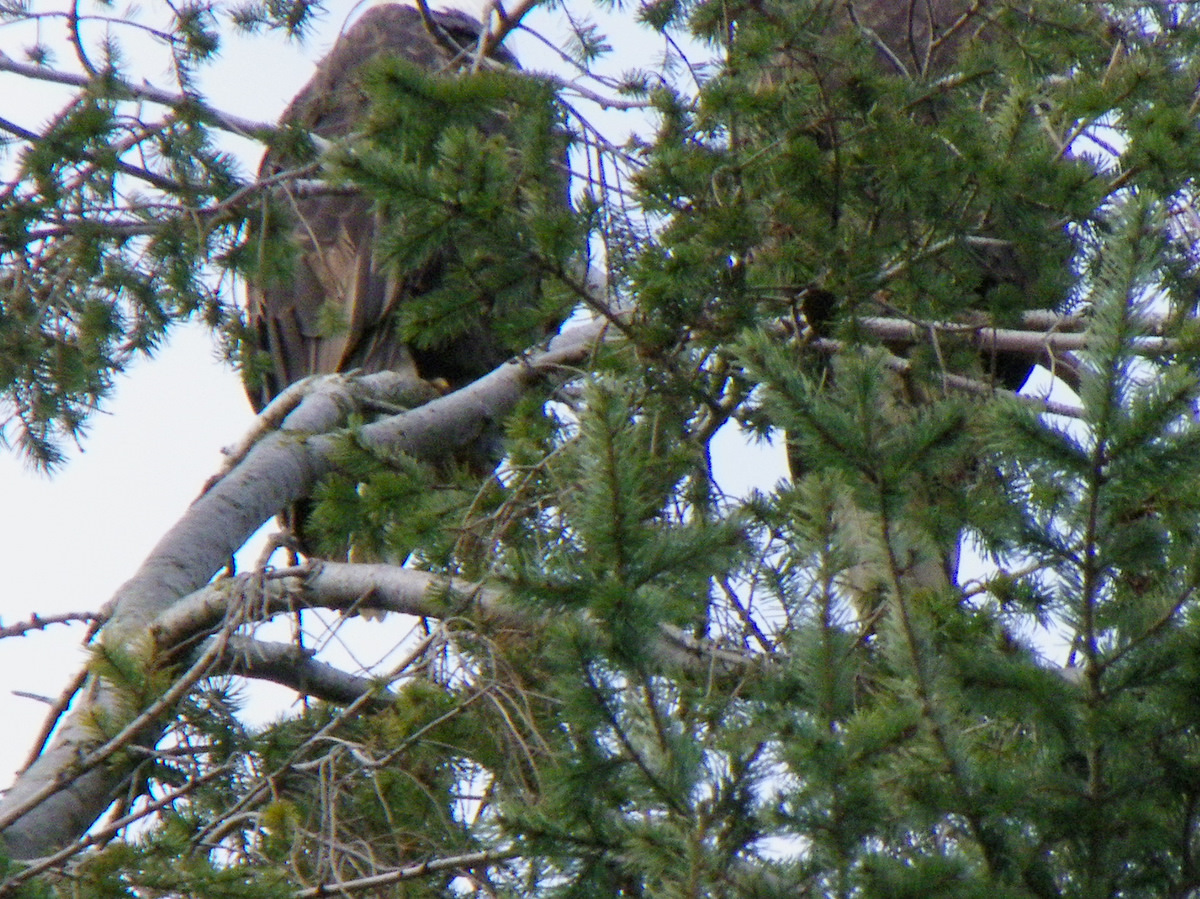
And this last photo is so frustrating! On our way back to the gate, Laurie took a photo of a little brown bird in an evergreeen. The bird flew away, leaving only a blur. Reviewing the photos at home, I almost tossed this one before I saw, 'way up at the top, a large, suspiciously bird-like, dark shape behind the branches. I cropped and brightened the photo, and found this:

Two big owls (or eagles?), right over our heads, that we never even saw.

Reminder to self; go SLOW! Look behind things! Stop thinking about home and supper!
Powered By Blogger