I promised you everything but the kitchen sink. There's more than I knew; these are the first three packing cases.
First lot: Beaches and birds:
 |
| The duck pond at Centennial Beach. The blue tarp-covered box at the back, eating up a good chunk of the marsh, will be new concession stands/washrooms/etc. |
 |
| Gull in the duck pond, with reflections of the reeds where the red-winged blackbirds nest. |
 |
| This makes Laurie laugh. Can you see what it is? |
 |
| Mount Baker, with Crescent Beach in the foreground. |
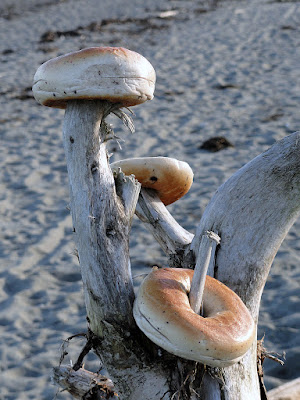 |
| And this made us both laugh. Someone set up a bagel tree for the crows. They hadn't found it yet. |
 |
| A green winged teal, quite a distance away, in the rain. |
 |
| Leaving the beach, walking back to the car, we passed my favourite purple wall, with these tall grasses (well over 6 feet) in winter drab in front of it. |
 |
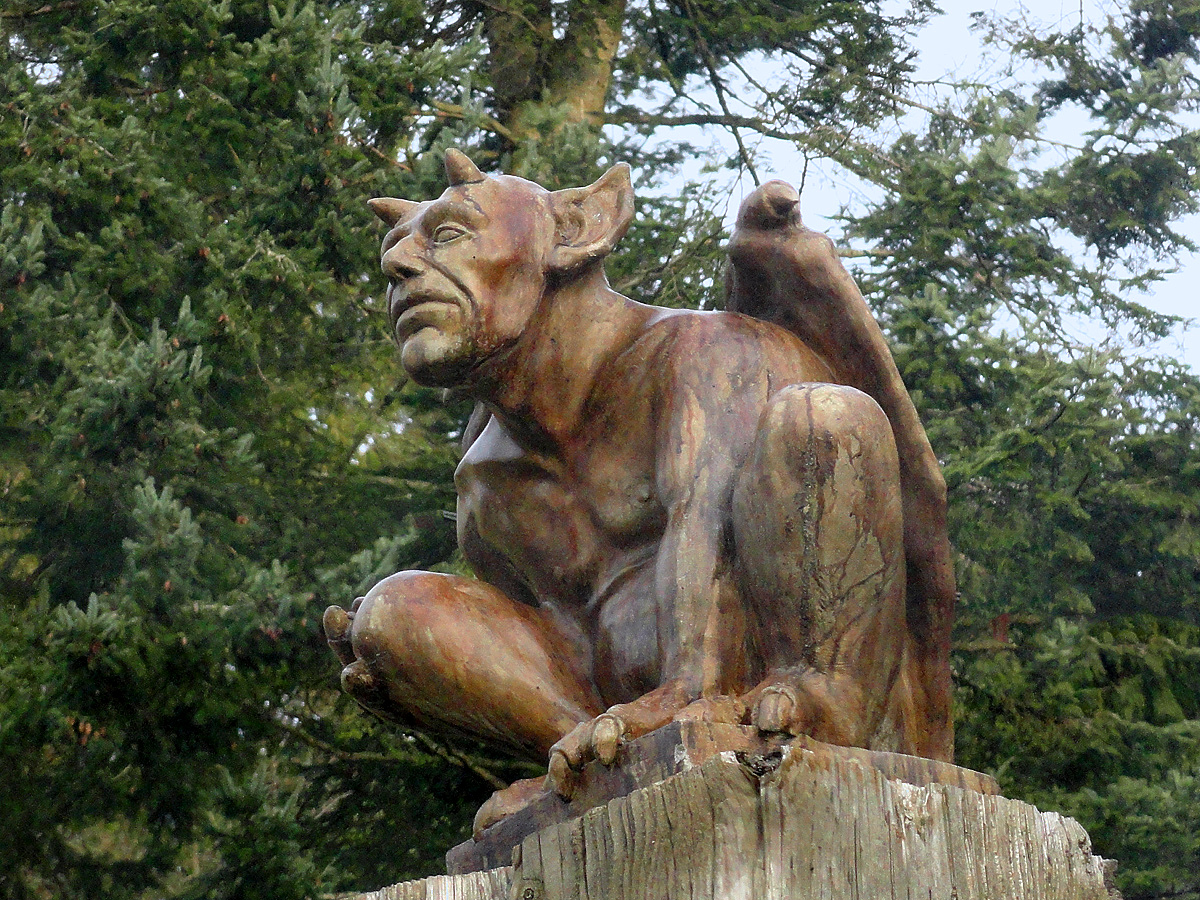
| Along the street behind Crescent Beach, a gargoyle guards a gate. |
 |
| His little companion chuckles between the roots of a tree. |
Lot 2: Critters and their stories.
 |
| A tiny jumping spider threatens the camera. |
And here's my shape-shifting spider. Sort of.
In mid-October of last year, Laurie brought me a tiny, bouncy, hoppy, blonde spider, and I put her in a glass box and kept her fed. I called her Hopalong, for convenience sake. From time to time, I brought in new branches for her, checking them over carefully for insects that could serve as food, or other spiders.
Later on, she had molted, and was twice the size. Twice, I brought her smaller spiders, identical to her in all but size. She ate them. I was calling her Hoppy by now.
It took some doing; she was incredibly good at hiding in plain sight, but eventually I got some decent photos and sent them in to BugGuide, both the baby pics and the adult ones. Confusion ensued. How can a spider change species in the course of a monitored life? The baby was a
Theridion; the adult was a
Philodromus. After a certain amount of
to-ing an fro-ing, we decided that Hoppy, the
Philodromus, must have come in on one of the branches, hiding so well that even though I examined them all with a lens, I never saw her. And, of course, she had eaten poor Hopalong.
She's got her comeuppance. Last week I brought in new branches for her. I looked them over extremely carefully, finding two pinhead black spiders, and a plant louse or two. I saw her two days later, scooting down a branch; that was the last time. After a couple of days, I took the branches out and cleaned the box, looking for her. No Hoppy; instead, I found this crab spider, an
Ozyptila, another of the spider clans that blend in perfectly to their background to ambush their prey. In the detritus at the bottom of the box, I found the mangled remains of a
Philodromus, sucked dry.
 |
| The current resident, fat with Hoppy's juices. |
Turn about's fair play, I guess.
One more story: remember this?
 |
| Not an igloo. |
I found this on a drying maple leaf towards the end of last October. Then, it was
just a silky ball, with no sign of entrance or exit. I put it in a sealed plastic container and left it outside to winter. I checked it a couple of times; nothing seemed to be happening until two weeks ago, when I found the ball perforated and empty.
In a corner of the container, a dead wasp lay, all scrunched up.
 |
| Previous resident of the not-igloo. |
I still have to resize photos to send in to BugGuide, for identification, which I will do by Monday.
Lot 3: Practicing on Element 10.
I've been plugging away at this, challenging myself with more difficult tasks each time. Here are a few things that look like they might be useful once I get proficient at them.
 |
| A complicated photo of a trail through the bush at Crescent Beach, with too-dark areas, and burnt-out whites. I learned to manage each section separately. I'm not too happy with the result, but next time I should do better. |
 |
| I'm happy with this. An adult bulrush bug, 4.5 mm long; the same species as the "cutie" nymph. This is a composite of two photos, one with the head in focus, the second with the back a bit better, but a blur where the head was. This technique has real possibilities. |
 |
| I cleaned up and corrected colour and lighting on a 10-year-old photo that was too dark to see. It's a Gray Jay, near a cabin in Chase, BC. |
 |
| An experiment. The osprey was 'way over to the side and top of the photo; the trees far below. Most of the photo was empty cloud. I used the compression feature to squish the photo together, removing most of the cloud in the center. This was fun, but I don't think I'll use it much. |
 |
| I did a poor job of removing the entire messy background and replacing it with the grass from another photo. Got rid of half a mallard in the process. A simple select and blend command sort of worked, but I had to finish it off with the healing tool. This will be useful once I get the hang of it. |
Now, back to work. Lichens, next.