Showing posts with label photo editing programs. Show all posts

Tuesday, November 04, 2014

Peevish

I'm busy trying to come to terms with an Elements upgrade, and feeling sort of crabby about it.

I'll get over it. She won't.

Why do they always tweak the things that work, and leave the bugs alone? (Mumble, mumble, gripe, whinge . . . )

Friday, December 14, 2012

Ant rescues sugar, I rescue ant photos

Ant with sugar cubes . . .

Trying to get a grip on it to haul it home.

This one was too big.

What a difference a bit of software makes! These photos were taken with the old Canon A720, back in 2008. I was using Piknik, if I remember correctly, to crop and lighten up, but that was it. The photos turned out dark, noisy, and brown, except for the one where the lighting was ideal. I found them tonight (looking for sky photos for Skywatch, but I'm always too distractable) and thought I might have a look at what Photoshop Elements could do. A few basic tweaks: levels, saturation, spot remover, and sharpening: and they're totally different!

Not a Skywatch post. Our skies these days are hopeless; grey on grey, with overtones of grey.

Tuesday, November 20, 2012

Rainy day sampler

I have a hard drive full of old photos, most too bad to be used, some with possibilities; but these get lost in the undergrowth. Following Ted McRae's example, I've been sorting them out and rescuing those I can, now that I have newer software and am slowly learning to use it.

Here's a random assortment of the most recent recovers, in no particular order. (Blogger's choice, and I didn't interfere.)

In a dry summer, an angel dreams of days when her pool was full. York Road, Campbell River, 2009.

Is that a ... turtle?!  Photo from Laurie's old film camera, pre-2006. Boundary Bay.

Rotting ball, White Rock beach, April 2009.

I posted this on the blog in August of 2010; I think it's a feather duster worm. The photo was messy and dark, but a few quick tricks with Elements (Ted's first two) brought it to life.

Same worm, clearer pose. It's about an inch and a half long.

Lion, in the jumbled entrance of a house in Finn Slough. The background camouflaged the lion in front; a pity, because I think he's beautiful. I finally figured out how to use the selection tool, masked the lion, and blended the mess. Simple, now I know how. October, 2010.

Signs in the corner of a store window in Strathcona. April, 2011.

1980s photo, taken with one of those little Kodachromes, much faded with age. Scanned and cleaned up, it's passable. This is my younger son rototilling a patch of swamp land we were draining and reclaiming. Wonderful soil! That first year, I had 7 boxes of tomatoes to can.
Firvale, the Bella Coola valley, BC.

Straw "painting" I brought back from Mexico in the 1970s. Cheating here; I threw out all my old photos, and took a new one now that I have a better camera and a decent flash. For the first time, the straw came out as straw, and Elements cleaned up the edges nicely.

I've done a batch of scanned family photos, which I've uploaded to Facebook, and umpteen worm photos; these I will store for reference material for the next time I find another. The weather people threaten us with two solid weeks of rain: I don't care; I'm having fun!


Saturday, February 11, 2012

Halfway caught up

I promised you everything but the kitchen sink. There's more than I knew; these are the first three packing cases.

First lot: Beaches and birds:

The duck pond at Centennial Beach. The blue tarp-covered box at the back, eating up a good chunk of the marsh, will be new concession stands/washrooms/etc.

Gull in the duck pond, with reflections of the reeds where the red-winged blackbirds nest.

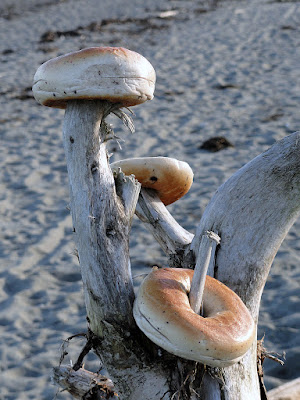
This makes Laurie laugh. Can you see what it is?

Mount Baker, with Crescent Beach in the foreground.

And this made us both laugh. Someone set up a bagel tree for the crows. They hadn't found it yet.


A green winged teal, quite a distance away, in the rain.

Leaving the beach, walking back to the car, we passed my favourite purple wall, with these tall grasses (well over 6 feet) in winter drab in front of it.

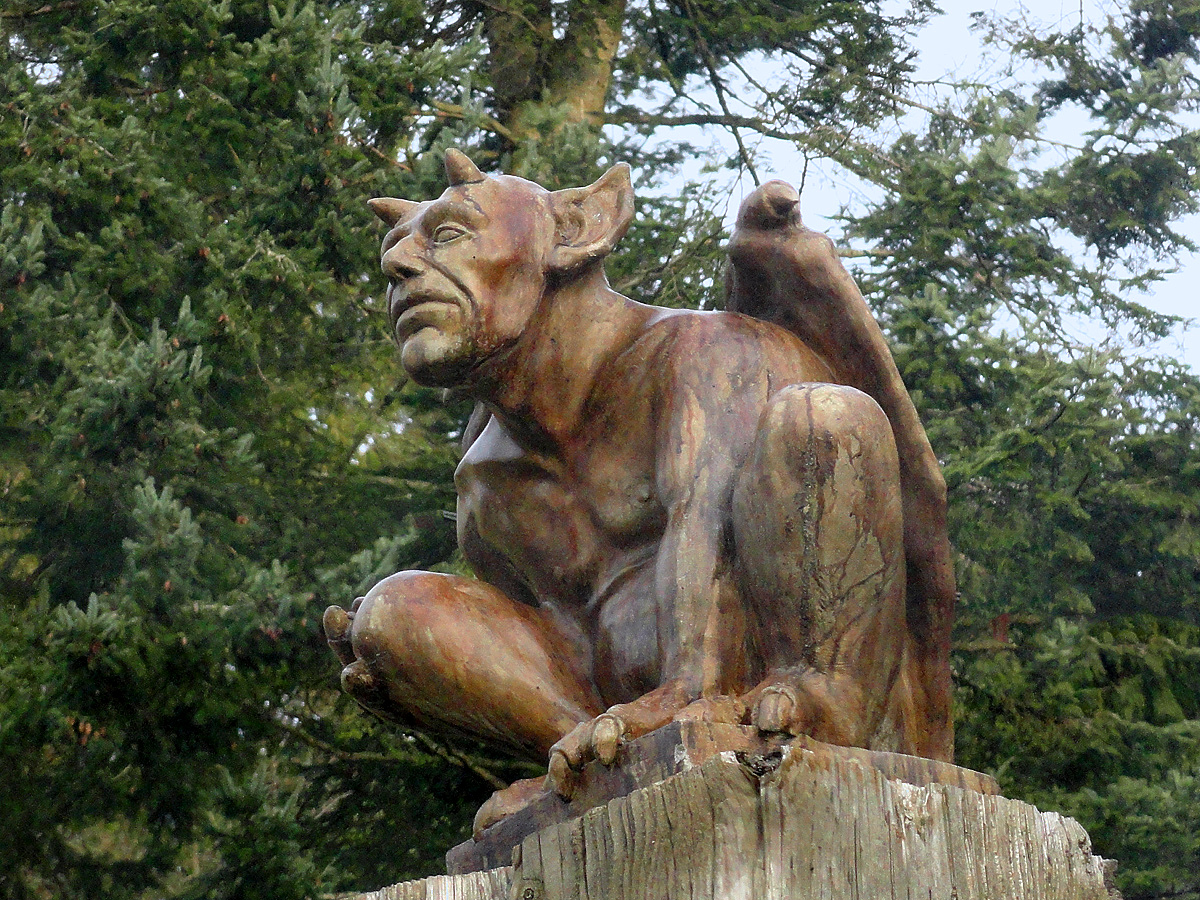
Along the street behind Crescent Beach, a gargoyle guards a gate.

His little companion chuckles between the roots of a tree.

Lot 2: Critters and their stories.

A tiny jumping spider threatens the camera.

And here's my shape-shifting spider. Sort of.

In mid-October of last year, Laurie brought me a tiny, bouncy, hoppy, blonde spider, and I put her in a glass box and kept her fed. I called her Hopalong, for convenience sake. From time to time, I brought in new branches for her, checking them over carefully for insects that could serve as food, or other spiders.

Later on, she had molted, and was twice the size. Twice, I brought her smaller spiders, identical to her in all but size. She ate them. I was calling her Hoppy by now.

It took some doing; she was incredibly good at hiding in plain sight, but eventually I got some decent photos and sent them in to BugGuide, both the baby pics and the adult ones. Confusion ensued. How can a spider change species in the course of a monitored life? The baby was a Theridion; the adult was a Philodromus. After a certain amount of to-ing an fro-ing, we decided that Hoppy, the Philodromus, must have come in on one of the branches, hiding so well that even though I examined them all with a lens, I never saw her. And, of course, she had eaten poor Hopalong.

She's got her comeuppance. Last week I brought in new branches for her. I looked them over extremely carefully, finding two pinhead black spiders, and a plant louse or two. I saw her two days later, scooting down a branch; that was the last time. After a couple of days, I took the branches out and cleaned the box, looking for her. No Hoppy; instead, I found this crab spider, an Ozyptila, another of the spider clans that blend in perfectly to their background to ambush their prey. In the detritus at the bottom of the box, I found the mangled remains of a Philodromus, sucked dry.

The current resident, fat with Hoppy's juices.

Turn about's fair play, I guess.

One more story: remember this?

Not an igloo.

I found this on a drying maple leaf towards the end of last October. Then, it was just a silky ball, with no sign of entrance or exit. I put it in a sealed plastic container and left it outside to winter. I checked it a couple of times; nothing seemed to be happening until two weeks ago, when I found the ball perforated and empty.

In a corner of the container, a dead wasp lay, all scrunched up.

Previous resident of the not-igloo.

I still have to resize photos to send in to BugGuide, for identification, which I will do by Monday.

Lot 3: Practicing on Element 10.

I've been plugging away at this, challenging myself with more difficult tasks each time. Here are a few things that look like they might be useful once I get proficient at them.

A complicated photo of a trail through the bush at Crescent Beach, with too-dark areas, and burnt-out whites. I learned to manage each section separately. I'm not too happy with the result, but next time I should do better.

I'm happy with this. An adult bulrush bug, 4.5 mm long; the same species as the "cutie" nymph. This is a composite of two photos, one with the head in focus, the second with the back a bit better, but a blur where the head was. This technique has real possibilities.

I cleaned up and corrected colour and lighting on a 10-year-old photo that was too dark to see. It's a Gray Jay, near a cabin in Chase,  BC.

An experiment. The osprey was 'way over to the side and top of the photo; the trees far below. Most of the photo was empty cloud. I used the compression feature to squish the photo together, removing most of the cloud in the center. This was fun, but I don't think I'll use it much.

I did a poor job of removing the entire messy background and replacing it with the grass from another photo. Got rid of half a mallard in the process. A simple select and blend command sort of worked, but I had to finish it off with the healing tool. This will be useful once I get the hang of it.

Now, back to work. Lichens, next.

Friday, January 27, 2012

Hopeful beginnings

The sun came out! And out shopping, we saw a flower bed covered with new shoots. We went to Home Depot and looked at mini-greenhouses, and bought more paving stones for the garden walk. It felt so good!

And then I came home and glued myself to the computer, trying out all the buttons and boxes in Element. I worked on 3 photos, one with a hard colour adjustment, one noisy squirrel, and one easy crop-and-sharpen job. The squirrel photo proved hopeless, but here are the other two.

Miniature harvestman. This had a distinct orange cast; Element took it out nicely. The background colour now matches the original piece of wood.

An older photo; the sky reflected in a corner beside the Ladner docks.

I used auto-adjust on the reflections photo. This almost never works in Picasa or Picnik, but with Element it did, at least on this photo. I don't like their sharpening tool, though; it's too small to control properly.

A Skywatch post.

Wednesday, January 25, 2012

Red Queen's Race

Since the photo editing program I have been using, Picnik, is going down soon, I've been looking into and trying out alternates. I finally bought Elements 10, and have spent all night tonight downloading, installing, and learning the basics. I like it, so far, although some things don't seem logical at the moment.

I need to figure out how to get the best quality in a tiny size for BugGuide; I've got several new critters to send in.

Meanwhile, here's a vintage photo I scanned and cleaned up in Picnik. It was scratched, wrinkled, and faded; I'm pleased with the job Picnik did. I've got a whole album of these to fix, so I hope Element isn't too terribly slow.

1950s photo; the weekly mail, Esperanza inlet, Vancouver Island.

Tuesday, February 02, 2010

Learning curve

I've been busy these days, learning something new. I downloaded a trial version of Lightroom, from Photoshop, and have spent the last few days trying to make sense of it. These are my thoughts, so far:

(I'm strictly an amateur, so take the rest of this post with plenty of salt.)

Up until now, I have been using Picasa, free from Google, but limited. It's fine for correcting a white balance, cropping and straightening, but that's about it. Anything I do to a photo there is global; if there's a problem with a sky that's too light while the rest of the photo is too dark, I can't do anything about it. It is easy to use, though, and quick; doesn't tax my memory, even while I run other programs in the background.

I have tried many other free programs. Some are better than others; none are better for me than Picasa. One was about as easy to use, and had layers. I don't know why I decided against it, and uninstalled it. It probably merited a second chance, but now I can't remember which one it was. Oh, me!

Lightroom can adjust parts of a photo separately, can balance colours and brightness in a variety of ways, has interesting possibilities. It allows for fine-tuning values like sharpness and "vibrance". I have rescued a couple of photos already, photos I normally would delete, or worse, keep because of sentimental value. And it will be half the price of Photoshop, which is what I would like to use.

So far, though, I'm not sure I like it enough to pay for it. It is slow, very slow. It loads everything to the web, which I think is what contributes to its sluggishness. It sometimes crashes my computer. It doesn't do layers. It doesn't co-ordinate well with Picasa, which is what I would use anyhow for the majority of my photos, needing just a quick tune-up. And sometimes, I am not sure if the photos look worse or better once I'm done; they seem a bit too dramatic, too definite, out of sync with BC's soft, greyed tones, but the Lightroom skin is a gloomy dark grey, which skews my perception of colours and brightness.

Here's a photo I tuned in Lightroom today:


First hellebore of the year. In a pot by my door.

What do you think?

What programs do you use? Would you recommend them?
Powered By Blogger