Showing posts with label ice. Show all posts

Tuesday, January 27, 2026

Ice on the beaver pond

The weather here on this lumpy, puddly island breaks up into mini-climates. Now, at the edge of freezing, from one hillside to the next, we go from green trees and wet ground to sheets of ice and frosty branches.  One lake is frozen over; the next has swimming ducks. The beaver pond (160 metres above sea level) was covered in paper-thin ice, but the trees and bare shrubs were untouched. None of the usual ducks showed up.

Beaver lodge, that dark mound in the centre. The water level is high.

I followed a beaver trail down the back way, a narrow, curvy line, barely some 25 cm. wide; how the beavers access their home coming back from alder-harvesting forays. In summer, this trail is hidden, and I have stumbled over fallen wood and unexpected holes, going from point A to point B in a straight line. Next time, I'll remember.

From the back. The high water almost surrounds the entire lodge; a light dusting of frost highlights the top. Inside, it will be warm and dark. Across this arm of the pond, the highway runs behind a low cement wall.

From the highway.  Cattails, hardhack, grasses and red buds on winter-bare sticks, against the ice.

The intake; moving water, with no ice. On the far side, the exit creek also flows ice-free. The dead trees have their roots in permanently-flooded ground.

Ice patterns near the centre of the pond.

Cropped for a better look at the patterns. Just under the surface, this area is covered with water lilies and other acuatic vegetation, maybe creating slightly warmer zones.

And this I don't understand. What made these ice cubes, what scattered them over the ice?

The most exposed area of the pond.

One of those cubes, resting on the thin ice. Why?

Next, a not-frozen creek, and what "lives" in it.

~~~~~~~~~~~~~

El clima aquí en esta isla de cerros y valles, de charcos, rios y lagos, está fragmentado, formando múltiples microclimas. Ahora que la temperatura anda alrededor de los cero grados, desde una ladera a la próxima vemos árboles verdes y tierra húmeda, y tantito más adelante, capas de hielo y ramas blancas, heladas. Un lago está congelado; el próximo lleva patos, nadando en agua clara. La laguna de los castores, a 160 metros sobre el nivel del mar, llevaba una capa tenue de hielo, pero los árboles y arbustos en las orillas seguían como siempre. Los patos que siempre veo aquí ya se habían ido.

  1. La madriguera de los castores es ese montoncito oscuro en el centro. El agua está a su nivel máximo.
  2. Seguí un caminito hecho por los castores para llegar a la madriguera; una linea angosta, apenas de unos 25 cm. de espacio entre hierbas; así es como los castores llegan a casa después del trabajo del dia, cortando alisos. En el verano, el camino está escondido, y yo he tropezado con troncos y caído en hoyos, tratando de llegar sin saber la ruta. Para la próxima, ya sé donde pisar. La vista muestra la madriguera casi completamente rodeada de agua, y con un poco de escarcha pintando las ramitas. Por dentro, estará bastante cómoda, hasta caliente. Al otro lado de este brazo de la laguna, la carretera pasa detrás de una pared baja de cemento.
  3. Visto desde la carretera. Totoras (Typha latifolia), Spiraea douglasii, pastos, y botones rojos en ramas desnudas. Con la laguna helada de fondo.
  4. Donde entra agua a la laguna. El agua fluye y no lleva hielo. En el extremo opuesto de la laguna, el riachuelo de salida también sigue sin congelarse. Los árboles muertos crecieron en tierra que ahora sigue permanentemente sumergida.
  5. Diseños en el hielo en el centro de la laguna.
  6. Foto cortada para exhibir mejor estos diseños. Bajo la superficie crecen lirios y otras plantas acuáticas, lo que puede producir zonas un poco menos helados.
  7. Y esto no lo entiendo. ¿Qué fue lo que produjo estos cubos de hielo, qué los esparció así sobre el hielo? Están en la zona más expuesta de la laguna.
  8. Uno de esos cubos de hielo, encima de la capa que cubre toda la laguna. ¿Porqué?
Siguente: un riachuelo sin hielo, y con lo que "vive" allí.

Sunday, January 25, 2026

Good ice

They keep promising us snow. Next week. But a few days later, they say, no, it's going to rain after all. Snow the week after that. I checked this morning; next week's snow is going to be rain again. It's a strange year.

In the centre of the island, about 200 metres above sea level, I found ice. No snow. Still, it's white and cold. And shiny.

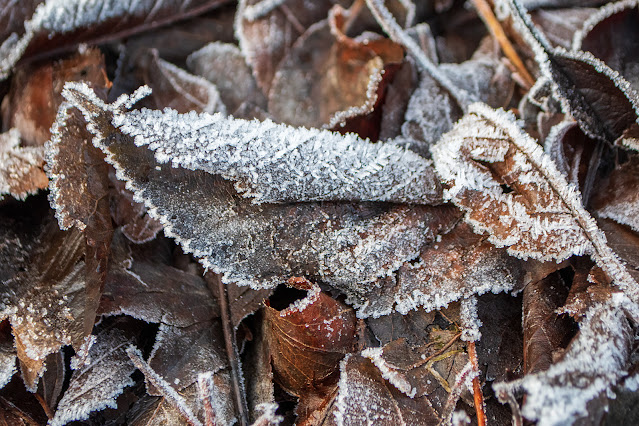
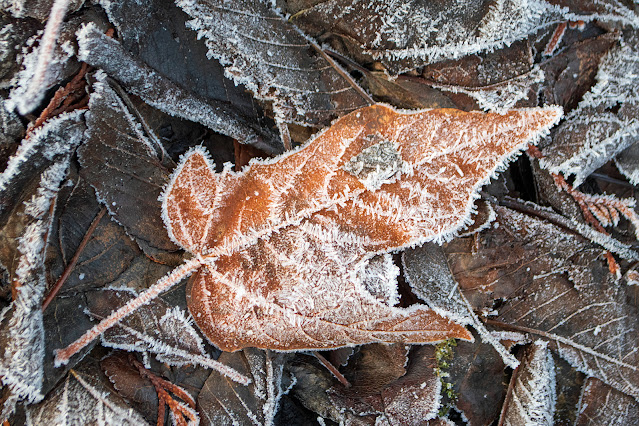
These are ice crystals found on the side of the road. They take on different shapes; cubes, pillars, tubes, spines; depending on the surface they're growing on.

On the cement wall by the beaver pond.

On an old log.

Another log. The moss is on a rock.

On moss.

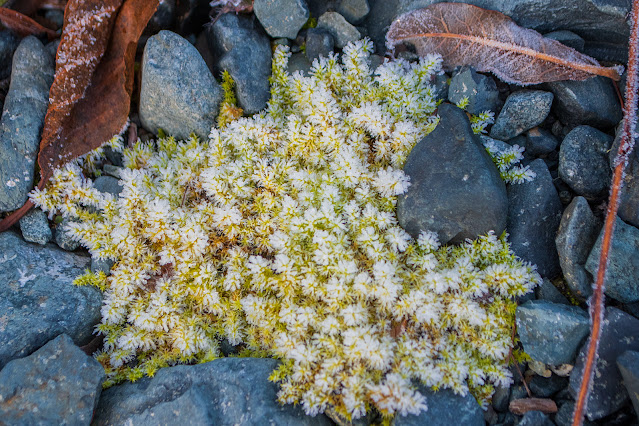
On a different moss. Here the ice forms tiny cubes.

On roadside salal.

On a young Scotch broom.

On a fallen pine cone.

On grass.

Next: ice on the beaver pond and an unnamed creek.

~~~~~~~~~~~~~~~~~

Los meteorológicos nos prometen nieve. Para la semana que entra, dicen. Luego, unos dias más tarde, dicen que no, que va a llover. Pero habrá nieve una semana más adelante. Esta mañana vi que la nieve  de la semana que entra otra vez va a ser lluvia. Es un año algo extraño.

En el centro de la isla, donde estamos a unos 200 metros sobre el nivel del mar, encontré hielo. No hay  nieve, pero el hielo es blanco y frio. Y brilla.

Estas fotos son de cristales de hielo que encontré al lado de la carretera. Tienen distintas formas;  hay cubitos, pilares, tubos, espinas: todo depende del sustrato que les provee el líquido.

  1. Hielo en el borde de una pared baja de cemento cerca de la laguna de los castores.
  2. En madera vieja.
  3. En otro tronco viejo. El musgo está creciendo en una roca.
  4. En otro musgo.
  5. Y en otro musgo distinto. Aquí el hielo forma cubitos.
  6. En las hojas de plantitas de salal. (Gualtheria shallon)
  7. En una planta joven de retama negra. (Cytisus scoparius)
  8. En un cono de pino blanco.
  9. Y en hojitas de pasto.
Mañana; hielo en la laguna de los pastores y un riachuelo sin nombre.

Monday, January 20, 2025

Cliff, non-conformist

This was strange. Unexpected and confusing.

The sun was shining; where you stood in its light, you could feel the gentle heat. Otherwise, along the edges of the lakes (Upper Campbell and Buttle) the temperature was near freezing. In spots, where the shadows hadn't seen sunshine all day, a light coating of frost or sometimes snow dusted the ground.

Along the upper end of Upper Campbell Lake and the bottom of Buttle Lake, the highway follows the east shore, heading almost directly south. This is an area of high, stony cliffs, facing west here; the afternoon sun hits them full on, even in winter.

One of these cliff faces, just one, was producing ice. It coated the vegetation in the shallow ditch beside the road. Above, the rock was clear, but wet; isolated drips fell onto the frozen plants below, probably from melting ice farther up. Moss and plants closer to the rock were untouched, ice-free. 

This was the only icy spot. It was in a bad spot for parking; the road was narrow, without a shoulder, and trucks could be expected to barrel around the curve at any moment. The nearest pullout was over a kilometre away in both directions. So I drove on, then back, then back again, looking for more ice. There was none, and I finally eased the car into a spot between guard posts, too close to the drop off for comfort, but it was the best I could manage.

And the icicles weren't following the rules. Some hung directly down, as gravity demands; but others hung at strange angles, up to a 30° angle off the vertical. Why?

See:

Ferns in ice. The moss is ice-free.

Ice-covered  branches.

Insane icicles.

Another fern. Ice coats one hanging vine; the others, on the right, are ice-free. Go figure.

Rose hips in ghostly shrouds.

And all the way to the middle of Buttle Lake, there was not a spot of ice on any of the rock faces. Or on the ground below them. Just on this one, with its own personal microclimate.

~~~~~~~~~~~

Esto era algo extraño, inesperado.

Era una tarde asoleada; se te detenías donde la luz del sol te llegaba, sentías un calor suave. Aparte de eso, en las orillas de los lagos Upper Campbell y Buttle, la temperatura andaba cerca de 0°C. En sitios en sombra, donde la luz no había tocado en todo el dia, el suelo llevaba una leve capa de nieve o de escarcha.

Desde el centro del lago Upper Campbell, hasta el centro del lago Buttle, la carretera sigue la orilla occidental, dirigiéndose hacia el sur. En este rumbo, el  agua llega hasta el pie de peñascos altos, con sus caras hacia el oeste; el sol de la tarde les pega directamente, aun en invierno.

Uno de estas pilas de piedra producía hielo. Uno solamente. El hielo cubría las hierbas que crecen en la zanjita al lado de la carretera. Arriba, la roca estaba mojada, pero sin hielo. De allí, gotitas aisladas de agua, probablemente producidas por hielo que se descongelaba, salpicaban las plantas congeladas. El musgo que cubre la faz de la roca, y algunas plantas más protegidas se quedaban sin hielo.

Este era el único lugar con hielo. Era un sitio no apropriado para estacionarme; la carretera es angosta, sin acotamiento, y en cualquier momento se podría esperar algún camión minero manejado a la máxima velocidad permitida. El primer sitio donde se había proveído un espacio para permitir el paso estaba a más de un kilómetro en ambas direcciones. Así que seguí adelante, di vuelta cuando pude, pasé por enfrente, y volví a pasar. Esto, sin ver hielo en ningún otro sitio. Por fin, me arrimé lo más que pude, estacionando el coche en el mero borde de la caída al agua. No muy seguro, pero, ni modo.

Y los carámbanos no obedecían las reglas. Algunos colgaban apuntando directamente hacia el suelo, como exige la gravedad, pero otros apuntaba en varias direcciones, hasta a unos 30° de lo vertical. ¿Porqué?

Fotos:

  1. Helechos cubiertos de hielo, y musgos sin hielo, en la faz de la roca.
  2. Ramitas completamente cubiertas.
  3. Carámbanos locos.
  4. Otro helecho. El hielo cubre por completo una de las ramas colgantes; otras, al lado derecho, quedaron completamente libres.
  5. Escaramujos (rojos) en sudarios de fantasmas.
Y en todo el camino, desde aquí hasta la mitad del lago Buttle, no hubo ni un solo pedazo de hielo en ninguna de las rocas. Solamente en este sitio, con su microclima muy personal.

Sunday, January 14, 2024

Chilly nest

More from the cold snap. From the hill where they've clearcut the forest, leaving a view over Seymour Narrows, the water looked strange, almost as if it were blue land, bumpy and solid-looking, almost as if you could walk on it. The smoother areas looked more like ice than like sea water. The temperature had dropped to 12 below zero Celsius, and the wind was vicious, especially in this area, creating a wind chill in the vicinity of -20°.

Looking northeast. The photo doesn't show the cross-hatching in the lighter areas.

I looked back at January temperatures for Campbell River over the last 30 years. The lowest it ever got, one day in 2004, was 10 below zero; the usual range was between 10 above and 5 below zero.

And the eagle nest is still there, still in use.

Two eagles standing guard. One above, one below.

I once saw, in Bella Coola, an eagle whose talons had frozen around his perch in -20° weather, hanging upside-down from the branch. I wonder what these two think of the unaccustomed chill. No protection from the wind in this tree now that their forest is gone.

~~~~~~~~~~~~~~~~~
Hacía frio. Pasando por el sitio donde han cortado todo el bosque, dejando una vista sobre el Estrecho Seymour, vi que el agua, agua salada, se veía muy extraña, como si fuera tierra sólida, pero azul. Parecía que se pudiera caminar allí; hasta donde el agua se veía más clara, más bien parecía hielo. La temperatura había bajado a 12 grados bajo cero, y con el viento helado, muy fuerte en este sitio, daba un enfriamiento eólico de unos 20 grados bajo cero.

Foto: El Estrecho Seymour, viendo hacia el noroeste.

Revisé las temperaturas obtenidas en enero durante los últimos 30 años aquí en Campbell River. La temperatura más baja, un dia en 2004, fue de 10 grados bajo cero. La temperatura normal variaba entre 10 grados sobre cero, y 5 grados bajo cero.

Foto: Y el nido de águilas sigue en uso.

Una vez vi, en el norte, en Bella Coola, un águila cuyas garras se habían congelado sobre su rama, con la temperatura aproximadamente unos 20 grados bajo cero. El pobre pájaro colgaba cabeza abajo, fijado en su percha. Me pregunto qué pensarán estos dos águilas de este frio inusitado. En ese árbol, ahora sin bosque alrededor, nada les protege del viento.

Friday, December 02, 2022

December Happy file folder

 And now we do have snow! While I wait for the snowplows to come by*, I'm digging into the "Things that Make me Happy" file again.

Snow makes me happy, so I'll start off with this, from last year:

Snow piled at the edge of the Elk Falls parking lot. Higher than my car.

Ice crystals on moss on a cement block. Two weeks ago.

An amphipod pausing for a second to look at me.

Red-tipped Lipstick Cladonia lichen in an old, old log.

Detail of a vintage tin mirror frame from Mexico.

An anchored sailboat in the mist. Campbell River estuary.

*Why I wait for the snowplow. I'm on a sidehill; the street at either end of my block is steep and slippery, even in rain. In an emergency, I can get out: I do have the snow tires on and a shovel in back. But I'd rather not have to dig myself out, and save my energy, instead, for walking in a snowy wonderland.

~~~~~~~~~~~~~~~~~~~~~~~~~~~~~~~~

¡Ahora sí que nevó! Mientras espero a que pase el quitanieves**, estoy mirando otra vez mi archivo de "Cosas que me hacen feliz".

  1. La nieve siempre me trae felicidad, así que empiezo con esta foto, del año pasado. La nieve amonotonada en el estacionamiento de las cataratas Elk. Un montón más alto que mi coche.
  2. Cristales de hielo cubriendo musgos en un bloque de cemento. Esto de hace dos semanas.
  3. En el acuario, un anfípodo se detiene un segundo para mirarme.
  4. Unos líquenes Cladonia spp., probablemente el llamado "Lapiz labial", en un troncón viejo.
  5. Detalle de un marco de espejo de hojalata (el marco) que mi hija me trajo de México hace años.
  6. En el estuario del rio Campbell, un barco velero duerme en la neblina invernal.
**Porque me quedo esperando el quitanieves: este lugar es puro cerro, subiendo precipitadamente desde la carretera al lado de las playas. Mi calle sale por ambos extremos a caminos empinados, bien resbalosos, aun cuando apenas está lloviendo. Bajo nieve, los coches patinan. Si hay emergencia, puedo salir, ya que tengo llantas para la nieve, y una pala en el maletero. Pero prefiero no tener que excavar el coche y en cambio ahorrar energías para caminar en un paraíso de nieve.

Tuesday, December 07, 2021

Frosted leaves

More frozen vegetation, from the same gravel where I found the "ice flowers".

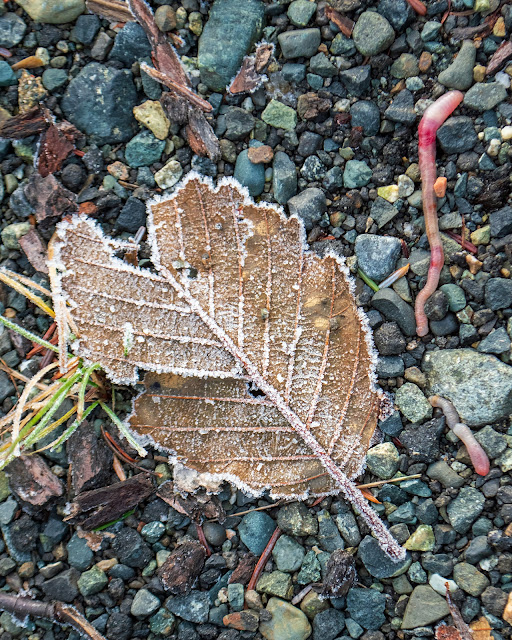
Frozen alder leaves

Not an alder leaf

Frozen moss

Another alder leaf, with frozen earthworm.

I didn't see the earthworm when I took the photo: I was concentrating on the leaf. It was only as I blew up the photo at home that I realized that the worm was there. One earthworm, and pieces of frozen earthworm. Or was it frozen? Was it still alive and out for a stroll? I wish I had noticed on the spot.

~~~~~~~~~~~~~~~~~~~~~~~~~~~

Aquí hay más plantas congeladas, en el mismo sitio donde encontré las "flores de hielo".

Fotos:

  1. Hojas de aliso.
  2. Otra hoja, que no es aliso.
  3. Musgo congelado.
  4. Hoja de aliso con lombriz de tierra congelada.
No vi la lombriz cuando saqué la foto, pues me estaba fijando en la hoja y su escarcha. Fue cuando procesé la foto en casa que me di cuenta que había una lombriz. Una lombriz, y pedazos de otra, congeladas. O tal vez no. ¿Estaba verdaderamente congelada? ¿O estaba viva y había salido a dar un paseo? Lástima que no la había visto en el momento para asegurarme.

Monday, December 06, 2021

Ice flowers

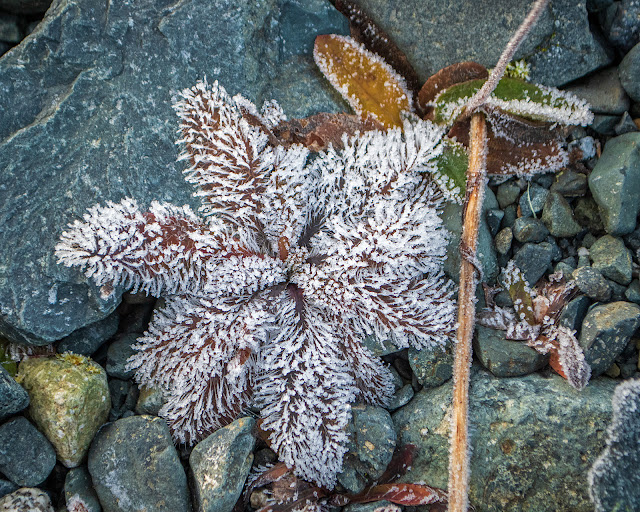
On the highway north, I stopped where road work had cleared away the trees, leaving a spot with a clear view of the mountains. The machines had left a slope covered with gravel, leading down to a creek below. Small hairy plants have started to push their way through the rocks; now, with freezing temperatures, each hair carries an ice crystal.
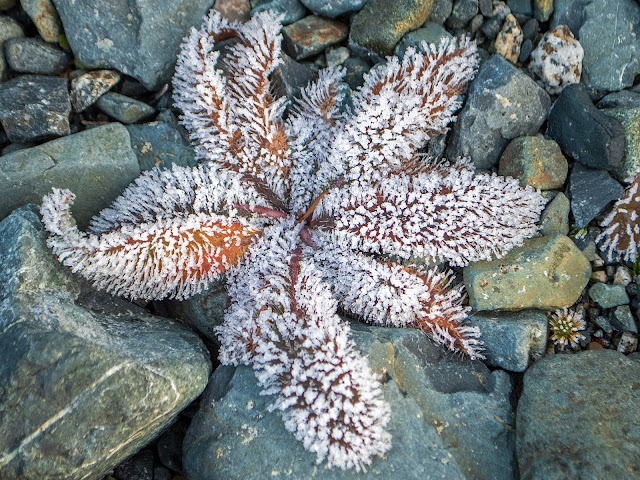
I'm calling them ice flowers.
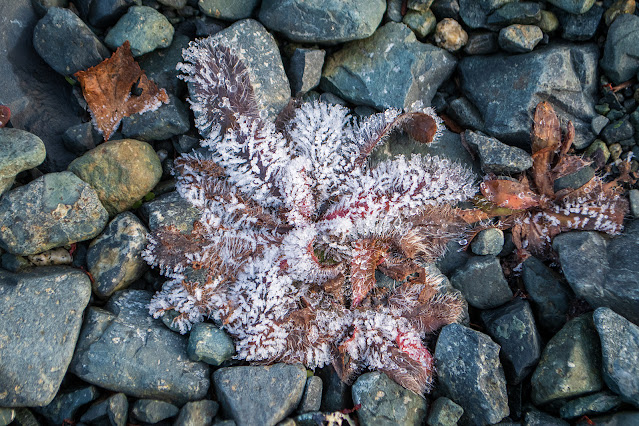
The long stem is the base of a flower stalk.

I can't identify the plant, frozen as it is.

Frozen flower stalks.

~~~~~~~~~~~~~~~~~~~~~~~~~

Camino al norte, me detuve al lado de la carretera donde obras viales habían cortado los árboles, dejando un sitio que ofrecía una vista a las montañas. La maquinaria había dejado un declive cubierto de grava, terminando en un riachuelo allá abajo. Algunas plantas peludas ya empiezan a brotar entre las piedras; ahora que la temperatura llega a 0°C, cada pelo lleva su cristal de hielo.

Fotos: las estoy llamando flores de hielo. La última foto es de los tallos y los restos de las flores.

Tuesday, February 25, 2020

At water's edge, Lake Roberts

I stopped at Roberts Lake Resort, on the shore of Roberts Lake. There was nobody about; it's really too cold for boating or swimming. I parked at a campsite on the shore and wandered about, taking photos of ice and rocks until my fingers froze and couldn't feel the camera shutter button.

It doesn't look that cold in the photos.

Rock just off-shore, with frozen moss on top. Mount Menzies reflected in the lake.

Ice and pine needles in the sunshine at the edge of the water.

Hardhack. The flowers stay put until spring: pink in summer, wine-red in fall, brown in winter. There's still a hint of warm red in the stems.

Rocks and reflections: cedar branches, Mount Menzies.

~~~~~~~~~~~

Pasé por las cabinas del lago Roberts, entre los árboles en el margen del lago. No había nadie; hace demasiado frío en estos días para nadar o andar en canoa. Me estacioné en un sito para acampar y salí a tomar fotos hasta que los dedos se me congelaron y no pude sentir el botón de la cámara.

No se ve tan frío en las fotos.

1. Una piedra, con musgo congelado encima. Reflejado: el monte Menzies.
2. Hielo donde pega el sol al borde del agua.
3. "Hardhack"; una de las espireas, muy común en tierras húmedas. Las flores permanecen hasta que salgan las nuevas en la primavera. En el verano están color de rosa, en el otoño toman un color de vino rojo, y en el invierno, son un fuerte café. Todavía queda un poco del color rojizo en los tallos.
4. Piedras y reflejos: ramas de cedro y el monte Menzies.

Monday, February 24, 2020

And more ice

Frozen leaves on the ground:


Trailing blackberry, Rubus ursinus

A very old maple leaf

Newer maple leaf, with alder leaves and grass.

~~~~~~~~~~~~~~~~~~~~~~~

Cristales de hielo en hojas en el suelo. 1. Zarzamora autóctona. 2. Hoja de maple. 3. Maple y aliso.

Friday, February 21, 2020

Icy tips

The tail end of winter. The sun was shining, and felt warm on my back. But in the shade, the frost nips at fingers.

On the shady shore of Roberts Lake, the moss is covered with tiny ice crystals.

Moss, sporangia,ice, on an old log.

The ice clumps at the tip of the moss blades.

Rocks are colder: the ice covers most of the moss.

Oregon beaked moss and Douglas-fir cone.

~~~~~~~~~~~~~~~

Se nos va el invierno. Ahora el sol aparece y se siente su calor. Pero en la sombra, el frío todavía ataca nuestros dedos y nariz.
En la costa del Lago Roberts, donde los árboles esconden el sol, el musgo está cubierto de pequeños cristales de hielo.

Thursday, February 20, 2020

Frozen

Dead ferns, with ice crystals, on the shore of Roberts Lake.

Helechos muertos, congelados.

Powered By Blogger