Showing posts with label douglas fir. Show all posts

Friday, January 28, 2022

Drinking larva

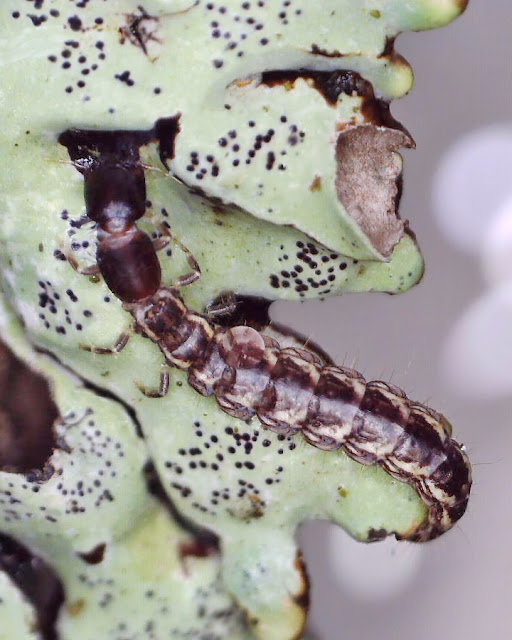
I thought I had examined them thoroughly. The lichens on twigs that I made into an arrangement in a vase. Nothing there but wood and lichen, or so I thought.

Looking at them again yesterday, I saw movement. Something running, something fast and curvy. I took many photos of the place where it had just been.
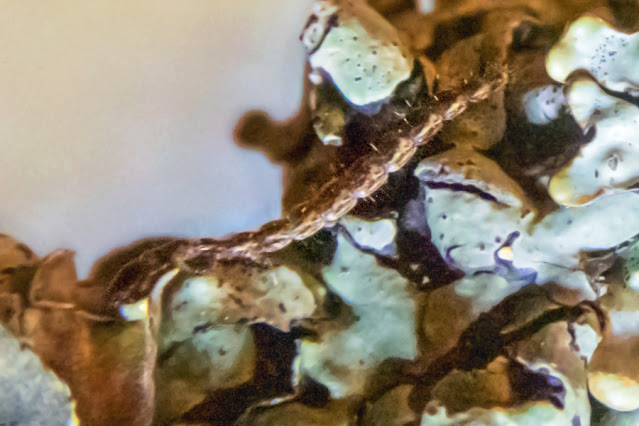
Caught it! Blurry, but it's there. Long, prickly beastie.

I gave up and went back to the planned operation; I sprayed the lichen down with de-chlorinated water. And the little runner stopped to take a drink. I even managed to get him under the microscope before he ran away again.
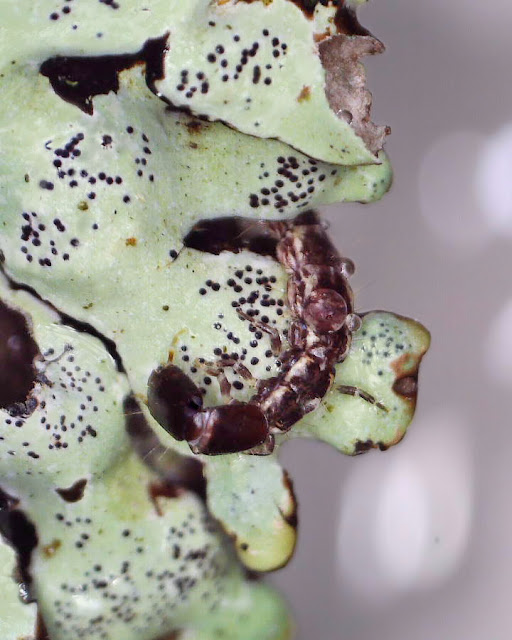
Square head, short antennae, 6 legs on the first segments. The round ball is a droplet of water.

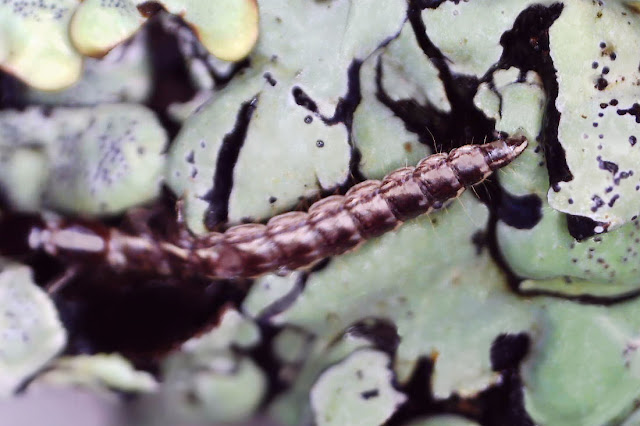
Nicely patterned tail segments, dragged along; no legs here.

And, drink finished, he's off and running again. I count 12 body segments, besides the head.

I looked at a zillion larvae on BugGuide, and I think he's probably a rove beetle youngster. I've sent photos in to BugGuide; they will know.

UPDATE: BugGuide has moved the photos to Snakefly larvae.

~~~~~~~~~~~~~~~~~~~~~~
Creí que los había examinado bien; los líquenes en las ramitas de abeto de Douglas que había arreglado en un vaso. No había nada más que la madera y las hojas de liquen, pensaba.

Examinándolos otra vez ayer, vi algo que se movía. Algo que corría, algo con curvas sinuosas, y que tenía mucha prisa. Saqué muchas fotos del lugar donde había estado un instante previo.

Primera foto: por fin lo capturé. Una foto borrosa, pero ahí está. Largo y con espinas.

Me di por vencida y regresé al plan anterior, de ver como respondía el liquen al agua. Rocié la ramita con agua declorada. Y el bichito correlón se detuvo para beber. Hasta tuve tiempo de colocarlo bajo el microscopio antes de que se pusiera a correr otra vez.

Segunda foto: La cabeza es grande y algo cuadrada; tiene 6 patas en los primeros segmentos. La bola redonda es una gota de agua.

Tercera foto: diseño de los segmentos de la cola. Pesada y larga, pero sin patas; la arrastra tras si.

Cuarta foto: ya terminó de beber, y empieza otra vez a correr. Cuento 12 segmentos del cuerpo, la cabeza aparte.

Miré gran número de fotos en BugGuide, y creo que este probablemente sea la larva de un estafilínido. Les envié unas fotos a los expertos en BugGuide; ellos podrán identificarla con más certeza.

Y ahora, BugGuide ha puesto las fotos en la categoría de los rafidiópteros.

Wednesday, January 19, 2022

Little forest at dusk

 Evergreens without the green ...

I ran a couple of errands first, and by the time I got to the museum woods where I planned to collect lichens, it was almost sundown.(By the clock; there was no sun to be seen behind the clouds.) And it is always dark in those woods, even at midday in the summertime; now, in the rain and fog of late afternoon, the colour was leaching out of everything but the brightest of the lichen on the trunks.

I took a few photos, anyhow.

Looking straight up. There's still light in the sky. These are Douglas firs.

And looking straight down. (I lightened up the photo; it was almost black. Wish I could lighten up my eyes, too.) The Douglas fir roots run along just under the duff. On the paths, they break through the surface.

Another forest, a week ago. Snow adds light, but only the moss shows up green.

Oh, I did find those lichens. Photos tomorrow.

~~~~~~~~~~~~~~~~~~~~~~~~~~~~~

Cuando lo verde se oscurece:

Había hecho un par de mandados antes de ir a buscar líquenes en el bosque del museo, y para cuando llegué ya estaba por ponerse el sol, el cual de todas maneras no se veía, escondido tras una espesa capa de nubes. Y siempre está oscuro en ese bosquecito, hasta a mediodía en pleno verano; ahora, con la lluvia y la neblina, los colores se desaparecían, aparte del color verde claro de los líquenes en los troncos.

Saqué unas fotos de todas maneras.
  1. MIrando verticalmente. Todavía hay luz en el cielo. Estos árboles son abetos Douglas.
  2. Mirando hacia mis pies. (La cámara y mis ojos registraron los colores como negro y casi negro, pero con Photoshop, le pude añadir algo de luz. No hay tal remedio para mis ojos.) Las raices de los abetos crecen horizontalmente debajo del suelo y los musgos. En los senderitos suben a la superficie.
  3. Otro bosque, hace una semana. Con la nieve en el suelo, hay más luz, pero aun así, solamente el musgo en las ramas se ve algo verde.
Y sí, hallé los líquenes que buscaba. Mañana habrá fotos.


Saturday, June 12, 2021

Root

I am intrigued by rainforest tree roots. So tall the trees, so heavy, so busy 'way up top in the sunlight, and it's all held in place by a few metres of roots grabbing the bit of soil coating the rocks that make up our mountains.

And sometimes they fail.

When young, Douglas-fir establishes a taproot in the soil. The taproot continues to penetrate into the soil for the next ten years. As the tree ages, it produces a slew of lateral roots. The main lateral roots breach the soil at a sharp angle. The depth of the root system is related to the soil structure and texture. In areas that receive abundant rainfall, the roots may burrow 60 to 100 cm into the earth, with some progressing even deeper. On well-drained soils, the lateral roots may reach up to 1 meter beyond the crown. (IronTreeService)

Another site says that the roots may extend themselves up to 3 metres vertically and laterally. That's not a lot of root for a tree that reaches up to 60 metres high.

I am perpetually amazed at this world we live in.

~~~~~~~~~~~~~~~~~~~~~~~~~~~

Las raices de nuestros árboles del bosque pluvial me fascinan. Tan altos los árboles, tan pesados, tan activos allá arriba donde calienta el sol, y ¡todo se mantiene en su lugar con unos cuantos metros de raiz agarrándose a la escasa cobija de tierra que cubre las rocas.

Foto: y a veces no es suficiente.

"Cuando brota, el abeto de Douglas establece una raiz primaria en la tierra. Esta sigue penetrando dentro del suelo por los próximos diez años. Mientras crece el árbol, produce una cantidad de raices laterales. Las raices laterales principales cortan el suelo en un ángulo agudo. Lo hondo del sistema de raices depende de la estructura y la textura del suelo. En sitios que reciben lluvia abundante, las raices pueden enterrarse de 60 a 100 cm. dentro del suelo, con algunas que se extienden aún más hondo. En suelos con buen drenaje, las raices laterales pueden alcanzar hasta 1 metro más que la corona." (De IronTreeService)

Otro sitio web dice que estas raices pueden extenderse hasta 3 metros tanto vertical como lateralmente. No es mucha raiz para un árbol que se alza hasta 60 metros al aire.

Siempre me quedo asombrada ante este mundo en que vivimos.

Thursday, April 02, 2020

On mossy trunks

Some more tree trunks to wonder about:

These are beside the Ripple Rock trail.

Douglas fir

The forest is deep and shady here. Most of the Douglas fir trunks have a good crop of moss, and the lower branches are lightly furred, with a different, dangly, hairy moss.

But, among them are the alders:

Red alder
The alders have bare trunks, but the branches are heavily laden with a moss that looks (from ground level) like the Douglas fir trunk moss.

Red alder trunk and branches.

Why?

~~~~~~~~~~~~~~~~~

Ya que estoy mirando los troncos de árboles, aquí hay otro misterio. En un bosque al norte de la ciudad, en camino a Ripple Rock, los abetos de Douglas llevan una capa gruesa de musgo en el tronco, y en las ramas, otro musgo, más delicado, como pelos colgantes.

En el mismo bosque, los alisos rojos no traen musgo en el tronco, pero las ramas están cubiertas del musgo que crece en los abetos.

¿Porqué?

Thursday, September 05, 2019

Ancient Vikings and eye seat belts.

Looking for the sasquatch, we took a trail through a dark forest of old Douglas firs, tall monsters with their tops blocking the sunlight; away from the edge of the forest, the rest of the trunks were bare, with deeply grooved, broken, and lumpy bark.  Any branches remaining below the greenery above were dead, black, wildly convoluted.


Bark, bits of burls, woodpecker holes (two sizes).

This tree has fallen, but got hung up on two others high above us by its tangle of dead branches.
Stump. With a face. An ancient Viking, maybe?

It's woodpecker habitat. At the edge of the forest, we came across a busy pileated woodpecker, pounding away at fallen wood.

He* sees me hiding behind a tree, but continues with his search for grubs.

*He's a male: the males have the red crest, and a red "mustache", as well.

Pileated woodpeckers need a large territory of old growth forest; one pair occupies about a square kilometer. Rebecca  Spit, where we met this one, is about 2 kilometres long, but only about an average of 150 metres across; it's his back yard only.

He pounded away at the broken logs on the ground; before he left, he'd made visible square holes in it:

His fresh holes are a paler brown.

Why don't woodpeckers get headaches?

Woodpeckers hit their heads up to 20 times a second. But muscles, bones and an extra eyelid protect their small bird brains.
Strong, dense muscles in the bird's neck give it strength to repeatedly thump its head. But it is extra muscles in the skull that keep the bird from getting hurt. These muscles act like a protective helmet for the brain.
Unlike the human brain, the woodpecker's brain is tightly confined by muscles in the skull and a compressible bone. This keeps the woodpecker brain from jiggling around when the bird is stabbing away at a tree trunk.
A millisecond before making impact, a woodpecker contracts its neck muscles. Then, it closes its thick inner eyelid.
 The eyelid acts like a seat belt for the eye, said University of California Davis ophthalmologist Ivan Schwab, whose 2007 study on this phenomenon was published in the British Journal of Ophthalmology.
Without an extra eyelid, the retina could tear, and worse, the eye could pop out of its socket. (From LiveScience.com)

I almost got a headache, watching him.

Sasquatch site and woodpecker forest.

Tuesday, May 07, 2019

Spring decor on the dunes

Most of the year, our Douglas firs are dressed in sober greens, dark and mysterious under the grey skies. But come spring, the youngsters deck themselves out in bright yellowy greens and orange paper decorations.

Young Douglas-fir, Oyster Bay dunes. The new buds grow at the tips of every branch, and before they open, they're gift wrapped.

New tips at the top of the tree, with the remains of the papery orange wrapping.

Another tree, another batch of buds, and a beetle just spreading his elytra, preparing to fly away. The wings underneath are transparent.

Monday, March 11, 2019

Old burn

In the summer of 1938, Vancouver Island sweltered through the longest drought seen for over 50 years. Sparks from logging operations set off dozens of small brush fires. Smoke hung over the hills.

Fire broke out in a log pile on Menzies Bay, just north of Campbell River, and leapt into the forest. A couple of days later, in spite of the 400 firefighters trying to quench it, it was burning over several thousand acres of timber. By the third day, it was threatening Campbell River, and racing up-river, past Elk Falls. The smoke rose two kilometres into the air, and covered almost two-thirds of Vancouver Island.

The fire headed south then, passing Campbell River, racing towards Comox, and east up the mountainsides to Mount Washington. 2000 men fought it, hopelessly. 470 square kilometres of forest were in flames, and the wind was picking up. At times, it reached 150 km/hr.

And then the rain came. The blessed, drenching West Coast rain, pouring down steadily for weeks. In the ancient forest off Elma Bay, these days called the Miracle Beach Provincial Park, the roaring blaze sizzled into damp coals.

Some say that's how Miracle Beach got its name.

Today, many of the older trees in Miracle Beach Provincial Park still wear the scars of that fire.

Survivor, still green up top.

Older Douglas-fir bark is thick and deeply grooved, providing habitat for many insects and nesting sites and groceries for birds and small animals. And old, damaged bark is even more hospitable. This old tree still retains some old scorch marks; it looks like most has been riddled by insects and then birds collecting insects.

The crevices go deep into the tree; I tried to light the bottom of several holes with the camera's flash, but the light didn't reach that far.

Near the centre of the section above, if you look closely, you'll see a white circle. I moved in to get a better look.

"Come into my parlor ..."

A spider hole, wide enough for a chickadee to wander in.

From another angle

I can't be sure; is that a spider lurking deep inside, or just blotchy patches in the bark? I didn't risk sticking a finger in to find out.

For comparison: a pair of unburnt Douglas-fir trunks. Grooved, but much neater.

And the remains of a smaller tree, after the woodpeckers have eaten their fill.


Sunday, March 10, 2019

Tall

The forest at Miracle Beach is mostly Douglas-fir, with a mixture of Western hemlock, Sitka spruce, and Big-leaf maple, and the ubiquitous red alder. It is second-growth forest; it has been logged off once, and once(that we know about; we are newcomers in tree years)  ravaged by fire, so most of the trees are relatively young, but a few of the older Douglas-firs are still standing.

These are tall trees; a mature Douglas-fir can be as much as 100 metres high, at least here on the coast. Inland, they are shorter.

In comparison, the Western hemlock grows normally to 50 metres, occasionally to 60.

I took a series of photos of one tree, and stacked them. I don't know how tall these ones are; the trunks are less than one metre in diameter. A normal width for a fully mature tree could be almost 3 metres.

Foreshortened from my viewpoint at its foot.

The trunk of an older Douglas-fir is branch-free for most of its length, with the foliage in a clump at the top. The bark is thick and deeply grooved. Look for the burl towards the bottom on this tree.

Looking  straight up from the same general area.


Saturday, March 09, 2019

Tall, tiny, tiniest

Yesterday (Friday) was bright and sunny, if still chilly. I wandered through the tall, shadowy forest at Miracle Beach, poking through the moss, peering under logs and down crevices in bark.

A corner of the forest. Douglas-firs, mostly.

Old, moldy Douglas Fir cone, with "mouse tails".

I turned over a broken branch, half covered by moss, exposing a small community of critters and fungi.

White, feathery mold. And a large pupal case, also coated in mold.

I was looking at the pupal case, wondering if the mold would have killed the critter inside, when something reddish dashed out from underneath and ran away. I chased it with the camera.

A very tiny spider. The sowbug is about 1/2 cm. long. The spider, legs and all is less than that; her body is about 2 or 3 mm., fangs to spinnerets. She was panicking; running back and forth, not seeming to be able to decide where to hide.

What I didn't see, until I got home and blew up the photos, were a few tinier red mites, and possibly a much smaller spider. On the red mite just below the grass bits, I can just barely see a leg. In other photos, the mites show up, but never in the same location; they were moving fairly fast, because I was taking photos as fast as I could follow the spider.

And then there were those other things; hundreds of them.

Or thousands? Each one has a dark spot, maybe an indentation, in the centre. If the spider is 3 mm. long, these would be 1/2 a millimetre at most. A dusting of miniature cup or birds' nest fungi?

Another sowbug. And two mini-sowbugs (top left).

And this time, on the way home, I counted 18 eagles, all adults. (The immatures are harder to see; they lack the white head, and their feathers are brownish and mottled. They blend in to the scenery.)

Tomorrow; fungi, I think. Or tree trunks. Or ... I brought home over 200 photos to sort and process.

Wednesday, January 16, 2019

Signs along the trail

On the Hoomak Lake trail, I found the interpretive signs interesting. I"ll include a few among my photos of the sights along the trail.

Sunlight on the top of a mossy log in a patch of salal.

Brief history of the site.

Legend: Reforestation History
Welcome to the Hoomak Lake trail. This site was logged in 1959 and slash burned in 1960. Since there was inadequate natural forest regeneration, Douglas-fir seedlings were planted in 1968-8-69. A white pine blister rust infestation had destroyed much of the natural young western white pine trees. In 1984, the site was juvenile spaced and pruned. ...

"... slash burned in 1960." After a site is logged off, the remaining broken timber and branches become a fire hazard, so the slash is piled and burned as prevention. The cleaned area then is colonized by fireweed, which provides shelter for early tree seedlings.

The white pine blister rust is similar to the (probable) rust I found on the Ridge Trail a few weeks ago. It can spread rapidly through a forest, killing the trees.

Western White Pine cone.

These cones can grow up to 30 cm. (12 inches) long. I don't know what those white patches are; they were hard and dry, and firmly attached to the cone.

Tree species on this site.

Partial legend, written in 2000: This area contains Douglas-fir, western redcedar, western white pine, western hemlock, and red alder trees.

Ferns growing on a well-rotted log. The duff is mostly pine or hemlock needles, dead ferns, and a few alder leaves.

Forest Succession

Legend (again, written in 2000):
An old forest will most often contain trees of various ages and sizes - from young to old, short to tall. Some species, such as western hemlock and western red cedar, can grow in low light conditions. Douglas-fir, on the other hand cannot survive under the shaded canopy of the tall trees.
Notice the different levels of tree heights in the forest around you. (Note: I craned my neck here. The Douglas firs are 'way up there in the sunlight.) The biggest and tallest trees in sight are Douglas-fir trees. They are the original or "pioneer" species, growing natural or planted before the ground was shaded by other vegetation. Pioneer species are the first species to grow back on a disturbed site.
Around you are numerous short, little western hemlock trees. They will eventually grow taller and take over from the pioneer species, ultimately being the tree species that exists on this site - the "climax" species - until the next disturbance. This process is called forest succession.

The "little" western hemlocks from 20 years ago are now tall, thin trees.

Once established, saplings in full light may have an average growth rate of 50–120 cm (20–47 in) (rarely 140 cm, 55 in) annually. (Wikipedia)
20 inches a year for 20 years: 400 inches or 34 feet, plus their year 2000 height; the trees are now nearly a third grown.

I didn't know this:

Sunscald

So Douglas fir that grew up in shady woods can get sunburnt. I can relate.

Legend: The damage on the Douglas-fir beside you is called sunscald. When such a thin-barked young tree is suddenly exposed to intense direct solar radiation, the high temperature can kill live tissue (cambium) below the bark. In this instance, juvenile spacing ... created openings that allowed sunshine into the previously shaded young forest.
... Trees that have grown up exposed to direct sun have usually developed a thicker, insulating bark.

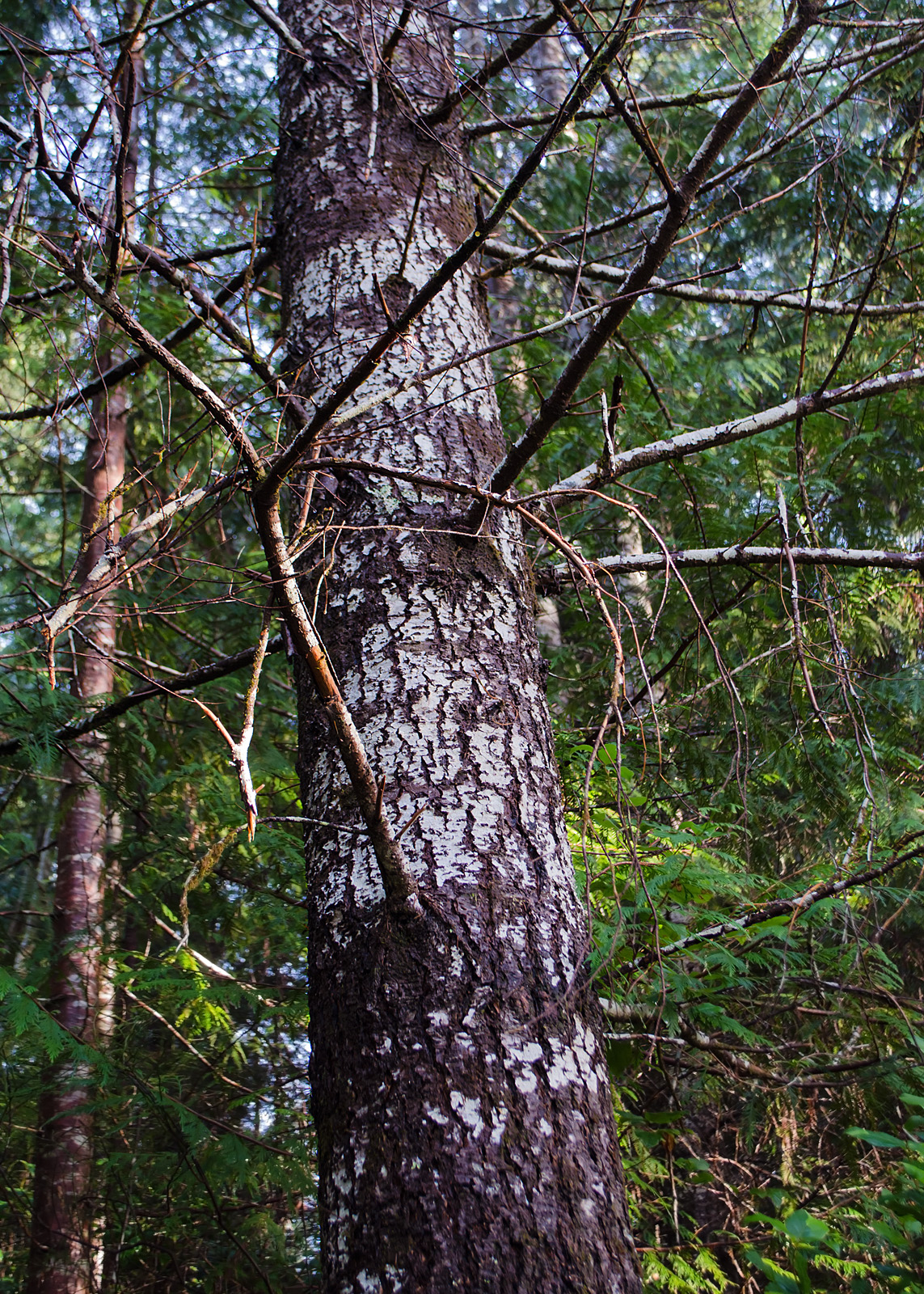
White patches on trunk.

This is the tree that was beside the sign. Whether it is the one the sign referred to, or that one has long turned into duff, I can't tell.

Mushrooms on fallen tree.

These mushrooms were soft, jelly-like, from white to tan to pinkish. The leaves on the ground around them are red alder.

Something else I didn't know, tomorrow.

Tuesday, November 27, 2018

Half-hidden mice

Douglas fir cones:

Pseudotsuga menziesii. Always identifiable by the three-pronged bracts.

I like Douglas fir: it's not a fir, nor, as some people call it, a spruce, but belongs in its own genus, Pseudotsuga, meaning "false hemlock". And it's always easy to identify by its unique cones. The bracts are, according to legend, the feet and tail of tiny deer mice hiding underneath the scales.

These mice are long and skinny. (Older cones, really.)

The cones are the only ones you will find in the Northwest with three-pointed bracts sticking out of the scales.  Unlike the true firs, the cones hang down rather than standing up on the branch. Also unlike the true firs, the Douglas Fir drops its cones to the ground intact. (From Northwest Conifers)

Monday, October 29, 2018

Mushroom country

And more mushrooms from Cathedral Grove. The forest was dotted with them everywhere; every few steps we saw another clump.

A rotting, moss-covered stump, with its sprinkling of mushrooms.

Most of the trees on this side of the highway are Douglas firs. About 300 years ago, a forest fire downed many of them, and their enormous trunks lie on the ground, covered in a thick mossy blanket. In the space the fire opened up, big-leaf maples reach for the sunlight.

Ideal mushroom habitat; green, dim, and wet.

Mushrooms, burnt bark, and a mulch of big-leaf maple leaves.

Weeping shelf fungus, looking like a sticky bun, on the cut end of a log.

Gilled brown and beige mushroom. There's a scrap of hairy lichen here; these elastic threads hang from all the upper branches.

A similar mushroom, with a paler stalk.

More mushrooms tomorrow.

Powered By Blogger