I had to go back. I had intended to take photos of the cliffs at McCreight Lake, but ended up at Pye Lake instead. So I went back, just for the cliffs.
 |
| View from the lake shore. The road runs behind those trees at the bottom. |
From the road, on foot, (WATCH FOR FALLEN ROCKS, a sign warns) the view is mostly vertical.
 |
| Rock face, with green skin. |
How do they do that? The trees; how can they grow on a hands'-breadth of soil? I have deeper soil in my flower pots at home for my sweet peas!
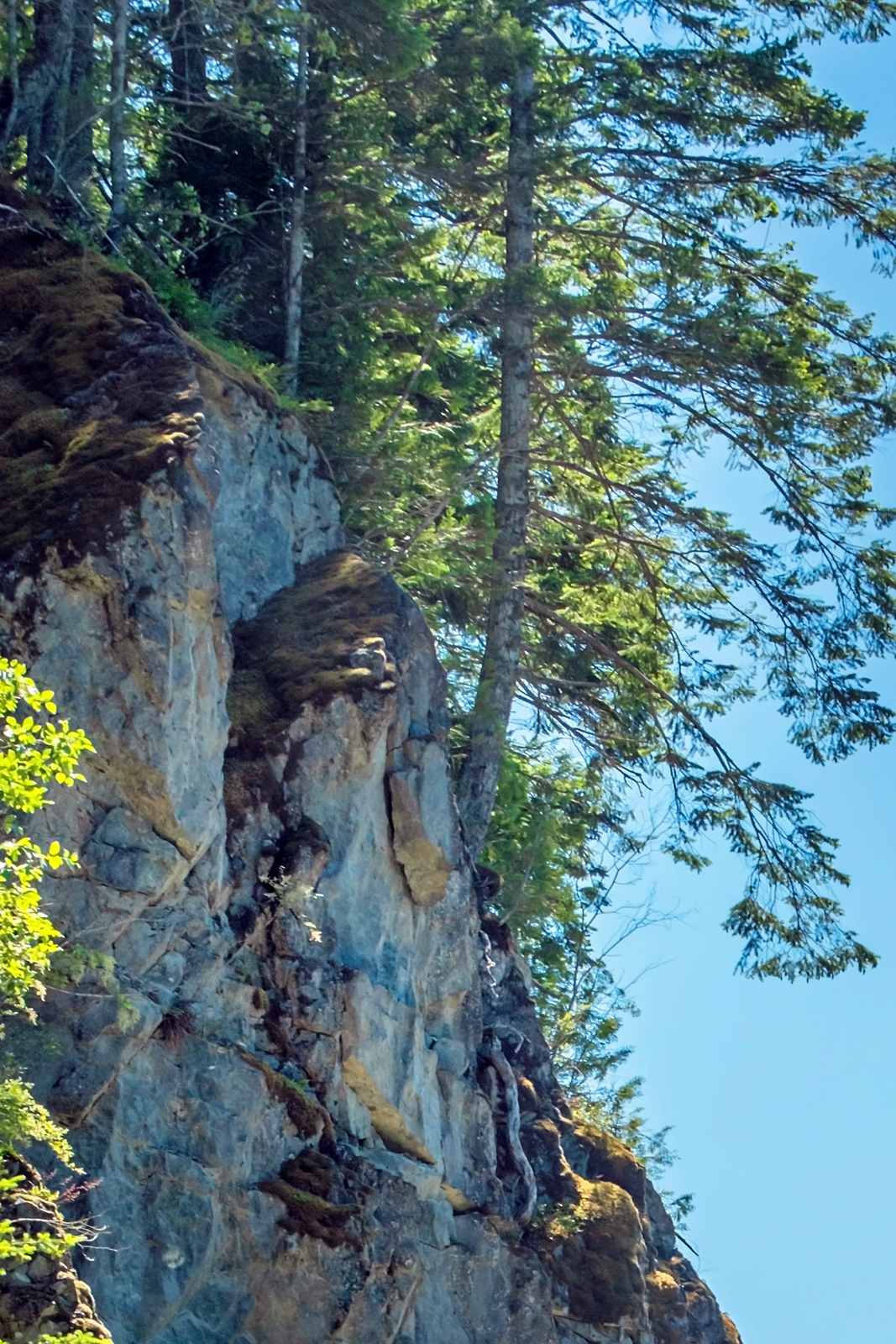 |
| A mere toe-hold. |
How deep does a 50 metre tall tree (hemlock) or a Douglas fir (200 m. tall) need to dig its roots so as not to fall over? Oh, Google!
The hemlocks and western red cedars have a shallow root system. The Douglas fir's roots go down deeper; from 0.6 to 1 metre, with their fine roots concentrated in the upper 20 cm of soil. Just that? But that layer of soil is half that!
So they spread their roots out in that thin, thin layer of moss and duff. Which isn't all that firmly attached to the rock: it's easy enough to detach it with one hand. So how do they stay put?
TreePlantation.com explains:
To overcome the hurdles posed by the rocky terrain, their roots seek out the smallest fractures within the rock structure. They follow these hairline cracks and fissures in the rock, inching their way deeper into the unforgiving terrain. As they penetrate further, they exert pressure,* gradually widening these cracks and burrowing deeper into the rocky structure. The result is a complex network of roots, splitting and webbing throughout the rock. (RootAdaptation)
*The seeds above a crack push their first small root – the radicle - inside the crack and quickly search for water. The radicle is capable of developing a pressure of over 50 bar (725 psi). (Groasis)
(For comparison, the air in my tires has a pressure of 32 psi.)
 |
| Another treed cliff. |
Thinking it over, thinking of those fine roots burrowing and fattening and networking deep inside the rock; maybe I have it backward; could it be that those fallen rocks were pried off by the trees?
Biological weathering, they call it.
~~~~~~~~~~~~~~
Tuve que regresar. Había planeado sacar fotos del acantilado frente al lago McCreight, pero me desvié hacia el lago Pye. Pues, regresé solo para mirar esos precipicios.
Fotos:
#1: Parte del acantilado, visto desde la orilla del lago. El camino corre atrás de los árboles en la base.
#2: Desde el camino, a pie, (PELIGRO: ROCAS CAIDAS advierte un letrero) la vista es casi vertical. Esta roca muestra su revestimiento verde.
¿Cómo lo logran? ¿Los árboles; como es que llegan a crecer en suelo del espesor de unos 15 centímetros? ¡En mis macetas en casa, tengo tierra más profunda para mis guisantes de olor!
#4: Agarrándose con uñas y dientes. Apenas.
¿Cuán profundo tiene que extender sus raices un árbol que mide 50 metros de altura, como la tsuga (T. heterophylla) o hasta 200 m, como el abeto de Douglas para no caerse? Le pregunté a Google.
Las tsugas del Pacífico y los cedros rojos tienen un sistema de raices de poca profundidad. Las raices del abeto de Douglas se hunden algo más, llegando desde 0,6 hasta 1 metro de profundidad, con las raices finas extendidas en los primeros 20 cm. de tierra. ¿Solamente eso? ¡Pero esa capa de tierra encima de la roca es apenas la mitad de lo que necesitan!
Entonces; extienden sus raices horizontalmente (o por lo menos paralelo a la superficie de la roca) dentro de esa capa tan delgada de musgos y humus. Lo cual no se adhiere muy firmemente a la roca; la puedo levantar con una sola mano. Entonces; ¿cómo es que se mantienen en su sitio?
El sitio web TreePlantation.com lo explica:
Para superar los obstáculos que impone el terreno rocoso, sus raices buscan las grietas más pequeñas en la estructura de la roca. Siguen estas fisuras y rendijas, del grosor de un pelo, forzando su entrada centímetro por centímetro en el terreno inhospitable. Al penetrar más adelante, ejercen presión*, amplificando gradualmente estas grietas y cavando aun más hondo entre la estructura de la roca. El resultado es una red compleja de raices, dividiéndose y uniéndose dentro de la roca. (Adaptación de Raices)
*Las semillas sobre una grieta empujan su primera raicita — la radícula — dentro de la grieta y rapidamente buscan agua. La radícula es capaz de desarrollar una presión de más de 50 "bar" (725 psi - libras por pulgada cuadrada) (Groasis)
(Para una comparación, el aire en mis llantas lleva una presión de 32 psi.)
#4: Otro acantilado con árboles.
Pensándolo bien, al pensar en esas raices finas excavando y engordándose y haciéndo redes en las profundidades de la roca, creo que es posible que lo he estado viendo al revés: ¿puede ser, tal vez, que esas rocas caídas fueron desprendidas por los árboles?
Meteorización biológica, se llama.


