Showing posts with label hemlock. Show all posts

Monday, February 23, 2026

Blink and you missed it

It was nice while it lasted. The snow. A few hours, a few centimetres deep, a few snowy branches. And then the rain washed it all away.

These are photos taken in late afternoon along the snowiest stretch of highway to the north, shortly before it started to rain again.

Just a light dusting on the hills.

Hemlock tips and snowy mountaintop. Hemlock trees have droopy tips.

Looking back.

The blue sky is also short-lived.

4:14 PM.

And that's it for winter, it looks like.

~~~~~~~~~~~~~~~~~

Por fin tuvimos nieve. Por unas pocas horas, con unos pocos centímetros, unas cuantas ramas cargadas de nieve. Hasta que la lluvia llegó y se la llevó.

Estas fotos las saqué en media hora en la carretera al norte en el tramo donde hubo más nieve. Una hora más tarde, ya estaba lloviendo.


Wednesday, September 24, 2025

Filed but not forgotten

 More photos from this summer's "hold" file. A few growing things.

Prune plums on a volunteer tree, Oyster Bay, August.

Douglas-fir, standing tall over the beaver pond. Late August.

Hemlock, standing crooked. McCreight Lake.

Willows on the shore of Buttle Lake. September.

Mushrooms under grass and clover. August.

Bull's eye lichen. Crofton ferry landing.

~~~~~~~~~~~~~~

Sigo con las fotos "dejadas para más adelante" de este verano. Ahora con algunas plantas, y además hongos y un liquen.

  1. Un ciruelo con sus frutas. Es un árbol "voluntario" que crece en el bosquecito de Oyster Bay.
  2. Un abeto de Douglas, muy alto.
  3. Tsuga heterophylla. Este árbol se puede reconocer en la distancia por el brote principal muy colgante.
  4. Sauces en la orilla del Lago Buttle.
  5. Honguitos escondidos bajo el césped, con algunas hojas de trébol.
  6. Un liquen, Placopsis sp. En inglés llamamos este liquen el "ojo de toro", o sea un blanco, una diana. Crece en las rocas, o en paredes de cemento.


Friday, July 12, 2024

Green skin and burrowing roots

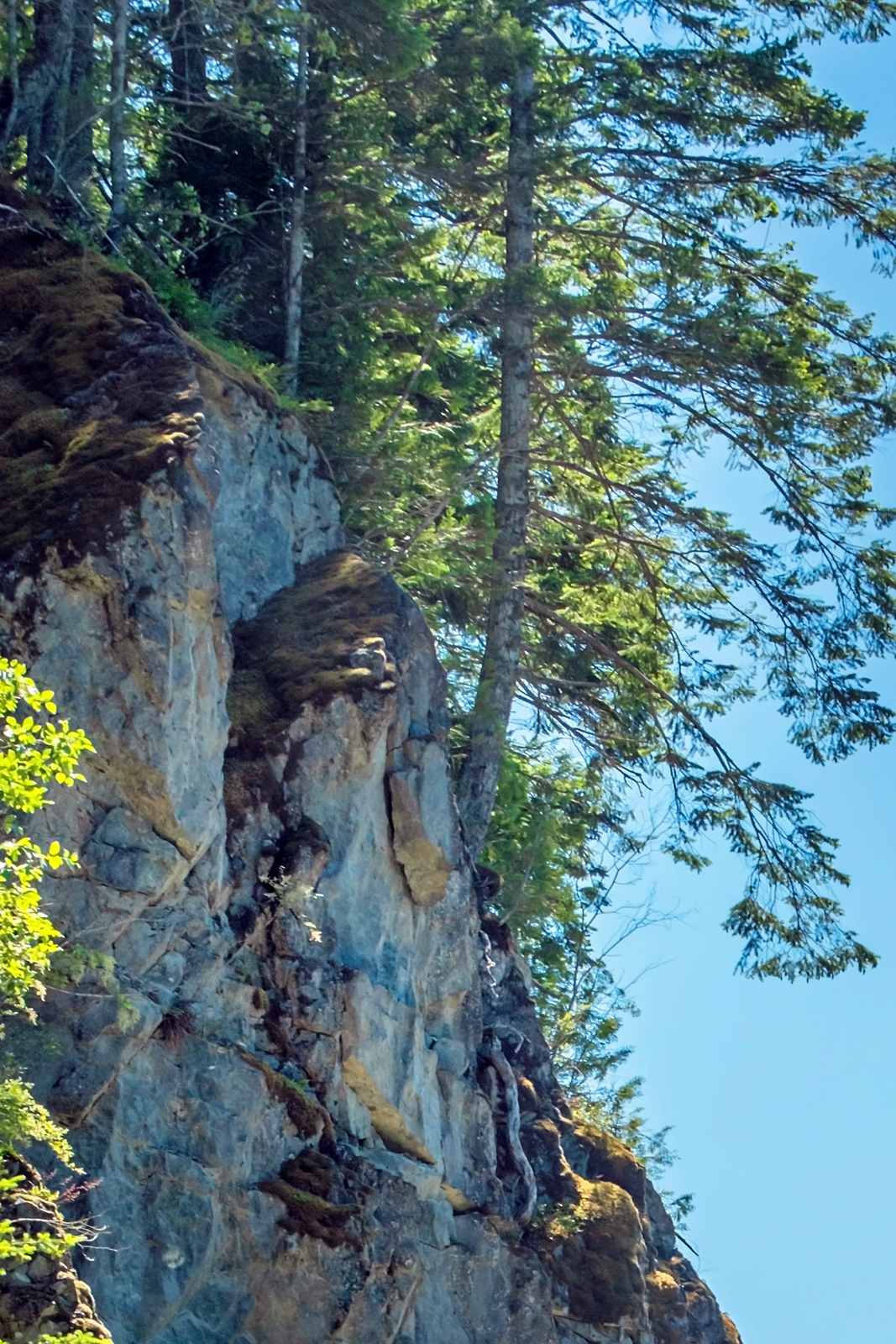
I had to go back. I had intended to take photos of the cliffs at McCreight Lake, but ended up at Pye Lake instead. So I went back, just for the cliffs.

View from the lake shore. The road runs behind those trees at the bottom.

From the road, on foot, (WATCH FOR FALLEN ROCKS, a sign warns) the view is mostly vertical.

Rock face, with green skin.

How do they do that? The trees; how can they grow on a hands'-breadth of soil? I have deeper soil in my flower pots at home for my sweet peas!

A mere toe-hold.

How deep does a 50 metre tall tree (hemlock) or a Douglas fir (200 m. tall) need to dig its roots so as not to fall over? Oh, Google!

The hemlocks and western red cedars have a shallow root system. The Douglas fir's roots go down deeper; from 0.6 to 1 metre, with their fine roots concentrated in the upper 20 cm of soil. Just that? But that layer of soil is half that! 

So they spread their roots out in that thin, thin layer of moss and duff. Which isn't all that firmly attached to the rock: it's easy enough to detach it with one hand. So how do they stay put?

TreePlantation.com explains:
To overcome the hurdles posed by the rocky terrain, their roots seek out the smallest fractures within the rock structure. They follow these hairline cracks and fissures in the rock, inching their way deeper into the unforgiving terrain. As they penetrate further, they exert pressure,* gradually widening these cracks and burrowing deeper into the rocky structure. The result is a complex network of roots, splitting and webbing throughout the rock. (RootAdaptation)
*The seeds above a crack push their first small root – the radicle - inside the crack and quickly search for water. The radicle is capable of developing a pressure of over 50 bar (725 psi). (Groasis)

(For comparison, the air in my tires has a pressure of 32 psi.) 

Another treed cliff.

Thinking it over, thinking of those fine roots burrowing and fattening and networking deep inside the rock; maybe I have it backward; could it be that those fallen rocks were pried off by the trees?

Biological weathering, they call it.

~~~~~~~~~~~~~~
Tuve que regresar. Había planeado sacar fotos del acantilado frente al lago McCreight, pero me desvié hacia el lago Pye. Pues, regresé solo para mirar esos precipicios.

Fotos:
#1: Parte del acantilado, visto desde la orilla del lago. El camino corre atrás de los árboles en la base.

#2: Desde el camino, a pie, (PELIGRO: ROCAS CAIDAS advierte un letrero) la vista es casi vertical. Esta roca muestra su revestimiento verde.

¿Cómo lo logran? ¿Los árboles; como es que llegan a crecer en suelo del espesor de unos 15 centímetros? ¡En mis macetas en casa, tengo tierra más profunda para mis guisantes de olor!

#4: Agarrándose con uñas y dientes. Apenas.

¿Cuán profundo tiene que extender sus raices un árbol que mide 50 metros de altura, como la tsuga (T. heterophylla) o hasta 200 m, como el abeto de Douglas para no caerse? Le pregunté a Google.

Las tsugas del Pacífico y los cedros rojos tienen un sistema de raices de poca profundidad. Las raices del abeto de Douglas se hunden algo más, llegando desde 0,6 hasta 1 metro de profundidad, con las raices finas extendidas en los primeros 20 cm. de tierra. ¿Solamente eso? ¡Pero esa capa de tierra encima de la roca es apenas la mitad de lo que necesitan!

Entonces; extienden sus raices horizontalmente (o por lo menos paralelo a la superficie de la roca) dentro de esa capa tan delgada de musgos y humus.  Lo cual no se adhiere muy firmemente a la roca; la puedo levantar con una sola mano. Entonces; ¿cómo es que se mantienen en su sitio?

El sitio web TreePlantation.com lo explica:
Para superar los obstáculos que impone el terreno rocoso, sus raices buscan las grietas más pequeñas en la estructura de la roca. Siguen estas fisuras y rendijas, del grosor de un pelo, forzando su entrada centímetro por centímetro en el terreno inhospitable. Al penetrar más adelante, ejercen presión*, amplificando gradualmente estas grietas y cavando aun más hondo entre la estructura de la roca. El resultado es una red compleja de raices, dividiéndose y uniéndose dentro de la roca. (Adaptación de Raices)
*Las semillas sobre una grieta empujan su primera raicita — la radícula — dentro de la grieta y rapidamente buscan agua. La radícula es capaz de desarrollar una presión de más de 50 "bar" (725 psi - libras por pulgada cuadrada) (Groasis)
(Para una comparación, el aire en mis llantas lleva una presión de 32 psi.)

#4: Otro acantilado con árboles.

Pensándolo bien, al pensar en esas raices finas excavando y engordándose y haciéndo redes en las profundidades de la roca, creo que es posible que lo he estado viendo al revés: ¿puede ser, tal vez, que esas rocas caídas fueron desprendidas por los árboles?


Tuesday, June 11, 2024

Still wandering in Sundew Bog

The plants in Sundew Bog (beside Upper Campbell Lake) grow in three distinct layers. First, the nose-to-the-ground level, the yellowish sphagnum mosses, the sundews that give the fen its name, the tiny bog cranberries. 

Get up off your knees and meet the middle layer. These are shrubs, knee- to waist-high. The bog-laurels, with their pink flowers in May, the Labrador tea, filling the fen with white flowers in June. Buckbeans, here and there a skunk cabbage, in a deeper puddle, a starter group of water lilies.

Stand tall and look up: there are a few trees, a snag or two. A smidgen of shade over a bench on the central platform. A handful of young evergreens. Mostly, though, there's open sky.

This week, the bog-laurel has produced its tiny, inedible fruit.

Kalmia microphylla ssp. occidentalis.

Strange fruits: tiny red capsules, with the flower's pistil still present at the top, looking like a continuation of the stem, as if the fruits were beads strung on a red string. 

In wetter, open areas, the buckbeans are waving their short stalks with three leaves to a stalk. A few, too far away to see clearly, are in flower.
 
Frilly buckbean flowers, Menyanthes trifoliata.

The tallest of the trees, too tall to get it all in without leaving the boardwalk. Lichen replaces the needles it once held.

Hemlock cones, above the observation post.

~~~~~~~~~~~~~~
Las plantas que observamos en la Ciénaga de Rocíos del Sol (al lado del lago Upper Campbell) crecen en tres niveles. Primero, con tu nariz casi en el suelo, ves los musgos esfagnos, y las plantas carnívoras que dan el nombre al sitio, y los arándanos de pantano, tan pequeñitos.

Estabas de rodillas. Ahora, párate para ver las plantas del nivel mediano, a la altura de tus rodillas hasta la cintura. Arbustos como la Kalmia microphyla, con sus flores color de rosa en mayo, el thé de Labrador, que ahora llena todo con sus flores blancas. Hay tréboles de agua, Menyanthes trifoliata; una que otra col de los pantanos; y en un charco algo profundo, unos lirios de agua.

Ahora levanta la cabeza. Cielo abierto, pero con unos cuantos árboles, tantos muertos como vivos. Un poco de sombra sobre uno de los asientos en la plataforma de observación. Algunos arbolitos juveniles de hoja perenne. 
  1. Esta semana, la Kalmia microphylla ha producido sus frutas pequeñas, no comestibles. Tienen una forma rara; un tallo rojo, luego la fruta, redonda como una canica, y luego el pistilo de la flor, como si fuera una extensión del tallo, como si la fruta fuera una perla roja ensartada en un hilo rojo,
  2. Tréboles de agua; cada tallo lleva tres hojas. Algunos, pero muy lejos, ya estaban en flor. Las flores son blancas con detalles en rosa, y con volantes en los pétalos.
  3. El árbol más alto. Ya muerto, con líquenes sustituyendo a las hojas.
  4. Una rama de un Tsuga sp., con sus piñas. Este árbol es el que nos dió un poquito de sombra donde nos sentamos a descansar.


Powered By Blogger