Showing posts with label nurse stumps. Show all posts

Friday, September 12, 2025

Trees are like cats.

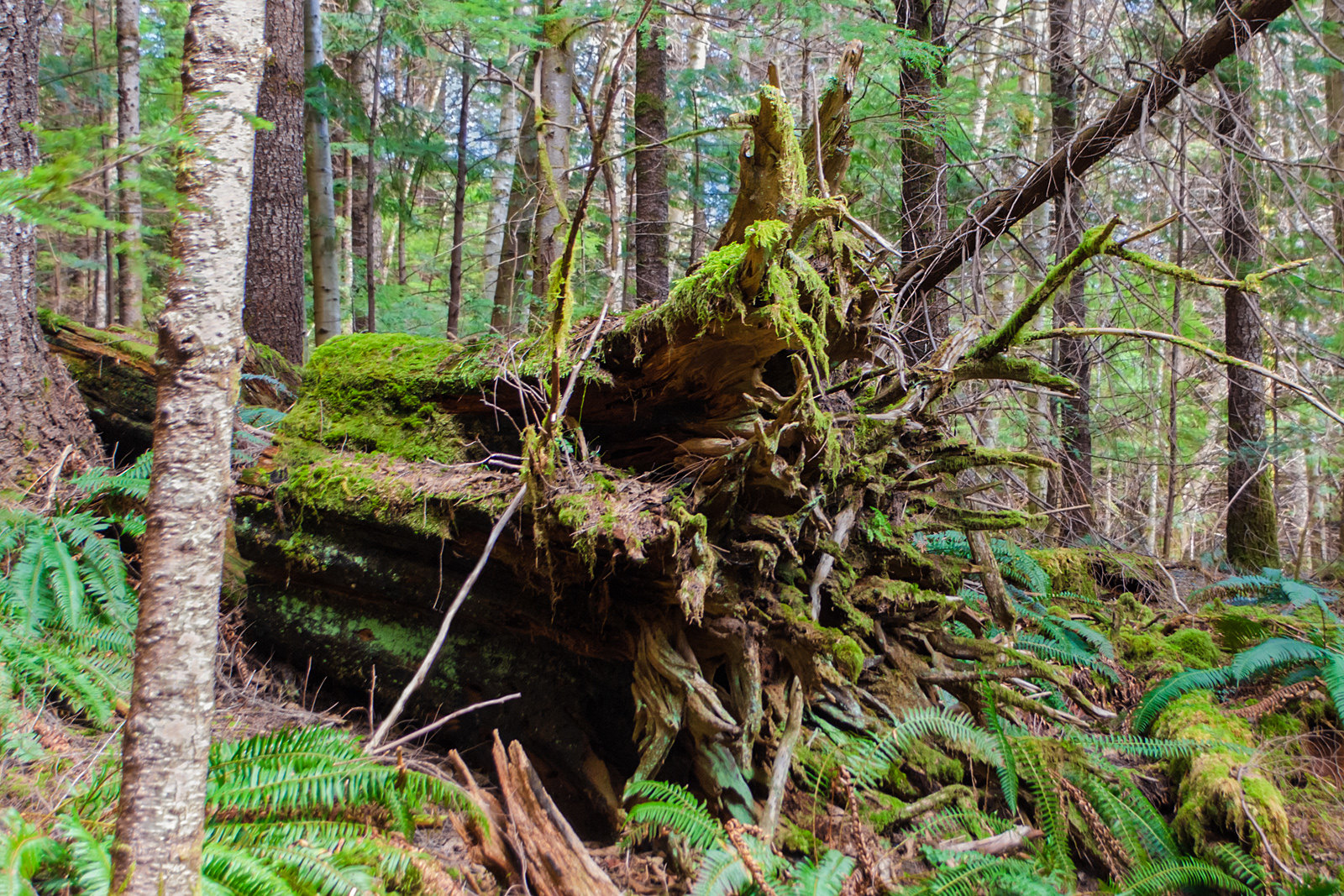
Trees are like cats; they have nine lives. This one is working on it's fifth life. "Dead" (so we say), dried and fallen, with its roots in the air, it's growing another crop of greenery.

Basking in the sunlight, enjoying life.

Counting the lives: 
  1. Standing tall, making leaves and cones.
  2. Still standing, supposedly dead, growing fungi and ferns and housing insects, birds and bats, squirrels and woodmice. Look for woodpecker holes. 
  3. Tipped over, or lying on the ground growing moss and more ferns and fungi, home to small beasties. Starting a family of saplings. 
  4. Dried out, full of holes. Resting. Ants and spiders hang out inside. Yellow witches butter bubbles out of the cracks.
  5. This one; roots in the air. Still mossy. Saplings rooting at the further end.
  6. Or it's a stump, standing firm to support the next generation. Wearing huckleberry shrubs as hair.
  7. Crumbled into the ground. Very much alive. The family is growing. New fungi spread hyphae throughout. Raccoons and bears dig for ants.
  8. Gone into hiding. Its fungi connect the family to nearby adult trees, bearing food and information.
  9. And so it goes ...
~~~~~~~~~~~~~~
Los árboles son como los gatos; tienen nueve vidas. Este ya anda en la quinta vida. "Muerto", decimos, ya seco y caído, con las raices al aire; y se cubre de vida verde.

Foto: Las raices de un árbol caído, con una capa densa de musgos.

Contamos las vidas: 
  1. De pie, formando hojas y semillas. (Conos en este caso; es un abeto.)
  2. Sigue de pie, pero parece estar muerto. Allí crecen hongos y helechos, y hacen sus nidos gran número de insectos, de pájaros y murciélagos, de ardillas y  ratones silvestres. Busca las cavidades que hacen los pájaros carpinteros. 
  3. Medio o totalmente caído, sostiene musgos y  helechos y otros hongos, provee animalitos con albergue. Empieza una familia de arbolitos. 
  4. Se seca, el musgo se cae; huecos y grietas abundan. Descansa. Hormigas y arañas se esconden adentro. Hongos gelatinosos de amarillo brillante brotan de las grietas. 
  5. Este; con las raices al aire. Sigue cubierto de musgo. Los arbolitos, su familia, están establecidos en el extremo opuesto.
  6. O es un tocón nodriza, manteniéndose de pie como sostén de la nueva generación. Lleva arbustos de huckleberry como si fueran cabello.
  7. Desmoronado sobre el suelo. Pero sigue muy vivo. La familia crece. Hongos nuevos infiltran sus   hifas por toda la masa. Los mapaches y los osos excavan entre la madera suave, buscando hormigas.
  8. Se ha escondido. Las hifas de sus hongos establecen enlaces entre la familia y árboles adultos  en las cercanías, llevando nutrientes e información.
  9. Y sigue la vida ...

  1. And so it goes ...

Monday, October 31, 2022

Back to normal: soggy

 So it's been raining off and on for a few days. Not heavy rain, just a steady dripping, but enough to wet down the fallen leaves and turn a few lawns green. I went to the museum to look for mushrooms, without much luck. There were a few, around stumps, but none of the usual ones that grow in the lawns. I'll try again in a few days. But I walked through their little wood, uphill and downhill. Again, there were no mushrooms, but the juncos were out in force, digging through the soggy leaves. And the air smells of autumn spice. Many of the big-leaf maple leaves have fallen, but the huckleberries and some of the alders still hold onto theirs; the woods are still green, with tan and yellow blobs.

Since there were no mushrooms, I took photos at random along the trails.

Big-leaf maple leaf, still on the tree.

Big-leaf maple leaf fallen into a hollow stump.

In the centre of the woods, a big rock waits, carelessly dropped by a glacier on its way down the hill.

Detail of roots clasping a nurse stump.

A tangled wood, with one junco who sat still for a moment.

Rock, moss, leaves.

A few more maple leaves.

I'll post the few mushrooms I did find around the lawn tomorrow.

~~~~~~~~~~~~~~~~~~~~~~~~~~~~~~~
Por fin está lloviendo, desde hace unos pocos dias. No es mucha la lluvia, solo una salpicadura, una llovizna, pero fue suficiente como para mojar las hojas caídas y volver el color verde al césped. Fui al museo a buscar hongos en sus alrededores, sin mucha suerte. Encontré unos pocos en muñones viejos, pero ninguno de los que crecen normalmente en el césped. Trataré otra vez en unos cuantos dias. Pero subí a su bosquecito y seguí los senderos cuesta arriba, cuesta abajo. Tampoco hubo hongos allí, pero una bandada de juncos escarbaba entre las hojas, buscando comida. Y el aire olía a otoño. Muchas de las hojas del arce de hoja grande han caído, pero los huckleberry (arandano nativo) y los alisos todavía retienen sus hojas verdes.

Ya que no veía hongos, saqué fotos casi al azahar a lo largo del sendero.

Fotos: 
  1. Una hoja de arce, todavía colgada del árbol.
  2. Una hoja de arce caída dentro de un troncón hueco.
  3. En el centro del bosque, una roca grande, dejado caer descuidadamente por los glaciares en su prisa para llegar al mar.
  4. Detalle de raices que se agarran fuertemente al muñon enfermera.
  5. Bosque desordenado, con un junco que se detuvo por unos segundos.
  6. Roca, musgos, hojas.
  7. Y más hojas de arce.
Y mañana subiré las fotos de unos cuantos hongos.


Tuesday, April 19, 2022

Roots like stilts

Douglas-fir seedlings need light. Down on the forest floor, shaded by thick-leaved salal and evergreen ferns, light is a scarce commodity. That's where nurse logs come in. And nurse stumps; the taller, the better. The seedling reaches up to the light, and sends its roots over the stump and down to the ground below.

High nurse stump, with mature tree on top.

The roots of a Douglas-fir*, on the ground, turn out horizontally, except for a main taproot, with a few supporting taproots, which extend downward for up to about 3 metres, depending on the substrate. The lateral roots extend about to the width of the crown.

These two trees are growing in wetlands; their roots, if they had started out on the ground, would be shallow.

Douglas-firs growing in soil frequently exposed to groundwater or runoff will often develop shallow rooting systems. (IronTreeService)

On top of a stump, this pattern has to change. Most of the roots head straight down until they reach the soil, then turn out horizontally.

The supporting stump will eventually rot away, leaving a "ghost". And now, the roots above ground have to become an extension of the trunk, supporting the tree above.

*UPDATE: I'm informed that this tree is a Western hemlock. The root system is similarly shallow, but it will not have a primary taproot.

Nurse stump, with tree and last week's red squirrel.

~~~~~~~~~~~~~~~~~~~~~~~~~~~~
Las plantulitas de abeto de Douglas* necesitan la luz. Y en el bosque donde viven, allá abajo donde las hojas gruesas de salal y de los helechos perennes cubren todo, apenas penetra uno que otro rayito de sol. De allí la utilidad de troncos caídos, podridos, que sirven de troncos nodrizas. Si siguen de pie, mejor; y entre más altos, tanto mejor. La plántula, de allí encima, se extiende hacia la luz, y manda sus raices sobre el tronco hasta alcanzar el suelo.

Foto: un tronco nodriza muy alto, con su abeto de Douglas encima.

Las raices de un abeto de Douglas, creciendo en el suelo, se extienden horizontalmente, aparte de una o varias raices primarias, que se hunden en el suelo hasta una profundidad que puede alcanzar 3 metros, según las características del sustrato. Las raices horizontales pueden extenderse hasta aproximadamente lo ancho de la copa del árbol.

Estos dos árboles crecen en un humedal; por lo tanto, en el suelo, sus raices obtendrán poca profundidad.

Los abetos de Douglas que crecen en terreno expuesto a frecuentes inundaciones o desagües muchas veces desarrolan sistemas de raices de poca profundidad. (IronTreeService)
Si el árbol crece encima de un tronco nodriza, este modelo tendrá que cambiar. La mayoría de las raices crecen verticalmente hasta llegar al suelo mineral. Solo entonces, se dan vuelta y crecen horizontalmente.

El tronco que sostiene el árbol nuevo, con el tiempo, se desintegra por completo, dejando un hueco "fantasma". Y ahora las raices al aire toman la función del tronco principal.

Foto: otro tronco nodriza, este con la ardilla embarazada de la semana pasada.

*Puesto al corriente: me informan que el árbol es probablemente un tsuga de Pacífico, Tsuga heterófila. El sistema de raices es parecido, solo que no tiene raiz primaria.

Friday, March 18, 2022

Burnt stump, early spring

 A burnt stump on a hillside, logged off a few years back, hosts salal, huckleberry, and lichens. Doing its bit to restore the lost forest.

The red branches are huckleberry, just ready to bud out. And on the ground, last year's bracken ferns shelter the new buds due to spring up this month from their rhizomes.

~~~~~~~~~~~~~~~~~~~~~~~~
Un tronco quemado en un sitio cosechado por los madereros hace pocos años, sirve como base y nutrientes para nuevas plantas de "salal", Gaultheria shallon; el nativo arándano rojo, Vaccinium parvifolium; y líquenes Cladonia, haciendo su parte en la restauración del bosque.

Las ramas rojas son del "huckleberry", el arándano rojo; están a punto de brotar las primeras hojas. Y el suelo está cubierto de helechos deciduos del año pasado; se mueren con las primeras heladas pero siguen en sitio protegiéndo a los nuevos brotes, que aparecerán este mes, brotando desde los rizomas.


Wednesday, April 08, 2020

Up Pye Road West

The day was sunny and warm. I took the highway north. Beyond Roberts Lake, I saw a logging road I hadn't investigated and headed up it.

Near the bottom, a trail went off into the forest. I parked and followed it.

First stop.

The human trail soon petered out, but a narrower trail wandered off uphill. So did I. It was a bear trail; I saw a few wide, round tracks, and a log torn apart, where a bear was looking for grubs. But in the daylight, it looked like I was alone. There was no sound except for the crackling twigs underfoot.

Open forest: ferns, moss, Oregon grape. Many downed, dry, crackling twigs.

Burned nurse stump. The new tree has split it in half.
Half a tree

Near the top of the woods, I turned back. At the bottom of the hill, the moss was thicker; there was a trickling stream winding through.

Fallen tree, with mossy roots.

Tomorrow: what else I found there. No, not a bear.

~~~~~~~~~~~~~~

Hacía sol, y un poco de calor; por fin pude dejar la chamarra. Tomé la carretera que va hacia el norte. Pasando el Lago Roberts, vi un camino de madereros que aún no había explorado. 

A no muy gran distancia, un caminito se dirigía dentro del bosque. Me estacioné y seguí el camino, que resultó ser muy corto. Pero otro sendero, no hecho por humanos, subía entre los árboles; lo seguí.

Era un camino de osos. Vi varias huellas, grandes y redondas, y un tronco viejo que el oso había hecho trizas, buscando hormigas o gusanos. Pero en ese momento, en el dia, parecía que yo estaba sola.

El bosque era abierto, con el suelo seco cubierto de ramas viejas, crujientes. Había un poco de musgo, algunos helechos, mucho silencio.

Cerca del final del bosque, di vuelta y regresé. Allá abajo, un riachuelo corría tranquilamente; el musgo era más espeso. Un árbol caído tenía las raices cubiertas de musgo.

Las otras dos fotos son de un tronco "criadero". El árbol a que dió albergue lo ha partido en dos.

Mañana: lo que encontré allí. No, no fue un oso.


Monday, April 29, 2019

Trail, trees, stumps

The Nunns Creek flowers were so astonishing, that I almost forgot to look at the trees. Almost.

The path through the woods, heading down to the creek.

Nurse stumps, one nursing mostly shelf fungi.

Woodpecker snag. Some of those holes, the neat round ones, may be nest holes.

Black fungi buttons.

Oddly-shaped burl, and an unusual lichen.

And that's it for now. I'll have to go back soon, this week maybe, to see the next batch of flowers, the lilies of the valley, the salmonberries, and possibly some early hardhack.

Sunday, January 27, 2019

Canyonview Trail

It's mushroom season. On a short (very short: I've been rather sick over the Christmas season, and still haven't got my strength back); ... a short walk along the Canyonview Trail beside the Campbell River, I took well over 100 photos, mostly of mushrooms, mostly tiny. I'm working now on processing and possibly identifying them.

Meanwhile, here's the trail itself:

A well-travelled trail. It's a few minutes from downtown, easy walking, with good parking at several points along the trail. Cedars, Douglas firs, hemlock, Bigleaf maples, red alder, ferns, more ferns, moss. Moss everywhere. More moss. And mushrooms.

Light and dark. The sunlight shines on the far side of the river; here, we're in permanent shadow.

When I was a kid, I would have called this a good climbing tree. Many, nicely separated branches, soft padding on each branch in case you slipped. Getting too old and stiff now, but I can still dream.

Where the sun shines through, each mossy trunk and branch is outlined with yellow-green.

At river's edge, the remains of an old stump hosts mosses and lichens. And - do you see it? - a baby huckleberry shrub.

Not a drowning buffalo/unicorn.

Tuesday, January 22, 2019

An assortment of nurse stumps

An old stump is a great spot for a growing sapling; it lifts it above the light-hogging mosses and ferns, it provides nutrients and good drainage.

Nurse stump with two trees, well established.

But some young trees are more ambitious. Here's one that chose a tall tree as a nurse stump:

There's plenty of sunlight up here! Tall snag with youngster, beside the Campbell River canyon.

Zooming 'way in: this young tree seems to be thriving up there, even in mid-winter. (And no, that's not a rabbit.)

And here are a couple of newborns, just getting settled in:

Evergreen on a nurse stump, a dozen and a half needles, about 2 inches tall.

Same stump, another seedling. Cute, isn't it?


Powered By Blogger