Showing posts with label logging history. Show all posts

Saturday, June 29, 2019

Rusted Ghosts

Long, long ago, back in the 20th century (it seems strange to say that now, to me who spent most of my life in that century) when logs were logs, when the saws in the woods were manned by two lumberjacks each, perched on supports jammed high into the stump, where the 12-foot-long saw could reach across the width of the trunk, the felling of a tree was only the first part of an arduous undertaking. Somehow, those monsters had to be hauled out of the dense BC bush, loaded onto trains or trucks, and dumped in a handy harbour. From there, they could be boomed or loaded onto barges and towed to a mill, usually some distance away over treacherous waters.

Google map: Comox Harbour, Goose Spit, Royston.

One such handy dumping ground was Comox Harbour, a deep river mouth with a spit partway across the opening, creating a safe place to store log booms. A logging railway came down the coast to Royston, on the far side of the harbour.

Starting in 1911, steam locomotives hauled logs from logging camps throughout the Comox Valley to the Royston log dump. The logs were sorted into booms and towed to more protected waters on the inside of Goose Spit. From there, the steam tugs towed the log booms to Fraser Mills in New Westminster. (Royston Seaside Trail website)

The ocean here can be stormy, and the Royston log dump had no protection. In 1937, the logging company started to sink derelict ships to form a breakwater. It was the age of the steam engine, and the old sailing ships could not compete; they were among the first to be riddled with holes and left to rot on the tide flats.

The Riversdale, a steel-masted Cape Horn windjammer, launched 1894, stripped and used as a barge before she was finally sunk. The bowsprit is all that remains of the superstructure.

From the sign at the trail.
The first member of the Royston ghost fleet was the five-masted auxiliary lumber schooner Laurel Whalen. Built in 1917 by Cameron Genoa Mills Shipbuilders in Victoria, the Laurel Whalen had a brief spell as an ocean going cargo ship before being converted to a floating cannery in the 1920's. Eventually she outlived her usefulness and was brought to the breakwater site in the 1930's. (Forgotten British Columbia Facebook page)

The Melanope and the Orotava. The Melanope is the oldest of the sailing vessels, built in 1876.

A world traveller: Liverpool to Australia to Asia to Royston, hauling everything from coal to rice, later stripped down and used as a log barge.

Then came WWII.  When it was over, many of the old warships were scrapped. Several ended up in the Royston breakwater.

The Prince Rupert, a WWII frigate.

In her active days.

In all, there are 14 ships rusting away on the old breakwater: "... three windjammers, three frigates, two destroyers, three steam tugs, one (maybe two according to some accounts) harpoon boat, and two barques (a kind of “workhorse” of the 19th century sailing ships)." (atlasobscura)

Another view of the Melanope and the Orotava

320 feet long, four-masted. Captured from the Germans, WWII.

When I arrived, the tide was low, but not as low as it gets at other times. I could see fragments of other ships, barely above the surface. Some, though, even at the lowest of the low tides, are now so rusted and rotted that they have almost disappeared.

On the shore, the remains of an old rail heading out to sea. A slipway, maybe?

For more complete info, see the book The Ghost Ships of Royston, by Rick James.

Related: about the breakwater at Oyster Bay: Rust in Peace

Wednesday, January 16, 2019

Signs along the trail

On the Hoomak Lake trail, I found the interpretive signs interesting. I"ll include a few among my photos of the sights along the trail.

Sunlight on the top of a mossy log in a patch of salal.

Brief history of the site.

Legend: Reforestation History
Welcome to the Hoomak Lake trail. This site was logged in 1959 and slash burned in 1960. Since there was inadequate natural forest regeneration, Douglas-fir seedlings were planted in 1968-8-69. A white pine blister rust infestation had destroyed much of the natural young western white pine trees. In 1984, the site was juvenile spaced and pruned. ...

"... slash burned in 1960." After a site is logged off, the remaining broken timber and branches become a fire hazard, so the slash is piled and burned as prevention. The cleaned area then is colonized by fireweed, which provides shelter for early tree seedlings.

The white pine blister rust is similar to the (probable) rust I found on the Ridge Trail a few weeks ago. It can spread rapidly through a forest, killing the trees.

Western White Pine cone.

These cones can grow up to 30 cm. (12 inches) long. I don't know what those white patches are; they were hard and dry, and firmly attached to the cone.

Tree species on this site.

Partial legend, written in 2000: This area contains Douglas-fir, western redcedar, western white pine, western hemlock, and red alder trees.

Ferns growing on a well-rotted log. The duff is mostly pine or hemlock needles, dead ferns, and a few alder leaves.

Forest Succession

Legend (again, written in 2000):
An old forest will most often contain trees of various ages and sizes - from young to old, short to tall. Some species, such as western hemlock and western red cedar, can grow in low light conditions. Douglas-fir, on the other hand cannot survive under the shaded canopy of the tall trees.
Notice the different levels of tree heights in the forest around you. (Note: I craned my neck here. The Douglas firs are 'way up there in the sunlight.) The biggest and tallest trees in sight are Douglas-fir trees. They are the original or "pioneer" species, growing natural or planted before the ground was shaded by other vegetation. Pioneer species are the first species to grow back on a disturbed site.
Around you are numerous short, little western hemlock trees. They will eventually grow taller and take over from the pioneer species, ultimately being the tree species that exists on this site - the "climax" species - until the next disturbance. This process is called forest succession.

The "little" western hemlocks from 20 years ago are now tall, thin trees.

Once established, saplings in full light may have an average growth rate of 50–120 cm (20–47 in) (rarely 140 cm, 55 in) annually. (Wikipedia)
20 inches a year for 20 years: 400 inches or 34 feet, plus their year 2000 height; the trees are now nearly a third grown.

I didn't know this:

Sunscald

So Douglas fir that grew up in shady woods can get sunburnt. I can relate.

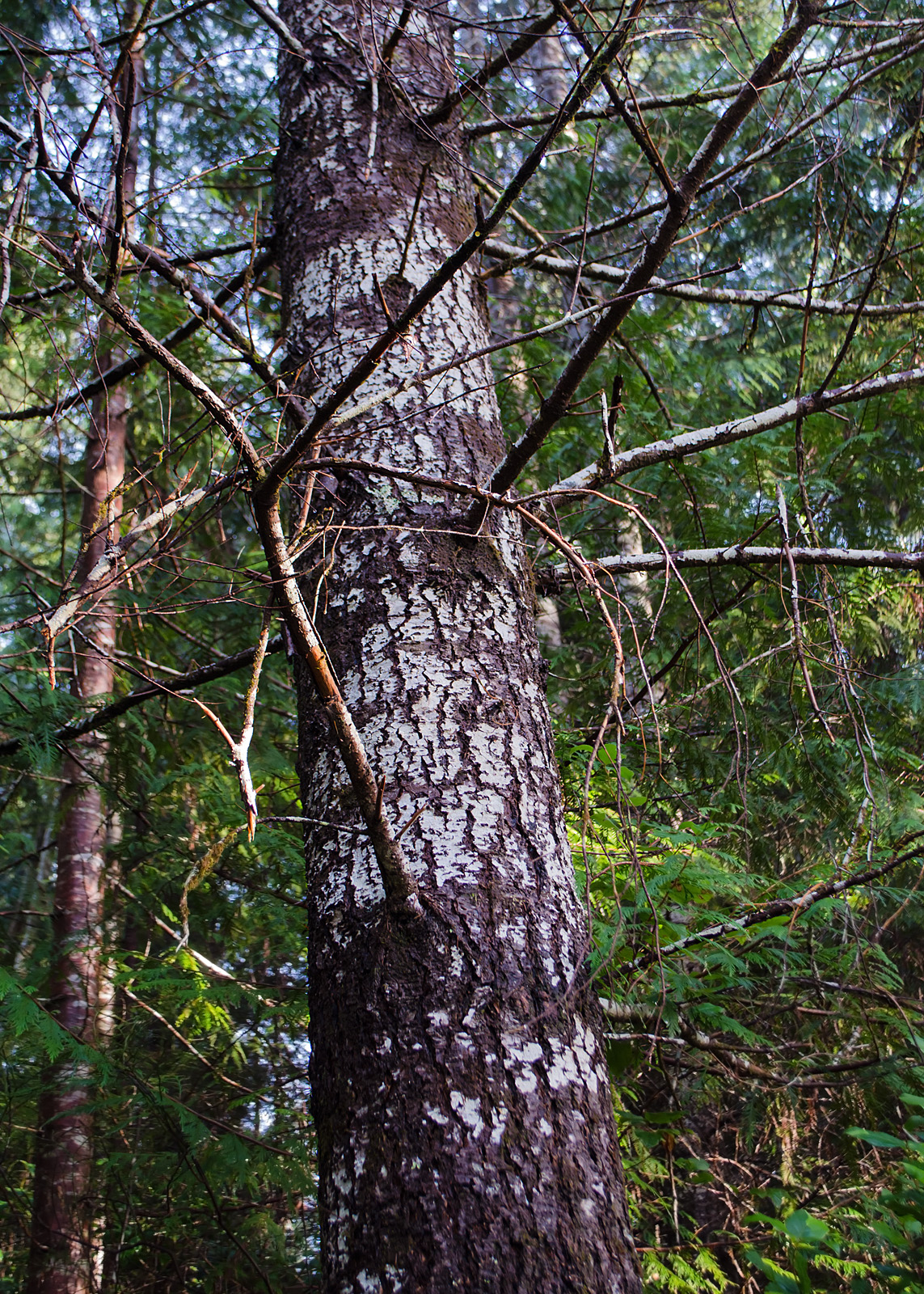
Legend: The damage on the Douglas-fir beside you is called sunscald. When such a thin-barked young tree is suddenly exposed to intense direct solar radiation, the high temperature can kill live tissue (cambium) below the bark. In this instance, juvenile spacing ... created openings that allowed sunshine into the previously shaded young forest.
... Trees that have grown up exposed to direct sun have usually developed a thicker, insulating bark.

White patches on trunk.

This is the tree that was beside the sign. Whether it is the one the sign referred to, or that one has long turned into duff, I can't tell.

Mushrooms on fallen tree.

These mushrooms were soft, jelly-like, from white to tan to pinkish. The leaves on the ground around them are red alder.

Something else I didn't know, tomorrow.

Tuesday, January 15, 2019

Your pick of trails

Hoomak Lake is half-way up the north end of Vancouver Island. There's a rest area beside the highway there, with picnic tables and maps and clean rest rooms. It's a good place to take a break, on a long, mostly empty highway. From the parking lot, the lake is just visible through the trees. I had found a sort of trail, steep and sllppery, down from there to the lake side on previous stops.

This time, I noticed a trailhead sign half hidden behind the restrooms. With stairs down to the lake. Nice! I went on down.

View of Hoomak Lake from the steps.

And from the landing.

From there a trail, wide and well travelled, leads off towards the upper end of the lake. I can't resist a good trail.

Looking back from above the trail.

In the year 2000 (I discovered from a sign up top later on) the trail had been improved with interpretive signs. They're old now, some badly spotted and smudged, but still legible, although some now point to trees or stumps ("just in front of you," they say) that are no longer here.

"Old Railroad Grade"

Legend: Old Railroad Grade.
You are now standing on an old railroad grade that was used for log hauling for about 22 years. Originally constructed here in 1955, this branch line ran from Woss Camp to Croman Reload, about 5 km west of here.
Croman Reload was one of several locations in the Nimpkish Valley where loads of logs were transferred from truck to railcar. Croman Reload became inactive in 1980 and this connecting rail line was taken out.
At one time, steam locomotives chugged along the rails, pulling their log loads right where you are now standing. More recently, diesel-electric locomotives hauled logs here. Canadian Forest  Products. Ltd. still uses these today in the Nimpkish Valley.

After a short walk, made longer by stopping to read the signs (more on this later), I came upon a new sign, still white and clean.

Long trail, short trail, and just plain trail. Take your pick.

I took the short trail. There was no way of knowing how long that long trail would be.

The short trail turned and went back up the bank, turned again to return to the parking lot. After a bit, I found another sign:

Long trail, short trail again. I took the short one.

Up top, I found a map of these trails.

So the long trail is fairly short, too. Next time, I'll take that one.

One more sign, for those who see water and think "Fish!":

Good Fishing

Legend: If you look across Hoomak Lake from here, the distance is about 700 m to the other shore. Hoomak's length is about 1800 m. Hoomak Lake offers good fishing and canoeing opportunities. It was stocked with10,000 cutthroat trout between 1984 and 1991 to supplement its natural trout population.
Look for a variety of birds on the lake, including ducks and Trumpeter Swans (in the late fall and winter months). Along the shoreline, watch for birds such as sparrows, juncos, wrens and warblers, plus woodpeckers in the older trees.

What I learned from the rest of the signs, next.

Powered By Blogger