Showing posts with label leaf lichen. Show all posts

Monday, March 04, 2024

Mostly green

I've been unable to post for over a week. Now where was I? Oh, yes; looking at mushrooms and lichens. And some rocks.

These are the last of the small finds on that hillside of mossy rock, sorted by age; fresh and new, old, ancient. 

A very tiny mushroom, with moss, old Douglas-fir needles, and a bit of ice.

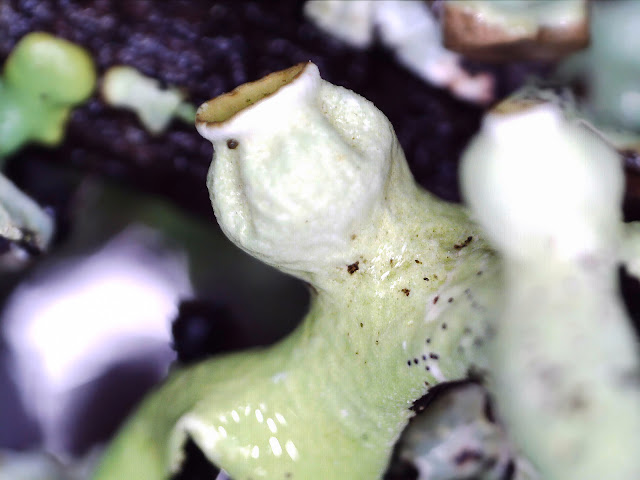
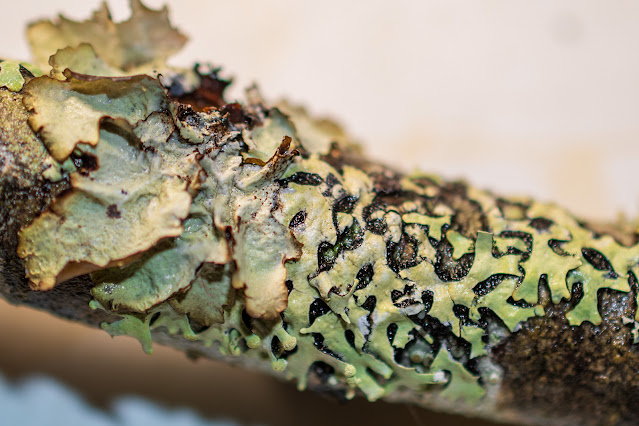
Leaf lichen and dry twig, both bleached almost white.

Lichen, by the time we notice it, is always old, having grown so slowly, a few millimetres a year.

Ancient, coming to us from the time of bouncing mountains: green veins in the rock, squeezed out like when I fix a broken pot and put on too much of the glue.

Pale pistachio green rock ooze. They tell me it's epidote.

Another vein, and some sprinkles.

And tomorrow, if all goes well, I can move on to the Deer Falls side hills.

~~~~~~~~~~~~~~~

Hace más de una semana que no he podido hacer un post. Y ahora, ¿dónde estaba? Ah, sí; mirando hongos y líquenes. Y unas rocas.

Estas son las últimas de las fotos que saqué en esas rocas envueltas en musgo. Las he organizado según la edad; algo fresco, algo viejo, y lo viejísimo.

  1. Un hongo muy pequeño, con musgos, hojas de abeto de Douglas, y cristales de hielo.
  2. Una rama rota, muy seca, con sus líquenes foliosos, todo blanqueado hasta volverse casi blanco. Los líquenes, crecidos hasta llamarnos la atención, siempre son viejos, ya que crecen tan despacio, al son de uno milímetros por año.
  3. Y viejísimo, ya que nos llega desde la juventud de las montañas; venas de roca verde, exprimida de entre la piedra mayor mientras se enfriaba.
  4. Otra vena, y gotitas.
Siguiente: otro cerro, éste cerca de las cataratas Deer.

Saturday, February 26, 2022

Empty-nesters

Lichens and mushrooms in the duff at Roberts Lake: the sun was shining, and in the open, the snow has melted although there are still heaps on the shady side of the road. I explored the ground under a stand of Douglas firs.

Bird's nest fungus, moss and Douglas fir needles.

It hasn't rained for a while, but melting snow dropping from the tree above has splashed the peridioles out of the cup; one of them is still in the open, on top of a dried fir needle.

Four bird's nest fungi.

Brown mushrooms, much beaten about by the weather. The cones are Douglas fir and hemlock.

A wide-leafed lichen. The underside is brown, shading to black.

~~~~~~~~~~~~~~~~~~~~~~~

Di una vuelta por el lago Roberts. Hacía sol, y en campo abierto, se ha derretido la nieve, aunque en la sombra todavía sigue amontonada. Alrededor de un grupo de abetos de Douglas, entre las agujas y los conos caídos, encontré hongos y líquenes.

Fotos:

  1. Un hongo "nido de pájaro". Aunque no ha llovido recientemente, gotas de la nieve al derretirse, cayendo desde el árbol han botado los sacos de esporas, los peridiolos, dejando el nido vacío. Se ve todavía uno de los periodolos encima de una agujita de abeto.
  2. Cuatro "nidos".
  3. Dos hongos algo maltratados por la nieve. Los conos son de abeto de Douglas y de pinos "hemlock".
  4. Un liquen folioso. La superficie inferior va de un color café hasta casi negro.

Friday, January 28, 2022

Drinking larva

I thought I had examined them thoroughly. The lichens on twigs that I made into an arrangement in a vase. Nothing there but wood and lichen, or so I thought.

Looking at them again yesterday, I saw movement. Something running, something fast and curvy. I took many photos of the place where it had just been.

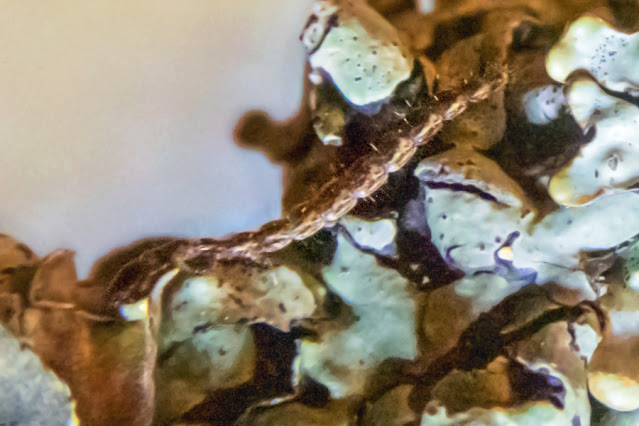
Caught it! Blurry, but it's there. Long, prickly beastie.

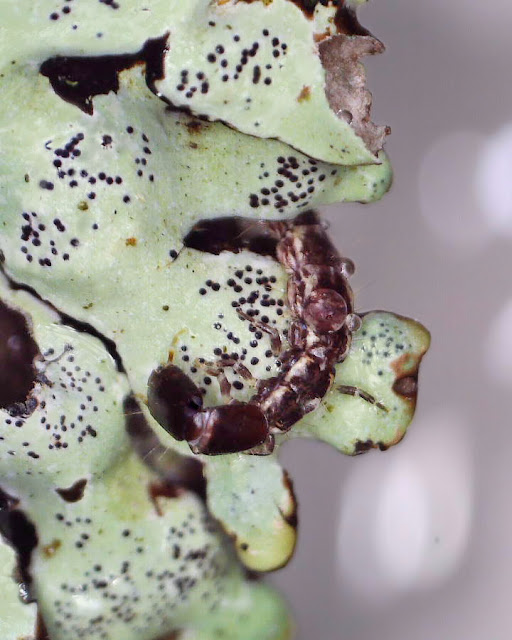
I gave up and went back to the planned operation; I sprayed the lichen down with de-chlorinated water. And the little runner stopped to take a drink. I even managed to get him under the microscope before he ran away again.

Square head, short antennae, 6 legs on the first segments. The round ball is a droplet of water.

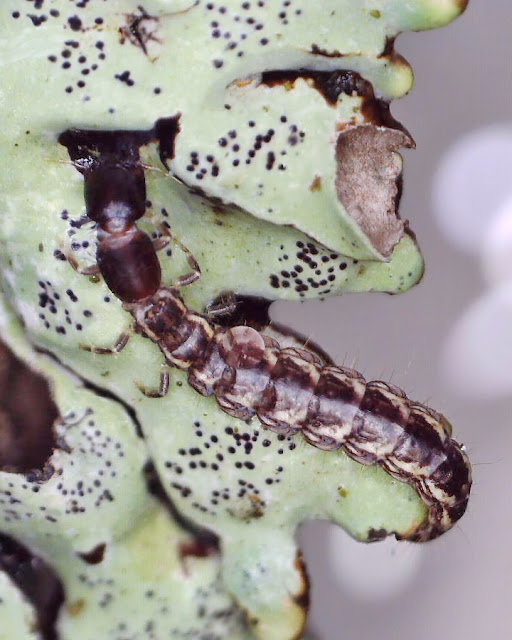
Nicely patterned tail segments, dragged along; no legs here.

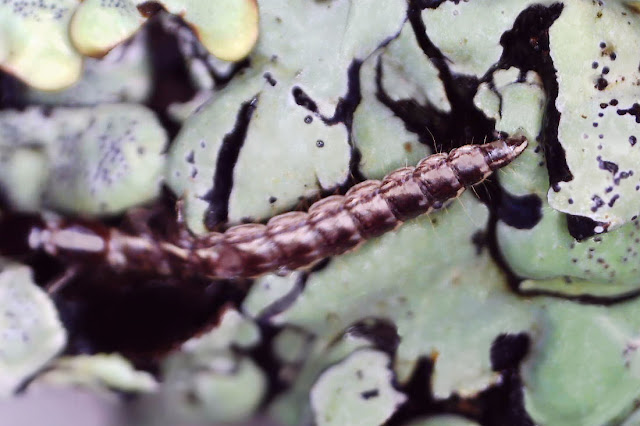
And, drink finished, he's off and running again. I count 12 body segments, besides the head.

I looked at a zillion larvae on BugGuide, and I think he's probably a rove beetle youngster. I've sent photos in to BugGuide; they will know.

UPDATE: BugGuide has moved the photos to Snakefly larvae.

~~~~~~~~~~~~~~~~~~~~~~
Creí que los había examinado bien; los líquenes en las ramitas de abeto de Douglas que había arreglado en un vaso. No había nada más que la madera y las hojas de liquen, pensaba.

Examinándolos otra vez ayer, vi algo que se movía. Algo que corría, algo con curvas sinuosas, y que tenía mucha prisa. Saqué muchas fotos del lugar donde había estado un instante previo.

Primera foto: por fin lo capturé. Una foto borrosa, pero ahí está. Largo y con espinas.

Me di por vencida y regresé al plan anterior, de ver como respondía el liquen al agua. Rocié la ramita con agua declorada. Y el bichito correlón se detuvo para beber. Hasta tuve tiempo de colocarlo bajo el microscopio antes de que se pusiera a correr otra vez.

Segunda foto: La cabeza es grande y algo cuadrada; tiene 6 patas en los primeros segmentos. La bola redonda es una gota de agua.

Tercera foto: diseño de los segmentos de la cola. Pesada y larga, pero sin patas; la arrastra tras si.

Cuarta foto: ya terminó de beber, y empieza otra vez a correr. Cuento 12 segmentos del cuerpo, la cabeza aparte.

Miré gran número de fotos en BugGuide, y creo que este probablemente sea la larva de un estafilínido. Les envié unas fotos a los expertos en BugGuide; ellos podrán identificarla con más certeza.

Y ahora, BugGuide ha puesto las fotos en la categoría de los rafidiópteros.

Waking up the lichens

I've been looking at lichens again. I had put some of the licheny twigs that I collected two weeks ago in a vase and I've been spraying them every two days to keep them growing.

Today, I spread them out and looked at them to see how they are coping with an indoor, heated environment. They were bone-hard and dry; it's been three days since they were watered, and the heat is on. When I sprayed each section, it would immediately start moving. Leafy lichens unrolled, spread out, sometimes jerkily. The thin, thready lichens stretched, as if they were waking from a long sleep.

Usnea sp., stretching out. Lichens of this genus have an elastic central cord; pull them and they stretch.

These ones, three days dry, were hard. Wet, they were soft and floppy.

Reindeer lichen in moss. I had left this one outside in my garden; it's wet and cold. And very happy.

And I found another beastie, where I least expected it. Photos tomorrow.

~~~~~~~~~~~~~~~

Otra vez he estado mirando los líquenes. Puse algunas de las ramitas con liquen que junté hace dos semanas en un vaso, y las he estado regando cada dos dias para mantenerlos líquenes en buen estado.

Hoy, las saqué para mirar los líquenes más de cerca, para ver como andan en un ambiente interior, con calefacción. Estaban duros como huesos, y secos; ya hacía tres dias que no las había regado. Cuando mojé cada sección, empezaba a moverse de inmediato. Los líquenes foliosos se desenrollaban, se extendían, a veces en saltitos. Los líquenes en arbusto, delgados, se estiraban como si se despertaran de un largo sueño.

Fotos:

  1. Un liquen del género Usnea, estirándose. Los líquenes Usnea tienen un cordón central elástico; si le das un jalón, rebota.
  2. Estos, los líquenes foliosos, estaban duros hasta que los mojé; entonces se volvieron suaves y flojos.
  3. Liquen de los renos, Cladina sp. en musgo. Estos los había dejado afuera en mi jardín; estaban empapados y frios. Y muy contentos, parece.
Y encontré otro animalito, donde menos lo esperaba. Mañana subo las fotos.

Sunday, January 23, 2022

Underfoot, up a tree, on a log

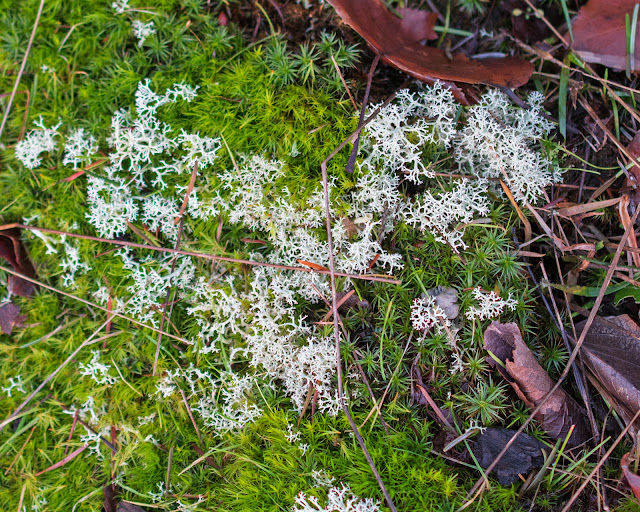
In the open areas of the Oyster Bay little forest, reindeer lichen is sprinkled over logs and moss, never in huge mounds like I see in other places; just a few inches deep, in handfuls or even individual "shrubs".

Reindeer lichen, Cladina portentosa?, and moss.

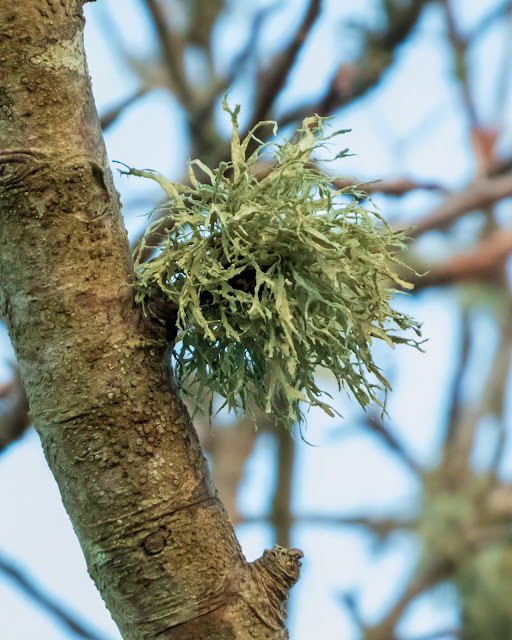
I walked to the dike overlooking the bay and down to the old apple tree. At this time of year, it is decorated with handfuls of hanging leaf lichen and buttons on the trunk and larger branches.

Antlered perfume lichen, maybe. Evernia sp., anyhow. And bark barnacles.

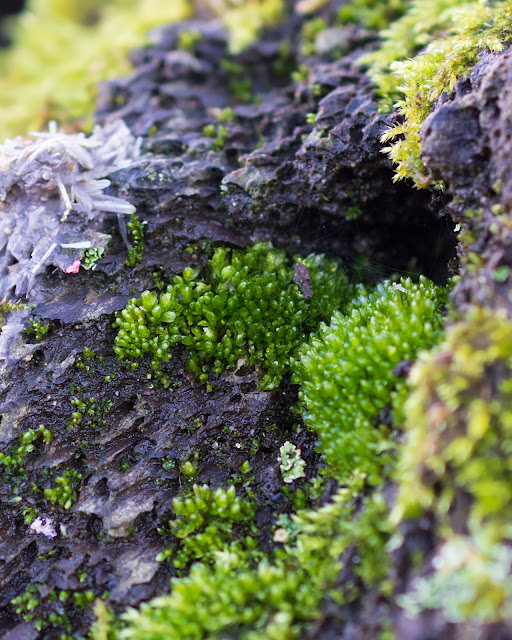
On the old landmark log, I found mosses. And something else.

Tiny, jewel-like moss, a yellow-green moss, spider webs (I couldn't find the spider) and the start of a leaf lichen. And what are those white sticks on the upper left? They almost look like ice crystals. Could be.

Sunset will be at 5:00 this afternoon! A milestone!

~~~~~~~~~~~~~~~~~~~~~~~~~~~

En las areas más abiertas del bosquecito de Oyster Bay, el liquen de los renos, Cladina sp., crece salpicado sobre los troncones y el musgo. Nunca, aquí, forma grandes cojines como los que veo en otros sitios; aquí apenas llega a unos cuantos centímetros de altura, en pequeños grupos o aun solitarios.

Primera foto: este liquen sobre musgos.

Fui hasta el dique que bordea la laguna y hasta el viejo manzano. En esta época del año está adornado solamente con líquenes foliosas y botoncitos en la corteza del tronco y las ramas mayores.

Segunda foto: una rama del manzano con sus botoncitos (a los que llamamos bálanos de corteza) y el liquen folioso, Evernia sp.

En el viejo troncón encontré musgos. Y algo más.

Tercera foto: musgos que parecen joyas miniaturas, además, un musto verde/amarillo, telarañas (pero no pude encontrar la araña) y un liquen folioso recién brotado. ¿Y esos palos blancos en la esquina superior a la izquierda? Casi parecen cristales de hielo. Podría ser.

¡Y el sol se pondrá esta tarde a las 5! ¡Feliz!


Sunday, January 16, 2022

Lichens, writ large

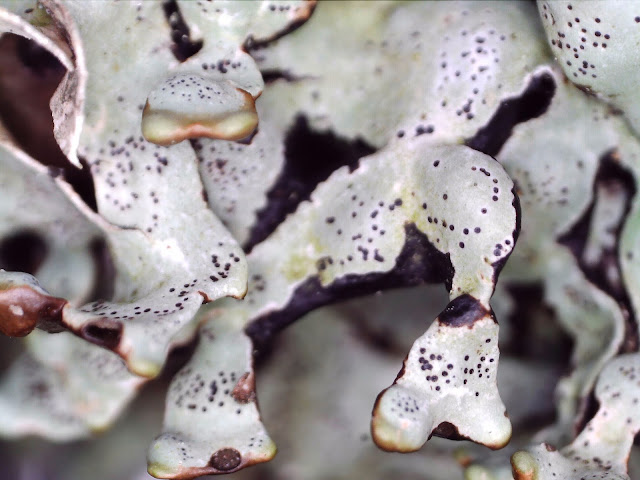
I give up. The more I try to identify these lichens, the more muddled I get. So here are three photos from the microscope, unidentified.

A leaf lichen on a Douglas fir twig. The round purplish dots are reproductive structures.

There are three main types of reproductive structures; one, pieces that break of the parent form new lichen clones, second, reproductive structures that are basically fragments containing both the algal or cyanobacterial and the fungal components of the lichen, and third, spore production. In this case, only the fungal spores are disseminated, and to produce a new lichen, they have to meet up, by chance, with the appropriate alga.

The asexual reproductive structures are:
Soredia (singular: "soredium") are small groups of algal cells surrounded by fungal filaments that form in structures called soralia, from which the soredia can be dispersed by wind. Isidia (singular: "isidium") are branched, spiny, elongated, outgrowths from the thallus that break off for mechanical dispersal. (From Wikipedia)

And the sexual structures:
Apothecia are usually cups or plate-like discs located on the top surface of the lichen thallus. When apothecia are shaped like squiggly line segments instead of like discs, they are called lirellae. Perithecia are shaped like flasks that are immersed in the lichen thallus tissue, which has a small hole for the spores to escape the flask, and appear like black dots on the lichen surface.(Wikipedia)
And in each lichen, the shapes and colours are different. Do you see why I'm confused?

On that same lichen, there are these little barrel-shaped things.

On yesterday's alder branch: little buttons, with no leaf structures.

Tomorrow, if it doesn't rain too much, I'll go looking for Cladonia lichens to pop under the microscope.

~~~~~~~~~~~~~~~~~~~~~

Me rindo. Por más que trato de identificar estos líquenes, más me deja sin entender. Así que aquí hay tres fotos de líquenes bajo el microscopio, sin identificación.


Primera foto: un liquen folioso sobre una ramita de abeto de Douglas. Los puntitos morados son estructuras reproductivas.

Un liquen se reproduce en varias maneras, principalmente de tres tipos. La reproducción vegetativa se lleva a cabo cuando fragmentos rotos del liquen se establecen en otro sitio, y forman una unidad nueva; esta es un clon del original.

La reproducción asexual ocurre por medio de estructuras que contienen tanto células del hongo como del alga o cianobacteria que componen el liquen.

Y en la reproducción sexual, el hongo produce esporas, a estos se las lleva el viento. Para formar un nuevo líquen tienen que encontrar, por azar, un alga del tipo compatible.

Las estructuras reproductivas asexuales son:
... estructuras especializadas llamadas soredios (que a su vez están agrupados en soralios) e isidios. Un soredio es una agrupación de hifas del hongo rodeando a unos pocos elementos algares que se desprende de la superficie del talo liquénico para ser diseminado bien por el viento, bien por salpicaduras de lluvia ...​ Los isidios ... son porciones de talo que se desarrollan en la superficie conservando la estructura en capas y córtex y que pueden desprenderse con facilidad. (de Wikipedia)

Y las sexuales:
Las esporas sexuales formadas en ascomicotas se encuentran característicamente en peritecios y apotecios; ... las estructuras producidas en el himenio se diseminan en busca en un nuevo fotobionte .... La estructura reproductora asexual más común es el picnidio, receptáculo abierto o cerrado con forma de copa o de esfera que contiene en su interior gran cantidad de conidióforos productores de conidios. (Wikipedia)
Y en cada líquen, las formas y colores son distintos. ¿Ves porqué estoy perpleja?

Segunda foto: en la misma liquen foliosa, existen estos barrilitos.

Tercera foto: estos botoncitos estaban en la rama del aliso.

Para mañana, si no llueve demasiado, iré en busca de unos líquenes Cladonia para mirar bajo mi microscopio.


Friday, January 14, 2022

Leaf lichen on an alder twig

 I'm getting down to the lichen, finally. These were growing on twigs from a fallen alder.

Foliose, or leafy lichen


Some large, semi-attached leaves, others small and lying flat on the surface

Further down on the same twig

The lichen is bright green, greener when it was wet, and a dark brown on the underside of each thallus (leaf). Some were thick, seeming inflated; others, both attached and loose, are thin.

I don't know if this is one species of lichen in different stages, or two lichens. I do know that these twigs did carry at least two species, one a tiny button lichen.

The more I try to sort these lichens out, the more confused I get. On "Ways of Enlichenment", I found some that more or less seem to match these, at least in some of the photos, except that they are not quite as green. (But how wet were they?) Hypogymnia sp.; see what you think.

Tomorrow; a few more from the microscope.

~~~~~~~~~~~~~~~~~~~~~~~~~

Por fin vuelvo a los líquenes. Estos son unos líquenes foliosos, que crecen en una ramita de un aliso caído.

Tres fotos de líquenes  en dos ramitas.

Este liquen es de un verde claro, sobre todo cuando está mojado, y en la parte de abajo de cada talo (u hoja). Algunos eran gruesos, hasta parecen inflados; otros, tanto fijos como sueltos, son casi planos.

No sé si esto representa una especie en diferentes etapas, o si son dos especies distintas. Sí sé que en estas ramitas habían por lo menos dos especies de liquen; una era de un liquen muy pequeño en forma de botoncitos.

Entre más trato de identificar estos líquenes, más me quedo sin entender. En el sitio, "Ways of Enlichenment", encontré algunos que más o menos se parecen a éstos, sino que no son tan verdes. (¿Pero si no estaban tan mojados?) Son especies del género Hypogymnia; ¿Qué piensas?

Para mañana, tengo algunas fotos más del microscopio.


Springtails, not springing

The weather was better today and I was able to collect a few leaf and Usnea lichens on Douglas fir twigs. I've been wanting to get a closer look at the lichens, to try to get a better understanding of their varied structures, looking at them under my little microscope.

I am easily side-tracked. The leaf lichens were crawling with tiny beasties; flies, worms, baby sowbugs, and several species of springtails. Most were too busy for my slow focusing with the microscope, but a few globular springtails were sleepy.

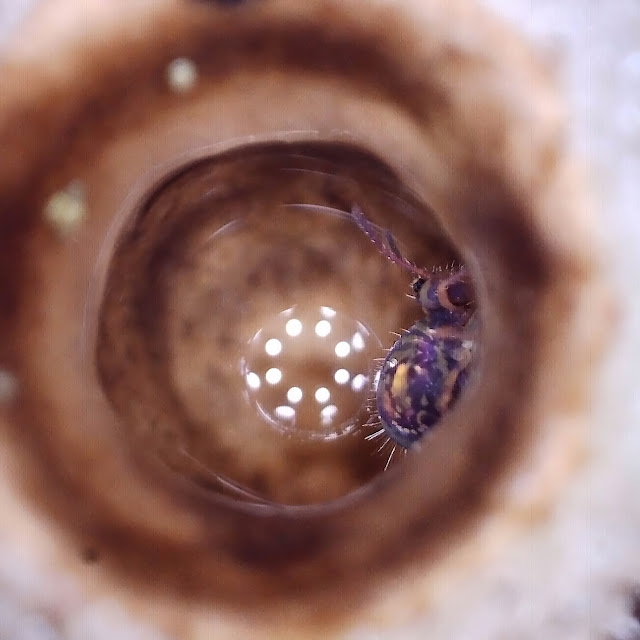
The globulars are the cutest of all the six-legged critters. This first one was hiding in the bottom of a birds' nest fungus.

Collembola, Dicyrtoma sp. The circle of lights are from the microscope.

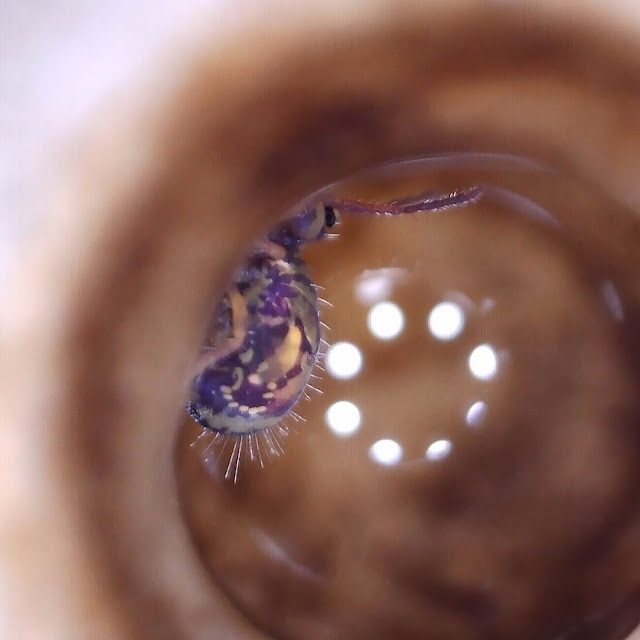
Getting a bit closer in.

Full side view. He's carrying a drop of water in his mouthparts. He dropped it soon after.

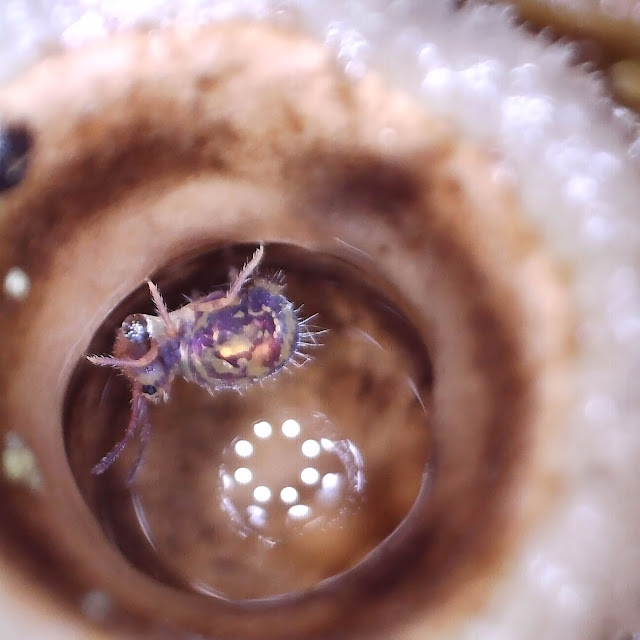
Two more, on a wet piece of bark.
And one walking over one of the worms. The worm is about 1 cm. long.

Watching the springtails live, I could see that the pattern on their abdomens constantly shifted back and forth, as if a small light was moving inside. Heartbeat or breathing or digestion?

The springtails are about 2 mm long. But they are giants compared to this other critter I found:

Very tiny. Maybe as long as a springtail's leg. By the mouthparts in front, it could be some variety of mite. Or not.

When I was done, I took them all out to the rainy garden.

~~~~~~~~~~~~~~~~~~~~~~~~

Hoy no llovió, y pude encontrar unas ramitas caídas de abeto de Douglas con sus líquenes; líquenes foliosas y del género Usnea. He estado buscando líquenes para mirarlos bajo el microscopio para lograr tal vez un mejor conocimiento de sus variadas estructuras.

Me distraigo facilmente. Estos líquenes estaban poblados de una gran variedad de criaturas, desde moscas miniaturas, gusanitos, cochinillas infantiles, y colémbolos de varias especies. La mayor parte estaban demasiado ocupadas en correr de aquí para allá para que yo, enfocando tan lentamente el microscopio, les capturara. Pero algunos de los colémbolos, los simfipleones, a los que llamamos "globosos", se estaban en paz.

Estos colémbolos globosos, a mi parecer, son los más adorables de todos los criaturas de seis patas. El primero que encontré se escondía en el fondo de un hongo "nido de pájaro".

3 fotos. Un colémbolo Dycirtoma. El círculo de luces es del microscopio. En la tercera foto, lleva en la boca una gota de agua, que luego abandonó.

Cuarta foto: otros dos colémbolos.

Quinta: y con un gusanito, que mide aproximadamente 1 cm. de largo.

Mirando los colémbolos en vivo, pude ver que los colores de su abdomen están en movimiento continuo, como si tuvieran adentro una pequeña luz. ¿Será su corazón que late, o su respiración, digestión?

Estos colémbolos miden más o menos 2 mm. de largo. Pero son gigantes al lado de esta otra criatura que vive en el liquen.

Sexta foto: ¡Tan pequeñito! Tal vez el tamaño de una pata de colémbolo. Viendo las estructuras alrededor de la boca, podría ser una variedad de ácaro. Quizás.

Cuando terminé, los llevé a todos afuera al jardín y la lluvia.


Sunday, December 19, 2021

Iced lichen

The day was clear and cold down here by the seashore, but up the hills a way, the snow was knee-deep, and frozen so hard on top I could even stand on it for a few seconds before I broke the crust. Under this crust, the snow was dry and fluffy, and didn't feel cold.

I walked to the first bridge on the Elk Falls trail, looking at mysterious mounds of snow and dark, bare trunks. And frozen lichens.

A leaf lichen on a fallen twig. Across the old wood pipe ditch, the sun is shining.

Reindeer lichen, moss, and Cladonia on a tree trunk.

Tiny mushrooms on the end of an old log. Fir needle for scale.

I wonder; are the cream and purple fungi above the same species as the brown and cream shelves below? The shape is slightly different, too. An earlier stage, perhaps?

UPDATE: The mushrooms have been identified (on Field Naturalists of Vancouver Island) as Stereum sanguinolentum and Trichaptum abietinum.


~~~~~~~~~~~~~~~~~~~~~~

Salió el sol y el cielo lucía un azul claro. Hacía frio aquí abajo cerca del mar, pero apenas había unos centímetros de nieve en el suelo. Subiendo hacia los cerros, ya era otra cosa; la nieve me llegaba casi hasta los rodillos, y estaba tan congelada que me podía mantener en pie encima por un momento antes de que se rompiera la capa de hielo. Abajo de esta, la nieve estaba seca y suave; no se sentía el frio.

Caminé en el sendero de Elk Falls hasta la primera puente, mirando montoncitos misteriosos cubiertos de nieve y troncos oscuros, casi negros en la sombra del bosque. Y líquenes y hongos congelados.

Fotos: 
  1. Un liquen folioso en una ramita caída. En la distancia al otro lado de una zanja, brilla el sol.
  2. Un liquen de los renos, otras Cladonias, y musgo en el tronco de un árbol.
  3. Honguitos pequeños en el extremo de un troncón, con una aguja de pino para dar el tamaño.
No sé si los hongos color crema y morado son del la misma especie, solo en otra etapa, que las de abajo, en crema y café. La forma es parecida pero no idéntica.

ACTUALIZANDO:  Los honguitos son Stereum sanguinolentum y Trichaptum abietum.


Saturday, January 16, 2021

Floury buttons

Last month I brought home a piece of bark with a good growth of leafy lichen and left it on a table outside my door. Yesterday I brought it in to look at it in detail.

Hyphenated ribbon, Ramalina farinacea

It's hard to really see these lichens; each lobe branches and twists and entwines itself among the others. The eyes rebel. But this time, I noticed the round buttons; what are they?

Soralia, bearers of soredia, the lichen's reproductive structures.

Soredia are powdery propagules composed of fungal hyphae wrapped around cyanobacteria or green algae. These can be either scattered diffusely across the surface of the lichen's thallus, or produced in localized structures called soralia. (Wikipedia)

There are two look-alike common species of leafy lichens in this area; the Antlered Perfume, and this, the Hyphenated Ribbon. I had assumed that this lichen was the Perfume, but then I went looking for photos with those flat plates. Hundreds of photos later, I found them on the Ribbon. (Hyphenated: I like that name!) iNaturalist calls them Farinose Cartilage Lichen. They do have a tough, cartilagey texture.

I got out the microscope:

Two soralia on a lobe.

The Latin name, farinacea, means "floury", referring to the texture of the top of these structures.

Another one. The white blobs are also reproductive structures.

One more. It stands up like a cake plate from the green thallus.

~~~~~~~~~~~~~~~~~~~~~~~
Hace más o menos un mes, me traje a casa un pedazo de corteza caída, donde crecía unas ramas de liquen folioso. Lo dejé en una mesa afuera de mi puerta.

Ayer, lo recogí para examinarlo con cuidado. Es difícil ver claramente estos líquenes; los lóbulos se dividen, se tuercen, se enredan con los otros. Mis pobres ojos se rebelan. Pero esta vez vi esos botones blancos; ¿Qué serán?

Talo fruticuloso de color gris verdoso formado por lacinias colgantes estrechas, acintadas y provistas de numerosos soralios ovales en los márgenes, que nacen todas de un único punto de fijación al sustrato. (Descripción por Miguel Varona, "Cuaderno")
Son soralios, estructuras reproductivas, donde se producen los soredios, la materia reproductiva, que consiste en hifas (algo así como raices) del hongo envolviendo una cianobacteria o un alga verde.

Hay dos especies de líquenes por este rumbo, casi idénticas; La Evernia prunastri, (aquí la llamamos la cornamenta perfumada), y la Ramalina farinacea, a la que le llamamos el listón con guiones. Creía que este liquen era la perfumada, pero después de mirar fotos, cientos de fotos, buscando estas estructuras, las encontré en el listón. En el sitio de iNaturalist, le nombran este liquen como el liquen de cartílago harinoso. Sí, tienen una textura algo tiesa, medio dura, como el cartílago, y la superfice de los soralios parece estar cubierta de harina. (De ahi viene el nombre científico, farinacea.)

Las examiné bajo el microscopio. Aquí se ven estas estructuras, algo levantados de la hoja en un pedestal, con el soralio encima. Hasta parece un postre en su soporte de pastel, ¿no?


Saturday, January 05, 2019

Who needs leaves in winter?

... when there's leaf lichen?

Licheny tree, Ridge Trail.

A branch within reach. Lungwort, Lobaria pulmonaria.

The lobes supposedly look like lung tissue. Basing their reasoning on sympathetic magic (if it looks like something else, it must be good for that thing), European physicians used this to treat lung ailments. Here on the Canadian west coast, the Sechelt First Nations people used it for the same purpose, but for different reasons.* Maybe it actually worked?

*See Plants of Coastal British Columbia
Powered By Blogger