Showing posts with label bird's nest fungi. Show all posts

Friday, January 17, 2025

Chocolate candies in custard cups?

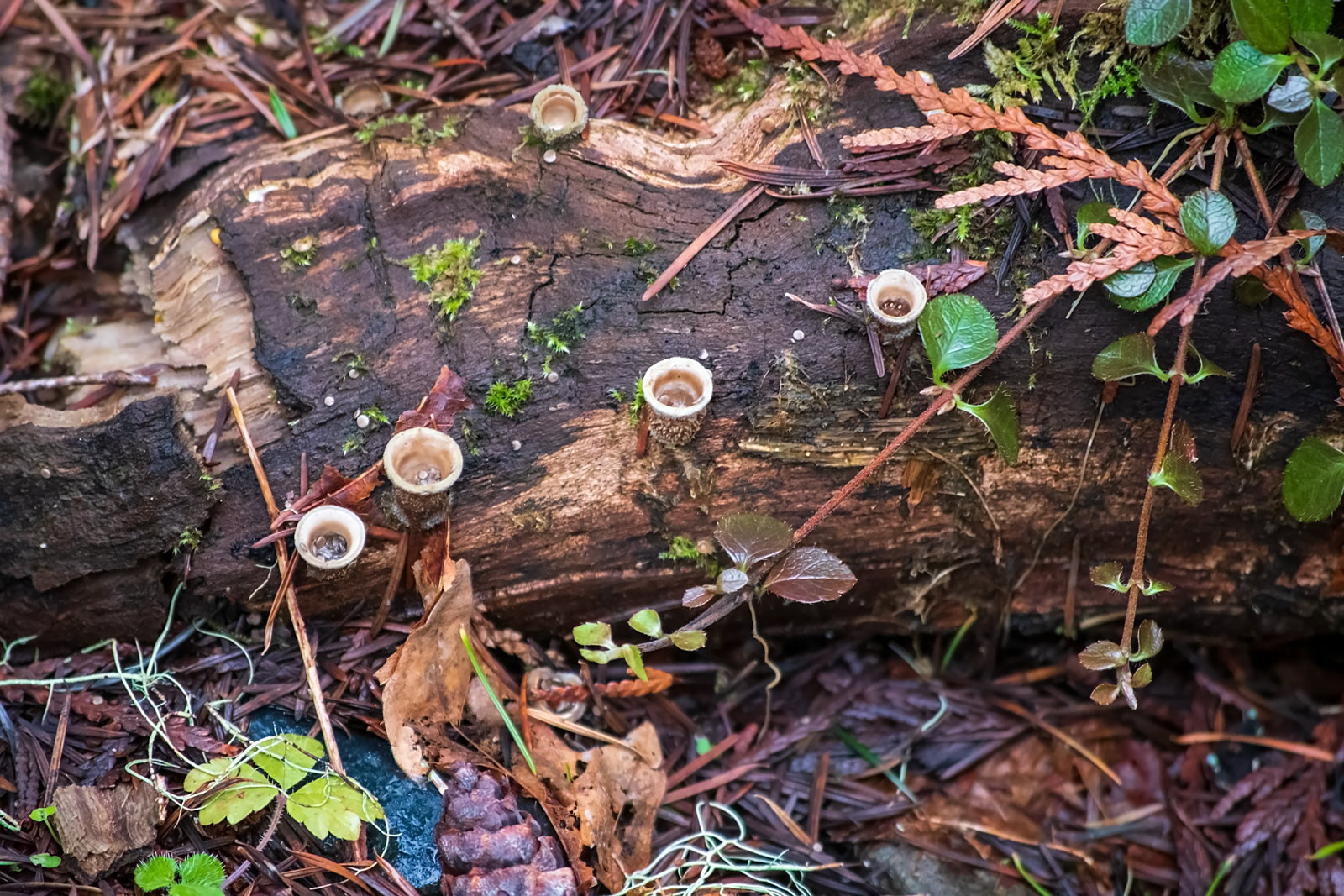
Among all the "normal" logs lying on the dunes and the shoreline, one has been colonized by hundreds of tiny bird's nest fungi.

Section of the log. I count 49 nests. Maybe I should have written, "thousands of bird's nest fungi". It's a long log.

The spore cases (peridioles) look more like candies than like eggs. Chocolate candies in pretty little custard cups.

A couple of nests with a couple of escaped spore cases. The rain will wash them away to reproduce in a new site.

Another, almost empty now, with two older nests, disintegrating.

This family of fungi goes by the tongue-twisting name of Nidulariaceae, from the Latin "nidulus", a nest.
The color of the peridioles is characteristic of the genera: Cyathus has black peridioles, Nidularia and Nidula have brown peridioles, Mycocalia has yellow- to red-brown peridioles, and Crucibulum has black peridioles that are surrounded by a whitish membrane called the tunica, which makes them appear white. (Wikipedia)
I looked back through my photos; all but one of the bird's nest fungi I've found have had brown peridioles. The one exception had white peridioles; this was in 2016, on a log on Tyee Spit that I've searched every year since, looking for more, but never seeing any.

~~~~~~~~~~~~~
Entre todos los troncos "normales" que se encuentran a lo largo de la playa y cubriendo las dunas, uno ha sido invadido por cientos (mejor dicho, miles) de honguitos "nido de pájaro", 
  1. Una sección del tronco. Cuento 49 "niditos" en este sector.
  2. Los sacos llenos de esporas, llamados peridiolos, se parecen (creo) más a golosinas que a huevos. Chocolatitos en una tacita de flan. Aquí hay dos nidos, y con dos peridiolos que ya escaparon. Se los llevará la lluvia para que broten en un sitio nuevo.
  3. Otro nido entero, y dos que ya descargaron sus peridiolos.
Esta familia lleva el nombre de Nidulariaceae, derivado del Latín; "nidulus", nido.
El color de los peridiolos es característico de los géneros: Cyathus tiene peridiolos negros, Nidularia y Nidula tienen peridiolos marrones, Mycocalia tiene peridiolos de color amarillo a rojo marrón, y Crucibulum tiene peridiolos negros que están rodeados por una membrana blanquecina denominada túnica, que los hace parecer blancos. (Wikipedia)
Buscando entre todas mis fotos, veo que en todos los niditos que he visto, aparte de uno, los peridiolos han sido cafés (marrones). El único blanco lo encontré en 2016, en un tronco en Tyee Spit; este tronco lo he examinado cada año desde entonces, sin haber visto ni un solo hongo nido.


Saturday, February 24, 2024

Nidulariaceae (Because I love the word.)

Nests full of eggs. Eggs that look like dried beans. And some like little buttons. Nests a half-centimetre across. Eggs that will give rise to no birdies.

Bird's nest fungi, of course. And the "eggs" are spore cases.

Nest found near Echo Lake.

These are growing on a dry twig, very dead, broken from its dead tree as it came crashing down onto an exposed hillside, all mossy rock. The nest is white and hairy on the outside. (Hard to see; the sun was too bright for my pocket camera.) And the spore cases are clustered inside, brown and slightly kidney-shaped. 

Vocabulary: there are always so many words to learn! The nest itself is called a peridium (plural, peridia). And the "eggs" are peridioles. All these belong to the family Nidulariaceae (So many vowels!) from the Latin "nidula" which just means "little nest".
There can be as many as 30 million spores in a single peridiole (Hassett et al. 2015), so an individual bird's nest fungus fruiting body could have more than a billion spores! (AskIFAS, U. of Florida)
Good thing most of them don't find a home, or we'd be buried under mountains of tiny bird's nests!

These next ones are growing on a broken branch in shady woods.

Nest found near Elk Falls.

Here, the peridioles are plump round disks, off-white to brown. Quite a few have already left the nest; you can see them on the log. 

I think, going by the brownish outside of the nest, and the colour of the peridioles, that these may be Nidula candida, the common gel bird's nest; it grows on rotting wood or on soil. The first one above may be Nidula niveotomentosa, the white-barrel bird's nest, which grows among moss and bracken ferns.

~~~~~~~~~~~~~
Nidos llenos de huevos. Huevos que se parecen a frijoles. O a botoncitos. Nidos que miden un escaso medio centímetro. Huevos que no van a producir pajaritos.

Son los hongos "nido de pájaro". Y los "huevos" son saquitos de esporas.

Fotos:

1. Hongo nido cerca del lago Echo. Estos crecen en una rama seca, muerta, separada de su árbol muerto cuando éste cayó encima de una roca cubierta de musgos. El "nido" es blanco, y su exterior es peludo. (Algo difícil de ver en esta foto; el sol estaba demasiado fuerte para mi camarita de bolsillo.) Los sacos de esporas en el interior son color café, con una forma parecido a la de los frijoles secos.

Vocabulario: ¡Siempre hay tantas nuevas palabras! Los nidos se llaman "peridia" (sing. peridium). Y los "huevos" son peridiolos. Estos hongos pertenecen a la familia Nidulariaceae. (¡Tantos vocales!) La palabra viene del latín; nidula, o sea niditos.
Puede haber hasta 30 millones de esporas en un solo peridiolo (Hassett et al, 2015) por consiguiente un solo ejemplar del hongo nido de pájaro podría contener más de un millón de millones. (AskIFAS, U. de Florida)
Por suerte, la mayoría no encuentran sitio donde establecerse, o si no, estaríamos sepultados bajo montañas enteras de honguitos!

2. Estos están creciendo sobre una rama podrida en la sombra de un bosque denso. Aquí, los periodolios son disquitos gorditos y redondos, de color blanquisco hasta marrón. Muchos ya han saltado del "nido"; se ven esparcidos alrededor. 

Creo, debido al color café del exterior y el color de los periodolos, que estos son de la especie Nidula candida, que crece en madera podrida o en el suelo. El primero, creo que pertenece a la especie Nidula niveotomentosa; éste crece entre musgos y helechos.


Friday, January 14, 2022

Springtails, not springing

The weather was better today and I was able to collect a few leaf and Usnea lichens on Douglas fir twigs. I've been wanting to get a closer look at the lichens, to try to get a better understanding of their varied structures, looking at them under my little microscope.

I am easily side-tracked. The leaf lichens were crawling with tiny beasties; flies, worms, baby sowbugs, and several species of springtails. Most were too busy for my slow focusing with the microscope, but a few globular springtails were sleepy.

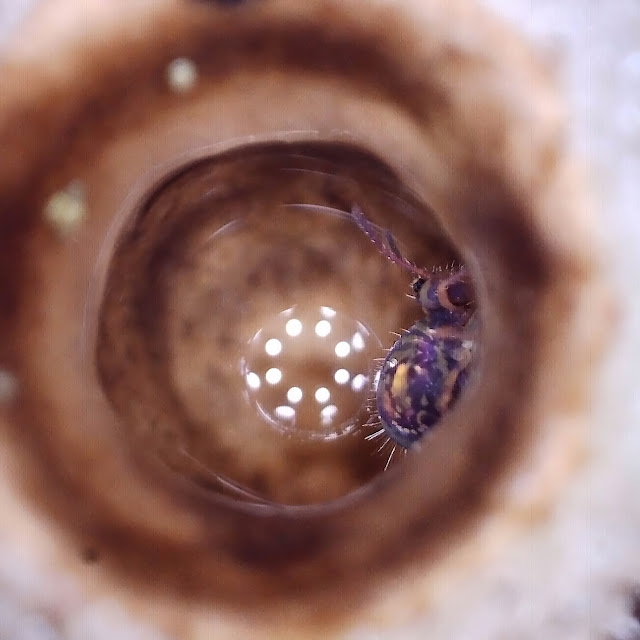
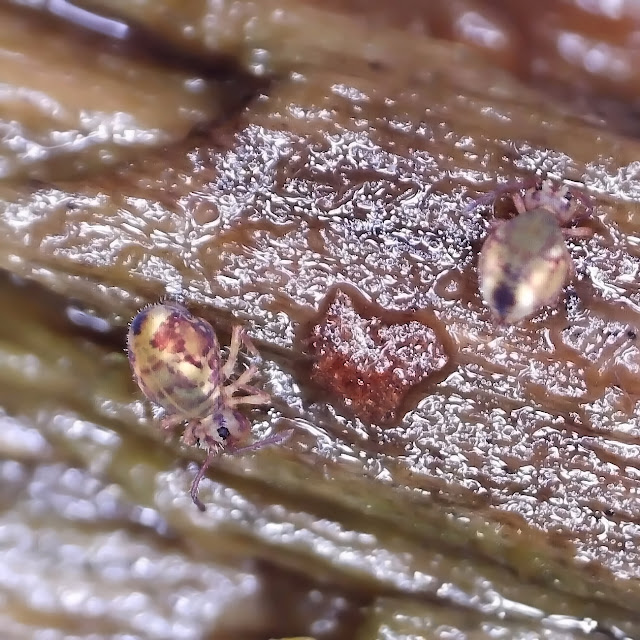
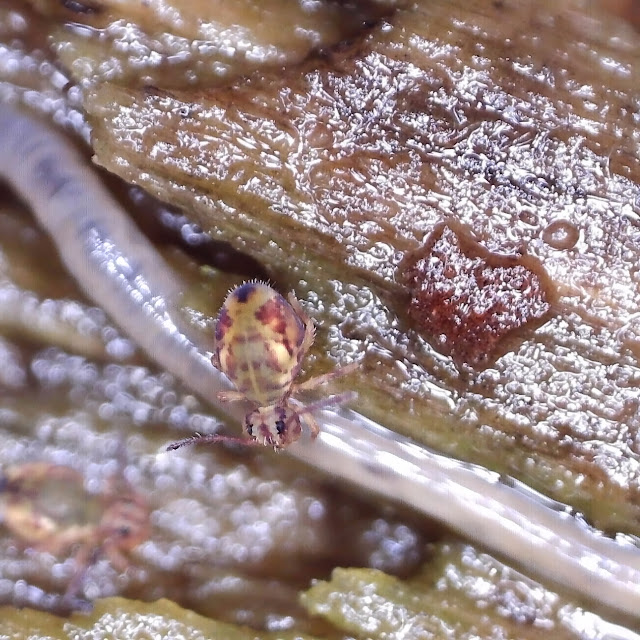
The globulars are the cutest of all the six-legged critters. This first one was hiding in the bottom of a birds' nest fungus.

Collembola, Dicyrtoma sp. The circle of lights are from the microscope.

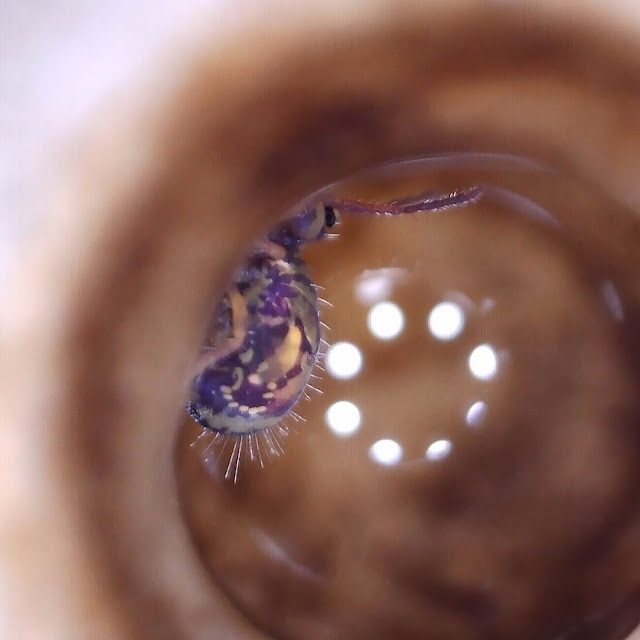
Getting a bit closer in.

Full side view. He's carrying a drop of water in his mouthparts. He dropped it soon after.

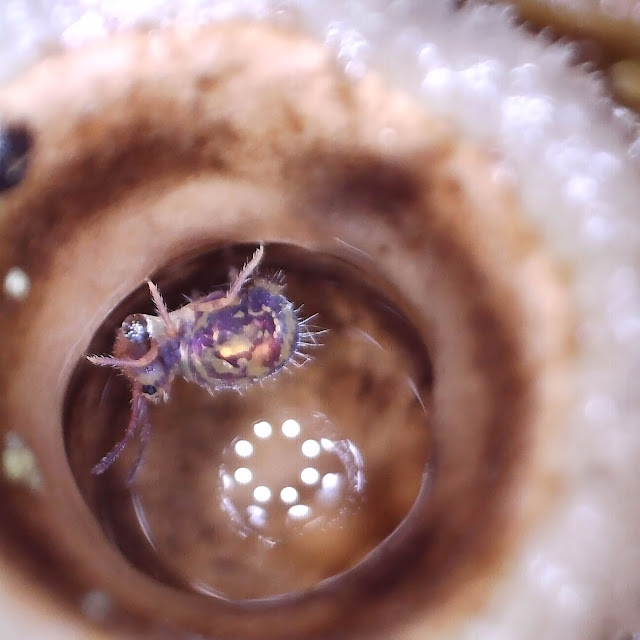
Two more, on a wet piece of bark.
And one walking over one of the worms. The worm is about 1 cm. long.

Watching the springtails live, I could see that the pattern on their abdomens constantly shifted back and forth, as if a small light was moving inside. Heartbeat or breathing or digestion?

The springtails are about 2 mm long. But they are giants compared to this other critter I found:

Very tiny. Maybe as long as a springtail's leg. By the mouthparts in front, it could be some variety of mite. Or not.

When I was done, I took them all out to the rainy garden.

~~~~~~~~~~~~~~~~~~~~~~~~

Hoy no llovió, y pude encontrar unas ramitas caídas de abeto de Douglas con sus líquenes; líquenes foliosas y del género Usnea. He estado buscando líquenes para mirarlos bajo el microscopio para lograr tal vez un mejor conocimiento de sus variadas estructuras.

Me distraigo facilmente. Estos líquenes estaban poblados de una gran variedad de criaturas, desde moscas miniaturas, gusanitos, cochinillas infantiles, y colémbolos de varias especies. La mayor parte estaban demasiado ocupadas en correr de aquí para allá para que yo, enfocando tan lentamente el microscopio, les capturara. Pero algunos de los colémbolos, los simfipleones, a los que llamamos "globosos", se estaban en paz.

Estos colémbolos globosos, a mi parecer, son los más adorables de todos los criaturas de seis patas. El primero que encontré se escondía en el fondo de un hongo "nido de pájaro".

3 fotos. Un colémbolo Dycirtoma. El círculo de luces es del microscopio. En la tercera foto, lleva en la boca una gota de agua, que luego abandonó.

Cuarta foto: otros dos colémbolos.

Quinta: y con un gusanito, que mide aproximadamente 1 cm. de largo.

Mirando los colémbolos en vivo, pude ver que los colores de su abdomen están en movimiento continuo, como si tuvieran adentro una pequeña luz. ¿Será su corazón que late, o su respiración, digestión?

Estos colémbolos miden más o menos 2 mm. de largo. Pero son gigantes al lado de esta otra criatura que vive en el liquen.

Sexta foto: ¡Tan pequeñito! Tal vez el tamaño de una pata de colémbolo. Viendo las estructuras alrededor de la boca, podría ser una variedad de ácaro. Quizás.

Cuando terminé, los llevé a todos afuera al jardín y la lluvia.


Saturday, April 17, 2021

Criss-cross arrangement

More bird's nest fungi. These were on a broken twig lying on the ground. I took the photos sitting on a log at the edge of the forest, then returned the twig to its original location.

Additional twig, needle, old grass as captured by the outside hair of the fungus.

The far end of the same twig.

~~~~~~~~~~~~~~~~~~~~~~~~

Hongos nido. Estos están creciendo en una ramita muerta que se encuentra en el suelo del bosque. (Se encuentra, tiempo presente, porque después de sacar las fotos, volví la ramita a su sitio original.)


Saturday, January 23, 2021

No bird built these bird's nests.

 They look like birds' nests. But most of the "eggs" have flown.

A cluster of bird's nest fungi on a branch beside the Eve River. Probably Nidula sp.

The "eggs" are spore cases. They lie in the bottom of the nest until a drop of rain dislodges them. Because of the shape of the cup, they can be shot out up to 2 metres from the source. There, they dry out and split apart, releasing the spores. 

Six of these nests are empty. It has been raining, and the spore cases (peridioles) are now settling in among the twigs in the duff around their tree. Two of the nests are still full.

I brought home a twig from Oyster Bay with a couple of bird's nest fungi, and turned the microscope on them.

The "eggs", tied up in string.

Some species have a sticky trailing thread, a funicular cord, attached to the peridiole. If that thread encounters a twig on its flight, the peridiole will swing around and wrap itself around the twig.(Wikipedia)

I don't know if these are the threads Wikipedia is talking about. I haven't noticed them on other bird's nest fungi, but then I haven't looked at the others under the 'scope. Next ones I find, I will.

~~~~~~~~~~~~~~~~~~~~~~

Parecen nidos de pájaro. Pero los huevos ya volaron.

Estos son hongos nido creciendo en una rama cerca del río Eve, probablemente perteneciente al género Nidula. Los dichos "huevos" son cuerpos fructíferos donde se desarrolan las esporas. Esperan en el fondo del nido hasta que una gota de lluvia, cayendo dentro del nido, les lanza al aire. Pueden llegar hasta a dos metros del sito de origen. Allí se secan y se abren, dejando las esporas en libertad.

Seis de estos niditos ya han esparcido sus esporas en las recientes lluvias, y los peridiolos (así se llaman los "huevos') ya estarán escondidos entre las ramitas caídas en el suelo. Dos esperan una próxima gota de agua.

Me traje una ramita con hongos nido de Oyster Bay y los examiné bajo el microscopio.

Foto: un nido con sus peridiolos, que parecen estar enredados con hilo.

Dice Wikipedia: "Algunas especies tienen un hilo pegajoso que se extiende desde el periodolo, una cuerda funicular. Si ese hilo se encuentra con una rama al volar, el periodolo se dará vuelta alrededor de la rama,"

No sé si estos hilos en la foto son los de que habla Wikipedia. No los he visto en otros hongos nido, pero no los he mirado con el microscopio, solamente con lente de mano o la cámara. Lo haré en el futuro.

Saturday, December 19, 2020

On my knees in wet duff

So I went back to poke around on the ground under that possible crabapple at Oyster Bay.

(Here's the original post: Beaded branches. And the Facebook discussion.) I was looking for seeds or the remnants of ancient crabapples. I may (or may not) have found one, but I didn't see it until I looked at the photos.

Nothing is ever simple. Under that tree there's a whole ecosystem, in shreds.


Grove snail shell, bird's nest fungi, perforated twigs, etc.

Underneath the greenish worm-eaten twig, there may be a dried, blackened crabapple. Or not. I don't know if that white button is a mushroom or an immature bird's nest fungus. And those taco-like things with the orange and brown filling? What are they?

It looks like I'm going to have to go back with a stack of plastic bags and bring home samples to look at under a lens or the microscope.

On my way back to the trail, I came across this grouping:

Worm-eaten pinkish mushroom, orange mushrooms, two kinds of moss, reindeer lichen, spider webs, evergreen needles, those "taco" things again, and freckle pelt.

Freckle pelt is another lichen, Peltigera sp. Like the lungwort, it is a pale green in dry weather, and turns bright green after a rain. The "freckles" are colonies of cyanobacteria.

~~~~~~~~~~~~~~~~~~


Regresé a Oyster Bay para buscar debajo de ese árbol misterio de lo que escribí hace unas semanas. (Aquí está el post: Beaded branches. Y la discusión en Facebook.) Buscaba semillas o tal vez una fruta podrida. Tal vez, o tal vez no, encontré una. No la vi en sitio, solo al mirar las fotos después.

Nada, nunca, es sencillo. Debajo de ese árbol hay todo un sistema ecológico, hecho pedazos.

En la foto hay la concha de un caracol, ya vacío, unos hongos "nido de ave", Nidula candida, palitos comidos por gusanos o insectos. No sé si el botón blanco es uno de los nidos, todavía sin abrirse, u otro hongo. Y no sé qué son esas cosas como taquitos llenos de una masa café con granos anaranjados. Y tal vez esa cosa negra al lado del palito verde sea una de las frutillas del árbol, ya reseca y podrida. O tal vez no.

Veo que voy a tener que regresar con un montón de bolsitas de plástico para traer muestras a casa, para poderlas mirar bajo una lente o el microscopio.

Regresando al sendero, me topé con un segundo grupo: un hongo bien comido por gusanos, color rosa claro, dos hongos anaranjados, dos especies de musgo, unos ramitos de liquen de los renos, telarañas con gotas de lluvia, agujas de los coníferos, esos "taquitos" otra vez, y unos talos de liquen perruno, Peltigera sp.

La Peltigera es un liquen como la pulmonaria, que seco es de un color verde grisaceo, pero después de la lluvia toma un color verde brillante. Las manchas negras son colonias de cianobacteria.


Monday, April 13, 2020

Nose to the ground

I watch where I step. In open forest, I might be squishing bird's nest look-alikes. They grow on dead twigs, on logs, on bits of bark. And sometimes they even have "eggs".

Two bird's nest fungi on a dead branch. The "eggs" are gone.

The "eggs" are little packages of spores.

The nests are "splash-cups". When a raindrop hits one at the right angle, the walls are shaped such that the eggs are expelled to about 1 m away from the cup in some species. (Wikipedia)

On a larger branch. With young kinnikinnick, moss, and the braided dried cedar tips.

Side view of a nest. About 5 mm. tall.

~~~~~~~~~~~~~~~~~~~~~~~~~

Caminando en el bosque, piso con cuidado; no sea que aplaste un hongo "nidito de pájaro" que hasta puede contener "huevos".

Los "huevos" son paquetitos de esporas en el fondo del hongo. Cuando cae una gota de lluvia, los bota afuera; pueden llegar hasta a un metro del nido.

Ya pasó la temporada; ninguno de estos honguitos tenía huevos.

La planta en la segunda foto es kinnikinnick, Arctostaphylos uva-ursi, una planta nativa de esta región. El nombre científico quiere decir Racimo de uvas de osos, uva-oso. Las frutillas son rojas y muy pequeñas, y si, se las comen los osos.

Friday, December 02, 2016

Spreading the word

I was crouched down on the path, peering intently at a wet log, when a woman walking her dog stopped to ask, was I alright?

I showed her the birds' nests.

Bird's eggs, or mini chocolate candies?

The "eggs" are spore cases, waiting their turn to flee the nest.

The nests are "splash-cups". When a raindrop hits one at the right angle, the walls are shaped such that the eggs are expelled to about 1 m away from the cup in some species. (Wikipedia: Nidulariaceae)

And then, there were the pixie cups:

The spores grow in nodes along the lip of the goblet. None visible here.

And the crust:

Unidentified porous fungus, with spiderlings and cream jelly dots.

And, as always, the orange jellies.

Good enough to eat. Really. But too tiny to harvest.

The dog walker thanked me, and went on her way, marvelling. And so the insanity spreads.

On another log, a few more of the rusty-gilled polypores were busy decomposing the wood:

Rusty-gilled polypore, Gloeophyllum sepiarium, about an inch long.

And a young-un.

About two weeks ago, I had seen this sepia mushroom near a few rusty-gills, and wondered what it was. I checked it again this Tuesday, and it had turned brown and black and matched the others.

(First five; Tyee Spit. The youngster is by Woodhus Slough.)

Thursday, November 03, 2016

Spots on a log

Beside the path on Tyee Spit, there's a big, old log. I walk past it, barely giving it a quick glance; old wood, holes and cracks, small patches of moss, weeds trying to get a footing; nothing much to see, I think.

I was wrong. I stopped to look at a dusting of yellow jellies, and discovered much more.

Yellow and orange jellies. And three white dots.

I wondered about the white dots, and went around the log, taking photos of dots; spots too small for my eyes to distinguish details. The camera sees better than I do. See:

Bird's nest fungi!

I don't know what to call these. Cups full of rising dough?

Could this be one of the same species? And the hole where one broke off?

Could these be related to the cannonball fungus, which grows its spores in a ball and expels the whole ball with force (up to 17 ft. away) when they're ripe?

Yellow fingers. The largest is about 1/4 inch long.

A different kind of bird's nest fungi. With Cladonia lichen.

It's raining again. Cats, dogs, and the occasional small fish. And I've discovered another prime mushroom site. Rain, rain, go away! Please!

More Tyee Spit mushrooms tomorrow.
Powered By Blogger