Showing posts with label grove snail. Show all posts

Monday, August 26, 2024

Retracting a false accusation

 What do snails eat?

Brown-lipped/grove snail, Cepaea nemoralis. With snail poop.

They get blamed for holes in the leaves of our flowers and veggies. I have exiled dozens, maybe hundreds, from my gardens. Here, being kind to a snail I wanted to take photos of, I gave it fresh parsley, nasturtium, and lemon balm leaves. Never a munch!

They've been maligned. Turns out they prefer dead or dying leaves. And they might nibble at a protein snack or two; a dead aphid, a defunct ant, maybe. I've noticed that they spend a lot of time on the bark of trees, where they find bits of lichen, another diet staple. And on old wood walls, they leave trails where they've been scraping off green algae. My salad veggies are safe.

On a concrete wall.

And there's this:
It is a calciphile (calcium lover) and is sometimes found upon concrete structures or debris. (Carnegie Museum of Natural History)
Their shells are made of calcium carbonate, with a small amount of protein. ... The baby snail needs to build up its calcium supply and strengthen its shell as soon as possible, so it begins this as soon as it has hatched by eating the eggshell it has just emerged from. As snails mature they are able to ingest a steady supply of calcium from their food and from the dirt in order to keep their shell strong and to help it to repair itself if damaged. (BugLife, UK) 
I found this one on the concrete wall. I thought I was doing it a favour by giving it fresh greens instead. I was wrong. At least, after the photo session, I returned it to a spot near a cement wall.

Bumpy texture of the snail body.

These snails wear shells in solid colours or with 1 to 5 stripes; the base colour can be anywhere from almost white to a darkish brown. The lip of the shell is usually brown (hence the name, Brown-lipped snail) but may be yellow or white. (The white-lipped snail, C. hortensis, almost identical, may have either white or brown lips.) On a bush beside the concrete wall where I found these two, there was another, a pure, unmarked brownish yellow.

~~~~~~~~~~~~~~~~
¿Qué comen los caracoles?
  1. Caracol moro, o caracol rayado, Cepaea nemoralis.
  2. Otro, en un muro de piedra con hormigón.
  3. El primer caracol, mirando la textura de su cuerpo.
A estos caracoles les hemos acusado de haber comido las hojas de nuestras flores y verduras. Yo he enviado al exilio docenas, o tal vez cientos de caracoles que inocentemente cruzaban mis jardines. Aquí en estas fotos, pensando hacer menos incómoda la sesión fotográfica, coloqué el caracol sobre hojas frescas de perejil, capuchinas y toronjil. ¡Ni una mordida les dió!

Era una calumnia. Resulta que prefieren hojas muertas o moribundas. Y pueden apreciar un bocadito proteínico; un áfido muerto, una hormiga desecada, tal vez. Los he visto muchas veces en el tronco de árboles maduros; allí se alimentan de trozos de líquenes, otro alimento básico. Y en las paredes de madera viejas dejan huellas donde han estado comiendo algas verdes. Mis lechugas, las dejan en paz.

Y hay esto:

Es un animal calcícolo, (que tiene gusto por suelos calcáreos) y a veces se puede encontrar sobre estructuras o escombros de concreto. (Carnegie Museum of Natural History)

Sus conchas consisten de carbonato de calcio, además de una poca cantidad de proteína. ... El caracol recién nacido tiene que aumentar sus reservas de calcio y fortalecer su concha tan pronto como sea posible, y empieza en cuanto sale del huevo, comiendo el cascarón del cual acaba de emergir. Mientras están madurando pueden ingerir una provisión regular de calcio para preservar fuerte su concha y para repararla si ha sido dañado, obteniéndolo de su alimento y del suelo. (BugLife, UK) 

Estos dos caracoles los encontré en un muro de concreto. Pensé que le hacía un favor al que traje a casa para sacarle fotos, al presentarle con hojas verdes. Un "favor" no apreciado. Por lo menos, después de la sesión fotográfica, lo llevé al jardín a un lugar cerca de otro muro de cemento.

Las conchas de estos caracoles vienen en una variedad de colores y diseños, estos desde monocromáticos hasta rayados con de 1 a 5 bandas. El color de fondo puede ser desde blanco hasta café algo oscuro. El borde del labio de la concha es casi siempre café (esto les da el nombre común en inglés de Caracol de Labios Cafés,) pero puede ser también blanco o amarillo. (Otro caracol casi idéntico, el Caracol de Labios Blancos, C. hortensis, puede tener el labio o blanco o café.) En un arbusto al lado del muro donde vi estos dos, había otro de puro color café claro, sin bandas.

Friday, July 21, 2023

On breathing and pooping snails

This little snail was crossing my driveway, almost under my front tire. Not a safe place, little one! I put him in a bowl of lemon balm to take a few photos before I relocated him to the lawn, a good distance from my flower beds.

He didn't like the lemon balm.

Grove snail, Cepaea nemoralis

And quickly found his way out of the bowl, away from those lemony leaves.

On his way.

Freedom!

And onto my desk. Where he made a wild dash for freedom, pooping as he went.

Yes, that is snail poop.

I had never actually watched a land snail in the act of excreting before, and looking at this photo, it seemed to me that the poop was leaving through the pneumostome, the breathing pore, which is always on the right side, (in the slugs, too) near the edge of the shell. In the diagrams I found of snail anatomy, the anus is close to this hole, but farther inside the shell.

But no, I was not seeing things:
Snail poop is discharged from the anus, which is near to and connected to the lung and breathing hole. This implies that when a snail poops, it does so in its shell. The poop then falls through the breathing hole and out of the shell’s side, falling to the ground or whatever surface the snail is crawling on. (Garden Tips)
Snails are weird. but this, I had to confirm. And there's a page dedicated entirely to snail poop, where I found: 
The breathing hole supplies the lungs with air. The anus is also on this same side. So apart from its usage for respiratory purposes, the breathing hole also serves as an outlet for passing the snail poop out of the body. The bottom line is:
Snails have internal organs, including an anus that secretes digestive waste inside the shell, not outside. 
The poop, after release, passes through the breathing hole and comes out from the side of the central opening of the shell. (A-Z Animals)

There's always more. While I looked at diagrams and descriptions of snail anatomy, I found this:

The sense of sight of snails is useful but only detect changes in the intensity of light to recognize whether it is night or day; They can move their tentacles up or down to improve their ability to see. However, they are practically deaf since they have no ears nor ear canal. To compensate this absence of hearing they have an excellent associative thought which helps them remember the places where they were or where the objects of their surroundings are. (Snail World - Snail Anatomy)

I hope this guy remembers that my driveway is not a good place to be.

~~~~~~~~~~~~

Este caracolito cruzaba mi camino de entrada, muy cerca de mi llanta delantera. —¡No es un buen lugar para pasear, chiquito! — Lo puse en un platito con hojas de toronjil para sacarle unas fotos antes de soltarlo en mi césped, a buena distancia de mis flores.

No le gustó el toronjil, y se apuró a salir del plato, y escapar, deslizándose sobre mi escritorio.

Fotos:

1,2,3: el caracol rayado, Cepaea nemoralis.

#4: Va dejando su excremento en camino.

Nunca antes había observado a un caracol terrestre en el momento de producir sus heces, y me pareció extraño que el excremento salía del sitio donde se encuentra el neumóstomo, el poro respiratorio; este poro siempre se encuentra en el lado derecho del caracol (y también de sus parientes, las babosas), cerca del borde de la concha. Busqué mapas de la anatomía de los caracoles; el ano se sitúa cerca del neumóstomo, pero dentro de la concha.

Pero no veía mal:

Las feces del caracol se emiten del ano, el cual está cerca y conectado con el pulmón y el poro respiratorio. Esto significa que cuando el caracol excreta, lo hace dentro de la concha. Las heces entonces caen desde el poro respiratorio saliendo desde el borde de la concha, y cayendo al suelo o a cualquier superficie en el cual se mueve el caracol. (Garden Tips)

Los caracoles son algo extraño, pero más valía asegurarme. En una página dedicada enteramente a excrementos de caracol, encontré esto:

El poro respiratorio proporciona aire a los pulmones. El ano se localiza en el mismo lado del cuerpo. Así que, además de su uso para propósitos respiratorios, el poro también sirve de punto de salida por donde el excremento del caracol deja el cuerpo. En fin: Los caracoles tienen órganos internos, entre los cuales es el ano, que secreta deshechos digestivos adentro de la concha, no afuera. El excremento, después de salir del ano, se escapa por medio del poro respiratorio y sale por el lado de la apertura central de la concha. (A-Z Animals)

Siempre hay algo más. Mientras buscaba entre diagramas y descripciones de la anatomía de los caracoles, encontré esto:

El sentido de la vista de los caracoles es útil, pero solamente puede distinguir los cambios de la intensidad de la luz, como para saber si es noche o dia. Pueden mover los tentáculos para mejorar la vista. Pero en cambio, son casi totalmente sordos, ya que no tienen orejas ni órganos de la audición. Para compensar esta falta de audición, tienen un "pensamiento" asociativa excelente, lo cual les ayuda a recordar los lugares donde han estado, o donde se encuentran los objetos de su medio ambiente. (Snail World - Snail Anatomy)

Ojalá este caracolito se acuerde de que bajo las llantas de un coche no es buen lugar para pasear.

Saturday, December 19, 2020

On my knees in wet duff

So I went back to poke around on the ground under that possible crabapple at Oyster Bay.

(Here's the original post: Beaded branches. And the Facebook discussion.) I was looking for seeds or the remnants of ancient crabapples. I may (or may not) have found one, but I didn't see it until I looked at the photos.

Nothing is ever simple. Under that tree there's a whole ecosystem, in shreds.


Grove snail shell, bird's nest fungi, perforated twigs, etc.

Underneath the greenish worm-eaten twig, there may be a dried, blackened crabapple. Or not. I don't know if that white button is a mushroom or an immature bird's nest fungus. And those taco-like things with the orange and brown filling? What are they?

It looks like I'm going to have to go back with a stack of plastic bags and bring home samples to look at under a lens or the microscope.

On my way back to the trail, I came across this grouping:

Worm-eaten pinkish mushroom, orange mushrooms, two kinds of moss, reindeer lichen, spider webs, evergreen needles, those "taco" things again, and freckle pelt.

Freckle pelt is another lichen, Peltigera sp. Like the lungwort, it is a pale green in dry weather, and turns bright green after a rain. The "freckles" are colonies of cyanobacteria.

~~~~~~~~~~~~~~~~~~


Regresé a Oyster Bay para buscar debajo de ese árbol misterio de lo que escribí hace unas semanas. (Aquí está el post: Beaded branches. Y la discusión en Facebook.) Buscaba semillas o tal vez una fruta podrida. Tal vez, o tal vez no, encontré una. No la vi en sitio, solo al mirar las fotos después.

Nada, nunca, es sencillo. Debajo de ese árbol hay todo un sistema ecológico, hecho pedazos.

En la foto hay la concha de un caracol, ya vacío, unos hongos "nido de ave", Nidula candida, palitos comidos por gusanos o insectos. No sé si el botón blanco es uno de los nidos, todavía sin abrirse, u otro hongo. Y no sé qué son esas cosas como taquitos llenos de una masa café con granos anaranjados. Y tal vez esa cosa negra al lado del palito verde sea una de las frutillas del árbol, ya reseca y podrida. O tal vez no.

Veo que voy a tener que regresar con un montón de bolsitas de plástico para traer muestras a casa, para poderlas mirar bajo una lente o el microscopio.

Regresando al sendero, me topé con un segundo grupo: un hongo bien comido por gusanos, color rosa claro, dos hongos anaranjados, dos especies de musgo, unos ramitos de liquen de los renos, telarañas con gotas de lluvia, agujas de los coníferos, esos "taquitos" otra vez, y unos talos de liquen perruno, Peltigera sp.

La Peltigera es un liquen como la pulmonaria, que seco es de un color verde grisaceo, pero después de la lluvia toma un color verde brillante. Las manchas negras son colonias de cianobacteria.


Saturday, November 28, 2020

New old find

The wind howled. Rain spattered my windows with flying mud. Dawn - a watery, grey sort of dawn - to a greyer dusk gave us barely 8 hours of muted light. No day to take the camera and go looking for kelp. I spent the day re-caulking the new leaks around the bathroom window,  and sorting 10-year-old photos. It seemed a good day to make drastic cuts, leaving the remainder easier to organize and, later on, find.

I found a new candidate for next year's Arachtober; a ten-year-old photo I had filed on the basis of a quick eye-balling under "Land snails".

And yes, I had included it in a blog post back then, but today it was a "new" find. Look:

Grove snail with patterned shell. And a busy mother spider.

And here's a second photo of the spider alone, cleaned up a bit.

Spotty mother, with pinkish egg case.
 
And for today, they're promising us sunny breaks. Interspersed with rain, of course.

~~~~~~~~~~~~~~~~~~~


El viento aulló. Gotas gordas de lluvia, llevando lodo levantado por el viento, salpicaron mis ventanas. Desde el amanecer — un amanecer tenue de color gris — hasta una puesta del sol aun más grisaceo, apenas tuvimos 8 horas de media luz. No era un buen dia como para salir con la cámara en busca de kelp. Me pasé el dia calafateando las nuevas grietas alrededor de la ventana del baño, y luego revisando y recortando fotos que tomé hace diez años y más. Parecía un buen día para eliminar muchas, dejando los que quedan más fáciles de organizar y encontrar.

Y en eso, encontré una foto que servirá para empezar mi folder para Arachtober del año que entra, una foto de 2010 que había puesto a base de un rápido vistazo, en el folder de caracoles terrestres.

Si, hay un caracol, pero ¡mira la arañita que lo acompaña! Una araña con su bolsita de huevos. ¡Tan miniatura! El caracol mide apenas 15 a 20 mm.

Y para hoy, nos prometen unos momentos de sol. Entre las lluvias, claro está.


Monday, March 23, 2015

Snail in a bottle

Round and round and round ...

... and no way out.

It's his own fault; he came in on his own, riding on the BirdCam. I'll send him back outside in the morning.

Saturday, August 03, 2013

Sleeping snail

On a chain link fence.

He's resting, holding onto a daisy leaf. It's a long, long trek up to the juicy petals above.

And like him, I'm quitting halfway through a planned blog post, and going to sleep. Goodnight, all!

Sunday, September 25, 2011

Artsy critters

 From the sidewalk in front of Paneficio Studios (Strathcona):

Fat cross spider. Lunch is a syrphid fly taco.

Fatter cross spider. I tried to get a photo that showed her girth, but she was having none of it; she kept turning and turning, to keep me and my intrusive camera within reach of her fangs. Check the photo full-size to see the droplets of glue along the web.

Snail on dying Solomon's seal. Artist's window in background.

Monday, March 28, 2011

Colour wheel, plus pink.

The sun was playing hide-and-seek yesterday, and I had work to do, anyhow, so I stayed in and got to it. Laurie took his camera out for a walk around our neighbourhood, and came back greatly cheered. Sure, it's smoky and dusty here; sure, construction goes on apace in the wasteland that was a mini-evergreen forest last year. The roads are congested, with more trucks, more hurrying shoppers; it's hard to cross, even at the lights. But, look! The spring flowers are blooming! Smile!

Purple crocuses, with last year's leaf

Yellow. Forsythia. First shrub to bloom every spring.

Pink and grey. Magnolia bud and opening flower

I love these furry coats on the magnolia buds.

More pink. Cherry or plum? Coming right along.

Orangey-red. Not a flower, but might as well be. Spring growth on Pieris.

Green. A mossy bouquet on rock.

Blue (ish). Snail out enjoying the sunshine.

I hope the sun shines again tomorrow. We'll go to Beach Grove or Crescent Beach (the town) and see what's blooming there. Work can wait!

Wednesday, October 27, 2010

Light from a quarter way up the sky

This time of year, the sun hangs low in the sky*, creating deep shadows, highlighting patterns and shapes we would have missed otherwise.


Alleyway, Beach Grove, Tsawwassen


Last flowers in the garden, Beach Grove


Drooping sunflower


Maple leaves, with bug holes. Richmond


Wheel and tap, Westham Island Farms


Mushrooms, Reifel Island


Yellow snail on a shady rock. Richmond


Big-leafed exotic. Crescent Beach.


Yes, this is the sun, through dark clouds, with hints of sunset pink. About 4 PM., from Kwomais Point rocks.

If I look at that sun for a half-minute or so, I can see (or so it seems) the clouds moving. Try it yourself; do you see it, too? (You may need to view it full-size; left-click it for a new tab.)

*About 23 degrees above the horizon, at 3 PM these days.

Wednesday, September 15, 2010

In a bowl of rocks; International Rock Flipping Day 2010

What kind of example am I? Reminding everybody to get out there and flip rocks on Sunday, and then sneaking out myself on Saturday, when it was convenient; is that right? Is it fair?

It isn't. So I redeemed myself by going out in the rain on Sunday -- a quick dash to bring in a bowl of rocks and put it on my desk.

Somehow, rocks always come home with me. Flat, round rocks that look like cookies, translucent rocks, rocks with strange insertions, red rocks, patterned rocks, heart-shaped rocks, rocks full of glassy crystals; I pick them up, look at them, and they find their way into my pocket.

At home, some end up holding down the soil in flower pots, some sit in the bird bath; most end up drifting around until they end up in a battered aluminum bowl that belonged to my mother when I was a kid. Usually, it sits in the garden. This is what I brought in.

It was raining, and the rocks were wet. I didn't expect to find much more than a slug or two. But there were more critters than rocks.


"Potato" rock.


Of course, there were a couple of slugs. This one sleeps in a clam shell, beside a pile of his own poop.


An ordinary grove snail, but with intriguing patterns carved into the shell.  And look at his companion!


This spider is tiny. I couldn't make out what she was carrying until I saw the photos.


Plenty of sowbugs; smooth ones, like this, and  ...


... textured one, like this one, captured wandering around the rim of the bowl.


Many tiny spiders dashed away as I removed the rocks, one by one. I caught this one rappelling his way down a rock face.


And landing safely on a rock below.


Turning to face his tormentor.


These were about the size of small fruit flies. But I have no idea what they are. One for BugGuide.


Another one. Hairy little critter.

*Update: Christopher Taylor identifies these flies as Psychodidae, otherwise known as "Moth flies" or "drain flies". They like damp organic matter.


On one of the lower, wetter rocks, an earthworm. I love how the twisting intestine shows through the skin.


And another tiny snail, a relative of the 2-millimetre snails from last year's RFD.

And there were two red things; a tiny mite, too small and too fast for me, and a fat, deep red, round-bellied thing, about 3 or 4 mm long, that I saw twice, racing into cover. I looked through all the rocks for it several times and never found it again.

And now my conscience is clear.

Friday, April 09, 2010

Intrepid explorer

The computer is back from the shop, with all its links and programs gone, wiped out, the photos and documents piled higgledy-piggledy on the spare hard drive. I've been stuck at the desk all day and night, getting everything back and putting photos and docs in their proper places.

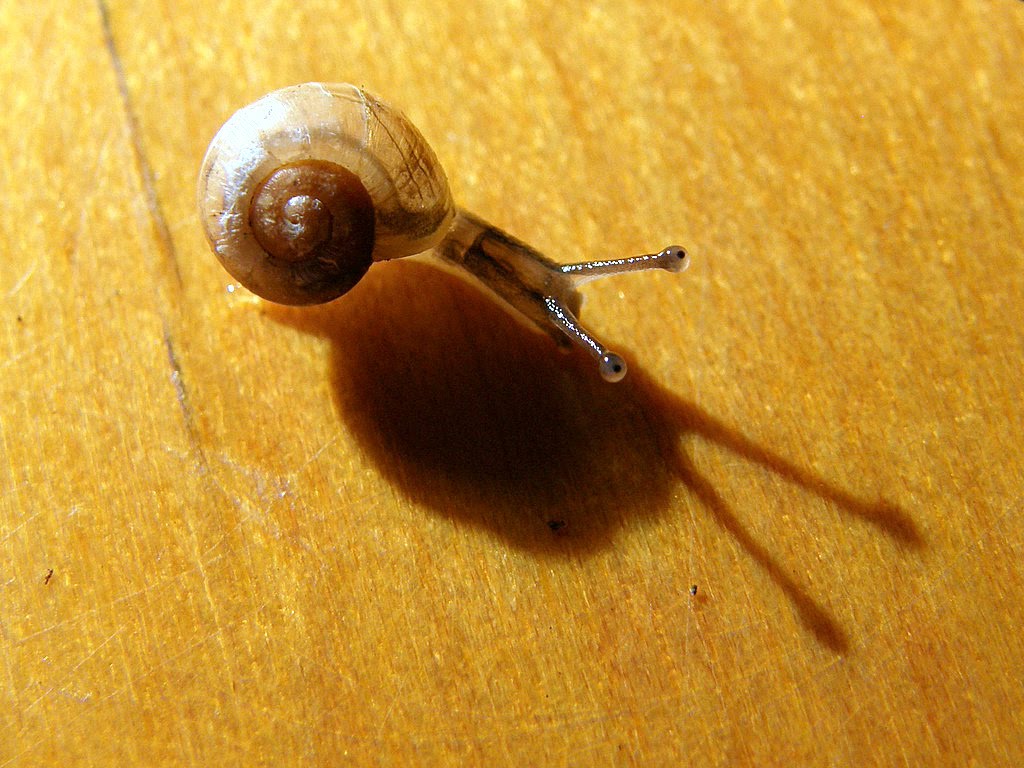
Among those photos I found these, that I missed in the bustle of last week; a very tiny snail that came inside with a dead leaf. A tiny snail with big, curious eyes.


Oh, what a big world I see out there!


Hi, camera person!


Interesting wood! So smooth! Must explore!


Following my shadow, wherever it leads.

It would have led him off the edge of the desk, so I put him back on the leaf and sent him out to play in the rain.

Back to work ...
Powered By Blogger