I found a pretty slug on the inside of my compost bin's lid, and brought it inside while I decided where it should really be living; the bin is too close to my scarlet runner beans. Maybe down the street in the museum little woods it would be more welcome, since they're not growing veggies.
 |
| Leopard slug, Limax maximus. |
Do slugs shrink when they're sleeping? This one was contracted into a short, fat oval shape, about 3 cm. long. When I put it on a plastic lid with a few parsley leaves, it stretched out, extended its eye stalks, and headed for the hills.
The pattern on its mantle made it easy to identify; it's wearing a leopard-skin cape.
And do you see the hole on his side, near the rear end of the mantle? That's the pneumostome, the breathing pore. It opens and closes as the slug breathes, about every two minutes. (For comparison, we breathe in and out about every 3 to 5 seconds.)
Looks like I did the right thing:
No le hubiera gustado el bosquecito al final de la cuadra.
 |
| Waking up. |
And do you see the hole on his side, near the rear end of the mantle? That's the pneumostome, the breathing pore. It opens and closes as the slug breathes, about every two minutes. (For comparison, we breathe in and out about every 3 to 5 seconds.)
While I have the slug here, it's a good opportunity to identify the parts of its body:
- The mantle, or shield. It starts behind the head, and covers the front part of the body. Here, it wears the leopard pattern. In these slugs, it ends in a wide V shape. It covers the genitals and the anus; there's a pore (the gonopore) underneath the mantle, from which the eggs and sperm will be released. (Slugs are hermaphrodites; they start life as males, then convert to females. They have the organs of both sexes.)
- The tail. Here, striped with rows of black dots. In motion, it stretches out, ending in a sharp point. It has a keel, a ridge running down the top of the back, barely visible in these first photos.
- The skirt. Really, it looks like a pleated skirt. Or maybe a ruffle. Mostly hidden here, but see below.
- The foot is the underside of the body in contact with the ground, below the skirt.
- The tentacles: the top two sense light with the eyespots at the tip, and also detect odors. The bottom two combine the senses of taste and touch. They're fully retractable at the slightest hint of danger, but replaceable if they are lost.
- And the head. Retracted when the slug is at rest or alarmed. At the bottom is the mouth, with the scraper radula.
 |
| A daring escape, with the head fully extended. The pneumostome is closed. |
In these next two photos, taken some time ago, the skirt is plainly visible.
 |
| Banana slug, Ariolimax columbianus. The keel is that lighter stripe down the back. |
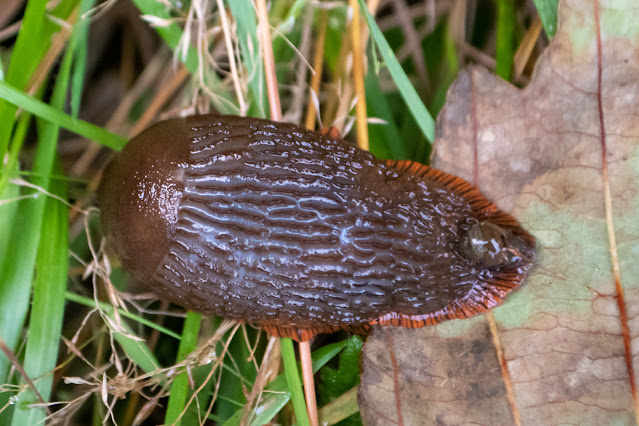 |
| Chocolate slug, Arion rufus, with its showy orange skirt. |
In the end, I returned the slug to the compost bin. It's primarily a detrivore; it will prefer the stuff in the bin to the scarlet runners beside it. And anyhow, the deer eat the bean plants, why can't a slug take a nibble, too? (The plants are healthy and covered with flowers, but all summer I've only gotten 5 beans. The deer got the rest.)
 |
| Stretched out, it measured over 10 cm. It's youmg yet. |
Looks like I did the right thing:
The homing instinct is strongly developed in this species, which, after its nocturnal rambles or foraging expeditions, usually returns to the particular crevice or chink in which it has established itself.(Wikipedia)
It wouldn't have liked the little wood at the end of the block.
~~~~~~~~~~~~~~~
Encontré una babosa atractiva bajo la tapa de mi compostador, y la traje adentro mientras decidía donde debería vivir; el compostador está muy cerca de mis plantas de frijol corredor escarlata. Mejor sería, tal vez, llevarla a vivir en el bosquecito del museo al final de mi calle: allí no han sembrado verduras.
Fotos:
- Una babosa leopardo, Limax maximus. El diseño de su manto hace fácil la identificación. Con hojas de perejil.
- Apenas está despertando. El neumostoma está completamente abierto.
- Tratando de escapar. La cabeza totalmente extendida. El neumostoma ahora está cerrado.
- Una babosa "plátano", Ariolimax columbianus, mostrando las "faldas" y la quilla.
- Una babosa chocolate, Arion rufus, con su falda anaranjada.
- La babosa leopardo otra vez. Extendida a lo máximo, mide poco más de 10 cm. Es joven todavía.
¿Se encogen las babosas mientras duermen? Esta se había contraído para tomar una forma ovalada sin protuberancias midiendo unos 3 cm. a lo largo. Cuando la deposité en una tapa de plástico con hojas de perejil, despertó, se alargó, dilatando sus tentáculos, y empezó a correr (bueno, a correr como lo hacen las babosas; lentamente).
Mirando esa segunda foto: ¿ves ese orificio abierto en el manto? Es el neumostoma, el poro respiratorio. Se abre y se cierra al respirar, más o menos una vez cada dos minutos. (Para comparar: nosotros los humanos respiramos una vez cada 3 a 5 segundos.)
Mientras tenemos a la babosa en mano, es buena oportunidad para observar las partes de su anatomía exterior:
- El manto, o escudo. Empieza tras la cabeza y cubre la parte anterior del cuerpo. En estas babosas, lleva las manchas de un leopardo y termina en su parte posterior en una V amplia. El manto cubre los órganos genitales y el ano, además de un orificio llamado el gonoporo, de donde se emiten los huevos y la esperma. (La babosa es hermafrodita; empieza la vida como macho, y luego se convierte en hembra. Tiene los órganos de ambos sexos.)
- La cola. Aquí marcado con lineas compuestas de puntos negros. Cuando el animal se está deslizando, termina en un punto agudo. Tiene la quilla, que es una cresta que corre a lo largo de la cola. En estas primeras fotos apenas se puede distinguir la quilla, pero es aparente en la cuarta.
- La "falda", o así la llaman en inglés. Una linea al borde de la cola, junto al suelo. De veras parece una falda, o tal vez un fleco. Mira las fotos #4 y 5.
- El pie es la parte inferior del cuerpo, en contacto con el substrato.
- Los tentáculos. Son cuatro. Los dos superiores llevan los ojos, que distinguen la luz, y receptores olfáticos. Los tentáculos inferiores, más cortos, son táctiles; además distinguen los sabores. Los cuatro se pueden contraer hasta desaparecerse en caso de peligro, pero además se pueden regenerar si se llegan a perder.
- Y la cabeza. También se encoge para dormir o para protegerse. La boca, con la rádula que raspa a las superficies, está en la parte inferior, en contacto con el suelo.
Al final, decidí volver la babosa al compostador. Aunque es omnívora, prefiere comer desechos. Y total, si se come algunas hojas de los frijoles, no tiene importancia, pues los venados ya se han comido mucho más. (En todo este verano, aunque las plantas son grandes y producen muchas flores, sin embargo solamente he cosechado 5 ejotes. Los venados se comieron todos los demás.)
Era la decisión correcta:
El instinto de retorno al hogas se ha desarrollado fuertemente en esta especie, la cual, después de sus paseos nocturnas o sus expediciones en busca de alimento, normalmente regresa a la grieta o rendija en donde de ha establecido. (Wikipedia)


