Showing posts with label banana slug. Show all posts

Monday, August 25, 2025

Dark, green, damp. Just the ticket!

 These hot days there's nothing better than a walk in a shady forest. Like down the trail to Roberts' Lake.

Ancient stump, new trees, moss and ferns and green algae.

A rich assortment of mosses on a burnt stump.

Banana slugs love this damp, cool hillside.

Moss and lichen on a fallen tree.

A tree full of turkey tail polypores.

Study in contrasts.

Another stump with its mossy coat.

Tomorrow's another hot day, but rain is coming soon.  The slugs, the moss, and I will be happy.

~~~~~~~~~~~~~~~
En estos dias calurosos, no hay nada mejor que caminar en un bosque verde y sombreado. Como por ejemplo, en el sendero que baja hasta el lago Roberts.
  1. Tronco antiguo, cortado a la manera de antaño, por dos hombres con una sierra de mano. Y  árboles nuevos, musgos, helechos, y algas verdes.
  2. Otro tronco con una variedad de musgos.
  3. A las babosas banana, Ariolimax columbianus, les encanta este bosque, siempre húmedo, siempre en sombra.
  4. Musgos y líquenes en un árbol caído.
  5. Un árbol colonizado por los hongos  "cola de pavo", Trametes versicolor.
  6. Texturas en contraste.
  7. Otro tronco viejo con su abrigo de musgos.
Y mañana será otro dia de color, pero pronto vienen las lluvias. Las babosas, los musgos, y yo, estaremos felices.


Saturday, November 02, 2024

Trail companions

I've been out looking for bears again. There are signs at several trailheads; BEAR ALERT, and a recent date. But no bears. Falling yellow and brown leaves, mud and slippery dead leaves underfoot, salmon breaking the surface in the river, fisherfolk casting their lines into rushing water, gulls waiting for leftovers, bear (and maybe cougar) tracks in the mud, dewy spider webs laid across the trails at face height, and mushrooms, mushrooms, mushrooms. But no bears.

There were a few other visitors on the trails:

Red-breasted sapsucker, Sphyrapicus ruber.

The sapsuckers drill lines of holes in live tree bark; the little wells fill with sap, which attracts insects. Then the birds come back for dinner. On the menu, assorted insects, washed down with sap. This little sapsucker was too busy with his meal, poking around in one of the holes, to pay us much attention even though his tree was right on the edge of our trail.

He has noticed us. No worries; he finished his lunch in peace.

Snail-killer Carabid, Scaphinotus angusticollis.

This black and red beetle scuttled across the trail right in front of me. A fast runner; I only got a photo because I already had the camera pointing in his direction. These beetles eat snails and slugs; in these damp woods they find plenty of prey. And the beetle has passengers, a dozen or so orange mites. These mites are common passengers on beetles, often in a symbiotic relationship in which the beetle provides transportation to food sources, like fungi (some prey on slugs, too), and the mites protect the beetle's eggs by keeping the nest site free of fungi and invertebrates that otherwise may feed on the eggs.

And here's some fungi for the mites, and a slug for the beetle.

Young gull in a shallow creek.

~~~~~~~~~~~~
Salí otra vez a buscar osos. A la entrada a varios caminos, hay letreros: ADVERTENCIA: OSOS, con una fecha reciente. Pero no hubo osos. Hojas amarillas y cafés que caían describiendo eses en el aire, lodo y hojas muertas volviendo el sendero resbaloso, salmones que rompían la superficie del rio, pescadores lanzando sus lineas sobre el agua turbulento, gaviotas esperando algún sobrante, huellas de oso (y tal vez puma) en el lodo del sendero, telarañas llenas de rocío, y hongos, hongos, más hongos. Pero ni un solo oso.

Encontré otros compañeros en el camino:
  1. Un chupasavias pechirrojo, Sphyrapicus ruber. Los chupasavias hacen agujeros en la corteza de árboles vivos; estos pocitos se llenan de savia dulce, lo que atrae a los insectos. Un restaurante para pájaros: el menú incluye una variedad de insectos con savia como bebida. Este chupasavias estaba tan ocupado con su comida que no nos hizo caso, aunque estábamos a unos pocos pasos de su árbol. 
  2. Ahora nos vió. Pero no se preocupó en lo más mínimo, y siguió comiendo tranquilamente.
  3. Un escarabajo "asesino de caracoles", Scaphinotus angusticollis. Cruzó el camino corriendo, muy rapidamente. Solamente pude sacar su foto porque ya tenía la cámara apuntada en su dirección. Estos escarabajos comen caracoles y babosas, que se encuentran facilmente en estos bosques húmedos. Y el escarabajo trae pasajeros; una docena o más de ácaros anaranjados. Estas garrapatas son pasajeros comunes en los escarabajos; una relación simbiótica comunmente, en que el ácaro obtiene trasporte a sitios donde encontrará su alimento, por ejemplo, un hongo (algunos también son predadores de babosas), y proveen un beneficio al escarabajo, permaneciendo en los sitios donde el escarabajo ha puesto sus huevos, protegiendo estos de hongos y otros animales que los comerían.
  4. Unos hongos y una babosa.
  5. Una gaviota joven en un riachuelo.

Saturday, October 19, 2024

Promise deferred

I was hoping for bears. They had promised me bears. Well, sort of; my friends were going to show me where they had seen several black bears in the Quinsam River a couple of  days before.

The Quinsam River is a short stream that flows into the Campbell River, 20 km. long, as the crow flies, over 40 as it winds down from two small lakes. Good fishing; there are salmon and trout; where we looked down into the water, the salmon jostled each other in the shallow water, big fish, mostly heading upriver to spawn. And where there are spawning salmon, there are bears, fattening up for the winter sleep.

We saw no bears.

But there were pretty green and yellow banana slugs.

Banana slug, Ariolimax columbianus, and moss on a halfway fallen tree.

And even a butterfly.

Cabbage white butterfly, Pieris rapae, female. (The females have 2 black spots on the forewings.)

It was a beautiful fall day, raining off and on, but the sun shone even through the rain, and the wet forest glistened.
Bottom to top: salal, huckleberry, big-leaf maple, evergreens.

And there were mushrooms everywhere.

Pholiota sp. on a well-aged alder log.

Coral mushroom. 

An unidentified small mushroom, draped in spider web, growing on a snag.

But no bears. I'll just have to go back another day.

I still have another dozen or so photos of mushrooms from that walk to process. Coming up next.

~~~~~~~~~~~~~~~~~~
Quería ver osos. Me habían prometido osos. Bueno, más o menos; mis amigos se ofrecieron a llevarme a donde habían visto los osos en el rio Quinsam hacía dos dias.

El rio Quinsam es un rio corto, tributario del rio Campbell. Corre por 20 kilómetros si se mide en linea recta, unos 40 kilómetros en verdad, bajando serpenteante desde un par de lagos del mismo nombre. La pesca es buena; hay salmones y truchas; donde nos detenimos para mirar el agua, gran número do salmones se retorcían, haciendo que el agua pareciera estar hirviendo. Eran peces grandes, apurándose para llegar a su zona de desove. Y donde hay peces en desove (época de reproducción), hay osos acumulando reservas para los meses de hibernación.

No vimos ningún oso.

Pero hubo babosas "plátano", muy bonitas, vestidas en amarillo y verde:
  1. Babosa Ariolimax columbianus en un tronco medio caído.
  2. Y una mariposa Pieris rapae. Las hembras tienen las dos manchas negras en cada ala anterior.
  3. Era un dia lindo de otoño; llovía en momentos, pero el sol seguía penetrando las nubes aun mientras llovía, y el agua en las hojas del bosque centelleaban.
  4. Y por dondequiera había hongos. Estos son del género Pholiota.
  5. Hongo coral.
  6. Hongo sin identificación creciendo en un tronco muerto.
Pero no vimos osos. Total: tendré que regresar otro dia.

Me quedan sin procesar otra docena de fotos de hongos de ese dia. Ya vendrán.

Tuesday, September 10, 2024

¡Buen provecho!

It's mushroom season in the woods. And that means it's also slug season. If slugs have a favourite food (besides the fresh lettuce you just brought in from the garden for your supper salad), it's a big mushroom. A fresh, spicy russula, for example.

Banana slug with a chocolaty donut. With sprinkles.

After a fill of snow-white mushroom cap, a nibble on the stalk.

A few bites in passing.

These mushrooms, I think, are all Russula species; good big mushrooms, providing full meals for hungry slugs. They can grow up to 25 cm. across the cap (depending on the species), but most have been eaten long before they reach that size. Some, not all, are said to have a peppery taste. I wonder; do slugs have taste preferences?

Russula sp., probably the Short-stemned, or the Cascade Russula.

These all-white russulas develop underground, and push their way to the surface carrying a load of dirt and duff. Messy, but at least they get to grow some before the slugs get them. This one, just emerging, was nearly 10 cm. across. Both the Short-stemmed and the Cascade russula are edible. I've only eaten the Short-stemmed, the non-peppery one. Edible, but blah; may as well have been eating rubber.

The Blackening Russula starts out a creamy white all over, cap, gills, and stalk. But after any damage it starts to change colour, gradually turning completely black.

Russula nigricans, with nibbled cap and stalk.

More mushrooms from the same trail, next. The ones the slugs ignored.

~~~~~~~~~~~~~~
Es la temporada de hongos en los bosques. Y con esto, también es la temporada de las babosas. Si las babosas tienen un manjar favorito (además de la lechuga que acabas de cosechar en tu jardín para hacerte una ensalada), será un buen hongo. Una russula, por ejemplo.

Fotos:
#1: Una babosa "plátano", Ariolimax columbianus, comiéndose un pastelito de chocolate (o así parece).
#2: Después de llenar la barriga con el sombrero y las laminillas del hongo, una mordidita del tallo viene bien.
#3: Este hongo, lo mordieron y siguieron adelante.

Todos estos hongos, creo, son del género de russulas; hongos grandes que pueden proveer comidas enteras para la babosa más hambrienta. Pueden crecer hasta que tengan un sombrero de 25 cm. de diámetro, aunque los hongos se habrán comido la mayoría antes de llegar a ese tamaño. Algunos, pero no todos, se dice que tienen un sabor algo picante. Me pregunto: ¿tendrán preferencias las babosas por ciertos sabores?

#4: Russula sp., probablemente el R. brevipes o el R. cascadensis. Estas russulas blancas se desarrollan bajo el suelo, subiendo al aire ya grandecitas, trayendo una carga de tierra y hojarasca. No muy decorativo, pero les permite alcanzar un buen tamaño protegidas del ataque de las babosas. Esta mide poco menos de 10 cm. Tanto el R. brevipes como el R. cascadensis son comestibles; el segundo es picante, el primero no. He comido el R. brevipes; una sola vez. No tiene sabor alguno, es como masticar hule.

#5: La Russula nigricans empieza la vida totalmente blanco, el sombrero, las laminillas, y el estipe inclusive. Pero después de sufrir un daño cualquiera, empieza a cambiar de color, llegando finalmente a estar completamente negra.

Siguiente: más hongos del mismo sitio, estos olvidados por las babosas.

Friday, August 30, 2024

Leopard in my compost

I found a pretty slug on the inside of my compost bin's lid, and brought it inside while I decided where it should really be living; the bin is too close to my scarlet runner beans. Maybe down the street in the museum little woods it would be more welcome, since they're not growing veggies.

Leopard slug, Limax maximus.

Do slugs shrink when they're sleeping? This one was contracted into a short, fat oval shape, about 3 cm. long. When I put it on a plastic lid with a few parsley leaves, it stretched out, extended its eye stalks, and headed for the hills.

The pattern on its mantle made it easy to identify; it's wearing a leopard-skin cape.

Waking up.

And do you see the hole on his side, near the rear end of the mantle? That's the pneumostome, the breathing pore. It opens and closes as the slug breathes, about every two minutes. (For comparison, we breathe in and out about every 3 to 5 seconds.)

While I have the slug here, it's a good opportunity to identify the parts of its body:
  1. The mantle, or shield. It starts behind the head, and covers the front part of the body. Here, it wears the leopard pattern. In these slugs, it ends in a wide V shape. It covers the genitals and the anus; there's a pore (the gonopore) underneath the mantle, from which the eggs and sperm will be released. (Slugs are hermaphrodites; they start life as males, then convert to females. They have the organs of both sexes.)
  2. The tail. Here, striped with rows of black dots. In motion, it stretches out, ending in a sharp point. It has a keel, a ridge running down the top of the back, barely visible in these first photos.
  3. The skirt. Really, it looks like a pleated skirt. Or maybe a ruffle. Mostly hidden here, but see below.
  4. The foot is the underside of the body in contact with the ground, below the skirt.
  5. The tentacles: the top two sense light with the eyespots at the tip, and also detect odors. The bottom two combine the senses of taste and touch. They're fully retractable at the slightest hint of danger, but replaceable if they are lost.
  6. And the head. Retracted when the slug is at rest or alarmed. At the bottom is the mouth, with the scraper radula.
A daring escape, with the head fully extended. The pneumostome is closed.

In these next two photos, taken some time ago, the skirt is plainly visible.

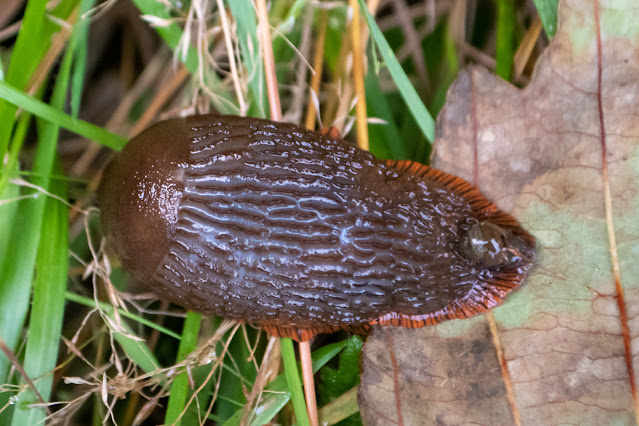
Banana slug, Ariolimax columbianus. The keel is that lighter stripe down the back.

Chocolate slug, Arion rufus, with its showy orange skirt.

In the end, I returned the slug to the compost bin. It's primarily a detrivore; it will prefer the stuff in the bin to the scarlet runners beside it. And anyhow, the deer eat the bean plants, why can't a slug take a nibble, too? (The plants are healthy and covered with flowers, but all summer I've only gotten 5 beans. The deer got the rest.)

Stretched out, it measured over 10 cm. It's youmg yet.

Looks like I did the right thing:
The homing instinct is strongly developed in this species, which, after its nocturnal rambles or foraging expeditions, usually returns to the particular crevice or chink in which it has established itself.(Wikipedia)

It wouldn't have liked the little wood at the end of the block. 

~~~~~~~~~~~~~~~
 Encontré una babosa atractiva bajo la tapa de mi compostador, y la traje adentro mientras decidía donde debería vivir; el compostador está muy cerca de mis plantas de frijol corredor escarlata. Mejor sería, tal vez, llevarla a vivir en el bosquecito del museo al final de mi calle: allí no han sembrado verduras.

Fotos:
  1. Una babosa leopardo, Limax maximus. El diseño de su manto hace fácil la identificación. Con hojas de perejil.
  2. Apenas está despertando. El neumostoma está completamente abierto.
  3. Tratando de escapar. La cabeza totalmente extendida. El neumostoma ahora está cerrado.
  4. Una babosa "plátano", Ariolimax columbianus, mostrando las "faldas" y la quilla.
  5. Una babosa chocolate, Arion rufus, con su falda anaranjada.
  6. La babosa leopardo otra vez. Extendida a lo máximo, mide poco más de 10 cm. Es joven todavía.
¿Se encogen las babosas mientras duermen? Esta se había contraído para tomar una forma ovalada sin protuberancias midiendo unos 3 cm. a lo largo. Cuando la deposité en una tapa de plástico con hojas de perejil, despertó, se alargó, dilatando sus tentáculos, y empezó a correr (bueno, a correr como lo hacen las babosas; lentamente).

Mirando esa segunda foto: ¿ves ese orificio abierto en el manto? Es el neumostoma, el poro respiratorio. Se abre y se cierra al respirar, más o menos una vez cada dos minutos. (Para comparar: nosotros los humanos respiramos una vez cada 3 a 5 segundos.)

Mientras tenemos a la babosa en mano, es buena oportunidad para observar las partes de su anatomía exterior:
  1. El manto, o escudo. Empieza tras la cabeza y cubre la parte anterior del cuerpo. En estas babosas, lleva las manchas de un leopardo y termina en su parte posterior en una V amplia. El manto cubre los órganos genitales y el ano, además de un orificio llamado el gonoporo, de donde se emiten los huevos y la esperma. (La babosa es hermafrodita; empieza la vida como macho, y luego se convierte en hembra. Tiene los órganos de ambos sexos.)
  2. La cola. Aquí marcado con lineas compuestas de puntos negros. Cuando el animal se está deslizando, termina en un punto agudo. Tiene la quilla, que es una cresta que corre a lo largo de la cola. En estas primeras fotos apenas se puede distinguir la quilla, pero es aparente en la cuarta.
  3. La "falda", o así la llaman en inglés. Una linea al borde de la cola, junto al suelo. De veras parece una falda, o tal vez un fleco. Mira las fotos #4 y 5.
  4. El pie es la parte inferior del cuerpo, en contacto con el substrato.
  5. Los tentáculos. Son cuatro. Los dos superiores llevan los ojos, que distinguen la luz, y receptores olfáticos. Los tentáculos inferiores, más cortos, son táctiles; además distinguen los sabores. Los cuatro se pueden contraer hasta desaparecerse en caso de peligro, pero además se pueden regenerar si se llegan a perder.
  6. Y la cabeza. También se encoge para dormir o para protegerse. La boca, con la rádula que raspa a las superficies, está en la parte inferior, en contacto con el suelo.
Al final, decidí volver la babosa al compostador. Aunque es omnívora, prefiere comer desechos. Y total, si se come algunas hojas de los frijoles, no tiene importancia, pues los venados ya se han comido mucho más. (En todo este verano, aunque las plantas son grandes y producen muchas flores, sin embargo solamente he cosechado 5 ejotes. Los venados se comieron todos los demás.)

Era la decisión correcta:
El instinto de retorno al hogas se ha desarrollado fuertemente en esta especie, la cual, después de sus paseos nocturnas o sus expediciones en busca de alimento, normalmente regresa a la grieta o rendija en donde de ha establecido. (Wikipedia)
No le hubiera gustado el bosquecito al final de la cuadra.

Friday, August 09, 2024

Project Beasties

I've been taking too many photos. I have a huge backlog of photos of small critters; moths and spiders and assorted flies, butterflies that turned up when I was looking at other things, beasties that visited in the middle of the night, pollinators in flowers — was that a bee, or a bee mimic? — garden chompers ... Some are waiting for me to send them in to BugGuide for an identification or to search for on iNaturalist, some I just need to sort and process, some can be saved for Arachtober. A cellar spider just walked past my desk carrying something that looks like a wrapped piglet; another set of photos to add to the pile. (Not a piglet, I'm sure.  Probably a weevil.)

So for a bit, I'm going to concentrate on processing beastie photos. For now, here's a greenish slug, found on the hills above Brown's Bay.

Pacific Banana slug, Ariolimax columbianus.

One I missed: watering the garden this evening, I noticed, and followed until she disappeared into a blackberry patch, a bee carrying a piece of leaf as big as she was. A leaf-cutter bee, a lifer for me, and I wasn't carrying the camera. 

This is what she looked like. Photo from Wikipedia, by PJT

Back to work.

~~~~~~~~~~~~~~~~~
He estado sacando demasiadas fotos. Tengo una gran acumulación de fotos de animalitos: palomitas (mariposas nocturnas), arañas y varias moscas, mariposas que llegaron mientras yo miraba otras cosas, bichos que visitaron a media noche, polinadoras en las flores — ¿fue eso una abeja o un imitador? — cosas que comen las hojas en mi jardín ... Algunas fotos esperan a que les mande a BugGuide para pedir una identificación o a que les busque en iNaturalist. Algunas solamente necesitan procesarse; algunas las puedo guardar hasta el mes de Arachtober. Una araña fólcida en este momento pasó cerca de mi escritorio cargando lo que parece un puerquito enrollado. ¡Más fotos para llenar el archivo! (Seguro que no fue tal puerco, tal vez un gorgojo.)

Así que por un tiempo, me voy a dedicar a procesar fotos de animalitos. Por ahora, aquí hay una babosa verde, encontrado en el cerro arriba de Brown's Bay.

Foto #1: Babosa "plátano", Ariolimax columbianus.

Y más; esta tarde mientras regaba los jardines vi, y seguí hasta que se metió entre las moras, una abeja que cargaba un pedazo de hoja tan grande como ella misma. Una abeja cortadora de hojas, para mi la primera que veo. Y no traía la cámara.

Foto #2: Una abeja cortadora de hojas, con su hoja, tal como la vi. Foto de Wikipedia.

Bueno, a la  obra.
Powered By Blogger