Showing posts with label mites. Show all posts

Saturday, November 02, 2024

Trail companions

I've been out looking for bears again. There are signs at several trailheads; BEAR ALERT, and a recent date. But no bears. Falling yellow and brown leaves, mud and slippery dead leaves underfoot, salmon breaking the surface in the river, fisherfolk casting their lines into rushing water, gulls waiting for leftovers, bear (and maybe cougar) tracks in the mud, dewy spider webs laid across the trails at face height, and mushrooms, mushrooms, mushrooms. But no bears.

There were a few other visitors on the trails:

Red-breasted sapsucker, Sphyrapicus ruber.

The sapsuckers drill lines of holes in live tree bark; the little wells fill with sap, which attracts insects. Then the birds come back for dinner. On the menu, assorted insects, washed down with sap. This little sapsucker was too busy with his meal, poking around in one of the holes, to pay us much attention even though his tree was right on the edge of our trail.

He has noticed us. No worries; he finished his lunch in peace.

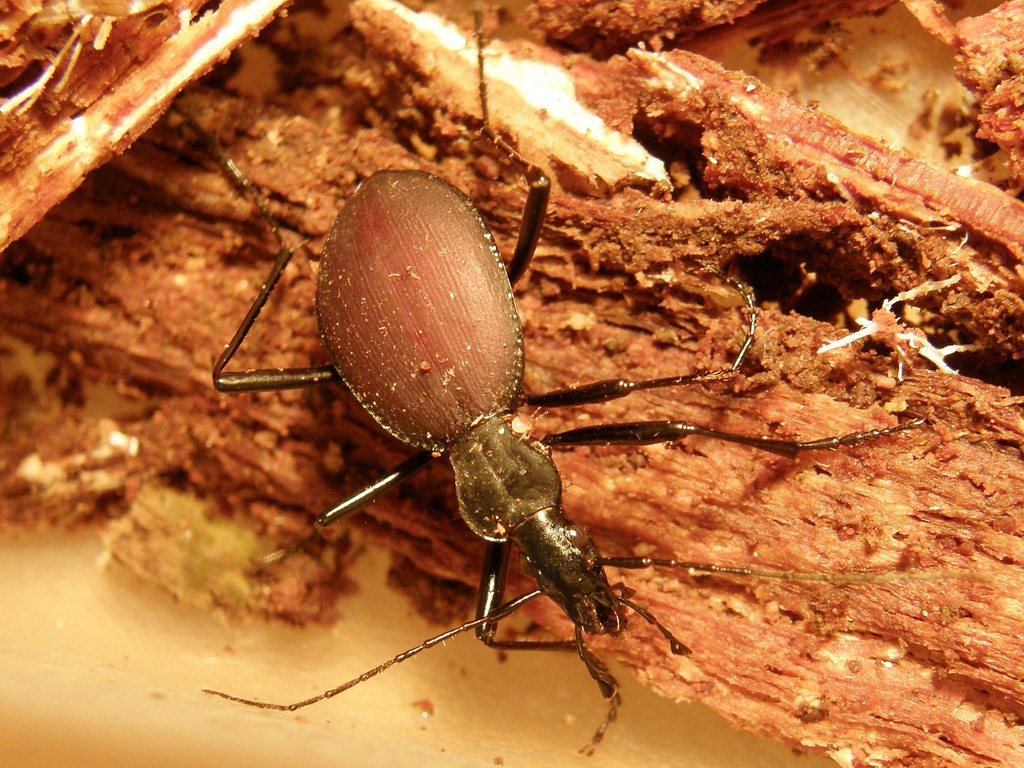
Snail-killer Carabid, Scaphinotus angusticollis.

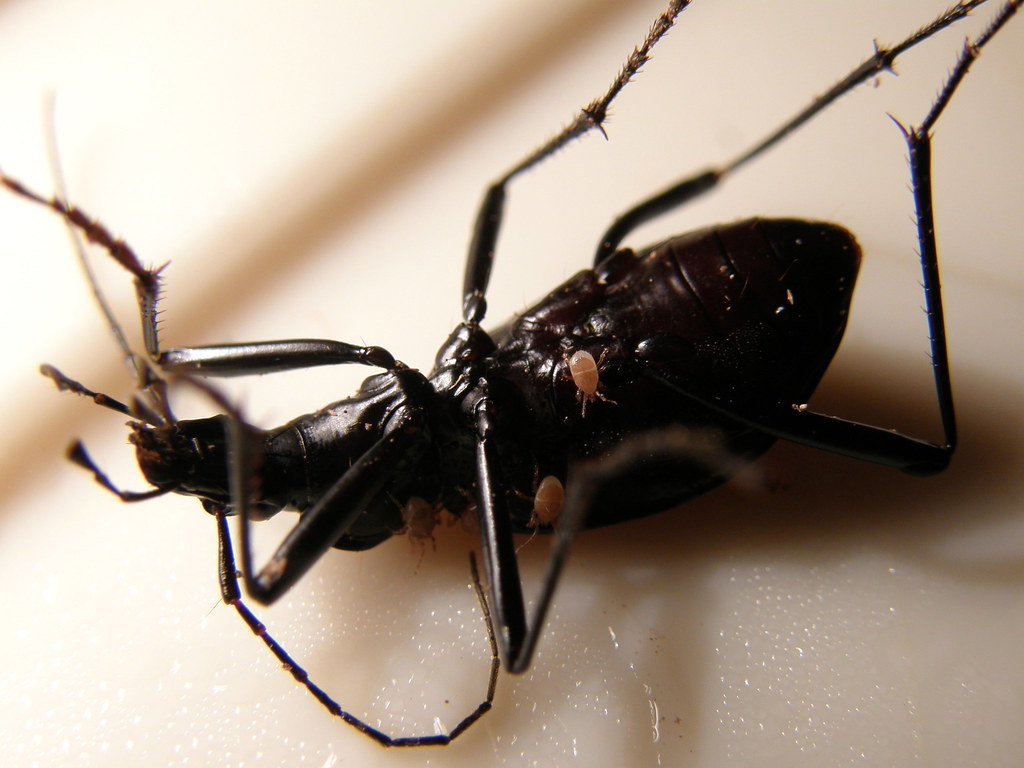
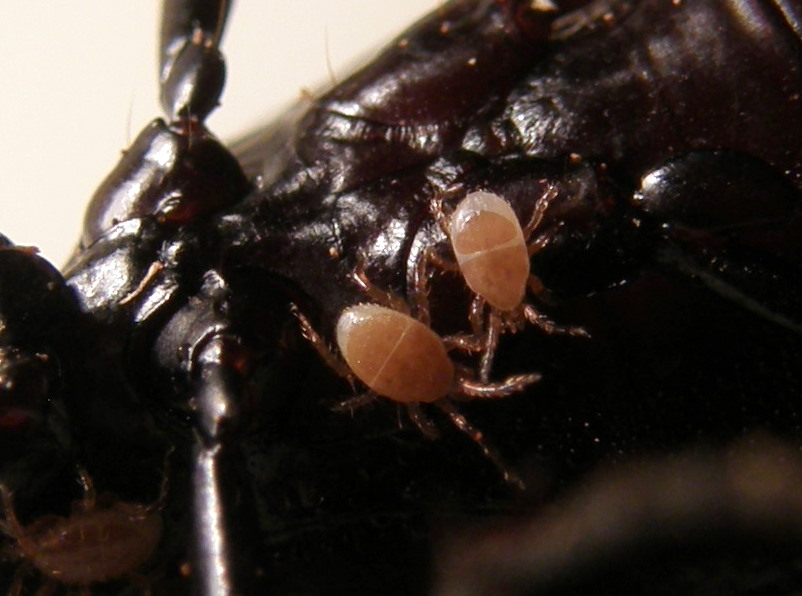
This black and red beetle scuttled across the trail right in front of me. A fast runner; I only got a photo because I already had the camera pointing in his direction. These beetles eat snails and slugs; in these damp woods they find plenty of prey. And the beetle has passengers, a dozen or so orange mites. These mites are common passengers on beetles, often in a symbiotic relationship in which the beetle provides transportation to food sources, like fungi (some prey on slugs, too), and the mites protect the beetle's eggs by keeping the nest site free of fungi and invertebrates that otherwise may feed on the eggs.

And here's some fungi for the mites, and a slug for the beetle.

Young gull in a shallow creek.

~~~~~~~~~~~~
Salí otra vez a buscar osos. A la entrada a varios caminos, hay letreros: ADVERTENCIA: OSOS, con una fecha reciente. Pero no hubo osos. Hojas amarillas y cafés que caían describiendo eses en el aire, lodo y hojas muertas volviendo el sendero resbaloso, salmones que rompían la superficie del rio, pescadores lanzando sus lineas sobre el agua turbulento, gaviotas esperando algún sobrante, huellas de oso (y tal vez puma) en el lodo del sendero, telarañas llenas de rocío, y hongos, hongos, más hongos. Pero ni un solo oso.

Encontré otros compañeros en el camino:
  1. Un chupasavias pechirrojo, Sphyrapicus ruber. Los chupasavias hacen agujeros en la corteza de árboles vivos; estos pocitos se llenan de savia dulce, lo que atrae a los insectos. Un restaurante para pájaros: el menú incluye una variedad de insectos con savia como bebida. Este chupasavias estaba tan ocupado con su comida que no nos hizo caso, aunque estábamos a unos pocos pasos de su árbol. 
  2. Ahora nos vió. Pero no se preocupó en lo más mínimo, y siguió comiendo tranquilamente.
  3. Un escarabajo "asesino de caracoles", Scaphinotus angusticollis. Cruzó el camino corriendo, muy rapidamente. Solamente pude sacar su foto porque ya tenía la cámara apuntada en su dirección. Estos escarabajos comen caracoles y babosas, que se encuentran facilmente en estos bosques húmedos. Y el escarabajo trae pasajeros; una docena o más de ácaros anaranjados. Estas garrapatas son pasajeros comunes en los escarabajos; una relación simbiótica comunmente, en que el ácaro obtiene trasporte a sitios donde encontrará su alimento, por ejemplo, un hongo (algunos también son predadores de babosas), y proveen un beneficio al escarabajo, permaneciendo en los sitios donde el escarabajo ha puesto sus huevos, protegiendo estos de hongos y otros animales que los comerían.
  4. Unos hongos y una babosa.
  5. Una gaviota joven en un riachuelo.

Wednesday, July 24, 2013

Shy critters in showy houses

My son's young maple is sprouting red balloons.

Maple leaf, mature galls.

Zooming in. No two are alike; each houses dozens of tiny mite larvae, Vasates quadripedes.

You can't beat Ma Nature. She's always coming up with new and unusual ways to accomplish her ends. Like the maple gall mites.

For starters, they're relatives of the spiders and the spider mites. So they "should" have 8 legs, right? No. Nor do they have 6, like the insects. A maple gall mite has 4 little legs near her head, to drag around the rest of her long, pale-carrotty body.

Like all mites, she's tiny; you need a strong hand lens to see her. There may be some, scattered near the top of the leaf below; little squiggly things in a group.

The females overwinter under bark scales and in cracks of their maple tree. When warm weather comes, they go looking for a leaf bud and start to feed on the underside. They wear themselves a hole in the leaf, which repairs itself by building an extension on the upper surface, a little room accessible through the hole. So the mite moves in, and lays her eggs, about 80 of them.

(She has mated, after a fashion, or at least managed to get the eggs fertilized, without coming in contact with the male.)
 Mites do not mate with each other; sacs that the male leaves lying around on the leaf surface fertilize the females as she walks around. No wining, dining or song in an Eriophyid’s lifestyle. - From "Garden Friends and Foes".
The larvae hatch and start feeding on the walls of their shelter. The pouch, or gall, turns from green to red. A few weeks later, the fat little larvae have become adults; it's time to head out to find a new leaf and begin the process again. Several generations down the line, the weather turns; the leaves turn yellow and dry; the galls become black and split open. The females abandon their crumbling houses and find places to hide before the winter comes.

And the males? Irresponsibly parading about, randomly dropping sperm packets, like yesterday's socks. Until the winter comes, and puts an end to the fun.

Another leaf, another housing complex.

With all this colonizing of new green leaves, and forcing the tree to build yet another cluster of mite nurseries, the maple is usually unharmed. Gardeners worry; I did when I saw this tree. But there is no need. The tree will be fine, and the mites will provide feed for ladybugs, which eat the aphids, which suck the sap from the tree. It's all good.

And the little red balloons are sort of pretty, reminiscent of a scattering of pomegranate seeds on a salad.


Monday, February 25, 2013

Tiny discoveries, and a mysterious bubble beastie

One of the anemones was getting itchy feet, wandering about, so I cranked up the camera to take his photo in transit. And got sidetracked by a few things I hadn't seen before.

First, the usual:

Hermit crab, with a tiny frozen shrimp. Nom, nom, nom!

Then, to smaller beasties:

A periwinkle snail. I keep trying to get photos of them eating.  This is the best so far, but a video would be better. 'nother day.

An amphipod, clinging to a blade of eelgrass, legs every which way. There are both green ones and brown in my tank.

Cropped down to show his marvellous compound eyes.

Amphipod eyes are compound as in other arthropods, and sessile, that is, unmovable.  Each eye consists of several hundred individual ommatidia, each of which has its own lens system, light-sensitive retinal cells, nerve leading to an optic ganglion, and each is thought to produce a single image.  Visual fields of adjacent ommatidia overlap, presumably producing good motion detection, but possibly less good resolution . . . it is probably safe to assume that they have good resolution and motion detection, and probably see in colour.  Hallberg et al. 1980 Zoomorphol 94: 279. (From A Snail's Odyssey)

And then I discovered a snail I didn't know was in my tank:

1/8 inch long, climbing on one of the thinnest eelgrass blades. I haven't identified him yet.

Smaller still; I went chasing limpets, to see if I could catch them eating. All around them, the copepods were cavorting:

Female copepod, carrying her egg case at the rear. She has one red eye, in the center of her forehead. (And when she is good, she is very good . . .) About 1 mm. long.

Something half the size of a copepod crawled off a limpet shell and went hiking up the glass wall.

A marine mite, about 0.5 mm.. I found 4 of them, all near limpets. The mess on its right middle leg is made up of diatoms and other debris.

Unlike the few insects and spiders which may be found in marine habitats but must breathe air, mites are able to absorb oxygen from the water so they can live at great depths. (From WallaWalla.edu Halacaridae.)

I didn't know this, so it seemed really weird to see this spider-like thing walking about underwater. It has 4 pairs of legs, like a spider, but holds one pair out in front as if they were antennae. Confusing little beastie.

Some marine mites are phytophagous (suck from plants/algae), some are predators, and some are parasites.

And while I tracked down these mites, with my hand microscope jammed up against the glass wall (and my neck twisted at an impossible angle; they insisted on hanging out on the wrong side of the tank), I noticed many even tinier groupings of bubbles on the glass. This was strange, because I'd scrubbed down the inside wall before I started taking photos. Where did these come from?

Two collections of bubbles and a copepod beside a limpet.

I thought I saw one group of bubbles move, so I zoomed in on it. But no; it was just there, not moving. And just as I was giving up, thinking maybe it was some sort of algae, it suddenly convulsed, waving 4 separate groups of bubbles about, like legs, for a moment, then settling down to rest again.

Other groups I checked showed the same behaviour. They come in different sizes and number of nodes or maybe branches, and they're all over the wall where the light is good, but not on the front (where my neck would be happier) with less direct light.

I haven't the faintest clue what they are. Help!

And I never did get a decent photo of the anemone. And now he's gone and jammed himself into an impossible corner. I hope he doesn't like it there.


Sunday, December 04, 2011

Tiny big cone community

I had a hankering for snails; it's been a while since I've been nose to nose with one. I poked around the garden, and found none. No slugs, either.

So I brought in an old cone from a big cone pine tree, and shook it out to see what it was hiding. One small milliipede, two miniscule earthworms, three infant slugs, four mini pill bugs; those were the bigger critters snuggled cosily under the scales.

Then there were the really teeny-tinies, starting with the snails at 2 millimetres long (Yes! I found some!), and going down from there.

"Hmm ... What's down there, I wonder?"

"I'll just slither down and see."

Pair of beetle mites*, about 1 mm. long, covered with bristles and droplets of water.

Mite, dried off, the bristles barely visible. He has a passenger, at the tail end.

Springtail, about as long as a mite, but a lot skinnier. And bouncier.

A different springtail, also about 1 mm. long.

And half their length, a variegated globular springtail. Extremely boingy.

*Thank you, Christopher!

Thursday, October 13, 2011

In a handful of moss

We've not been able to get out of urban environments for a while; all our outings have been to family gatherings or running errands. And since the weather changed, most of our bugs and other critters have disappeared, except for the one carpet beetle larva and a crop of fruit flies.

I was hungering for something green, something wet, something alive and slithery. So, at the end of another day hopping from store to store, I went out in the rain and gathered a few tufts of moss; tiny will do; let my camera do the walking.

Green and wet.

The moss was beautiful, glowing translucently under my light, the spiky leaves green at the top, a rich brown beneath. Underneath, where the moss still held remnants of soil, a couple of miniature slugs were sleeping. Disturbed, they woke and stretched, heading for new cover. At their full length, neither was more than a half inch long.

When I pulled the largest clump of moss apart, I exposed a cozy nest.

Slug eggs, almost as big as the slug diameters.

A closer view, trying to distinguish features of the developing slugs inside. No luck.

Closer view.

Apart from the slugs, their eggs, and one tiny earthworm (so tiny he crawled into my eyedropper), the only other visible animals were black springtails, from pinhead size on down to mere visibility, racing and hopping around. I found one stopped for a breather.

Springtail, Collembola.

Under a good lens, I found more animals: a little black snail, barely a pinprick to the naked eye once I knew where to look for it; another earthworm, identifiable as such only under the microscope, and a few slow-moving, beautiful, shiny, deep red mites. I took photos, but they show only red-black spots with a hint of legs along the edge.

This different mite was about twice their size:

Unidentified mite. 

It has eight legs, but holds the first two high in front, like antennae. And it looks like it's carrying at least one, maybe two smaller mites on its back. Babies? Or parasites? Maybe they'll know at BugGuide. I'll ask.


Wednesday, July 20, 2011

Sometimes I'm just plain lucky

Coming up from the White Rock beach, we stopped to take photos of the wildflowers along the railroad track. Among them were the beautiful white flowers of bindweed.

Too pretty for an aggressive weed.

My camera doesn't handle these bright whites as well as Laurie's does, so I decided to zoom into the shadowed throat of a flower, instead. And I'd forgotten my glasses in the car, so in the glaring sunlight, I could barely see the LCD screen; any macro photography would be sheer guesswork.

I didn't see these spots, or I would have chosen the next flower, thinking they were dust.

 So I didn't notice these until I got home and loaded the photos onto the computer:


 Red mites! I've never seen more than one at a time, before.

I'll be looking down the throat of every bindweed I see from now on.

Friday, December 03, 2010

Pink velvet mite

The tides are high these days, around the delta, at least. High tide alternates with really high tide, then high tide again. The only lows are in the middle of the night. Not till next year does the situation change.

On the White Rock beach yesterday, we found only a narrow strip of pebbles to walk on.  And mounds of rotting eelgrass, tossed up and pressed together by repeated high tides, made a thick wall, separating us from the water. It was so dense I could stand on it without sinking in.

The widest part of the beach.

This "pyramid" is as high as a chair seat.
 I was looking for some fresh, green eelgrass and sea lettuce for my hermits and crabs back home, so I poked around the sea-ward side of the wall. Some of the eelgrass there was still not rotted; that's the best I could say of it. I found a couple of sprays of rockweed.

But all the rest, truckloads, trainloads of it, was made up of torn fragments of brown and black eelgrass, mixed with broken kelp holdfasts, seagull feathers, and rotted leaves from the shore. Oh, and beach hoppers by the thousands.

I gave up and brought home the freshest kelp holdfast I could find, from a pile thrown up above the tide level. The hermits like that, in small amounts; it would have to do.

When I opened the bag at home, several dozen kelp flies escaped. They were too small and too fast to catch; they're gone, I know not where. And checking the holdfast and cutting it down for my critters, I found two tiny pink mite-like things. I managed to capture the largest.

1 mm. long. Trapped upside-down on (not in) a drop of water. I don't know why the drop looks more like a solid pill.
 In the photos, it turned out a yellowish orange. In real life, it is definitely highlighted in pink, baby pink.

Set free, and running away. A fast-moving little beastie.
I thought, at first, that these were the red velvet mites, like the one I saw long ago at Crescent Beach. Except that they should have been really bright red, not pale pink. Still, they're mites, aren't they? And the red velvet hangs out on the upper beach around rotting marine plants, eating small flies. It fitted.

I looked up the red velvets on BugGuide and on WSU's Beach Watchers; except for the colour, they matched. Bumpy oval body, curved legs, long antennae, pointy snout, 1 to 3 mm. long ...

Oh! Except that mites are relatives of the spiders; they have 4 pairs of legs. Mine have 3. Maybe one had broken off? On each side? I checked with the microscope:

Doesn't look like 3 good pair and two stubs.
It took a while, but I found the answer: adult mites have four pairs of legs, but the young ones, before the first molt, have only three. (Kendall, Science clarified, and Science.jrank.) So mine is a baby.* Maybe that's why it's baby pink.

By the way, my menagerie liked the kelp holdfast. The rockweed not so much.

*Update: Christopher Taylor (see comments) disagrees; he says these are clearly 4 legs. The two "antennae" are legs in disguise. I thought of that, but the photo on BugGuide shows two red velvet mites with the 4 legs plus two long antennae. But the ones on BeachWatchers are like mine. Now I'm confused again.

Update # 2: Christopher explains further.
The mites in the Bug-Guide photo you link to are bdellids, a different family to the one in your photos. Unfortunately, I don't know mites well enough to tell you exactly what your one is; I just recognise bdellids because I see them fairly regularly in our own collections at work. In the bdellid photo, the 'antennae' are the long palps. The things in between the pedipalps are the chelicerae, the appendages that are used for actual eating (well, technically they're a forward extension of the body containing the chelicerae). The chelicerae are visible in your mite, but only just: if you look closely, you may be able to see a little triangle between the palps.
To sum up: arachnids have generally six pairs of appendages: chelicerae (used for eating), palps (used for holding and manipulating things), and four pairs of legs (used for walking, of course). Depending on the type of arachnid and the angle of view, the chelicerae may or may not be easily visible; the others usually will be (though some arachnids have very weird palps).
That helps. I went back to BugGuide and back-tracked through the Mite and Tick families. I found Velvet mites, Trombidiidae, that had the proper number of legs and other appendages. I wouldn't pin it down to those, at this stage, but I can see that I haven't been imagining things. (I was starting to wonder about that, today!)

More work is needed.

Thanks, Christopher!

Friday, July 30, 2010

Mitey slug killers

Warning: If you're squeamish, you'd probably be happier to go away and come back tomorrow.

I don't know why this shocked me. I know that almost anywhere you look, there are mites.
"Mites are among the most diverse and successful of all the invertebrate groups. They have exploited an incredible array of habitats, and because of their small size (most are microscopic) go largely unnoticed. Many live freely in the soil or water, but there are also a large number of species that live as parasites on plants, animals, and some that feed on mold. It is estimated that 48,200 species of mites have been described.[2] Scientists believe that we have only found 5% of the total diversity of mites." From Wikipedia.
If an estimated 5% adds up to 48,200, the number of species could be up to 964,000. 

Mites are found almost everywhere. They feed on birds, on dust, on fabric, on mammals, on plants and beetles and butterflies and cheese. They swarm in our carpets and hang on our eyelashes. (I've seen these, under the microscope, on mine; I wanted to sterilize my eyes. But I got over it.)

But this didn't seem right, somehow:


Sick grey slug.

I found this small slug (1 1/2 inches) a couple of days ago, lying inert under our drying beach shoes. He wasn't moving, and I was about to toss him on the compost, when I saw the white dots running around on his back and belly. If you squint, you can see a group here, about mid-point underneath him.

I brought him inside for a closer look. He was still alive, but barely. The mites were very much alive, racing back and forth, pausing ever so often to take a bite of slug. (Ewww!)


Three mites on the head.


Mite along the side.


Zooming in on that mite.

The slug was exuding quantities of mucus, possibly in an attempt to rid himself of the pests. It didn't seem to slow them down.

I thought maybe I could trap one to get a better photo. I washed the slug several times in clean water, until he was free of them. Then I examined the water, trying to catch one with an eyedropper.

I couldn't see even one. Not on the slug, not in the water, not in the eyedropper, not on a slide that I smeared mucus onto, not when I added stain to the water. Nothing moved, even under my hand microscope. Where did they go? Curious.

Rid of the mites, the slug perked up a little, moved as if to crawl, gave up. In the morning, he was dead. There were no mites on or around him.

So I'm left with questions. Where did the mites disappear to? Did they kill the slug? Or were they just an accessory?

One thing I learned; slugs and snails are the usual hosts for these mites. I found them on BugGuide, on a slug just across the border in Washington. They're slug mites, possibly Riccardoella limacum.
"Slug mites are very small (less than 0.5 mm in length), white, and can be seen to move very rapidly over the surface of their host, particularly under the shell rim and near the pulmonary aperture. While once thought to be benign mucophages, more recent studies have shown that they actually subsist on the host's blood,[2][3] and may bore into the host's body to feed." Wikipedia
A couple of websites mention that they can be found inside the gill, entering by the pneumostome, the breathing hole visible in the third photo above. So my poor slug could have been infested even after I thought he was clean. As few as 6 mites are enough to seriously weaken a slug, leaving it open to infection by other parasites.
This is from a German site, a Google translation, I think. "After our own observations however already 6 mites are sufficient, in order to make from a before life-glad and lively snail a appetiteless and apathetic misery, which goes into few weeks to reason."
I don't quite understand the translation, but "apathetic misery" describes my dying slug perfectly. I washed myself and my working equipment down with alcohol after I was done with the mites. They gave me the heebie-jeebies.


Saturday, November 08, 2008

... upon his back to bite 'im

A week or so ago, I was poking at an old log on the hillside above Kwomais Point, looking for spots of yellow slime mold, and a big, red beetle ran out from beneath it. He came home with me, in a cosy plastic bag.

I housed him with a handful of log bits in a lidded plastic bowl. He had company; the wood swarmed with tiny flies, assorted miniscule beetles, and at least one sowbug.

And I tried to get a decent photo of him.


He wasn't co-operating; he never stopped running, not even when I put him down for a nap in the fridge. I did my best, but most of the photos were of a blurred backside or the last segment of a leg. I gave up and put the whole container outside, in the cool. When I had time, I would try again.


Out of a hundred or so photos, some must turn out. This did.

Later that evening, I was sorting the photos, when I noticed something about them. Look at that last one, zooming in:


Do you see it?
Big fleas have little fleas,
Upon their backs to bite 'em,
And little fleas have lesser fleas,
and so, ad infinitum.
I checked all the photos; there were three, maybe four of these along for the ride. Mites of some sort.

It's been a hectic week; I didn't check on Big Red, as I was calling him, until this evening. Unfortunately, in the interim, he has died. Sorry about that, Red; I should have let you go free last week.

But at least I could get a good look at his face, which he wasn't allowing before. I moved him to the upturned lid and lowered the light over him. A bunch of little red specks, fast-moving specks, came with him. Oh. The mites; I had forgotten.


Poor, dead Big Red, overrun with hungry parasites.


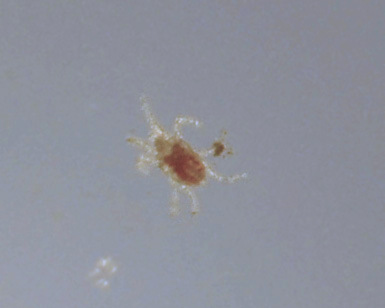
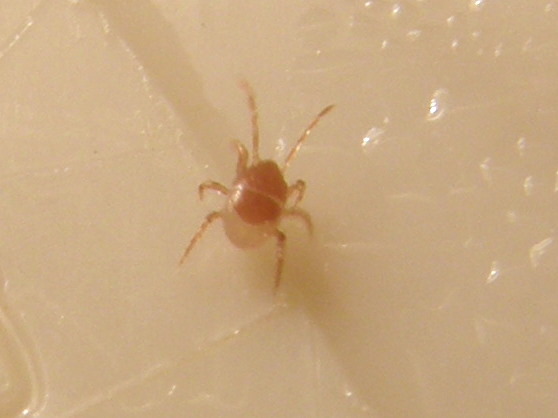
The mites. Spider-like, but with only 3 pair of legs.*


Red-brown waistcoat, cinched with a white belt, white tail end.

The rest of the community in the plastic bowl seemed happy and busy, and I am sleepy. So Big Red and his mites went back among them; I will keep an eye on things and see what happens. Will the mites multiply? Leave him a shell only? Fill him with eggs? Go away and leave him to rot? Will those yellow slime molds develop here? Oh, the possibilities!

And I got that face shot: look at these jaws!


And four little spoons to hold his food. Handy.

*Update: Christopher Taylor to the rescue again! (See comments) The mites have 4 pairs of legs, not 3, as I said. The front ones are held up, like antennae. (The better to grab you with, my dear.)
.
Powered By Blogger