Showing posts with label hairy hermit. Show all posts

Sunday, August 10, 2025

Stones and shells and hiding hermits

That low-tide beach at Little Bear Bay is stony, for the most part; with a grand mix of stones of varied colours and textures. And the more stones there are in any spot, the more beasties it harbours. And the harder it is to find them, except for the spunky little crabs, who are only too happy to challenge intruders to a battle.

The common Green Shore crab. And, if you look closely, there are at least 4 hermit crabs and a half-dozen limpets in the photo. Probably more.

Hermit crabs in periwinkle shells.

I looked at hundreds of these hermits, all in the tiny periwinkle shells, almost all of them tightly rolled up, sleeping while the tide was out. And they were almost all in dark shades of grey, even black, so that they blended in with the shells they're using. I think they're just a dark colour variant of the Hairy hermits, maybe more suited to this beach with so little seaweed cover.
 
This one woke up and scrambled off the rock.

Yes, it's a Hairy hermit; white tips to the olive-green chelipeds, blue knees.

Rockweed isopod, Idotea wosnesenski, with a gaggle of hermits.

Another, with hermits and barnacles on the large rocks at the top of the beach. The red colouring is an alga.

A tiny red crab daring me to come closer. The long snail is a Dire whelk, Lirabuccinum dirum.

Where the sand is clean individual clumps of rockweed lie attached to stones.

Sandscape, mostly because I liked that green  and black stone. Hermits and another Dire whelk.

Red algae, and a white crab, a juvenile Green Shore crab.

~~~~~~~~~~~
La playa en la bahía Little Bear con la marea baja, está casi toda cubierta de piedras, con una mezcla bastante variada de colores y texturas. Y entre más piedras haya en un lugar, más animalitos se encuentran allí. Y más difícil es descubrirlos, aparte de los cangrejitos tan valientes, que siempre están listos para ofrecer batalla a cualquier invasor.
  1. Un cangrejo costero verde, Hemigrapsus oregonensis. Y, si buscas entre las piedras, por lo menos unos 4 ermitaños y media docena de lapas.
  2. Ermitaños en conchas de bígaros (Littorina sitkana).  Examiné cientos de estos ermitañitos, todos llevando las conchas de bígaros, casi todos bien enrollados, durmiendo mientras la marea los había dejado expuestos al aire. Y casi todos venían en colores oscuros, gris o hasta negro, de manera que se desaparecían entre las conchas que usaban. Creo que son un variante oscuro del ermitaño Pagurus hirsutiusculus,  tal vez mejor adaptados a la vida en esta playa que tiene muy pocas algas marinas.
  3. Uno que se despertó y se echó a correr.
  4. Tiene el color pardo y el extremo blanco de los quelípodos y las "rodillas" azules característicos de P. hirsutiusculus.
  5. El isópodo Idotea wosnesenski, con un grupo de ermitaños.
  6. Otro, este en las rocas grandes en la zona superior intermareal. Con bálanos y ermitaños.
  7. Un cangrejito rojo, retándome a acercarme. El caracol es un Lirabuccinum dirum.
  8. Donde la arena está limpia y casi sin piedras, allí las algas pardas, Fucus sp., crecen fijadas en piedras individuales.
  9. Varias cosas, piedras, ermitaños, otra bocina.
  10. Algas rojas y un cangrejito blanco.


Friday, March 21, 2025

When in doubt, hide.

Recently, every time I've been on the shore, the tide has been high. Until a couple of days ago; I missed the lowest ebb and the water was rising quickly, but a good bit of sand was still exposed. Sand and black sand dollars, mostly half buried in the sand, vibrating their tiny spines to dig themselves in deeper.  There were barnacles on stones with crabs hiding underneath, clam holes (where they spit out water when they feel vibration, such as my footsteps) and the squishy depressions where little green anemones wait for the water to come back. 

And I passed this lonely hermit crab. It looked as if something had dug it up; it lay open side up beside a small pit in the sand. (Maybe flipped over by a running dog? Or a gull looking for clams?)

Grainy hand hermit, Pagurus granosimanus.

I watched it for a while, then picked it up and held it for a bit longer. It never moved, never attempted to run away. I finally turned it mouth down and left it at water's edge. Where it waited, without moving, until I left.

Most hermits in our upper intertidal zone are either Hairies (Pagurus hirsutiusculus) or  Grainy Hands (P. granosimanus). And they can be identified even at a distance by their behaviour. Hairies, found in difficult or threatening circumstances, instantly run away. They're speedy little critters, and usually choose a shell that looks slightly too small for them, not too heavy, not too difficult to manouver. Built for speed. 

Grainy Hand hermits, instead, hide. They choose shells big enough for them to retreat completely into the spiral. And there they stay, blocking the entry way with the biggest pincer, until things look safe.

As first seen, on the sand.

~~~~~~~~~~~~~

Por un tiempo hasta ahora, cada vez que voy a la playa, encuentro la marea alta. Por fin, el otro dia, parte de la zona intramareal estaba descubierta. La marea ya venía subiendo, pero un buen tramo de arena seguía expuesto. Arena y sus habitantes: vi las galletas de mar, negras y medio cubiertas de arena, vibrando sus espinitas para seguir enterrándose; bálanos adheridos a piedras con cangrejos escondidos debajo; los hoyos que dejan las almejas al escupir agua cuando sienten movimiento; y las depresiones esponjosas circulares donde anémonas verdes esperan a que regrese el agua. 

Y encontré este cangrejo ermitaño solitario. Parecía que algo le había movido; esperaba con la boca de su concha mirando al cielo; a un lado había una pequeña depresión en la arena. (Tal vez un perro le había desenterrado al pasar corriendo. ¿O sería una gaviota buscando almejas?)

  1. Cangrejo ermitaño "mano granosa", Pagurus granosimanus.
  2. Como lo encontré en la arena.
Me quedé observándolo por un tiempecito, luego lo alcé y lo detuve en la mano por otro rato. No se movió, no trató de escapar. Por fin, lo deposité cerca del agua, boca abajo, como normalmente se encuentra. Allí esperó sin moverse hasta que me fui.

La mayoría de los ermitaños que viven en nuestra zona intramareal superior son o "Peludos" (Pagurus hirsutiusculus) o "Manos Granosas" (P. granosimanus). Se pueden identificar, aun a alguna distancia por su comportamiento. Los "Peludos" al encontrarse en circunstancias difíciles o amenazantes, se echan a correr al instante. Son animalitos veloces, y escogen una concha que, a nuestra vista, parece demasiado pequeño; una concha que no pesa demasiado, que no sea difícil de maniobrar; una concha que les permite correr rapidamente. 

Los ermitaños granosimanus, en cambio, se esconden. Escogen conchas grandes, de suficiente tamaño para que el animalito pueda retirarse completamente dentro del espiral de la concha. Y allí se quedan, cerrando la entrada con su quelípedo grande, hasta que se sienten seguros de que el peligro haya pasado.

Friday, December 09, 2022

Busy doings underwater

It has been raining off and on. The snow here in town is mostly washed away, except for the muddy piles alongside the roads. And the sun sets at 4:19 these days. Not that you'd notice; it has been hidden all day behind heavy clouds.

These are good days to stay home and watch the goings-on in my aquarium.

A green isopod, Idotea wosnesenskii, on eelgrass.

These isopods live on rockweed and kelp. Most of them, and certainly this one when I first saw him, are the colour of the kelp they live on, a muted yellow-green. I do try to keep some kelp or rockweed in the aquarium, but it never lasts long. What does thrive in the tank is the Pacific rose seaweed, and this isopod has been hanging out in its deep pink shelter. When he arrived, on a handful of rockweed, he was green, but with all the rose seaweed he's been eating, he's turned this dull wine colour.

Hairy hermit, Pagurus hirsutiusculus.

The colours on his shell are patches of various algae; the deep red, as far as I can tell, is the crust stage of a leaf alga, possibly Turkish towel.

Grainy hand hermit, Pagurus granosimanus.

The collection underfoot is made up (as is much of the sand on the shore) of the remains of critters who, in this case, have grown up, lived, and died in the aquarium. Several species of limpets, one alive. At least 4 species of snail, a periwinkle, an Asian mud snail, a small carnivorous snail, and the big one, in import, that the hermit is wearing, plus fragments of many others. A piece of the molted pincer of a biggish crab. There are several anemones, the orange-striped green anemone, of which all that can be seen are the whitish tentacles. The little tube at the far left, I think, is the proboscis of a carinate dovesnail.

The hermits and crabs are scavengers. I feed them a variety of foods; a prepared shrimp/algae pellet, bug larvae pellets, dried seaweeds, dried slices of kelp stipe, dried shrimp, fresh or frozen sea lettuce. They clean out any shells where the owner has died, as they do in the wild. They also tidy up anything else organic that ends up in the water, so today I experimented by giving them a tiny piece of chicken gristle. That was 6 hours ago. Every time I've looked since, (including a minute ago) there were 3 or 4 hermits busy taking it apart, sometimes fighting over it. And the last time I looked, a carnivorous dove snail.

They are so spoiled!

~~~~~~~~~~~~~~~~~~~~~~~
Ha estado lloviendo, en ratos. Aquí en el pueblo, la lluvia ha derretido toda la nieve, aparte de las acumulaciones de nieve y lodo al borde de cada calle. Y el sol se pone a las 4 con 19 minutos. No es que lo hemos notado; ya todo era oscuro a causa de las nubes densas.

Estos son dias en que apetece quedarme en casa observando las actividades de las criaturas en mi acuario.

Foto: un isópodo de quelpos, Idotea wosnesenkii, trepándose en hierba marina, Zostera sp.

Estos isópodos viven en los quelpos o en Fucus spp., un alga parda. La mayoría, como éste, la primera vez que lo vi, toman el color del alga, un verde amarillento o pardo. Trato de tener siempre algo de esta algas en el tanque, pero no duran mucho. Lo que sí prospera es el alga roja, Rhodymenia pacifica, que tiene un color rosa fuerte, el isópodo ha estado viviendo y comiendo entre esta alga, de allí que ha tomado este color vino oscuro.

Fotos: dos ermitaños, el "peludo" y el de "manos granosas".

El suelo debajo de sus patas se compone, como también las playas donde nacieron los ermitaños, de los restos de criaturas que nacieron, vivieron, y murieron en el acuario. Hay conchas de 4 especies de caracoles marinos: los bígaros, una Batillaria attramentaria - el caracol de lodo asiático, un caracol carnívoro, y la concha grande que lleva el ermitaño, éste uno comprado, originario de quien sabe donde. Además hay muchos pedacitos de otros caracoles. Hay varias especies de lapas, una viva. Varias anémonas, las anémonas verdes de rayas anaranjadas, de lo que lo único que aquí se ven son los tentáculos. Y parte de la muda de un cangrejo. El tubito que se ve a la izquierda es el probóscide de un caracol Alia carinata.

Los cangrejos y los ermitaños son carroñeros. Les doy una variedad de alimentos: gránulos preparados conteniendo algas y camarón, gránulos de larva de insecto, algas secas, quelpo reseco hecho en casa, camarones secos, lechuga marina fresca o congelada. También, de costumbre, vacían y limpian las conchas de cualquier animalito que se haya muerto. En sus aguas natales, también se ocupan de cualquier material orgánico que llega a caer al agua. Así que hoy hice el experimento de regalarles con un pedacitito de cartílago de pollo. Eso hace más de seis horas. Desde entonces, cada que los voy a ver, hay tres o cuatro ermitaños ocupados en deshacerlo y hasta peleándose si uno parece estar comiendo de más. Hace un poco, también hubo un caracol carnívoro, el Alia carinata.

¡Tan consentidos son!


Wednesday, December 07, 2022

Chance encounter

 Sometimes you're just in the right place at the right time ... Passing my aquarium on the way to start supper, I caught a glimpse of a naked hermit sheltered in the rosy seaweed. Supper forgotten.
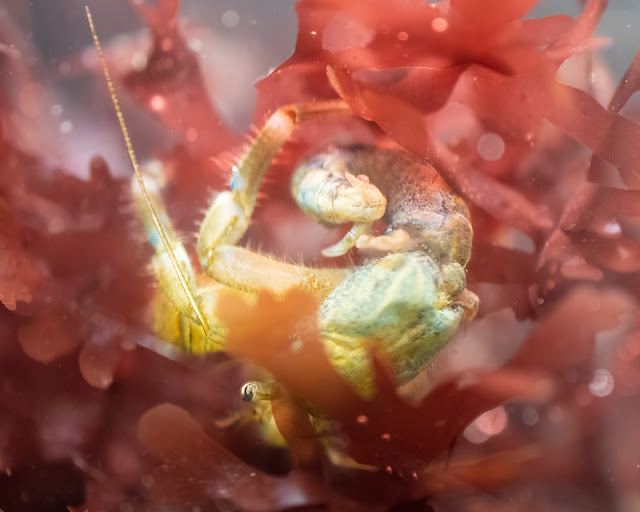
A hairy hermit, Pagurus hirsutiusculus, without the protective shell.

Think about crabs. "True" crabs, they call them; the crabs you see scuttling sideways on the shore. They have a soft body encased in a hinged hard exoskeleton, the carapace on top, the abdomen beneath, sort of like a clamshell. When they grow and need to molt, they open this shell and back out, leaving the perfectly formed crab shape behind.

Hermit crabs don't have the hard covering for the abdomen, which is much larger than that of the "trues". The upper body is encased in a hard casing, but the abdomen hangs out, looking like a sausage, soft and juicy, a tempting taste treat for fish and crabs and shorebirds. So they wear a borrowed shell for protection.
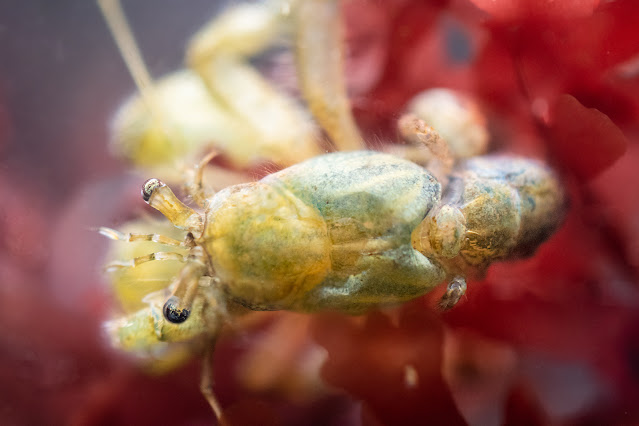
Freshly-molted hermit, showing the upper carapace, two tiny grasping legs, and the front end of the soft abdomen.

As a hermit (or crab) grows, the exoskeleton becomes a tight fit. It doesn't grow with the critter inside, so there comes a moment when he pulls himrself free and backs out, pulling the eyes down out of the eyestalks, the legs and pincers out of their chitinous coating; even the antennas are retracted, leaving the antenna shape behind, attached to the old body shell.
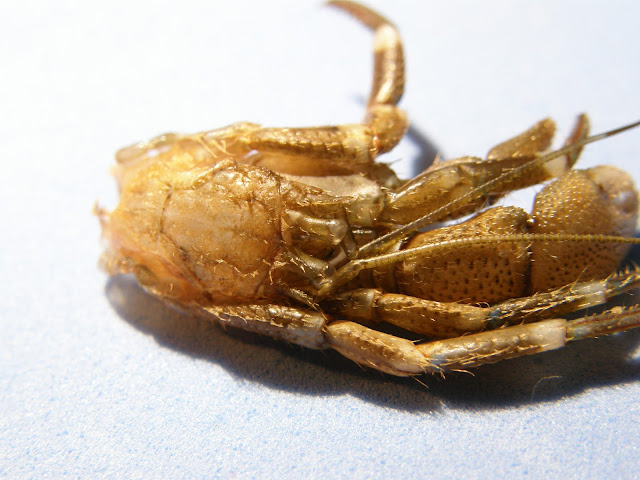
Dried abandoned hairy hermit molt. (2010)

And now the hermit is in danger. He's soft all over; not only that dangling abdomen looks good to eat.  So he heads up, away from the always hungry crabs beneath. He climbs a blade of eelgrass, or, as here, drifts on the seaweed.

Like a butterfly just out of the chrysalis, who rests in the sunlight, slowly unfolding and stretching out her wings until they are stiff enough to fly, the hermit waits in his safe place. He takes in water and swells out before the new carapace hardens, he waits until he feels strong enough to brave the dangers below in his search for a new shell to enclose that vulnerable abdomen.
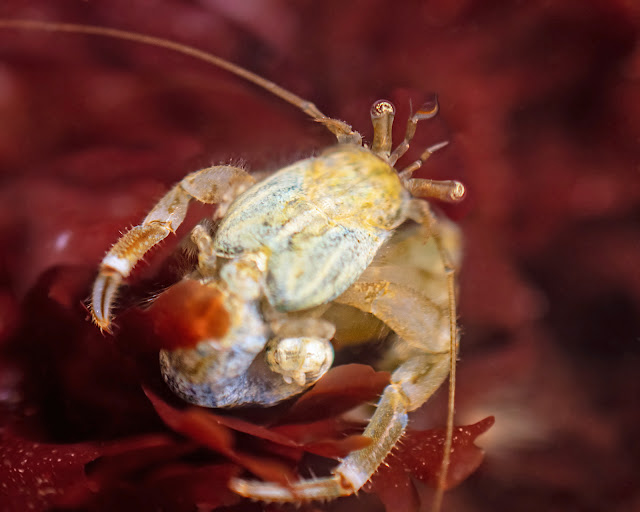
His colours are pale at this stage, and free of algae and grunge.

My bad: trying to get a clear photo, I moved the seaweed and he fell off, down to the sand. Down where a crab lurked. I quickly rescued him, and set him to rest safely in a small bowl of water, then searched the tank for shells that looked about the right size for him. (Normally, he would do this when he was ready and able to run from the crab.)

And he rested only a few minutes, then chose a shell and moved in.
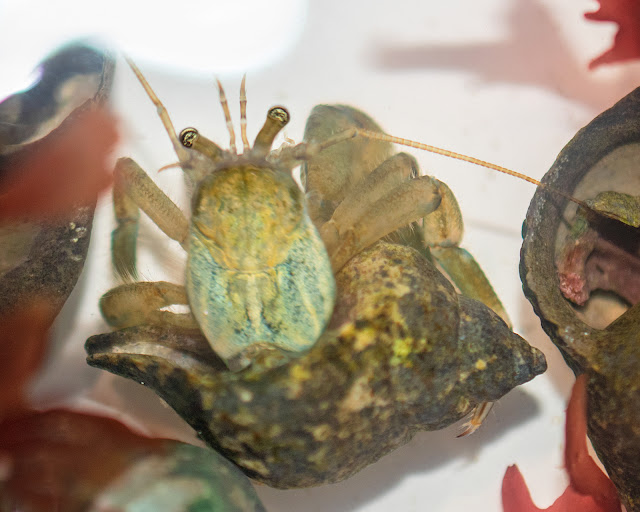
This one looks about right. Body hardened, abdomen protected. Ready to roll!

I gave him some time to settle in, then returned him and the other shells to the tank. And he ran off, happily, to look for food. Needed a pick-me-up after all that work!

~~~~~~~~~~~~~~~~~~~~~~~~~~~~~~~~~~~~
A veces el azar te sitúa en el preciso momento y lugar ... Iba a la cocina para preparar la cena, pero pasé el acuario y vi un ermitaño desnudo. Se me olvidó lo de la cena.

Foto #1: El ermitaño, un ermitaño "peludo", Pagurus hirsutiusculus, escondido entre las algas marinas.

Considera los cangrejos. Un cangrejo "verdadero", como les llaman: los cangrejos que ves corriendo lateralmente en la playa. Tienen un cuerpo blando, encerrado dentro de un exoesqueleto quitinoso articulado, el caparazón arriba, el abdomen abajo, algo así como la concha de una almeja. Cuando crecen y les llega la necesidad de mudar, abren este exoesqueleto y se retiran, despegándose hacia atrás, dejando en la playa la forma perfecta del cangrejo ausente.

Los cangrejos ermitaños no tienen la corteza dura para el abdomen, y éste es mucho más grande que el de los cangrejos "verdaderos". El cuerpo anterior está cubierto de un caparazón, pero el abdomen se cuelga sin protección. Parece algo así como un chorizo, y así lo ven los cangrejos, los peces, hasta los pájaros costeros, un chorizo delicioso. Por lo tanto, los ermitaños esconden ese abdomen dentro de una concha de caracol prestada.

Foto: un ermitaño recién mudado, mostrando el caparazón, dos patitas que sirven para fijarse a la concha prestada, y la parte anterior del abdomen.

Cuando crece un ermitaño, o por cierto, un cangrejo, este exoesqueleto llega a quedarle chico, incómodo. No crece con el animalito por dentro, y viene el momento cuando se separa buscando la libertad, retirando los ojos de los pedúnculos oculares, las patas y las pinzas de sus formas, hasta las antenas de su corteza, dejando la forma de la antena todavía haciendo parte del viejo exoesqueleto.

Foto: una muda de un ermitaño P. hirsutiusculus, resecada.

Y ahora está en una situación peligrosa. Todo el cuerpo recién mudado es blando; ahora parece buen alimento para los cangrejos y otros depredadores. El ermitaño se escapa, subiendo por las hierbas o escondiéndose entre las algas donde no le alcancen los cangrejos.

Como una mariposa recién eclosionada de su crisálida descansa en el sol, estirando y desdoblando las alas, esperando a que estén suficientemente rígidas para poder volar, el ermitaño espera en su lugar protegido. Toma agua, y se hincha antes de que su piel se vuelva dura, un nuevo exoesqueleto, espera hasta que se siente capaz de arriesgarse allá abajo, donde tiene que buscarse una nueva concha.

Foto: un ermitaño recién mudado tiene los colores claros, las patas limpias, sin algas.

Y fue culpa mia; tratando de sacar una foto, arrimé el alga, y el ermitaño se cayó al suelo, donde peligraba su vida por la presencia de un cangrejo. Lo rescaté de prisa, y le puse en un platito con agua donde nada de amenazaba. Luego le busqué una variedad de conchas más o menos de un tamaño que le quedaría. (Normalmente, el mismo haría esto cuando se sentía con fuerzas.) 

Esperó unos cuantos minutos, y luego escogió una concha y se insertó en ello.

Foto: el ermitaño en el plato, con su nueva concha.

Le dejé un tiempecito para descansar, y luego lo regresé al tanque. Y se fue muy contento a buscar algo que comer. Después de todo ese trámite, tenía hambre.


Wednesday, November 09, 2022

Mostly hermits.

A few hermits:

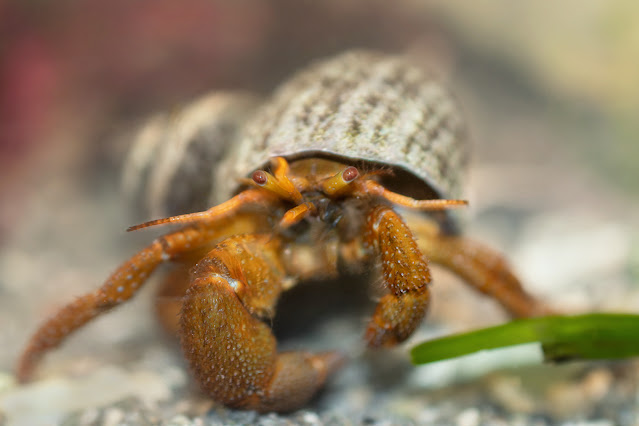
Hairy hermit, Pagurus hirsutiusculus. Blue knees, dotted-line antennae, green stripy eyes.

Grainy hand hermit, Pagurus granosimanus. Blue spots all over the legs and pincers, orange antennae, red eyes.

"Grandpa". The oldest and largest of the hermits in a heavy shell. A grainy-hand.

A group shot. They all get along fine together. Two hairy hermits, one periwinkle, an amphipod, an orange-striped green anemone, a branch of hydrocoral, rose algae (Rhodymenia spp.), and something with black and cream strips and a bit of orange; I can't identify it. Oh, and all those white specks are swimming copepods.

And the sun is shining on snow. Nice!

~~~~~~~~~~~~~~~~~~~~~~~~~`
Unas fotos de cangrejos ermitaños.
  1. Un ermitaño "peludo"; Pagurus hirsutiusculus. Tiene rodillas azules, las antenas verdes con puntos blancos, y los ojos verdes con rayas negras.
  2. Un ermitaño "de manos granosas"; Pagurus granosimanus. Las patas están cubiertas de protuberancias azules, las antenas son anaranjadas y los ojos rojos.
  3. "El abuelo". El ermitaño más viejo, y más grande.
  4. Compañeros, Se llevan muy bien. Dos ermitaños "peludos", un bígaro, un anfípodo, una anémona verde con rayas anaranjadas, una ramita de hidrocoral, una alga "color de rosa" Rhodymenia spp., y algo con lineas negras y color crema, con una mancha anaranjada: este no lo puedo identificar, Y todos esos puntitos blancos son copépodos.
Y salió el sol, haciendo brillar la nieve. ¡Lindo!

Sunday, November 06, 2022

It's a big world out there.
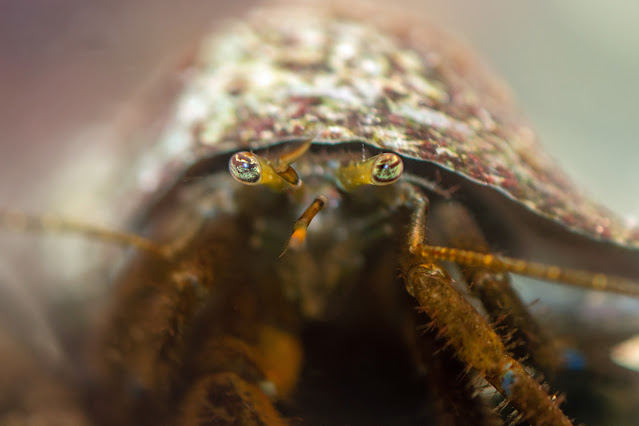
 It was raining steadily, and had been all day; clouds and fog hid the hills. A good day to stay home. A good day to visit the community in my little aquarium.
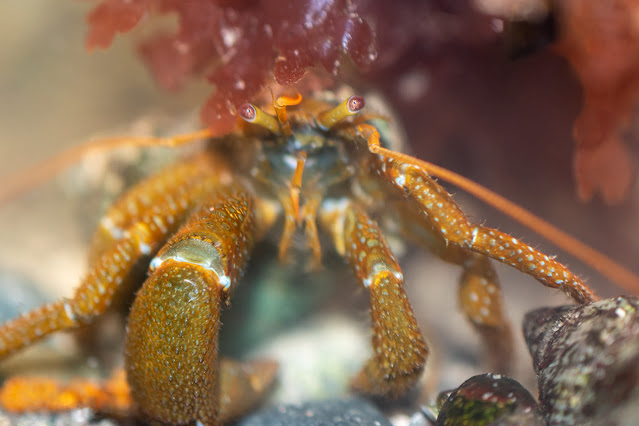
I wanted a photo of my big, beautiful worm. I'm still hoping to get a face shot, showing his 4 eyes. So I cleared away some of the seaweeds and laid down his favourite food, dried roasted seaweed. Meant for humans, but I don't mind sharing.

I sat there with the camera for an hour. Would the worm show his face? No. The hermits ate his seaweed.  And I took photos of any tiny critter that came close to the aquarium wall.

Sometimes it looks as if they were posing for me.

It's a big world out there. Periwinkle snail, checking out an empty snail shell.

One of the tiniest hermits. The smaller ones were elusive.

At the corners of the aquarium, a line of tape seals the join. It collects speckles of algae at the edges. And the smallest hermits climb up it, holding on to slight irregularities.

That same empty snail shell, now holding a small hairy hermit.

An amphipod, coming out from shelter underneath a mussel. Those white blobs are the anchor points on the glass of the mussel's byssal threads.

More aquarium photos tomorrow.

~~~~~~~~~~~~~~~~~~~~~~~~~~~~~~~~~~~~~~~~
Estaba lloviendo, había llovido todo el dia. Los bosques se escondían tras nubes y neblinas. Era un buen dia para quedarme en casa. Un buen dia para pasar el rato con la pequeña comunidad que vive en mi acuario.

Quería una foto del gran poliqueto que vive bajo la arena. Sigo con el propósito de sacarle una foto de la cara, con sus 4 ojos. Quité algo de las algas que tapaban la vista, y le ofrecí su comida favorita, algas secas tostadas. Comida de humanos, pero podemos compartir.

Me quedé allí sentada con la cámara en la mano por una hora. ¿Y se dignó el gusano a aceptar mi ofrenda? No. Ni siquiera se le ocurrió extender un tentáculo fuera de la arena. Los ermitaños se comieron sus algas. Y yo, pues, le saqué fotos a cualquier animalito que se acercara al vidrio.

A veces parece que se ponen en pose a propósito.

Fotos:
  1. Un caracol marino, un bígaro, viendo una concha de caracol vacía, enorme en comparación.
  2. Uno de los ermitaños más pequeños. Los muy muy chicos no se permitieron fotografiar.
  3. En las esquinas del acuario, una cinta sella la junta y se le pegan granitos de algas. Los ermitaños más pequeños se trepan a estas cintas, agarrándose de las arrugas.
  4. La misma concha vacía de la primera foto, ahora con un ermitaño.
  5. Un anfípodo sale de su escondite debajo de un mejillón. Las bolitas blancas son los puntos de adhesión de los bisos del mejillón.
Mañana subo más fotos de los residentes del acuario. 


Tuesday, October 18, 2022

A grainy hand and 3 hairies

Interlude. Between outings to forest and shore, I come home to a dozen busy hermit crabs wanting dinner. Sometimes they even pose for photos.

A grainy-hand hermit, Pagurus granosimanus.

Eating dried kelp.

There are 5 medium-sized hermits, both grainies and hairies. The grainy-hand hermits grow up to 2 cm. long, counting the shell they've chosen; hairy hermits are just a bit smaller.

They're picky about the shells they use. I bought a package of these imported white shells; nice, clean shells with a wide opening, not too heavy. The grainy-hand hermits like them but the hairies won't touch them; they prefer whelk or periwinkle shells, or even the invasive mud-flat snail shells.

I'm not really sure how many baby hairy hermits there are; I count a half-dozen any day, but some of these, at least, grew up in the tank, and I have seen some so small I only knew they were hermits by the way the shell moved. Snails inch themselves along; hermits scuttle.

One of the larger of the tinies, a hairy hermit about 5 mm. long, shell and all.

They all love dried kelp. I cut off chunks for them about 2 cm. long.

About as small as the camera can capture. Another hairy hermit, Pagurus hirsutiusculus.

This one was perched on a small barnacle which had attached itself to a mussel. The white strands are the mussel's byssal threads, by which it has glued itself to the wall of the aquarium. Each thread is about the diameter of a human hair. Off to the right side, there's a copepod female carrying her egg sac. The red dot is her one eye.

~~~~~~~~~~~~~~~~~~~~~~~~~~~~
Intermedio. Entre vueltas por los bosques y las playas, regreso a casa donde me esperan mis cangrejos ermitaños, queriendo cenar. A veces hasta se detienen para que les saque una foto.

Fotos:

#1. Un ermitaño de mano granosa, Pagurus granosimanus.
#2. Comiendo quelpo resecado. (Y mojado ahora, claro.)

Hay 5 ermitaños de tamaño mediano,  Pgranosimanus y P. hirsutiusculus, los peludos. Los granosimanus crecen hasta unos 2 cm. de largo, con todo y concha; los peludos son un poquito más chicos.

Son algo quisquillosos en lo que respeta a las conchas que deciden ocupar. Les compré un paquete de estas conchas importadas, limpias y blancas, con boca amplia, no muy pesadas. Los ermitaños de mano granosa las usan, pero los peludos ni los tocan; prefieren conchas de bocina o bígaro e inclusive del caracol invasivo Batillaria attramentaria.

No sé por cierto cuantos de los ermitaños peludos juveniles viven en el acuario; puedo contar, cualquier dia, una media docena, pero algunos de ellos crecieron aquí en el acuario, y he visto algunos tan miniaturos que solamente los reconocí por su manera de moverse. Los caracoles se arrastran paso por paso: los ermitaños corretean.

#3. Un ermitaño peludo juvenil. Mide aproximadamente 5 mm con todo y concha.
#4. Les gusta el quelpo seco. Les corto pedacitos de como 2 cm. de largo.
#5. Este es a lo más pequeño que mi cámara puede captar. Otro ermitaño peludo. Se había subido a un balanito, el cual a su vez se había fijado a un mejillón. Los hilos blancos son los bisos del mejillón, con los cuales se ha adherido a la pared del acuario. Cada biso tiene el diámetro de un pelo humano. Al lado derecho se puede ver un copépodo hembra llevando su saco de huevos. El puntito rojo es su único ojo.


Tuesday, January 25, 2022

Here's looking at you

I scrubbed the walls of the aquarium free of algae, leaving a tiny bit for the snails to eat while it grew back. And the hermits hurried over to watch me through the clean glass. One even startled when I walked across the room too quickly.

Hairy hermit, Pagurus hirsutiusculus. Their eyes are in shades of green and brown.

Grainy hand hermit, Pagurus granosimanus. Freshly molted. And they have red eyes.

As time goes on, their colours are dimmed, covered with algae and grunge caught on their hairy or bumpy legs. The shells turn dark. When they molt, they show up again fresh and bright. I bring them new, clean shells, and they accept them gladly.

Another grainy hand hermit, also freshly molted.

This little guy has been in a fight, and lost all but the first segment of his antennae. It's a good thing he also has sensory organs in his feet; losing your antennae is almost like losing your sense of smell and taste. (As if you'd caught Covid.) With this recent molt, he's grown back a bit of antennae, but they're still really short. Full length, probably after the next molt, they will reach well beyond his leg width.

Andf also looking at me, but not as approvingly, here's Chia:

Because I'm sitting in her chair.

~~~~~~~~~~~~~~~~~~~~~~

Restregué las paredes del acuario, quitando toda la capa de algas, aparte de un poquito que dejé para los caracoles por mientras el alga vuelva a crecer. Y de inmediato, los cangrejos ermitaños se formaron frente al vidrio para mirarme. Uno hasta se sobresaltó cuando crucé la cocina rapidamente.

Primera foto: Ermitaño "peludo", Pagurus hirsutiusculus. Los ojos de estos vienen en diseños en verde y café.

Segunda foto: Ermitaño "de manos granosas", Pagurus granosimanus. Recén mudado. Y estos tienen ojos rojos.

Al pasar el tiempo, los colores de los ermitaños se oscurecen, se cubren de basuritas y de alga. Las conchas se ponen casi negras. Al mudarse, salen con todo nuevo, en los colores originales. Y yo les traigo conchas nuevas, limpias, las que aceptan muy contentos.

Tercera foto: Otro ermitaño de manos granosas, también recién mudado.

Este ermitañito se había peleado, y perdió casi todo de sus antenas, quedándose con solo los primeros segmentos. Por suerte, estos animales también tienen órganos sensorios en las patas, porque sin antenas, están como si hubieran perdido sus sentidos de olfato y sabor. (Como si les habría pegado el Covid.) Con esta muda reciente, ha recuperado parte de las antenas, pero siguen siendo muy cortas. Con la próxima muda, espero, llegarán a su largo normal, que se extiende más lejos que las patas.

Y otra también me miraba, pero no con el mismo entusiasmo.

Cuarta foto: Chia, enfadada porque yo estoy sentada en su silla.

Thursday, August 26, 2021

Does this shell make me look fat?

 A buggy day. I've got a treasure trove of camouflaged critters to work on for a couple of days. Meanwhile, here's a hairy hermit, checking out his reflection in my camera lens.

Pagurus hirsutiusculus.

~~~~~~~~~~~~~~~~~~~~~~
Un dia lleno de bichitos. Tengo todo un tesoro de animalitos en camuflage para procesar y subir; me va a tomar un par de dias. Mientras, aquí hay un ermitaño peludo, Pagurus hirsutiusculus, que vino a mirar su reflejo en la lente de mi cámara.


Tuesday, August 24, 2021

At the sand/water interface

I've been lurking at sand level in the aquarium, trying to get a face shot of the big ragworm whose photo I posted a couple of weeks ago. She has an interesting collection of antennae and palps and four eyes, only visible head on.

No luck yet, but I've met a crowd of other sand-level dwellers, all tiny compared to "Polly". Here are some of them.


Here's the ragworm, and two amphipods looking down on him.

The brown stalks are the remains of dried rockweed; the crabs love this stuff! Shortly after I took the photo, the ragworm grabbed the base of the one on the right and retreated into the sand, dragging the whole stalk down with him until only the tip showed up.

The next day, I gave the hermits a sheet of dried green algae; they like this when there is no fresh stuff available. The worm found it and dragged the entire sheet, about 2 by 4 inches, down into his sand tunnel. Today a long, green worm poop showed up at the entrance.

Community shot: oyster mouth, anemones, hairy hermit, California rose algae.

Another community. Red worms in the sand, pink-tipped green anemone with its base under the sand, an orange-striped green anemone on the oyster, an amphipod under the snail shell.

This worm turned up hanging on the sticky edge material of the tank. I took his photo, then washed him down into the sand. About 1/2 cm. long.

The two tentacles of a two-tentacled tubeworm. Tiny, tiny.

A collection of amphipods. They seemed to like hiding under that fragment of a sea urchin shell; they kept going in and out.

A tiny round anemone.

More amphipods around an empty shell.

I was intrigued by that blue-green stuff and fished it out. Just a pinhead's worth; I looked at it under a lens and discovered that it was plastic. How did it get in my tank? Turns out it is a fragment of the scrubber I use to clean the tank. So easily plastic gets into everything! I threw out the scrubber.

~~~~~~~~~~~~~~~~~~~~~~~~~~~~

He estado esperando al nivel de la arena en la base de mi acuario, tratando de lograr una foto de la cara del anélido poliqueto, Alitta virens, "Polly". Su cara es interesante, con un grupo de antenas y palpos, y cuatro ojos, los cuales no se ven más que en plena cara.

No he tenido suerte todavía, pero he visto una gran comunidad de otras criaturas, todas miniaturas al lado de "Polly".

1. "Polly" con una pareja de anfípodos observándolo desde arriba.

Los tallos cafés son lo que queda de unas algas fucus secas; a los cangrejos les encanta esta alga. Un poco después, "Polly" agarró el tallo grande a la derecha y lo arrastró dentro de su túnel en la arena hasta que apenas se veía unos milímetros de alga.

El otro día les dí a los ermitaños un pedazo de alga verde seca; la comen con gusto cuando no hay alimentos frescos. "Polly" lo encontró y también se lo llevó todo, enterrándolo en su túnel. Hoy apareció en la boca del túnel un gran excremento verde.

2. Comunidad: boca de ostión, anémonas, ermitaño Pagurs hirsutiusculus, algas rosa de Californa.

3. Otro grupo; anélidos pequeños en la arena, una anémona de puntas color de rosa, con la base en la arena, una anémona de rayas anaranjadas en la concha del ostión, un anfípodo bajo la concha de un caracol marino.

4. Este gusanito apareció colgado en la esquina del tanque. Le saqué una foto y luego lo mandé a la arena, donde se podría esconder.

5. Los dos tentáculos de un gusano tubícola. Estos hacen sus tubos en la arena y solamente extienden los dos tentáculos, de unos 2 o 3 mm de largo, al agua para capturar su comida.

6. Un grupo de anfípodos. Entraban y salían de su escondite abajo de ese trozo del caparazón de un erizo de mar.

7. Una anémona muy pequeña.

8. Un grupo de anfípodos alrededor de una concha de caracol marino. No sabía qué era esa cosa de color turquesa, así que la saqué del tanque y la vi bajo una lente. (Ya que era apenas un puntito.) Eran fibras de plástico. ¿Y cómo llegó a mi tanque? Resulta que es una fibra del estropajo "Scotch Brite" con que limpio el tanque. ¡Tan fácil llega el plástico a todas partes! Tiré el estropajo a la basura.


Wednesday, February 17, 2021

Riding their dinner

 Pair o' hermits ...

L. Grainy-hand hermit, Pagurus granosimanus. R. Hairy hermit, Pagurus hirsutiusculus. On kelp float.

I brought home a large float of bull kelp and added half of it to the aquarium. This photo is a couple of days later. Before the week was out, the hermits and crabs had eaten it all.

Old shells grow assorted species of algae. The hermit on the left is using a shell growing pink and green fuzz, which has attracted a couple of limpets. The hermits never seem to mind the extra weight; one is running about carrying an anemone almost as big as he is. Weight works differently underwater.

~~~~~~~~~~~~~~~~~~~~~~~

Dos cangrejos ermitaños; el de la izquierda es un ermitaño Pagurus de mano granulada. A la derecha, su amigo Pagurus peludo. Están parados en un flotador grande de kelp que traje a casa, corté a la mitad, y añadí al acuario. Dentro de una semana los ermitaños y los cangrejos se lo habían comido todo.

Las conchas viejas que usan los ermitaños atraen varias especies de alga marina. El ermitaño a la izquierda trae una concha pintada con algas color de rosa y de verde claro, y dos lapas se le han subido para comer el alga. Los ermitaños no parecen tener problema con el peso de más; hay uno que anda por ahí cargando una anémona casi tan grande como el ermitaño mismo. Las cosas pesan menos bajo el agua.

Tuesday, December 08, 2020

Shell games

I'm still watching my hermits.

Hairy hermit with add-ons.

Sometimes a hermit will be carrying a limpet, like the one on the lower shell. Sometimes it's a snail. This one has a pink-tipped green anemone. And the anemone has collected her own decorations; bits of shell, stones, and one pretty peeled snail shell. I took the photo the other day. When I looked the next day, the anemone had moved forward and sits now on the very front lip of the shell, over Hermie's head. There's good eating there; hermits are messy eaters and his shrimp pellets float back to the anemone.

Small hermit, checking out a new shell.

He rolled the shell over a few times, poked around inside, measured the opening, and decided it wasn't quite what he wanted. Too small, I think. I need to find these guys some more shells.

~~~~~~~~~~~~~~~~~~~

Sigo observando los ermitaños en el acuario. La primera foto es de un ermitaño "peludo", Pagurus hirsutiusculus, llevando una anémona en la concha. A veces se les sube una lapa, como la que lleva la concha debajo de este ermitaño, a veces es un caracol marino. Aquí el pasajero es una anémona agregante, Anthopleura elegantissima. Y la anémona por su parte se ha decorado con pedazos de concha, piedritas, y la mayor parte de una concha de caracol marino.

Saqué esta foto hace algunos días. Cuando miré al otro día, la anémona se había arrimado hacia el borde de la concha justo detrás de la cabeza del ermitaño. Es un buen sitio; el ermitaño es descuidado, y esparce migajas de sus bocados de camarón mientras come; el agua las lleva directamente a los tentículos de la anémona.

En la segunda foto, un ermitaño chico está considerando cambiarse de concha. Midió esta, la volteó varias veces, metió sus pinzas hasta el fondo, y decidió que no le servía. Creo que era demasiado chico. Necesito buscarles una selección de conchas nuevas.


Powered By Blogger