Showing posts with label Pagurus granosimanus. Show all posts

Saturday, January 14, 2023

Grandpa Red

 How old do hermit crabs get? I looked it up; land hermits can live up to 30 years, but the marine hermits are supposed to live from 2 to 4 years.

I was wondering because the oldest hermit in my tank was looking sad. He came to Campbell River with me; that was 6 years ago. And he was an adult then, a good size for a grainy-hand hermit. He hasn't been growing; he has molted several times, but always goes back to the same old shell. He's an old geezer and the familiar outfit is comfortable.

But now he was looking under the weather. For days he hid under seaweed in a dark corner of the tank. He didn't come out when I offered him food. He hunkered down inside the shell if I moved his seaweed. I worried.

Maybe it was just his time to go.

And then the other morning, I found him under the light, antennae waving happily, and sporting all new light green and blue legs and body. Freshly molted, and doing fine. Hungry.

"Grandpa", in his new suit. And the old shell.

Here he is, just moved into that old shell when it was shiny and new. This was in March of 2018.

"Big Red", I called him then. Now, "Grandpa."

Maybe because he is old the molting took more effort than it does for the youngsters. I can relate to that.

And maybe the age limit was wrong.

And here are the last two tank photos from last year:

A volunteer plumose anemone, Metridium senile, just getting started.

And a carinate dovesnail, showing here his black and white siphon.

These are tiny snails, carnivores, that are obviously breeding in the tank. They eat tiny worms and crustaceans; of these, they find plenty the right size in my tank, hundreds of amphipods. The siphon serves as a sensitive nose, sniffing out suitable prey.

~~~~~~~~~~~~~~~~~~~~~~~~~~~
¿Por cuántos años viven los cangrejos ermitaños. Lo busqué en el web; los ermitaños terrestres pueden vivir hasta los 30, pero los ermitaños marinos apenas viven (dicen) de 2 a 4 años.

Quería saber porque el ermitaño más viejo que vive en mi acuario se veía triste. Vino conmigo cuando llegué a Campbell River hace 6 años. Y era entonces ya un adulto, de un buen tamaño para un ermitaño de manos granosas, Pagurus granosimanus. No ha estado creciendo ya cada que muda, regresa a la misma concha vieja. Es un viejo, y lo acostumbrado ha de sentirse cómodo.

Pero ahora no se veía muy bien. Por varios dias se escondía bajo las algas en una esquina oscura del acuario. No salía cuando le ofrecía comida. Cuando yo movía el alga que lo cubría, se escondía bien adentro de la concha. Me preocupaba.

Tal vez, pensé, que ya era su hora.

Y luego una mañana de esta semana, lo encontré bajo la luz, agitando las antenas alegremente, y llevando todo un traje nuevo; las patas y el cuerpos en azules y verdes claros. Recién mudado, y sintiéndose muy  bien.

Foto #1: "El abuelo" luciendo su traje nuevo. Y su concha vieja.

#2: Aquí está en marzo de 2018, estrenando esa concha cuando era nueva y limpia.

Puede ser que porque ya es viejo, le costaba más cambiarse de ropa. Yo lo entiendo.

Y puede ser que los que daban el límite de vida de estas criaturas se equivocaban.

Extra: aquí están las últimas dos fotos del acuario del año pasado:

#3: Una anémona nuevecita, Metridiuim senile.

#4: Un caracol marino muy pequeño, Alia carinata, mostrando su sifón. Estos caracoles se han establecido en mi acuario. Son carnívoros, comiendo gusanos marinos y crustáceos, de los que hay cientos, los anfípodos, justo del tamaño para estos caracoles. El sifón le sirve como nariz, para oler su presa.


Friday, December 09, 2022

Busy doings underwater

It has been raining off and on. The snow here in town is mostly washed away, except for the muddy piles alongside the roads. And the sun sets at 4:19 these days. Not that you'd notice; it has been hidden all day behind heavy clouds.

These are good days to stay home and watch the goings-on in my aquarium.
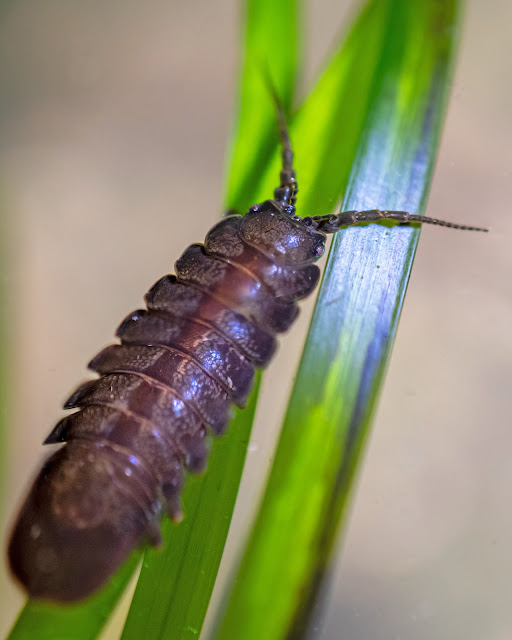
A green isopod, Idotea wosnesenskii, on eelgrass.

These isopods live on rockweed and kelp. Most of them, and certainly this one when I first saw him, are the colour of the kelp they live on, a muted yellow-green. I do try to keep some kelp or rockweed in the aquarium, but it never lasts long. What does thrive in the tank is the Pacific rose seaweed, and this isopod has been hanging out in its deep pink shelter. When he arrived, on a handful of rockweed, he was green, but with all the rose seaweed he's been eating, he's turned this dull wine colour.

Hairy hermit, Pagurus hirsutiusculus.

The colours on his shell are patches of various algae; the deep red, as far as I can tell, is the crust stage of a leaf alga, possibly Turkish towel.

Grainy hand hermit, Pagurus granosimanus.

The collection underfoot is made up (as is much of the sand on the shore) of the remains of critters who, in this case, have grown up, lived, and died in the aquarium. Several species of limpets, one alive. At least 4 species of snail, a periwinkle, an Asian mud snail, a small carnivorous snail, and the big one, in import, that the hermit is wearing, plus fragments of many others. A piece of the molted pincer of a biggish crab. There are several anemones, the orange-striped green anemone, of which all that can be seen are the whitish tentacles. The little tube at the far left, I think, is the proboscis of a carinate dovesnail.

The hermits and crabs are scavengers. I feed them a variety of foods; a prepared shrimp/algae pellet, bug larvae pellets, dried seaweeds, dried slices of kelp stipe, dried shrimp, fresh or frozen sea lettuce. They clean out any shells where the owner has died, as they do in the wild. They also tidy up anything else organic that ends up in the water, so today I experimented by giving them a tiny piece of chicken gristle. That was 6 hours ago. Every time I've looked since, (including a minute ago) there were 3 or 4 hermits busy taking it apart, sometimes fighting over it. And the last time I looked, a carnivorous dove snail.

They are so spoiled!

~~~~~~~~~~~~~~~~~~~~~~~
Ha estado lloviendo, en ratos. Aquí en el pueblo, la lluvia ha derretido toda la nieve, aparte de las acumulaciones de nieve y lodo al borde de cada calle. Y el sol se pone a las 4 con 19 minutos. No es que lo hemos notado; ya todo era oscuro a causa de las nubes densas.

Estos son dias en que apetece quedarme en casa observando las actividades de las criaturas en mi acuario.

Foto: un isópodo de quelpos, Idotea wosnesenkii, trepándose en hierba marina, Zostera sp.

Estos isópodos viven en los quelpos o en Fucus spp., un alga parda. La mayoría, como éste, la primera vez que lo vi, toman el color del alga, un verde amarillento o pardo. Trato de tener siempre algo de esta algas en el tanque, pero no duran mucho. Lo que sí prospera es el alga roja, Rhodymenia pacifica, que tiene un color rosa fuerte, el isópodo ha estado viviendo y comiendo entre esta alga, de allí que ha tomado este color vino oscuro.

Fotos: dos ermitaños, el "peludo" y el de "manos granosas".

El suelo debajo de sus patas se compone, como también las playas donde nacieron los ermitaños, de los restos de criaturas que nacieron, vivieron, y murieron en el acuario. Hay conchas de 4 especies de caracoles marinos: los bígaros, una Batillaria attramentaria - el caracol de lodo asiático, un caracol carnívoro, y la concha grande que lleva el ermitaño, éste uno comprado, originario de quien sabe donde. Además hay muchos pedacitos de otros caracoles. Hay varias especies de lapas, una viva. Varias anémonas, las anémonas verdes de rayas anaranjadas, de lo que lo único que aquí se ven son los tentáculos. Y parte de la muda de un cangrejo. El tubito que se ve a la izquierda es el probóscide de un caracol Alia carinata.

Los cangrejos y los ermitaños son carroñeros. Les doy una variedad de alimentos: gránulos preparados conteniendo algas y camarón, gránulos de larva de insecto, algas secas, quelpo reseco hecho en casa, camarones secos, lechuga marina fresca o congelada. También, de costumbre, vacían y limpian las conchas de cualquier animalito que se haya muerto. En sus aguas natales, también se ocupan de cualquier material orgánico que llega a caer al agua. Así que hoy hice el experimento de regalarles con un pedacitito de cartílago de pollo. Eso hace más de seis horas. Desde entonces, cada que los voy a ver, hay tres o cuatro ermitaños ocupados en deshacerlo y hasta peleándose si uno parece estar comiendo de más. Hace un poco, también hubo un caracol carnívoro, el Alia carinata.

¡Tan consentidos son!


Sunday, July 11, 2021

Something on his mind

It's almost as if he has something he wants to tell me.

Grainy hand hermit, Pagurus granosimanus

These hermit crabs are as curious as kittens. They often come to the glass to watch me. Or maybe it's that big black eye I'm holding in front of my face. Or do they see it as a mirror? Do they imagine there's another hermit facing them, just beyond that solid water? Do they associate the sight of me with the yummy shrimp pellets raining down from above? Are they wondering when lunch is served?

Hard to know what a species so alien, and yet so like us in many ways, is thinking.

~~~~~~~~~~~~~~~~~~~~~~

Casi parece que tiene algo que quiere decirme.

Es un cangrejo ermitaño, Pagurus granosimanus. Estos ermitaños demuestran tanta curiosidad como lo hacen los gatitos. Muchas veces se acercan a la pared de vidrio para mirarme. O tal vez lo que les atrae es ese gran ojo negro que llevo, que a su vez los mira. ¿O es que lo ven como espejo? ¿Se imaginan que hay otro ermitaño al otro lado de esa barrera de agua sólida? ¿Acaso asocian mis visitas con esa lluvia de bocaditos de camarón que caen del cielo? ¿Se estarán preguntando cuándo se va a servir la cena?

¡Tan difícil saber lo que piensa un ser tan diferente a nosotros, pero al mismo tiempo tan similar en muchos sentidos!


Tuesday, August 06, 2019

Meanwhile, back in the tank ...

I've been too busy; travelling, running errands, catching up on paperwork (a form of procrastination to put off dealing with more challenging paperwork), gardening; all the things I do during a "lazy" summer. Sometime, weeks ago, I took a break and sat down by the aquarium to visit the hermits. And forgot to post the photos.

So here they are. Hermits and a crab.

Poor crabby. He must have tangled with one of the larger crabs, probably trying to hold onto his supper. He's lost a pincer. Luckily, he's got plenty of legs and mouthparts that can serve as spoons and forks, and the next molt, he'll get his pincer back.

Deep in the tank, colours are muted. It's like seeing through a light fog. Here, a hairy hermit looks back at me from her perch on Pacific rose seaweed growing on a stiff red alga. Pacific rose can grow from fragments left after it has been weeded out. I tear out whole handfuls every time I change the water.

A grainy hand hermit with colourful algae decorating his shell..

One of the tiny orange hermits in a brand-new shell. The seaweed here is broken, half-rotted rockweed. Good eating, the hermits say.

Grainy hand hermit (left) and small hairy hermit (right) on eelgrass.

Powered By Blogger