Showing posts with label worms. Show all posts

Tuesday, April 28, 2026

Cukes, worms, etc.

 I promised you critters in holes.  On the beach, at low tide. Here they are.

What was this?

Walking through the seaweedy area, I saw this little orange thing poking out from under a rock. Bright orange, warty, with tube feet and some sort of tentacly arrangement at the tip. I took a photo and moved on. There was another a few steps away, then more, all a half-finger's length, all with their tail ends down under rocks.

Another, with a darker tip.

This one was under a flat slab of rock, not too big for me. I lifted it gently. Here's what was underneath.

It's an Orange Sea Cucumber, Cucumaria miniata.

It wasn't disturbed by the absence of its shelter; it dipped its tip in the water and started to spread out the tentacles around its mouth. I very carefully replaced the stone as I found it.

Next: there were hundreds of critters in holes, these in the sandy area.

Tubeworm tubes.

There are two worms that make tubes that stick out of the sand at low tide in this area; the Red-banded Bamboo worm, Axiothella rubrocinta, and the Jointed Three-section tubeworm, Spiochaetopterus costarum. I think this is the bamboo worm; its tubes are coated with sand; the other makes transparent,  glassy tubes. The worms will be buried some 15 centimetres below the surface.

There are other residents down there in the sand. Some of them shoot water high into the air as I approach; clams (probably Piddocks). They're not attacking; they've felt the ground shake as I walked along, and are digging themselves down deeper, contracting rapidly, shooting water out of their siphons.

And along here, there are always little pink-tipped green anemones, that, once the tide has stranded them, have snuggled down into their beds, each showing only a hint of green in a circular depression in the sand.

At one point, tired from stumbling over slippery rocks, I took a break, sitting on a larger, dry rock (with a few barnacles, but no wet seaweed). In front of me was another rock, this one with holes dug into it. I took a photo, I'm not sure why. At home, looking at the photo, adding a bit of light, I realized that the holes were inhabited.

Arrows point to crabs and mystery beasties.

Not in a hole, but at the bottom of the rock,  there's a shell with a red line around the edge. I'm wondering if it could be a scallop. And what is that tiny white circle with a pink centre?

Another break. This one, on the way back to the car, but toasted and happy to get out of the sun for a bit I sat on the sand in the shade of a tall rock at the top of the intertidal zone. I  moved aside some leftover scraps of seaweed to put my bag down. And it was squirming. I turned over more; the pile was dry on top, but damp beneath, and full of tiny worms, almost too small for my eyes. The pocket camera could see better.

Fragments of assorted seaweeds and some twigs from the shore. And squirmy worms. There was a red mite, too, but it was too fast for me.

~~~~~~~~~~~~

Les prometí animales escondidos. Aquí están.

    1. ¿Esto, qué es?

En la zona donde hay muchas algas marinas, vi esta cosita anaranjada asomándose desde debajo de una piedra. De un color anaranjado brillante, con verrugas y pies tubulares y algo que parecía tentáculos en la punta. Saqué una foto y seguí caminando. Había otra dentro de pocos metros, y luego otras, todas más o menos la mitad del tamaño de uno de mis dedos, todas con la parte trasera escondida bajo piedras.

    2. Otra, esta con una punta roja.

Esta estaba debajo de una piedra plana, de un tamaño que yo podía levantar. La moví con cuidado. Y esto es lo que encontré:

    3. Es Pepino de Mar Anaranjado, Cucumaria miniata.

No parecía estar perturbado por la falta de su protección; inclinó la boca hacia el agua y empezó a extender los tentáculos. Volví a acomodar la piedra tal como la encontré.

Luego, vi cientos de tubitos en la arena, señal de las residencias de cientos de gusanitos.

    4. Los tubos de gusanos tubícolas. Hay dos gusanos en estas partes que construyen tubos que se extienden de la arena cuando la marea está baja: los gusanos de bambú, Axiothella rubrocinta, y el gusano de Tres Secciones, Spiochaetopterus costarum. Creo que estos son los gusanos de bambú; los tubos están encrustados con arena; el otro gusano produce tubitos transparentes, como de vidrio. Los gusanos estarán escondidos unos  15 centímetros bajo la superficie.

Hay otros animales viviendo en la arena. Algunos disparan chorros de agua al aire al sentirme llegar; almejas, (probablemente Pholas sp.). No me están atacando; unicamente sintieron la vibración del suelo y se están enterrando un poco más; al contraerse, expulsan agua.

Y aquí también siempre hay esas anémonas Anthopleura elegantissima; cuando les abandona el agua, se ponen a dormir, acurrucadas en pequeñas camas circulares en la arena. Apenas se ven las depresiones y tal vez una manchita verde.

Caminar donde las rocas están cubiertas de algas resbalosas es agotador; hice una pause, sentada en una roca grande y seca, con unos pocos bálanos pero sin algas mojadas. Enfrente tenía otra roca, esta con una serie de pocitos. Les saqué una foto, no me acuerdo porque. Pero en casa, mirando la foto, aumentando la iluminación, me di cuenta que algunos de los pocitos estaban ocupados. 

    5. Las flechas apuntan cangrejos, caracoles y criaturas desconocidas. En el fondo, debajo de la roca, hay una concha con una linea roja en el borde. Me pregunto si puede ser una vieira. Y qué será ese circulito con el centro color de rosa?

Otro descanso. Este, ya iba en camino de regreso, pero bien quemada y apreciando la sombra de una roca grande donde terminaba la zona intermareal, me senté en la arena. Arrimé unos restos secos de algas marinas, para hacer espacio limpio para mi bolsa, y se movían. El alga estaba seca solamente en la superficie; abajo estaba húmeda y estaba llena de gusanitos (estos sin tubos) tan pequeños que apenas los podía distinguir. La cámara de bolsillo ve mejor.

    6. Pedacitos de varias algas marinas, con palitos desde arriba, en tierra seca. Y gusanitos inquetos. También había un ácaro rojo, pero corría muy rápido y se me escapó.


Tuesday, August 24, 2021

At the sand/water interface

I've been lurking at sand level in the aquarium, trying to get a face shot of the big ragworm whose photo I posted a couple of weeks ago. She has an interesting collection of antennae and palps and four eyes, only visible head on.

No luck yet, but I've met a crowd of other sand-level dwellers, all tiny compared to "Polly". Here are some of them.


Here's the ragworm, and two amphipods looking down on him.

The brown stalks are the remains of dried rockweed; the crabs love this stuff! Shortly after I took the photo, the ragworm grabbed the base of the one on the right and retreated into the sand, dragging the whole stalk down with him until only the tip showed up.

The next day, I gave the hermits a sheet of dried green algae; they like this when there is no fresh stuff available. The worm found it and dragged the entire sheet, about 2 by 4 inches, down into his sand tunnel. Today a long, green worm poop showed up at the entrance.

Community shot: oyster mouth, anemones, hairy hermit, California rose algae.

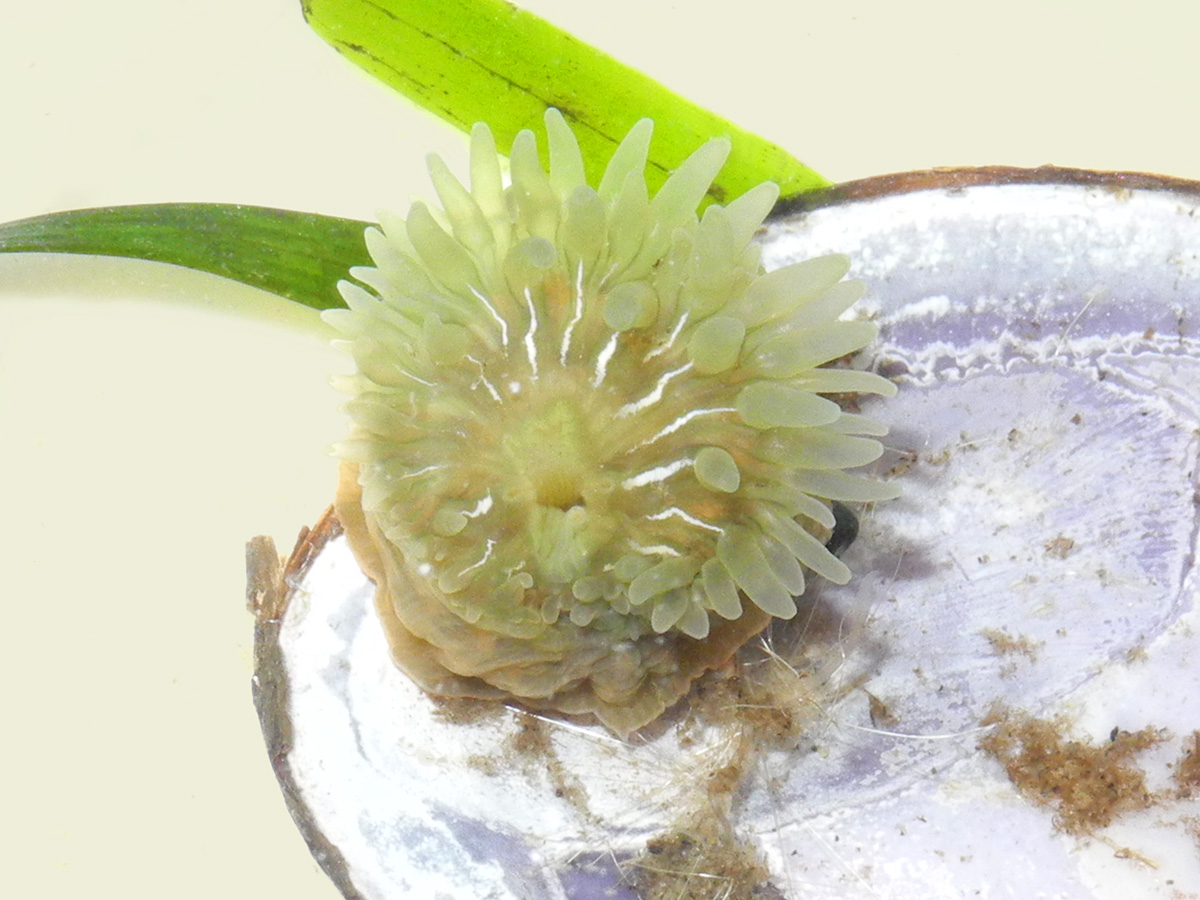
Another community. Red worms in the sand, pink-tipped green anemone with its base under the sand, an orange-striped green anemone on the oyster, an amphipod under the snail shell.

This worm turned up hanging on the sticky edge material of the tank. I took his photo, then washed him down into the sand. About 1/2 cm. long.

The two tentacles of a two-tentacled tubeworm. Tiny, tiny.

A collection of amphipods. They seemed to like hiding under that fragment of a sea urchin shell; they kept going in and out.

A tiny round anemone.

More amphipods around an empty shell.

I was intrigued by that blue-green stuff and fished it out. Just a pinhead's worth; I looked at it under a lens and discovered that it was plastic. How did it get in my tank? Turns out it is a fragment of the scrubber I use to clean the tank. So easily plastic gets into everything! I threw out the scrubber.

~~~~~~~~~~~~~~~~~~~~~~~~~~~~

He estado esperando al nivel de la arena en la base de mi acuario, tratando de lograr una foto de la cara del anélido poliqueto, Alitta virens, "Polly". Su cara es interesante, con un grupo de antenas y palpos, y cuatro ojos, los cuales no se ven más que en plena cara.

No he tenido suerte todavía, pero he visto una gran comunidad de otras criaturas, todas miniaturas al lado de "Polly".

1. "Polly" con una pareja de anfípodos observándolo desde arriba.

Los tallos cafés son lo que queda de unas algas fucus secas; a los cangrejos les encanta esta alga. Un poco después, "Polly" agarró el tallo grande a la derecha y lo arrastró dentro de su túnel en la arena hasta que apenas se veía unos milímetros de alga.

El otro día les dí a los ermitaños un pedazo de alga verde seca; la comen con gusto cuando no hay alimentos frescos. "Polly" lo encontró y también se lo llevó todo, enterrándolo en su túnel. Hoy apareció en la boca del túnel un gran excremento verde.

2. Comunidad: boca de ostión, anémonas, ermitaño Pagurs hirsutiusculus, algas rosa de Californa.

3. Otro grupo; anélidos pequeños en la arena, una anémona de puntas color de rosa, con la base en la arena, una anémona de rayas anaranjadas en la concha del ostión, un anfípodo bajo la concha de un caracol marino.

4. Este gusanito apareció colgado en la esquina del tanque. Le saqué una foto y luego lo mandé a la arena, donde se podría esconder.

5. Los dos tentáculos de un gusano tubícola. Estos hacen sus tubos en la arena y solamente extienden los dos tentáculos, de unos 2 o 3 mm de largo, al agua para capturar su comida.

6. Un grupo de anfípodos. Entraban y salían de su escondite abajo de ese trozo del caparazón de un erizo de mar.

7. Una anémona muy pequeña.

8. Un grupo de anfípodos alrededor de una concha de caracol marino. No sabía qué era esa cosa de color turquesa, así que la saqué del tanque y la vi bajo una lente. (Ya que era apenas un puntito.) Eran fibras de plástico. ¿Y cómo llegó a mi tanque? Resulta que es una fibra del estropajo "Scotch Brite" con que limpio el tanque. ¡Tan fácil llega el plástico a todas partes! Tiré el estropajo a la basura.


Sunday, May 07, 2017

Just worms. Beautiful worms.

They hide their bright, flowery faces in the deep shadows underneath rocks. When the tide abandons them, they flee. When the water comes back, it pays to kneel in seaweed and peer into their hideaways, cautiously; the slightest disturbance will cause them to retreat into their tubes and slam the doors.

Red trumpet calcareous tubeworms, Serpula columbiana. Taken with flash: it's dark down there.

The worms live in white tubes attached to the rock, curved outward at the head to spread their feeding tentacles. The central circle is a funnel-shaped door, or operculum. It seals the tube when the tide goes out, hiding the brilliant head.

Zooming in. I like the rayed funnel on the one on the right.

The spaghetti worms cannot retract their tentacles, as most tentacled worms do. And they really do look like wet spaghetti dumped in the sand, with a sculpted carrot for a body.

Spaghetti worm, Terrebelid sp.

The white "spaghetti" are feeding tentacles. Just beneath them, some of the red gills are visible here. The worms build themselves a soft mud tube, but are not always protected by it. In this photo, only the tail of the worm remains in the tube.

The polychaete worm is not as spectacular as its cousins, but viewed closely, has lovely, shimmery colours, blue, green, pink, and sometimes red.

Zooming in to display the iridescence.


Saturday, January 11, 2014

The mystery deepens

To recap:  photographing small, native limpets in my aquarium, I found one with a long worm between the body and the shell. Ever since, I've been examining all the limpets daily, hoping for another view of it.

And I've found several worms*, on the larger (about 1/4 inch) limpets. But they're not like the one I'd seen before.

Limpet with passenger, just poking its head out from shelter.

The worms* are shy; they stretch out just this little bit, wave around for a second, then retreat back behind the body of the limpet.

Zooming in, showing the structure of the worm*. I darkened the background to make it more visible.

As far as I can tell, this is a polychaete worm, aka bristle worm. There are many species of these, some free-living, many living on or in other organisms. Since my limpets are growing and appear to be healthy, their relationship with the worms is probably commensal; each one provides some benefit to the other.

The limpet in this case provides transportation, protection, and maybe even some food, whether crumbs from the limpet's diet of algae or excreted fecal matter (poop). It may be that the worm's contribution is basic housekeeping, keeping the place clean, taking the garbage out, etc.

But they're not the worm that started me looking in the first place. Here's the previous photo, for comparison:

Long, thin worm. Not shy at all.

I'll keep on looking.

*UPDATE: Not a worm. See next post.

Friday, February 08, 2013

Rescue operation

They line up along the shore, all these busy housing developments, piled higgledy-piggledy among the rotting remains of their gardens, their tenants struggling to cope with the sudden changes in the weather, the drafty walls, the loss of food sources. Some move out; others have no place to go. They're doomed. Once in a great while, they are rescued on time.

Laurie keeps finding me bull kelp holdfasts, full of stranded critters. I can only bring so many home; there's not enough time to examine them all, nor can I save more than a few of the dispossessed. Last week, I picked two of the freshest (but they were already disintegrating in my hands) and brought them home to see who was still living there.

Worms, of course; the almost microscopic snaky threads; a few polychaetes, already dead, which I fed to the hermit crabs, a special treat; and a purple ribbon worm, Paranemertes peregrina.

The underside is a paler brownish colour. The worm was about 4 inches long, although he wasn't too enthusiastic about untangling himself to be measured.

The species name, peregrina, means travelling, so this worm is also called the wandering worm, or the restless worm. It's a predator that wanders about hunting for smaller worms among rocks and mud.

There were several snails deep inside the maze, hard to dig out without dismantling the walls. A couple of dead barnacles. A very small clam, alive and active, now delving happily in my aquarium bottom. Circular patches of bryozoans. And amphipods, of several species; the common beach hoppers, squatters in the abandoned hallways, and some very large, brown amphipods, twice the size and more of the ones that live in the eelgrass.

And on the topside of one of the holdfasts, there were two fat, solid-looking, yellow, bagel-shaped things. Egg cases, probably, although it seems early for them. They were about 2 mm across. I left them in the aquarium while I tended to other things, then went back two days later to take their photos. Alas! All that was left was a large mass of transparent jelly, fraying and dissolving into the water even as I looked it over.

A couple of handfuls of eelgrass, roots and all, were more productive. On the blades themselves, I found many limpets, a couple of very small mussels (one survived), green amphipods, bryozoans and just a few little containers that seemed to be holding eggs.

Round, fat, crystal vases with scalloped rims, some still holding a few white egg masses. On rotting eelgrass. What will come of these? I'm holding them in their own little cup; so far, they seem to be alive.

I always check eelgrass roots for skeleton shrimp. There are usually a few, even in winter; this time, they included the largest one I have ever seen. They grow up to about an inch and a half; this one was half that.

A female, carrying young in her green brood pouches.

Anemones, when they don't approve of their surroundings, often up anchor and slide or even float away. My burrowing anemone has worked her way about a foot along the floor of the aquarium to a spot she likes. Other anemones just let the water carry them whither it will. So when I found three small, green anemones, probably the orange-striped anemone, in the bag of eelgrass and holdfasts, I couldn't be sure where they had been attached. These do like the upper intertidal zone, so they were probably on the eelgrass.

The largest one, found first. I settled him down on a clam shell, and he seemed pleased with that, but once in the tank, he left it and climbed up the wall to just under the water surface. There he remains, for the time being.

Bottom disc. The orange striping is visible. About half an inch across.

The other two were much smaller, and have been eelgrass hopping, not yet finding blades to their taste. They will, but it has to be their decision; for critters without a brain, amazingly, they still manage to have their own ideas.


Sunday, December 09, 2012

Babies growing up!

Even a worm can be beautiful:

Polychaete on barnacles

I moved all my animals into a larger tank two weeks ago, transferring the sand, the planted eelgrass, the stones and shells, then the hermits and crabs once everything was going again. While I was combing the sand with my fingers to make sure I got out all the scrambling critters before the serious earth-moving started, I came up with a 3-inch polychaete. I don't know who was more startled, and I dropped it and/or it slithered out of my hand instantly.

The only worms I have brought into the aquarium have been microscopic. I've been watching them grow and make their tunnels, skinny red wires reaching up to the sand surface. I'd seen no sign of one of these big (and they do get big!) paddle-footed predators. It must have grown up in the tank in the few months it's been operational, since the beginning of September.

(The one in the photo is from 2010; I didn't chase the newcomer down. I'll let it grow for a bit.)

And something small, that will grow, soon enough:

New "grain of rice" hermit, on a fragment of molted crab shell.

By the dotted antennae, I gather he's a hairy hermit. He's too small to see if he has blue knees.

Tomorrow, weather permitting, the beach!


Tuesday, February 21, 2012

Between micro and macro

It's embarrassing when someone uses a word that I should have, should definitely have, known, but that draws a blank. Snail caught me with the word, "meiofauna". She wrote, "If you can find a good guide to meiofauna, ..." The "fauna" part was easy, but, "meio-"? I had to look it up.

This is how Wikipedia describes them:
Meiofauna are small benthic invertebrates that live in both marine and fresh water environments. The term Meiofauna loosely defines a group of organisms by their size, larger than microfauna but smaller than macrofauna, rather than a taxonomic grouping. One environment for meiofauna is between grains of damp sand (see Mystacocarida).
In practice these are metazoan animals that can pass unharmed through a 0.5 – 1 mm mesh but will be retained by a 30 – 45 μm mesh, but the exact dimensions will vary from researcher to researcher. Whether an organism passes through a 1 mm mesh also depends upon whether it is alive or dead.

And I always have to look up micrometres (μm), too. Was that 100 times, or 1,000? A millimetre (mm) is 1000 micrometres (μm). So a member of the meiofauna is from 45 μm to 500 μm long. Quite a range.

With that out of the way, I Googled "meiofauna" and found a few - too few - pages. I'll have to continue the search, but already I'm fascinated.

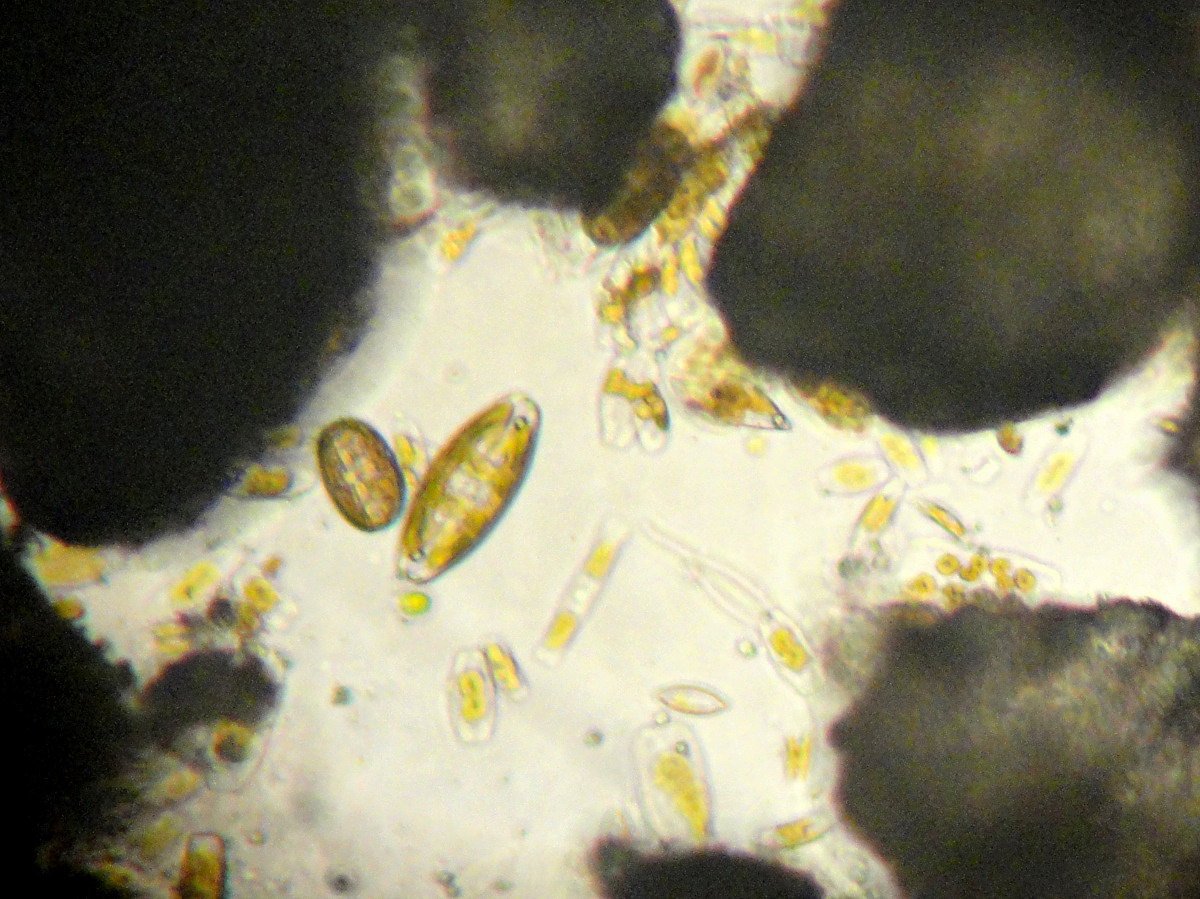
Some of my meiofauna. Taken by removing the eyepiece from the phase microscope and pointing the camera down the tube.
The marine meiofauna, defined as animals of microscopic size living in marine sediments, is one the earth’s richest and most diverse community extending from the shore to the deep sea. The marine meiofauna still contains numerous undescribed species and higher taxa. Special morphological adaptations evolved, especially in meiofauna living in the intertidal zone which is under a strong abiotic regime. Certain higher taxa evolved exclusively in the marine interstitial system. Evolutionary constraints caused elaborated life-cycles, migration patterns, special reproductive behaviours and structural adaptations. The interstitial system is also habitat for larvae and juveniles of certain macrofaunal species.
From Marbef.org (Marine Biodiversity and Ecosystem Functioning)

The majority of these organisms live in the top inch of the sand or mud. I sampled the top half inch. With Snail's help, I have more or less identified diatoms, (like those in the photo above, and more), ostracods (the jittery #8 from Sunday's post), hydroids, copepods, and worms. Hundreds of worms.
Most contaminants reside in sediments, and meiofauna are intimately associated with sediments over their entire life-cycle, thus they are increasingly being used as pollution sentinels. Because meiofauna have short lifecycles, the effects of a contaminant on the entire life-history can be assessed within a relatively short time. (Marbef)

Nematodes (worms) are relatively insensitive to man-made pollutants. I found in my samples several small, fat worms, a few polychaetes, identifiable by their red colour and their hysterical swimming style, and hundreds of long, sleek worms, from almost invisible at high magnification, to monsters a millimetre long or more. 

Mostly diatoms in various sizes and stages, probably a hydroid, and something making a chain. Taken with the low-power lens.

And while I was watching the diatoms, a worm snaked by, knocking away the sand grains in his path . This is his mid-section. At bottom left, one of the critters I was looking at.

My grandson has come for his microscope, leaving me in its place a less powerful direct light one that the camera can't cope with. Back to the drawing board ...

Stalked animals. I think the upper one is a hydroid.

The diatoms next, probably tomorrow.


Saturday, October 22, 2011

Obelia and the Very Messy Limpet

When we go to the beach, I pick up a bag of veggies for the animals in my aquarium. The crabs love green sea lettuce; I often see them grab a floating leaf, tear it into chunks and gobble it down. They're fond of a side salad of red Turkish towel, too. The big brown anemone seems to do better when there is a bit of rotting kelp nearby. Hermit crabs like the red stuff; thin red algae and Turkish towel. Some hang out on the sea lettuce, picking at the surface.

Snails and limpets feed on fresh eelgrass, but the hermits like it best a bit aged, covered with weedy growths. They browse knee-deep in the "pasture", whether eating the weeds or searching for bits of detritus, I don't know.

Eelgrass blade, with fuzz and a couple of limpets.

The last batch of fuzzy eelgrass brought along a small limpet, as fuzzy as the grass itself.

Limpet, bubbles, and a city on a hill.

The limpet is about 1/2 cm. lengthwise, less than 1/4 inch. I looked at it through a magnifying glass, to see if the tiny spiral worms were alive, and found a thriving community, more diverse than I had expected. I've been trying to get photos ever since, difficult since I needed it to stay underwater so that the waving, feeding critters would be out. There was so much activity that, even in still water, the eelgrass blade floated to and fro.

Side view.

In the peak of the limpet shell, a new eelgrass plant is growing. Under its shade, there's a circular patch of bryozoans. The red blob above this, and red lines in other spots, are feeding tubeworms. At the rim, two tiny (less than a millimetre long) mussels are hanging on.

Empty worm cases (Spirorbis) on the top of the shell.

The feeding tentacles of many tubeworms, in the crevices between stalks and spiral worm shells, are only visible under a microscope; among them tiny crawling and swimming things wander about.

A mussel on the eelgrass. Maybe a millimetre long. And on its tip (look closely) there's another shell, possibly a limpet.

It would be much easier to examine this limpet shell without all the weeds cluttering up the view. Or so I thought, until I came to my senses and paid attention to them, too.

One branch, covered with buds.

More than buds.

The "weeds" are animals: hydroids, one of the Obelia* species. They are cnidarians, related to the jellyfish; the adults form stalked colonies, but the young start out as medusas, miniature jellies. The "buds" are polyps, some feeding, some reproductive. In the photo above, just above the centre, you can see one open polyp, feeding. The tentacles are tipped with stinging capsules that explode when a prey animal touches them, incapacitating it so that the tentacles can bring it down to the mouth.

When a polyp is disturbed, it shuts down quickly. Most of the ones I saw were closed. I guess I was scaring them.

A closed polyp, with the tentacles pulled inside a thin case.

Life cycle of an Obelia. Image from Kent Simmons, U of Winnipeg.

The reproductive polyp has no tentacles. Inside it, baby medusas form and are set free as they mature.

Empty reproductive polyp.

I saw one tiny stalk with the open tentacles at the top, hiding at the base of the eelgrass blade, either a new branch on the old colony or a young polyp, recently settled. It was too small, too transparent for my camera.

*Obelia. Sounds like a woman's name. Would you name a kid Obelia?

Monday, September 12, 2011

We haz critters: IRFD #5


Well, you have been busy, haven't you? You've flipped wet rocks, dry rocks, seashore rocks and mountainside rocks, paving stones, and the occasional log. And you've found ... let's make the list:


From the blogs, I moved on to Twitter, (hashtags #rockflip and #irfd) and there I found:

  • "... Rattan creek #rockflip. Usually there's lots of water here. #irfd yfrog.com/kjnd9exj yfrog.com/h8jasqjwj yfrog.com/kjzldhkj" From @gjesse
  • @microecos reports "A little light rock flipping in the early PM: annelids, planarians, isopods, chilopods, slugs, snails, ants, springtails", but so far, hasn't put up a blog post. UPDATE: His post is "Flippant", but packed with goodies.
  • Jenny, with her 4- and 6-year-old daughters got wet and muddy and mosquito-bitten in a creek bed. Such fun!
  • The Science Goddess had to resort to flipping a birdbath. See What It's Like on the Inside for details.
  • CabinGirl didn't just bend the rules; she made pretzels out of one. But she found a beautiful Banded Tussock Moth Caterpillar, so I'll waive the (nonexistent, anyhow) penalties.

Several of these posters added their photos to the Flickr group, as well. 

And this one; how do I categorize it? It's a blog post, but it's fiction. Or is it? You be the judge; here's Hugh's fictional character, the Interpreter, Flipping Rocks.

There will be more. Several people have mentioned their plans to flip, but haven't done a blog post yet. I'll add the links as they come in, so do check back to see them.

Thursday, July 07, 2011

Two mountains

Worm mountain:

Towering above the plain.

People mountain:

Mount Baker, up to its old flying tricks again.

From another low tide at Boundary Bay.

Friday, March 04, 2011

Behind the red door

On a sunny morning, at low tide, walk down a rocky beach picking up bits of seaweed, old clamshells and mussels, bits of rock. Chances are, you've picked up a few, or many, dwarf calcareous tubeworms, tiny white coils of calcium carbonate catching the sunlight. They're beautiful, so perfectly round, so sparkly, but that's about the limit of what you will see on that mussel in your hand. It lies inert, just a coiled hard pipe.

I tend to notice them, then turn my attention to something more intriguing.

Several tubeworms. But I was looking at the bryozoans and sponges. And is that a nudibranch?

The trouble is, to really see one, you have to find it alive, unafraid, and underwater. And you need a lens; they are too small to see more than a speck of red, even while they're feeding. And you need the light in the right place. So when I noticed one glued to the tip of a limpet cruising the eelgrass in my tank, and close to the glass, to boot, I ran for the camera and my home-made lens.

Dwarf tubeworm on limpet on eelgrass, about 1/2 inch wide (the eelgrass, that is).

There are several species of these calcareous tubeworms in BC waters*, virtually indistinguishable from each other without close study. Some prefer to settle on seaweeds, others choose rocks or shells; some form large communities.

The tube is white, sometimes thin enough to show the orange-red worm inside. Feeding, they extend a crown of red tentacles from the mouth of the tube. Startled (and your shadow will do the trick), they disappear inside, and the only sign of occupancy is the red trapdoor, or operculum, that they shut tight against predators.

The trapdoor has other uses. The worm has both male and female segments; once she/he has fertilized the eggs, the door becomes a brood chamber. Sometimes, depending on the species, the chamber is like a cup; sometimes it's more like a helmet.

Another species characteristic is the direction of the spiral. Going from the center outwards, this worm coils counter-clockwise. Others follow the clock.

A closer view. Trapdoor in front, crown of tentacles behind. The tube is old and stained, and has been banged about; it's broken in several places. The worm shows red through one hole, but can't be seen in the central coils.

Responding to my shadow. He's hidden inside, and the door is fast shut.

I found another limpet/worm combination on some sea lettuce. This one's quite a bit smaller.

A newer tube, cleaner and less chipped. Also counter-clockwise.

There are a few astoundingly gorgeous photos of similar worms from California, a much larger species, but with the same colours and structures, on Flickr, in John Albers-Mead's photostream. Look at this one!

*They can be found in many other locations, in a wide range of latitudes.
Powered By Blogger