Showing posts with label holdfast. Show all posts

Monday, May 31, 2021

Anchors aweigh

Each beach has its own unique fingerprint, made up of sand and stone, animals large and small, plants and algae. This, that I've labelled "moon snail beach" in my files, is a mostly sandy beach after the top few metres of stone and crabs; clean sand, on a gentle slope, and home to a forest of young bull kelp.

Looking south. Salmon Point in the distance.

The green stuff is eelgrass and sea lettuce. Reddish brown; sargassum, bull kelp, winged kelp. Red: eyelet algae, red noodles. Two moon snail collars visible here.


Young kelp, under 2 metres long, holdfast to fronds.

The holdfasts are not roots; they don't provide nutrients, at least for the kelp, but serve to anchor the algae on the sea floor, glued somehow to rocks. Even in strong tidal surges and wave action, the stipe is strong enough to resist breaking, as long as the holdfast is attached to something heavy and solid enough. Unfortunately for this youngster, it chose the wrong location, and a stone far too small to stay put under the waves. It will end up tossed and drying high on the beach.

Kelp needs to establish itself in the subtidal zone; young ones that grow intertidally don't survive, but they do provide habitat and food for small invertebrates while they last.

Unwise choice of anchor stone.

These foolish kelp youngsters all picked the same small stone. Even in calm water, they had no hope of staying anchored to the bottom.

Winged kelp. This has been torn from its holdfast underwater. The holdfast will survive to grow another blade next year.

While the blades of kelp only live about a month or two, holdfasts can live and grow for up to ten years or more! (Catalina Sea Camp)


Red eyelet silk seaweed, covered in sand. This grows from the low intertidal zone downward.

A red noodle seaweed, attached to its holdfast.

This one can live in the low intertidal zone, as long as it remains attached to the stone.
 

~~~~~~~~~~~~~~~~~~~

Cada playa tiene su propias características, incluyendo si se basa en piedra o arena, los animales grandes y pequeños que allí viven, las plantas y las algas. Esta playa, a la cual he nombrado "playa de caracoles luna" en mis archivos en la computadora, se compone principalmente de arena, aparte de los primeros metros de la zona superior, que está cubierta de piedras y cangrejos. La arena se inclina ligeramente hacia el mar; allí, en la parte más baja, crece un bosque de algas kelp juveniles.

Primera foto: la playa, mirando hacia el sur. En la distancia, Salmon Point.

Lo verde en la foto es hierba marina Zostera, y lechuga de mar. Lo café es sargazo y kelp. Y las algas rojas son el alga "ojete de seda", Sparlingia pertusa, y espagueti rojo. Se ven dos cuellos de caracol luna. también.

Segunda foto; un alga kelp juvenil, midiendo menos de 2 metros, desde el rizoide hasta las láminas.

Los rizoides no son raices; no proveen nutrición al alga, sino que sirven como ancla fijada de alguna manera a las piedras bajo el agua. Aun cuando la fuerza de la marea y las olas es vigorosa, las estipes (el tallo) son suficientemente fuertes como para resistir sin romperse, siempre y cuando el rizoide esté fijo en algo pesado y sólido. Mala suerte fue para esta kelp juvenil escoger una piedrita que no le puede detener en su lugar. Terminará aventada y secándose en las piedras al lado del mar.

El alga kelp necesita establecerse en la zona submareal para sobrevivir. Estos jóvenes no vivirán, pero mientras proveen habitat y comida para animalitos invertebrados.

Tercera foto: sitio mal escogido. Varias algas se fijaron a una sola piedrita. Ni en aguas tranquilas esto le iba a servir.

Cuarta foto: kelp "con alas", separado de su rizoide, que sigue en el agua y producirá nuevas láminas el año que entra.

¡Mientras las láminas de kelp viven solamente uno o dos meses, el rizoide puede vivir y crecer por diez años o más! (de Catalina Sea Camp)

Quinta foto: el alga "ojete de seda" cubierta de arena. Esta alga vive tanto en la zona baja intramareal como en la submareal.

Sexta foto: un alga "espagueti rojo". Esta puede vivir aquí en la zona baja intramareal mientras sigue en contacto con la piedra.


Wednesday, December 09, 2015

Another lifer!

I picked up a couple of small kelp holdfasts on the beach last week, rescued them from the mounds of seaweed shreds the tide and waves had tossed onto the rocks. They'd make a temporary addition to my tank; the hermits love to poke at them, roll them around, play King of the Castle on them.

They were battered and broken, and I noticed a couple of orange bits that looked like snapped stems of something, along with all the torn worm tubes and unidentifiable bits. More stuff for the hermits to pull apart.

Tonight, cleaning the tank, I saw that the orange bits were now a strong pink. I replaced the holdfast in the tank, right up against the glass to get a better view, and once things had settled down, they stretched out and opened two little pink pipes.

A tunicate, or sea squirt, standing tall at the foot of the holdfast. (Off to the right side, the tentacley thing is the edge of a busy sand dollar.)

"The basic tunicate is attached to something solid and has two openings at the top called siphons." (From Marine Life of the Pacific Northwest, pg. 346)

I'd never seen one of these before today*. It's a solitary tunicate, Pyura haustor, aka warty sea squirt, wrinkled seapump, or the decorator tunicate (because they glue stuff to their bodies; this one has a bunch of old worm tubes and, if you look closely, a tiny snail shell. When they are not feeding, they may be completely hidden under their collection of junk.). They can grow up to about 3 inches tall.

Zooming in. One siphon is the mouth, or intake, the other is the outflow.

*At the link above, from WallaWalla.edu, there is a photo of one of these, completely coated in blackish gunk; I could have seen hundreds like that, and never recognized them.

Sunday, January 04, 2015

Welcoming committee

For New Year's Day, I posted a photo of a brand new, freshly hatched, pinhead-sized Leafy Hornmouth snail, just starting out on his adventure. This is the backstory.

It started with the small kelp holdfast I brought back from the beach in November. It came with its own cargo of crabs and worms and starfish, but there was a small blank space on the inner side of the clamshell; here, the pair of big snails* in my tank chose to anchor their latest batch of egg cases.

The inner side of the clamshell, as it is today. Much-nibbled-on kelp "roots", and the egg cases at the bottom.

The first of the baby snails started to emerge from the cases a couple of weeks ago. I was on hand to photograph the "birth". So were some other observers, with more ominous intentions.

Three open egg cases. The siphon tip of the latest baby peeks out the exit hole of one.

Several snails hatching at once, at the beginning of the escape. Several egg cases still have their plug in the escape hatch. (Top two on the left, for example.) But look carefully at the background!


Waiting for dinner to be served. Flatworms are always hungry!

There were two flatworms, both very tiny, as flatworms go, humongous in relation to baby snails. One was green; I'd seen it before, but this purplish one has only showed up for the hatching, and has never been seen before or since.

The smallest of the black-clawed crabs, still living in the holdfast.

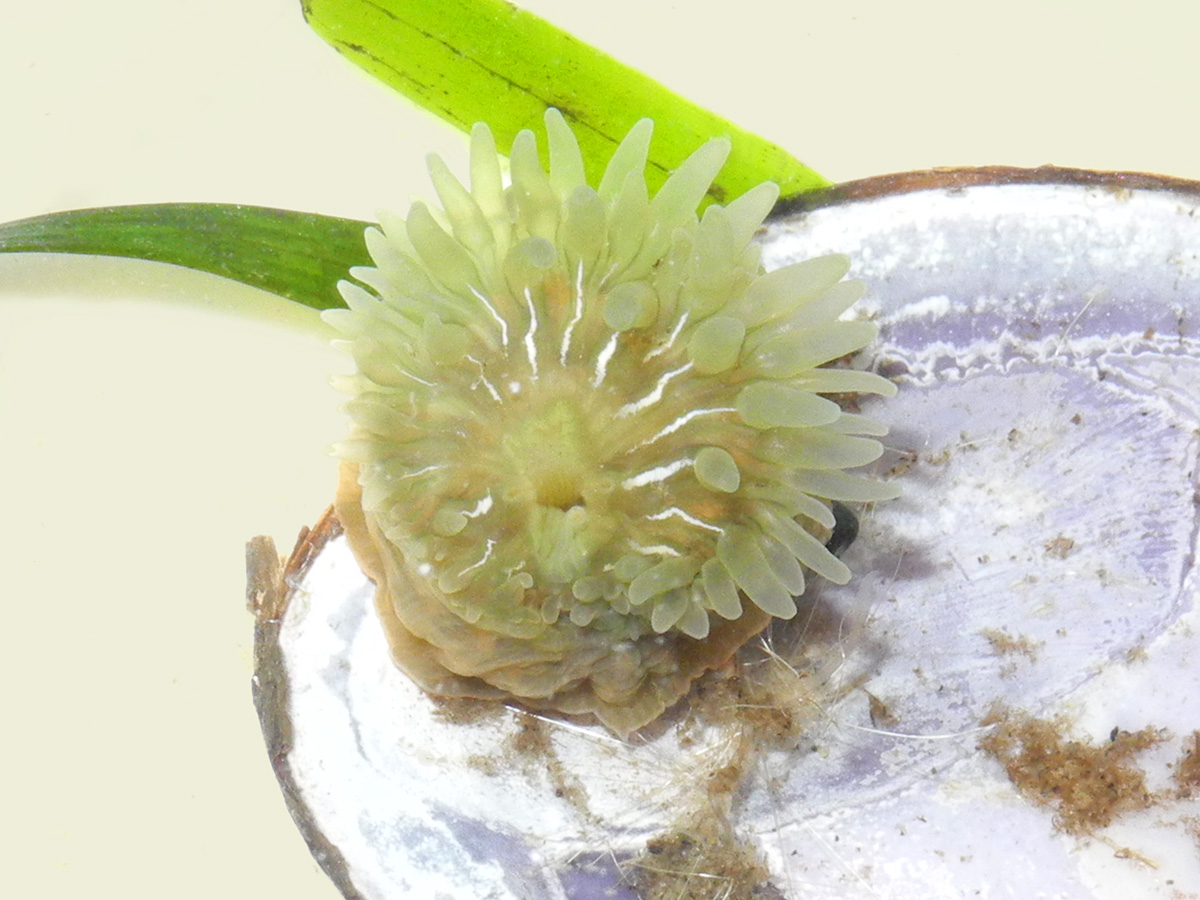
Against the back wall of the clamshell, too tiny to see without a lens, I found a colony of green anemones. Looking again later, I saw that one had a snail in its mouth.

Watch the holdfast for a couple of minutes, and somewhere among the roots, a worm will poke out his head. There are a dozen or so living here.

Polychaete in his tunnel made of a glued fold in sea lettuce. Tiny, but those jaws will gape as wide as the belly of the beast.

Out searching for food. The tail never leaves the burrow, but he can stretch the full width and height of the holdfast colony.

The brittle stars seem to have disappeared, which would be a relief to the snail parents, if they were of the type to fuss over their offspring. The other two stars have been deported to the shore where they came from, for crimes against snaility. (They were eating the tank cleanup crew; they would have had these babies for appetizers.)

Mortality rates are high in the intertidal zone, especially for the young. One of those egg cases would have started out with about 50 eggs; less than half would survive to hatch. And of the hatchlings, depending on where they emerge and the predator load, anywhere from 50% to 99% will die within the first few weeks.

Observations in San Juan Islands, Washington show that a newly hatched N. lamellosa (Related to my leafies - me) has a 1-2% chance to reach 3mo of age.  An individual reaching 3mo has a 35% chance to reach 1yr of age.  Older, larger, individuals have a 40-60% chance to survive through subsequent years.  Spight 1975 Oikos 26: 9. (From A Snail's Odyssey)

My baby snails, those that made it past the welcoming committee, hurried out of the holdfast to hide in the sand.

On his way.

Zooming in. Siphon to the left, leading the way. Within a few seconds, he had ballooned off the holdfast root, washed away in the current to a "safer" place.

Even out of the holdfast, there are dangers. Hermit crabs. Even the tiny hermit crabs. Shore crabs. Anemones everywhere. Any of these will relish a tender baby snail hors d'oeuvre. The ballooning snail burrowed down into the sand as quickly as he could.

But there are worms down there.

Three times, I've seen a baby on the glass, high above the sand, out of reach of all but the climbing hermits. Good choice. They may survive.

Infant snail, above the water line, surrounded by his own body bubble. Taken through the glass, against the light, which shines through the yellow button at the tip, and shows the ridges on the shell. The dark spot is the operculum, which closes the shell when the snail is resting.

*The parents were Mike and Tillie, Leafy Hornmouth snails (Ceratostoma foliatum). They have since been returned to their home beach, since my visits to the winter shores weren't providing enough juicy barnacles to keep them fed in the tank.


Saturday, December 06, 2014

Beauty or war?

I mentioned the other day that a teeny, tiny crab was living in the kelp holdfast. I was mistaken; there's a whole family hiding in those roots. I've caught three, so far.

The largest is 5 mm. across the widest part of the carapace. The smallest is less than half that, a mere crab-walking speck, even in a white bowl.

I took a few photos of the two largest in a bowl, and then in the holdfast, dodging behind the roots.

Three "teeth" are visible at the corners of his carapace.

This one looks pinkish. The little striped "flags" he waves constantly flash bright red when they catch the light. 

Then tonight, doing routine maintenance on the tank, I found a freshly molted carapace; a good chance to get a look at those black claws!

Top view. He's lost some of his colour; the carapace is actually translucent, so much of the colour of a crab is from the body underneath.

And bottom view, showing the pincers and black claws.

This is the black clawed crab, Lophopanopeus bellus, aka Xanthteo bella. The species name, "bella" or "bellus" comes from the Latin, "beauty", although it has also been mis-translated as "war", from "bellum". Not without reason, in this case; these are aggressive crabs.

The crabs are variably coloured, ranging from whitish or grey to purple, but they all have black claws. They may grow to about an inch and a half across the carapace, and are known to give quite a hearty pinch for their size. (This one drew blood!) They live in sand under rocks, or in the holdfasts of kelp, eating a bit of everything, from algae to other crustaceans.

The holdfast also is home to a fair number of worms. Food for the crabs, or competition for the food available? Or both?

Tuesday, November 11, 2014

Snaky star

As soon as the holdfasts I'd brought back from the beach were out of the bag and in a bowl of clean salt water, three brittle stars squirmed out from among the roots. They were so tiny, so almost colourless, that I wouldn't have seen them if they hadn't been trying to escape the light.

The first brittle star, captured in a plastic cup. Missing half an arm.

Brittle stars are not starfish, but are related to them. They do not use suction cups on tube feet to move, but rather wave the arms about wildly to swim, in a haphazard fashion, going where the current takes them.

The arms break off easily, leaving a hungry predator with a mouth full of spines and no meat. The star grows the arm, or arms (up to 4) back. The detached arms themselves don't regenerate a new brittle star, though. (As some starfish do.)

A second brittle star, in the aquarium. Parts of two arms missing. The star-shaped opening at the centre is the mouth.

These are possibly the dwarf brittle star, Amphipholis squamata, aka  the holdfast brittle star, aka the small serpent star (for the movement of the long arms). The ones we found a few years ago in Campbell River had much longer arms, and were probably the long-armed brittle star, Amphiodia occidentalis.

Much bigger, much more wriggly. More here and here.

Within a few minutes of being placed in the tank, all three had disappeared. I've been looking for them since Brat intervals, with a lens and flashlight, but have seen no sign of them. They seem to prosper in other aquaria, so they may show up again, with all their arms intact.

I've been watching that bigger starfish; the more I look, the more interesting it gets. I just took another batch of photos, to process tomorrow, I hope.

Friday, February 08, 2013

Rescue operation

They line up along the shore, all these busy housing developments, piled higgledy-piggledy among the rotting remains of their gardens, their tenants struggling to cope with the sudden changes in the weather, the drafty walls, the loss of food sources. Some move out; others have no place to go. They're doomed. Once in a great while, they are rescued on time.

Laurie keeps finding me bull kelp holdfasts, full of stranded critters. I can only bring so many home; there's not enough time to examine them all, nor can I save more than a few of the dispossessed. Last week, I picked two of the freshest (but they were already disintegrating in my hands) and brought them home to see who was still living there.

Worms, of course; the almost microscopic snaky threads; a few polychaetes, already dead, which I fed to the hermit crabs, a special treat; and a purple ribbon worm, Paranemertes peregrina.

The underside is a paler brownish colour. The worm was about 4 inches long, although he wasn't too enthusiastic about untangling himself to be measured.

The species name, peregrina, means travelling, so this worm is also called the wandering worm, or the restless worm. It's a predator that wanders about hunting for smaller worms among rocks and mud.

There were several snails deep inside the maze, hard to dig out without dismantling the walls. A couple of dead barnacles. A very small clam, alive and active, now delving happily in my aquarium bottom. Circular patches of bryozoans. And amphipods, of several species; the common beach hoppers, squatters in the abandoned hallways, and some very large, brown amphipods, twice the size and more of the ones that live in the eelgrass.

And on the topside of one of the holdfasts, there were two fat, solid-looking, yellow, bagel-shaped things. Egg cases, probably, although it seems early for them. They were about 2 mm across. I left them in the aquarium while I tended to other things, then went back two days later to take their photos. Alas! All that was left was a large mass of transparent jelly, fraying and dissolving into the water even as I looked it over.

A couple of handfuls of eelgrass, roots and all, were more productive. On the blades themselves, I found many limpets, a couple of very small mussels (one survived), green amphipods, bryozoans and just a few little containers that seemed to be holding eggs.

Round, fat, crystal vases with scalloped rims, some still holding a few white egg masses. On rotting eelgrass. What will come of these? I'm holding them in their own little cup; so far, they seem to be alive.

I always check eelgrass roots for skeleton shrimp. There are usually a few, even in winter; this time, they included the largest one I have ever seen. They grow up to about an inch and a half; this one was half that.

A female, carrying young in her green brood pouches.

Anemones, when they don't approve of their surroundings, often up anchor and slide or even float away. My burrowing anemone has worked her way about a foot along the floor of the aquarium to a spot she likes. Other anemones just let the water carry them whither it will. So when I found three small, green anemones, probably the orange-striped anemone, in the bag of eelgrass and holdfasts, I couldn't be sure where they had been attached. These do like the upper intertidal zone, so they were probably on the eelgrass.

The largest one, found first. I settled him down on a clam shell, and he seemed pleased with that, but once in the tank, he left it and climbed up the wall to just under the water surface. There he remains, for the time being.

Bottom disc. The orange striping is visible. About half an inch across.

The other two were much smaller, and have been eelgrass hopping, not yet finding blades to their taste. They will, but it has to be their decision; for critters without a brain, amazingly, they still manage to have their own ideas.


Sunday, August 22, 2010

In the holdfast: feathers, spines, eyes and ... mustaches?

When the tide is at its lowest, we try to be there, to walk out to the far edge and wade in the eelgrass beds or scramble over the weedy rocks. Here the shore critters thin out, giving way to those that like deeper, colder water; here the big crabs roam and the geoducks spit at us as we walk. There's a line where the starfish start, a sunfish level, a nest of kelp crabs waving pincers at the careless hand, fish and sand dollars.

I always wade in, looking out at the deeper water, where the kelp grows. I can't go there. The swaying forest with its multi-species community is always just out of reach.

But at high tide, on windy days, the tables are turned. The waves rip up boatloads of kelp and eelgrass, roll them up like carpets, and toss them on the dry shore for me to poke at. I search the eelgrass for isopods and snails, the kelp for bryozoans and flatworms, or maybe even a nudibranch or two. This week I left the blades of kelp alone and we collected small holdfasts.


Holdfast, somewhat sun-bleached.

A holdfast looks like a root mass, but it doesn't gather nutrients. It's function is to hold the kelp down. At the far end are the long fronds, and the floating bladders; without a good anchor, the kelp is at the mercy (none) of the waves. The holdfast is tough and strong; it grabs onto rocks at the bottom, where it may stay for up to seven years. It's an ideal hiding place for small creatures, an interface between sea floor and live plant, a food source and a hunting ground. I wanted to see what lived there.

At home, I dumped my holdfasts into a bowl of fresh sea water, and gently pried and cut them apart. (Even the thinner stems are as tough as green wood.) Quite a few dead amphipods and skeleton shrimp floated off; it had been a rough trip, from sea floor to rollers to dry shore and sunlight, then to a plastic bag in the trunk of a car.  And the centre area, inside the teepee of "roots" was full of broken barnacle shells, the barnacles eaten away.

But then the worms came wriggling out. First, the polychaetes:


Small polychaete with an almost-human face. Love the moustaches!* And a live amphipod.

There were quite a few of these, mostly small; under a couple of inches long. And another few scale worms, which I had not seen before.


15-scaled worm, Harmothoe imbricata. I counted the scales, 15 per side.


Another 15-scaler, about an inch long.

Look at the upper end: each scale is like a sequin, circular. In these, one arc of the circle is black, which makes the pattern down the back. It is the same species as the one above, though.

And look at that little tentacly thing. That's what held me up; I couldn't identify it.


A better view. Notice the black dots on the central stalks of the "feathers".

I looked for others in the holdfasts, and thought I saw a tiny one like this, but with a stalk. I missed it, trying to fish it out, and never found it again. But there was something similar, fixed on the holdfast:


Hmmm ... Cnidarian, said my granddaughter.  Tubeworm? said I. Not in my book, whatever it is. About 1/4 inch high.

What else? There were a half-dozen mussels jammed in between the "roots", umpteen sand-grain-sized, black snails, many little brown isopods, several clams:


It looks like a geoduck, but it's barely a centimeter long, siphons and all. And it was the largest.

And loads of tiny green sea urchins:


Green sea urchin, Strongylocentrotus droecachiensis. With three black snails.

Sea urchins thrive on kelp, in such numbers that they are capable of killing an entire kelp forest if not kept down by other predators, such as sea otters.
Both sea otters (Enhydra lutris) and sea urchins (Strongylocentrotus spp.) play critical roles in the stable equilibrium ecosystem. Sea urchins graze kelp and may reach population densities large enough to destroy kelp forests at the rate of 30 feet per month. Urchins move in "herds," and enough urchins may remain in the "barrens" of a former kelp forest to negate any attempt at regrowth. Sea otters, playing a critical role in containing the urchin populations, prey on urchins and thus control the numbers of kelp grazers.
From NOAA.
The ones that came home with me are too tiny, as yet, to have done much damage. Now they're in my aquarium, in the remains of one of the holdfasts; they can eat that, for now.


Tiny, unusual shell. No snail inside. Checkered hairysnail, Trichotropsis cancellata. Eats leftovers from calcareous tubeworms.

And I was still wondering about that spiral of tentacles. I couldn't find it anywhere on the web or in my books. I decided, last night, to search again; I washed the bits of holdfast that hadn't gone into my tank thoroughly, again, shaking and prying at the stuff stuck in cracks. And I found these:


Feather duster worm. I don't know what species.


Same worm, different angle. This was about an inch and a half long.

I found several more, smaller and much smaller. The tiniest, I picked up in an eye-dropper:


Very much alive, and waving about.

So I'm thinking that the mystery "flower" (as Laurie calls it) is probably the plume of a feather-duster worm, broken off. I couldn't find its match in the Encyclopedia, but reading every description, I discovered another clue: some of these feather-duster worms have small eyes on the spine of the branches (radioles). The twin-eyed feather-duster, Bispira sp., for an extreme example, may have as many as 1,000 pairs!

Here's that photo again:


Are those eyes?

I almost forgot: there were also at least three flatworms, so tiny they were just pale brown specks that wandered around when I put them in a plastic cup with a few teaspoons of water. They're in the tank, now; competition for the two big ones that were already there.

*Reminds me of Yosemite Sam.


Powered By Blogger