Showing posts with label subtidal invertebrates. Show all posts

Monday, July 28, 2025

Lumpy, bumpy, spiny, smiley?

 Is this smiley critter a crab?

Phyllolithodes papillosus

Yes, it is! The thick spines on its legs and pincers make excellent camouflage, especially since it mainly feeds on sea urchins.

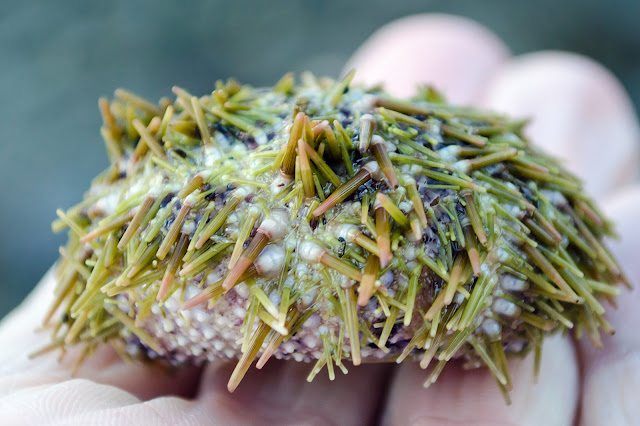
Sea urchin spines on a broken, bleached test. 2015.

It's a heart crab, so called because of its carapace; in the centre there's  a lumpy, knobby, sometimes red, sort of heart-shaped shape.

Sort of heart-shaped, anyhow.

In the description on WallaWalla. edu, they say, "This species is not frequently encountered." It may be more frequently encountered than recognized, camouflaged among the rocks and urchins and hiding under anemones, as is its custom. Younger ones are often white, with red or orange lumps; I found 354 reports on iNaturalist, mostly of these brightly coloured youngsters.

It's a subtidal species, but younger ones can be found in the lower intertidal zone, hiding under rocks. This one is spending the summer in the Discovery Passage Aquarium; come fall, he'll be returned to the place where he was found.

~~~~~~~~~~~~~~~~
Esto; ¿será un cangrejo sonriente?

Foto: Phyllolithodes papillosus, el cangrejo "corazón".

Sí, es un cangrejo. Las espinas gruesas en las patas y quelípodos le sirven muy bién de camuflaje, sobre todo porque se alimenta principalmente de erizos de mar.

Foto: un pedazo de erizo mar, mostrando las espinas cortas y gruesas.

Lo llaman el cangrejo "corazón" por la forma de su carapacho: en el centro hay muchas protuberancias redondeadas, a veces rojas, arregladas en forma, más o menos, del concepto estilizado de un corazón.

Foto #3: El cangrejo visto desde arriba.

Donde lo describen, en WallaWalla. edu, añaden, "Esta especie pocas veces se encuentra ." O puede ser que se encuentra sin ser reconocido, camuflado entre las rocas y los erizos y escondido bajo las anémonas como es su costumbre. Los cangrejos juveniles frecuentemente son blancos con protuberancias rojas o anaranjadas; encontré 354 observaciones en iNaturalist, y la mayoría son de estos cangrejos jóvenes con sus colores brillantes.

Son cangrejos de la zona submareal, pero se pueden encontrar algunos de los inmaduros en la zona baj intermareal, escondidos debajo de las rocas.  Este está pasando el verano en  el  acuario local. En el otoño lo volverán a depositar en el sitio donde lo hallaron.


Thursday, January 04, 2024

Feathery orange quill; the sea pen

For those of us humans restricted to dry land, or at least anywhere above the low-tide zone, there are creatures, close neighbours, that we rarely see except in aquariums. Like the orange sea pen; even though it likes relatively shallow water (down to 135 m.), it still remains stubbornly sub-tidal. "Try gently stroking one ..." suggests the Encyclopedia, but adds, "... on your next night dive".

I found an orange sea pen on the shore at high tide. Dead, of course; tossed up by winter storms, but still almost intact.

Orange sea pen, Ptilosarcus gurneyi. About 18 cm. long.

Back side. Restored to water, just in case it still clung to life.

"It", I say, but my pronouns are wrong; I should be saying, "they". It's not an animal; they're a whole community, or colony, of animals, each one joined to his or her neighbour (they come in both sexes) and performing his or her own function in the community. Some fish for planktonic food, some pump water in and out of the central stalk, some attend to respiration, some start the next generation. And one becomes the main support; it loses its tentacles and forms itself into a calcium carbonate stalk ending in a bulbous peduncle which serves as a root, anchoring the colony in the sea floor. The other members of the colony branch off the upper stalk.

They're Cnidarians, members of the phylum that includes sea anemones and corals; each animal is a polyp, a hollow column with eight tentacles, like a miniature sea anemone. They arrange themselves in rows with the tiny tentacles along the outer rims. (For more detail, WallaWalla.edu has photos. Scroll down.)

They can live up to 100 years. If a sea star doesn't eat them. Or a nudibranch; the opalescent nudibranch, Hermissenda crassicornis, common on our shores, is one of its main predators. Scientists estimated the age reading the growth rings in the stalk, like the growth rings on a tree, one ring assumed to represent one year

Oh, and stroking them? Like a cat purring, the sea pens glow green when they're petted. Gently, now!

~~~~~~~~~~~~~~~~
Para nosotros los humanos, los que estemos limitados a explorar en tierra firma, o por lo menos, si estamos cerca del mar, en la zona intramareal cuando la marea la deja expuesta, hay criaturas vecinas que raramente vemos si no están en el acuario. Entre ellas, la pluma de mar anaranjada; aunque vive en aguas cercanas a la costa (de 10 a 135m. de profundidad) se mantiene sumergida aun en las mareas más bajas. "Acaricie una suavemente," sugiere mi Enciclopedia, pero añade, "en su próximo buceo nocturno."

Encontré una pluma de mar anaranjada en la playa a marea alta. Muerta, claro está, arrancada de su sitio por las tempestades de invierno, pero casi entera.

Fotos: la pluma de mar anaranjada, Ptilosarcus gurneyi, primero fuera del agua, luego en agua, y volteado "boca abajo".

La pluma — pero mejor debo decir, las plumas, porque no es un individuo sino una comunidad, una colonia de animalitos, cada uno (o una; los hay en ambos sexos en la misma comunidad) con su tarea específica; unos (o unas) pescan entre el plancton para alimentar la colonia, unos llenan de agua el soporte, unos se encargan de la respiración, otros llevan a cabo la reproducción. Y uno forma la columna que sostiene erguida la colonia. Perdiendo sus tentáculos, se transforma en un tallo de carbonato de calcio, con el extremo inferior abultado para formar el pedúnculo, que se introduce al fondo marino. Todos los otros miembros de la colonia forman ramas de este tallo.

Son miembros del Filo Cnidaria, animales que incluyen las anémonas de mar y los corales; cada animalito es un pólipo, una columna hueca con ocho tentáculos. Se acomodan en hileras con los tentáculos en el borde exterior. (Para más detalle, vean las fotos de WallaWalla.edu.)

Pueden vivir hasta los 100 años, si no las come una estrella de mar. O un nudibranquio; el nudibranquio opalescente, Hermissenda crassicornis, que se encuentra comunmente en nuestras playas, es una de sus principales depredadores. La edad la estimaron los scientíficos leyendo los anillos de crecimiento en el tallo, parecidos a los anillos de crecimiento que se hallan en el tronco de los árboles, estimando que se forma un anillo cada año.

¿Y eso de acariciarlas? Como cuando lo acaricias, el gato ronronea, la pluma de mar produce un brillo verde, bioluminiscencia. 

Monday, June 12, 2023

Composite critter

 Ma Nature is never boring. She always turns up with something new and different. Like this arrangement of crab and lobster parts, with a bit of hermit thrown in.

Squat lobster, Munida quadrispina

I had never seen these before. They live on the ocean floor, from about 12 metres down to 'way down. Seeing them in the aquarium, under a few inches of water, they looked like long-pincered hermits that lost their abdomen to a predatory crab. But it's there; like true crabs, they hold it doubled underneath, although, like the hermits, they do not hide it under a self-made shell.

While squat lobsters look like true lobsters, they are more closely related to hermit crabs. Instead of carrying shells on their backs, they squeeze their bodies into crevices and leave their claws exposed to defend themselves from predators or other squat lobsters. (Wikipedia)
They hide from predators in rock crevices and under cobbles. Their long claws allow them to feed from the safety of these recesses. (Wikipedia, Munida quadrispina)
And, like a lobster, they can actively swim backwards; they extend that abdomen and flap the fan-like uropods at the end.

Uropods, these belonging to a Norway lobster. Wikipedia, Vassil, Public domain.

E-Fauna BC has a clear photo of a stretched-out squat lobster: link.

Two squat lobsters trying to hide under a fragment of seaweed.

Wikipedia says that members of this family sometimes have setae near the eyes that look like eyelashes. I think, blowing the photos up, I see faint hints of these; I'll have to look more closely the next time I visit the aquarium.

~~~~~~~~~~
La Madre Naturaleza nunca aburre. Siempre nos sorprende con algo nuevo. Como por ejemplo, este arreglo de partes de cangrejo y de langosta, con un poquitito de ermitaño para darle sabor.

Foto: Una langosta "achaparrada", Munida quadrispina.

Nunca antes había visto estos animalitos. Viven en fondo del oceano, desde unos 12 metros debajo de la superficie hasta sitios muy profundos. Viéndolos en el acuario, bajo unos cuantos centímetros de agua, se parecen a cangrejos ermitaños con pinzas largas, ermitaños que han perdido el abdomen, debido a un ataque de un cangrejo hambriento. Pero sí tienen el abdomen, no más que lo llevan doblado bajo el cuerpo, como un cangrejo "verdadero", pero sin el caparazón protector.

Mientras que las langostas "achaparradas" (también conocidas como langostas gregarias o langostinos de los canales) se parecen a las langostas verdaderas, son más cercanamente relacionadas a los ermitaños. En lugar de llevar una concha en el abdomen, insertan sus cuerpos en grietas y dejan expuestas las pinzas para defenderse de depredadores o de otras langostas. (Wikipedia)
Se esconden de los depredadores en grietas de las rocas y debajo de piedras. Las pinzas largas les permiten capturar su comida desde estos refugios. (Wikipedia, Munida quadrispina)
Y como las langostas, pueden nadar para atrás; desdoblan el abdomen y agitan los urópodos al final.

Foto: los urópodos de una langosta de Noruega. Foto de Wikipedia.

En E-Fauna BC, hay una foto de uno de estos animales extendido, enseñando los urópodos; haz clic aquí

Foto: dos langostas achaparradas tratando de esconderse bajo un fragmento de alga.

Wikipedia dice que algunos miembros de esta famila tienen setas alrededor de los ojos, y que se parecen a pestañas. Viendo estas fotos aumentadas a lo máximo, me parece que tal vez veo unas de estas pestanas. A la próxima visita al acuario, las observaré con más atención.

Thursday, June 16, 2022

Showy

I stopped by our local (tiny) aquarium, and took a few photos, near the open door where the light was adequate. It is stocked every summer with local species, which are returned to their site of origin in the fall. 

And though all the animals are local natives, there were critters I have not seen before, all decked out in fiery colours:

Bright orange and red hermit. With orange antennae. In a large shell, and wearing a pink-tipped anemone.

I think this is a blackeyed hermit, Pagurus armatus. They are subtidal hermits, which may be why I have never seen them in the intertidal zone. They grow to 4.5 cm. long.

And then there's this one with red and white antennules. The same species, or another? 

Orange is a common colour for our subtidal hermits.

And a small community:

Orange, red, pink, and green, against a blue background.

The large tube on the right is the neck of a bottle, covered with encrusting sponges; a brittle star is inside, waving a couple of legs at us. It's probably the daisy brittle star, Ophiopholis aculeata; I do find these in our intertidal zone. There's another under the bottle. 

On the left, perched on a shell, there's a small orange tunicate, maybe a sea peach. Lower down, two anemones. On the stone, a a pink encrusting sponge. The two spiny spikes at the bottom may be the legs of a feather star.

And this I do recognize; there are hundreds of them on any local beach, near the bottom of the intertidal zone.

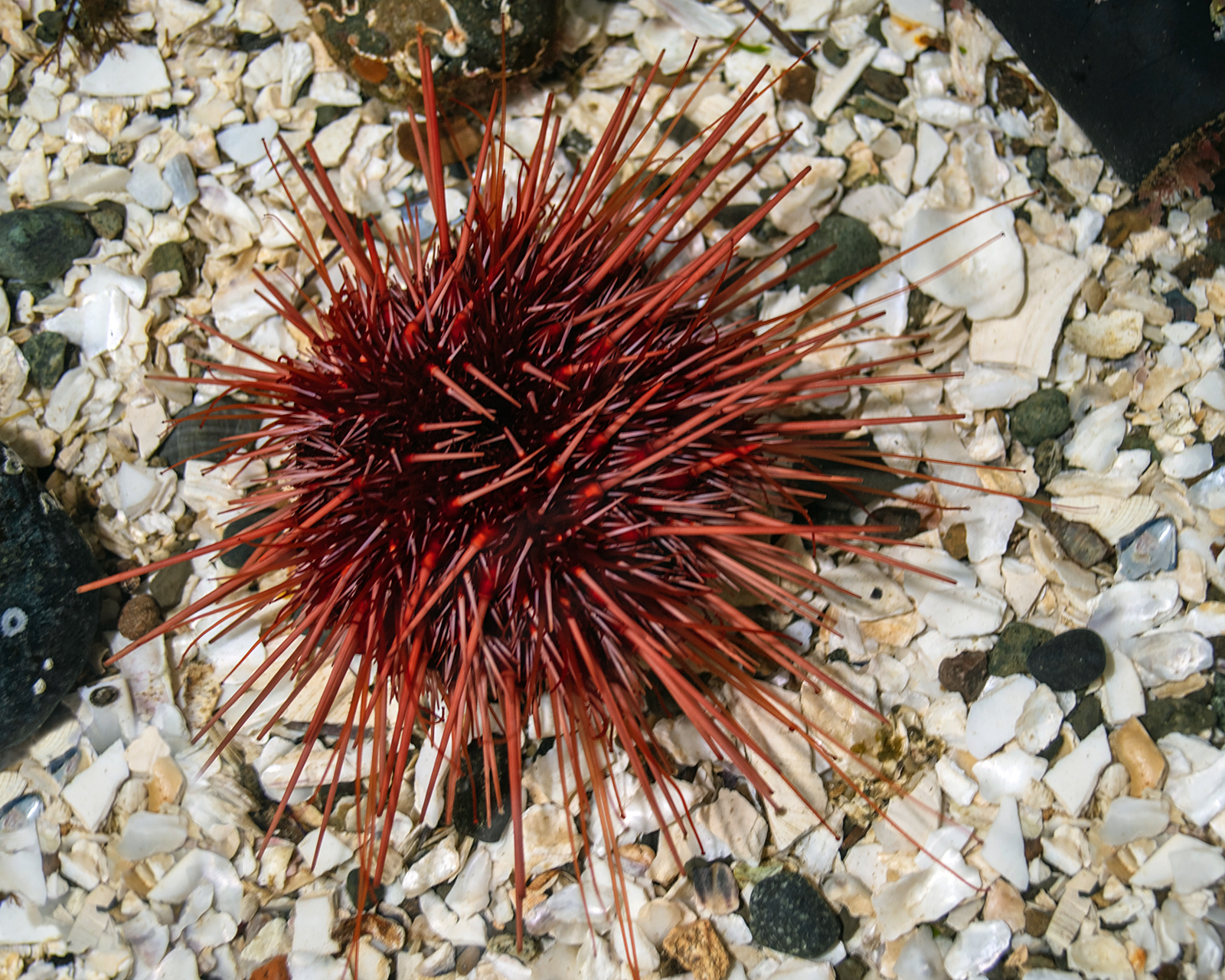
Red sea urchin, Strongylocentrotus franciscanus.

~~~~~~~~~~~~~~~~~~~~~~~~~~~~
Visité nuestro acuario local, muy pequeño, donde cada verano se llena de animales de nuestras playas y el mar, todos nativos a la región. En otoño, se vuelven a su stitio de origen y el acuario se mantiene cerrado todo el invierno.

Aunque los animales viven aquí cerca, había varios que yo no había visto antes, todos luciendo sus colores de fuego.

Foto # 1: Un ermitaño anaranjado con rojo, y con antenas anaranjadas, llevando de adorno una anémona de puntas color de rosa. Creo que es el ermitaño de ojos negros, Pagurus armatus. Estos son ermitaños que viven en la zona submareal, que puede explicar porque no los he visto. Son ermitaños grandes, que llegan hasta 4.5 cm. de largo.

Foto #2: Y este tiene anténulas con rayas rojas y blancas. No conozco la especie. El anaranjado es un color muy común entre nuestros ermitaños submareales.

Foto #3: Una pequeña comunidad. El tubo a la derecha es la boca de una botella, toda cubierta de esponjas encrustantes, anaranjadas, rojas, y cafés. Adentro hay una estrellita quebradiza, probablemente la estrella quebradiza margarita, Ophiopholis aculeata; si encuentro estas en nuestra zona intramareal. Hay otra debajo de la botella.

A la izquierda, pegada a una concha, hay un tunicado anaranjado; tal vez sea un "durazno de mar". Más abajo, dos anémonas. En la piedra, una esponja encrustante color de rosa. Y las dos patas espinadas al fondo pueden ser, tal vez, las de una estrellita plumosa.

Foto # 4: Esto sí que lo conozco; hay cientos de estos en cada una de nuestras playas, cerca del extremo inferior de la zona intramareal. Un erizo de mar rojo, Strongylocentrotus franciscanus.


Sunday, August 22, 2010

In the holdfast: feathers, spines, eyes and ... mustaches?

When the tide is at its lowest, we try to be there, to walk out to the far edge and wade in the eelgrass beds or scramble over the weedy rocks. Here the shore critters thin out, giving way to those that like deeper, colder water; here the big crabs roam and the geoducks spit at us as we walk. There's a line where the starfish start, a sunfish level, a nest of kelp crabs waving pincers at the careless hand, fish and sand dollars.

I always wade in, looking out at the deeper water, where the kelp grows. I can't go there. The swaying forest with its multi-species community is always just out of reach.

But at high tide, on windy days, the tables are turned. The waves rip up boatloads of kelp and eelgrass, roll them up like carpets, and toss them on the dry shore for me to poke at. I search the eelgrass for isopods and snails, the kelp for bryozoans and flatworms, or maybe even a nudibranch or two. This week I left the blades of kelp alone and we collected small holdfasts.


Holdfast, somewhat sun-bleached.

A holdfast looks like a root mass, but it doesn't gather nutrients. It's function is to hold the kelp down. At the far end are the long fronds, and the floating bladders; without a good anchor, the kelp is at the mercy (none) of the waves. The holdfast is tough and strong; it grabs onto rocks at the bottom, where it may stay for up to seven years. It's an ideal hiding place for small creatures, an interface between sea floor and live plant, a food source and a hunting ground. I wanted to see what lived there.

At home, I dumped my holdfasts into a bowl of fresh sea water, and gently pried and cut them apart. (Even the thinner stems are as tough as green wood.) Quite a few dead amphipods and skeleton shrimp floated off; it had been a rough trip, from sea floor to rollers to dry shore and sunlight, then to a plastic bag in the trunk of a car.  And the centre area, inside the teepee of "roots" was full of broken barnacle shells, the barnacles eaten away.

But then the worms came wriggling out. First, the polychaetes:


Small polychaete with an almost-human face. Love the moustaches!* And a live amphipod.

There were quite a few of these, mostly small; under a couple of inches long. And another few scale worms, which I had not seen before.


15-scaled worm, Harmothoe imbricata. I counted the scales, 15 per side.


Another 15-scaler, about an inch long.

Look at the upper end: each scale is like a sequin, circular. In these, one arc of the circle is black, which makes the pattern down the back. It is the same species as the one above, though.

And look at that little tentacly thing. That's what held me up; I couldn't identify it.


A better view. Notice the black dots on the central stalks of the "feathers".

I looked for others in the holdfasts, and thought I saw a tiny one like this, but with a stalk. I missed it, trying to fish it out, and never found it again. But there was something similar, fixed on the holdfast:


Hmmm ... Cnidarian, said my granddaughter.  Tubeworm? said I. Not in my book, whatever it is. About 1/4 inch high.

What else? There were a half-dozen mussels jammed in between the "roots", umpteen sand-grain-sized, black snails, many little brown isopods, several clams:


It looks like a geoduck, but it's barely a centimeter long, siphons and all. And it was the largest.

And loads of tiny green sea urchins:


Green sea urchin, Strongylocentrotus droecachiensis. With three black snails.

Sea urchins thrive on kelp, in such numbers that they are capable of killing an entire kelp forest if not kept down by other predators, such as sea otters.
Both sea otters (Enhydra lutris) and sea urchins (Strongylocentrotus spp.) play critical roles in the stable equilibrium ecosystem. Sea urchins graze kelp and may reach population densities large enough to destroy kelp forests at the rate of 30 feet per month. Urchins move in "herds," and enough urchins may remain in the "barrens" of a former kelp forest to negate any attempt at regrowth. Sea otters, playing a critical role in containing the urchin populations, prey on urchins and thus control the numbers of kelp grazers.
From NOAA.
The ones that came home with me are too tiny, as yet, to have done much damage. Now they're in my aquarium, in the remains of one of the holdfasts; they can eat that, for now.


Tiny, unusual shell. No snail inside. Checkered hairysnail, Trichotropsis cancellata. Eats leftovers from calcareous tubeworms.

And I was still wondering about that spiral of tentacles. I couldn't find it anywhere on the web or in my books. I decided, last night, to search again; I washed the bits of holdfast that hadn't gone into my tank thoroughly, again, shaking and prying at the stuff stuck in cracks. And I found these:


Feather duster worm. I don't know what species.


Same worm, different angle. This was about an inch and a half long.

I found several more, smaller and much smaller. The tiniest, I picked up in an eye-dropper:


Very much alive, and waving about.

So I'm thinking that the mystery "flower" (as Laurie calls it) is probably the plume of a feather-duster worm, broken off. I couldn't find its match in the Encyclopedia, but reading every description, I discovered another clue: some of these feather-duster worms have small eyes on the spine of the branches (radioles). The twin-eyed feather-duster, Bispira sp., for an extreme example, may have as many as 1,000 pairs!

Here's that photo again:


Are those eyes?

I almost forgot: there were also at least three flatworms, so tiny they were just pale brown specks that wandered around when I put them in a plastic cup with a few teaspoons of water. They're in the tank, now; competition for the two big ones that were already there.

*Reminds me of Yosemite Sam.


Powered By Blogger