Showing posts with label solitary tunicate. Show all posts

Thursday, June 16, 2022

Showy

I stopped by our local (tiny) aquarium, and took a few photos, near the open door where the light was adequate. It is stocked every summer with local species, which are returned to their site of origin in the fall. 

And though all the animals are local natives, there were critters I have not seen before, all decked out in fiery colours:

Bright orange and red hermit. With orange antennae. In a large shell, and wearing a pink-tipped anemone.

I think this is a blackeyed hermit, Pagurus armatus. They are subtidal hermits, which may be why I have never seen them in the intertidal zone. They grow to 4.5 cm. long.

And then there's this one with red and white antennules. The same species, or another? 

Orange is a common colour for our subtidal hermits.

And a small community:

Orange, red, pink, and green, against a blue background.

The large tube on the right is the neck of a bottle, covered with encrusting sponges; a brittle star is inside, waving a couple of legs at us. It's probably the daisy brittle star, Ophiopholis aculeata; I do find these in our intertidal zone. There's another under the bottle. 

On the left, perched on a shell, there's a small orange tunicate, maybe a sea peach. Lower down, two anemones. On the stone, a a pink encrusting sponge. The two spiny spikes at the bottom may be the legs of a feather star.

And this I do recognize; there are hundreds of them on any local beach, near the bottom of the intertidal zone.
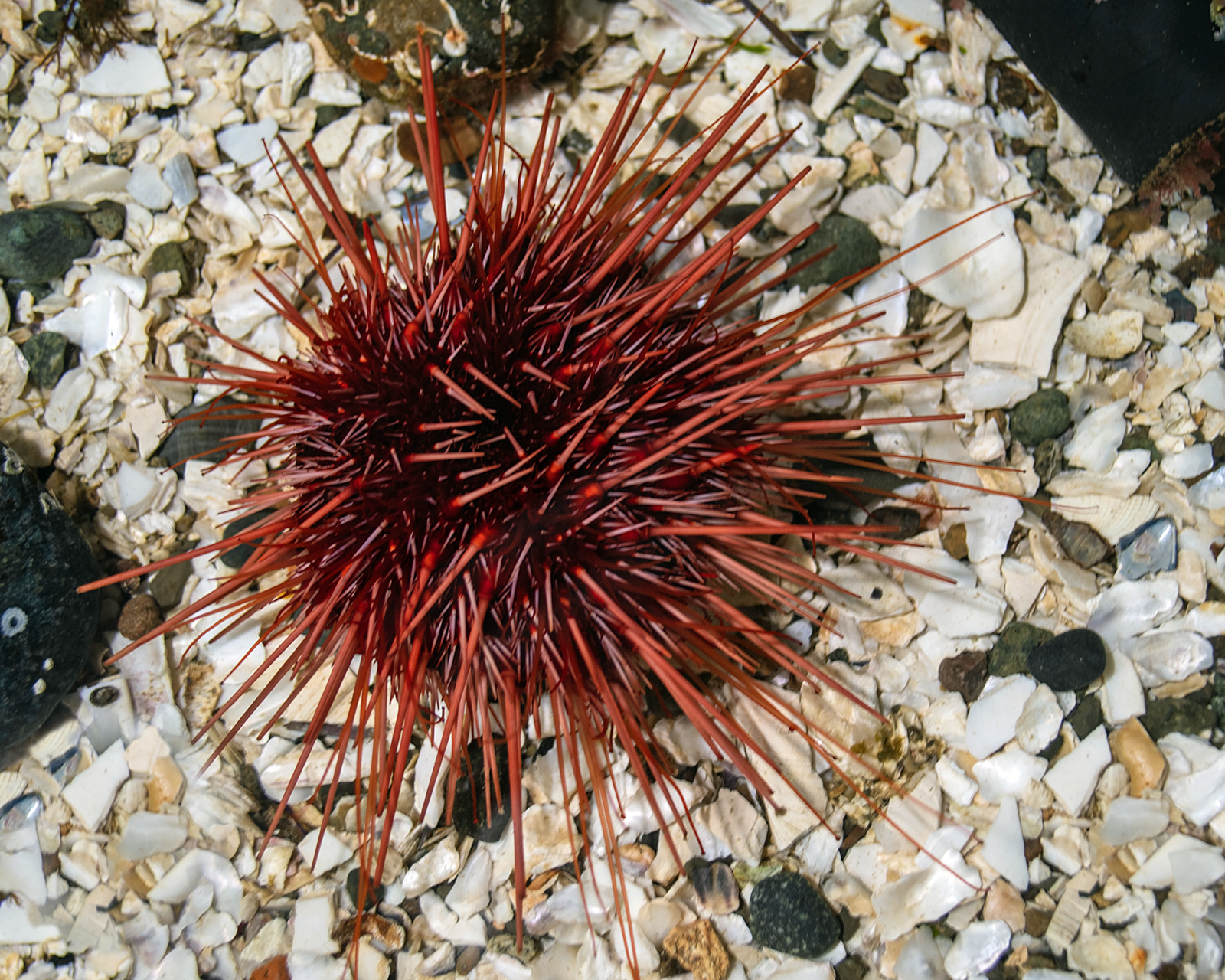
Red sea urchin, Strongylocentrotus franciscanus.

~~~~~~~~~~~~~~~~~~~~~~~~~~~~
Visité nuestro acuario local, muy pequeño, donde cada verano se llena de animales de nuestras playas y el mar, todos nativos a la región. En otoño, se vuelven a su stitio de origen y el acuario se mantiene cerrado todo el invierno.

Aunque los animales viven aquí cerca, había varios que yo no había visto antes, todos luciendo sus colores de fuego.

Foto # 1: Un ermitaño anaranjado con rojo, y con antenas anaranjadas, llevando de adorno una anémona de puntas color de rosa. Creo que es el ermitaño de ojos negros, Pagurus armatus. Estos son ermitaños que viven en la zona submareal, que puede explicar porque no los he visto. Son ermitaños grandes, que llegan hasta 4.5 cm. de largo.

Foto #2: Y este tiene anténulas con rayas rojas y blancas. No conozco la especie. El anaranjado es un color muy común entre nuestros ermitaños submareales.

Foto #3: Una pequeña comunidad. El tubo a la derecha es la boca de una botella, toda cubierta de esponjas encrustantes, anaranjadas, rojas, y cafés. Adentro hay una estrellita quebradiza, probablemente la estrella quebradiza margarita, Ophiopholis aculeata; si encuentro estas en nuestra zona intramareal. Hay otra debajo de la botella.

A la izquierda, pegada a una concha, hay un tunicado anaranjado; tal vez sea un "durazno de mar". Más abajo, dos anémonas. En la piedra, una esponja encrustante color de rosa. Y las dos patas espinadas al fondo pueden ser, tal vez, las de una estrellita plumosa.

Foto # 4: Esto sí que lo conozco; hay cientos de estos en cada una de nuestras playas, cerca del extremo inferior de la zona intramareal. Un erizo de mar rojo, Strongylocentrotus franciscanus.


Thursday, January 28, 2016

Unexpected guests

I was hunting for barnacles. My leafy hornmouth snails were hungry, and that's all they would eat. And I wasn't having any luck. I walked miles down the shore, over several days, finding nothing. Not a barnacle in sight, except on huge rocks. At the higher tide levels, they don't like small stones that can be rolled around by the waves, crushing their shells. For critters with only feet and an intestine, they're remarkably smart.

Last Saturday, I was out searching again. Nothing, nothing, nothing. I gave up and started walking at the extreme high tide line, where seaweeds and bits of driftwood tossed up by the recent stormy weather were drying. And there, far above their normal haunts, I found three large oysters, covered in barnacles.

They had to be dead by now, cast up this far above the usual water line for several days. But the barnacles would be ok, and I could open up the oysters, scrape them out, and put the clean shells with their load of snail food into the tank. I brought them home.

Except that they weren't dead. When I put them in water to wash them off, they opened up. When I touched them, they closed down. Alive and healthy; they're hardier than I imagined.

Oysters in the aquarium. With happy leafy hornmouth snails and hermits.

The snails got busy right away, eating several big barnacles each every day. And the scavengers, hermits and crabs, swarmed over the shells, picking away all the rotting seaweed, cleaning out dying barnacles. (The snails won't touch those: they like their meals very fresh.) The oysters pumped water in and out as the hermits cleaned off their lips.

Under the detritus, the hermits discovered a couple of anemones, looking miserable, shut down and fraying. The hermits took over, tearing away all the dead flesh, cleaning out the wounds. A day later, the anemones were as good as new.

Anemone # 2. Looking good. Smaller than a barnacle. Pink-tipped anemone, Anthopleura elegantissima, maybe.

Yesterday's anemone, once the minor surgery was finished, went for a walk and ended up parked on one of the snails. In the top photo, above, it's on the snail on the right.

While I was at it, I took a few more photos of the warty tunicate (the orange tubes in front of the oysters above). It has also been thoroughly cleaned by the hermits; they're busy little beasties.

Warty tunicate, Pyura haustor, showing the "warts", now that the old gunk is gone.

Zooming in on one siphon. It looks like a smaller tunicate is growing there.

Wednesday, December 09, 2015

Another lifer!

I picked up a couple of small kelp holdfasts on the beach last week, rescued them from the mounds of seaweed shreds the tide and waves had tossed onto the rocks. They'd make a temporary addition to my tank; the hermits love to poke at them, roll them around, play King of the Castle on them.

They were battered and broken, and I noticed a couple of orange bits that looked like snapped stems of something, along with all the torn worm tubes and unidentifiable bits. More stuff for the hermits to pull apart.

Tonight, cleaning the tank, I saw that the orange bits were now a strong pink. I replaced the holdfast in the tank, right up against the glass to get a better view, and once things had settled down, they stretched out and opened two little pink pipes.

A tunicate, or sea squirt, standing tall at the foot of the holdfast. (Off to the right side, the tentacley thing is the edge of a busy sand dollar.)

"The basic tunicate is attached to something solid and has two openings at the top called siphons." (From Marine Life of the Pacific Northwest, pg. 346)

I'd never seen one of these before today*. It's a solitary tunicate, Pyura haustor, aka warty sea squirt, wrinkled seapump, or the decorator tunicate (because they glue stuff to their bodies; this one has a bunch of old worm tubes and, if you look closely, a tiny snail shell. When they are not feeding, they may be completely hidden under their collection of junk.). They can grow up to about 3 inches tall.

Zooming in. One siphon is the mouth, or intake, the other is the outflow.

*At the link above, from WallaWalla.edu, there is a photo of one of these, completely coated in blackish gunk; I could have seen hundreds like that, and never recognized them.

Powered By Blogger