Showing posts with label tunicates. Show all posts

Monday, June 19, 2023

View from the dry side of the glass

I promised more aquarium photos "tomorrow" and then I took the weekend off. "Mañana" works better; it's more flexible. So here's a stack of underwater critters.

Orang sea pens, Ptilosarcus gurneyi. And a shrimp.

The lighting on this tank in the aquarium was strongly pink. To highlight the sea pens? I'll have to ask why next time.

Tunicates, just a living bag of water with an intake and outlet.

Plumose anemone, Metridium senile.

A green starfish with white bands around the centre.

And a very long-armed, spiky starfish.

Crescent gunnel, Pholis laeta.

And the same painted greenling I posted earlier. Oxylebius pictus.

And here he is, standing on his tail to get a better view of those strange noisy creatures just beyond the glass.

For some of the critters spending the summer in the aquarium, we are the spectacle; something to tell the folks back home about this fall.

Next, a pair of hermits, the ever-curious hermits.

~~~~~~~~~~~~
Prometí subir más fotos de los animales en el acuario "mañana", y luego flojeé todo el fin de semana. Pues, aquí están, por fin.

Fotos:
  1. Las plumas de mar anaranjadas, Ptilosarcus gurneyi. La luz en el acuario, en este tanque por lo menos, tiene un tinte color de rosa. Hay un camarón que probablemente no tiene ese color bajo luz natural.
  2. Tunicados. Apenas una bolsa de agua viviente, con una entrada y otra salida para mantener la corriente.
  3. Una anémona plumosa, Metridium senile.
  4. Una estrella de mar verde con círculos blancos alrededor del centro.
  5. Otra estrella de mar, esta con brazos largísimos.
  6. La borda creciente, o blenio, Pholis laeta.
  7. Y el mismo greenling pintado que subí anteriormente, Oxylebius pictus.
  8. Y aquí se para sobre la cola, para ver mejor a esas criaturas extrañas y ruidosas al otro lado del vidrio.
Para algunos de los animales que pasarán este verano en el acuario, el espectáculo somos nosotros. Tendrán aventuras para contar a sus amigos cuando regresen a casa en el otoño.

Siguiente: un par de ermitaños, que nos miran con mucha curiosidad siempre.


Sunday, June 12, 2022

Under the donut shop

I took a short detour this afternoon, downtown, looping through a small dock area, peering between floats and under ramps.

Where the sun managed to reach, and where the waves stopped dancing, I caught a few glimpses of a vibrant community.

Plumose anemone, Metridium senile.

Back in the shade, there's a glassy bulb, possibly a tunicate. And a branch that may be a hydroid.

A small lion's mane jelly, Cyanea capillata

This was a youngster, only about a hands'-breadth across, and swimming actively, folding itself up, then opening again rhythmically.

Spreading out, heading under the wharf. With a green sea urchin.

On the bottom of a float (blue) and the pipes under a cabin.

So many critters! So many colours and shapes! I can't identify most of them, but there's a beautiful purplish feather-duster worm, limpets, orange and pink sponges, another plumose anemone, and something bright orange that may be the lips of a scallop.

And everywhere, there were tiny fish, breaking the surface so that it looked as if it were raining.

With the reflection of a donut shop.

Present, but too dark or too blurred by waves, hundreds of green sea urchins, mussels and barnacles, many orange starfish, a kelp crab and another two, too well hidden to identify, a fair number of chitons. And a kid fishing for shrimp. Who scared them all away.

Oh, and a big seal. Photos tomorrow.

~~~~~~~~~~~~~~~~~
Tomé un desvío corto esta tarde. Pasando por el centro, di una vuelta por un pequeño muelle, buscando entre los flotadores y debajo de las rampas. Donde alcanzaba la luz del sol, y donde las olas dejaban de bailar, llegué a ver señas de una comunidad vibrante.

Fotos:
1.  Una anémona plumosa, Metridium senile. En la sombra hay algo que parece un foco; posiblemente sea un tunicado. Y lo que parece una rama de árbol puede ser un hidroide.

2. Una medusa melena de león, Cyanaea capillata. Muy chica aun; apenas medía unos 10 cm. Iba nadando, estirándose y encogiéndose repetidamente.

3. Aquí está estirada. Con un erizo de mar verde.

4. Debajo de un flotador (azul) y en la tubería debajo de una cabaña. ¡Tantas criaturas! ¡Y de tantos colores y formas! No puedo identificar la mayor parte de ellas, pero se ve un gusano plumero color mora, lapas, esponjas anaranjadas y color de rosa, otra anémona plumosa, y algo anaranjado brillante que posiblemente sean los labios de una vieira.

5. Y dondequiera había un banco de pececitos, tocando la superficie del agua hasta que parecía que estaba lloviendo. Aquí están unos con los reflejos de una tienda de donas.

También hubo, pero escondidos en lo oscuro, o borrosos bajo las olas, cientos de erizos de mar verdes, mejillones y bálanos, muchas estrellas de mar anaranjadas, un cangrejo "kelp" y otros dos, sin poderlos identificar por estar bien escondidas, y bastantes quitones. Y un muchacho que pescaba camarones. Los cuales se habían hecho escasos.

Y también una foca grande. Mañana subo las fotos.


Friday, August 21, 2020

Jarritos

 There's always something new ...

Transparent tunicates. With their shadows.

In a corner between three floats, a stray ray of sunlight caught a group of whitish blobs, visible only from one awkward angle.

They looked like lightbulbs to me. The rope on the left is probably about an inch or a bit less across, so the largest of these bulbs would be two and a bit inches long.

There's a local solitary tunicate that looks like these, the Lightbulb tunicate, Clavelina huntsmani, but it has two very visible "filaments". The Transparent tunicate, Corella willmeriana, is slightly larger than the Lightbulb, and is mostly translucent, with a visible gut on one side. I found photos of these in two websites, one taken here in Campbell River, the other just across the channel on Quadra Island. There's another, very similar tunicate, an invasive, Ciona savignyi but it is much larger. It has showed up just across the border; I don't know if it has arrived here yet.

It's hard to see clearly, but I think this one is the Transparent.

A solitary tunicate is like a little jug, with two openings, an intake and an outflow tube. It attaches itself to a solid substrate at the base.

The structure of a solitary tunicate. Image: Washington U.

~~~~~~~~~~~~

En una esquina entre tres flotadores, encontré estos animalitos, que parecen un foco. El cordón a la izquierda mide tal vez una pulgada de diámetro, lo que hace que el más grande de estos animales medirá aproximadamente 2 pulgadas de largo.

Son urocordados, también conocidos como tunicados, y solitarios; muchos de los urocordados viven en colonia; estos se juntan pero cada uno por separado.

Hay tres especies de tunicados como este que viven en nuestras aguas; el "Foco", el Transparente, y un invasivo, que es más grande. El "Foco" tiene dos lineas en  el interior, como los filamentos de un foco a la antigua.

Creo que estos son el tunicado Transparente, Corella willmeriana. Encontré fotos de estos tomados aquí en Campbell River, y al otro lado del estrecho, en la isla Quadra.

Un tunicado solitario tiene la forma de un jarrito, con dos aperturas, por las que fluye el agua. Se fija por su base en un sustrato sólido.

Thursday, August 20, 2020

Under the water line

 The wharf, on the sunny side, is a quiet place, a watery parking lot. There are a few people, gulls, a dog or two, maybe even a cat. Sometimes a heron.

But on the underside; that's another story. There's more busy and crowded biodiversity there than in the entire city of Ankh-Morpork*.

Plumose anemones, sponges and much more, on the side of a float.

At first glance, this is a mess. Too much going on; too crowded, too many shapes. So I've added labels to the photo. It might be a good idea to click on it to bring it up to full size.

There's even a nudibranch!

Another anemone, same species, with friends.

And here it is, with labels. Help me out here!

And another photo, from a wharf edge in full sun:

A few barnacles grow above the water line, in the splash zone.

And here it is, labelled:

The worms like the dark better.

Summing up: there are anemones, sponges, tunicates, barnacles and mussels and limpets, assorted feather duster worms, at least one nudibranch, a sea urchin, hydroids, assorted algae. Present, but not visible, are a full contingent of amphipods, copepods, assorted worms out of tubes, assorted worms in tubes, snails, bryozoans, probably some isopods, maybe a few shrimp. The usual crabs are not the one here, which I think, seeing only the underside, is probably a shore crab; the usual crabs are kelp crabs, longer-legged for crawling on floaters, and an olive-green colour which makes them hard to see. 

But there is still more! I'll upload a few more photos tomorrow.


*Which includes trolls, dwarfs, golems, werewolves, vampires, banshees, gnolls, gnomes, Wee Free Men, zombies, talking dogs, ditto ravens, gargoyles, elves, goblins, orcs, Death, incarnated auditors, the 5 horsemen, bogeymen, and humans, just taking into account the "intelligent" (although not necessarily wise) species. And not counting the yeti, who is wise enough to stay up in the snows.

~~~~~~~~~~~~~~

En el muelle, todo es tranquilo; al fin es un estacionamiento, aunque sea sobre agua. Hay algunas personas, gaviotas, uno que otro perro, tal vez hasta un gatito. Y a veces una garza.

Abajo del agua, ya es otra cosa. Hay un ecosistema tan diverso, tan lleno, que es difícil verlo o describirlo.

En estas fotos, tomadas al lado de dos flotadores, hay: anémonas, esponjas, un nudibranquio, cientos (aunque solo se ven algunos) de anélidos, uricordados (tunicados), lapas, mejillones, cirrípedos, hidroides, y un cangrejo. Y muchas algas, rojas y verdes, que se intermezclan con los anélidos que viven en tubos y, abiertos, se confunden con los hilitos de alga.

Hay mas animales aquí que no se pueden ver, pero por cierto están escondidos bajo el alga: anfipodos, copepodos, más anélidos, briozoos, caracoles, probablemente unos isopodos, y camarones. Los cangrejos que veo a seguido no son como el que aparece en la foto, un cangrejo que más bien se halla entre las piedras en la playa, pero un cangrejo "kelp" que tiene las patas larguísimas para mejor agarrarse a los flotadores, y de un color verde oliva, que lo hace muy difícil de ver entre el alga.

¡Hay más! Subo más fotos mañana.

Wednesday, December 09, 2015

Another lifer!

I picked up a couple of small kelp holdfasts on the beach last week, rescued them from the mounds of seaweed shreds the tide and waves had tossed onto the rocks. They'd make a temporary addition to my tank; the hermits love to poke at them, roll them around, play King of the Castle on them.

They were battered and broken, and I noticed a couple of orange bits that looked like snapped stems of something, along with all the torn worm tubes and unidentifiable bits. More stuff for the hermits to pull apart.

Tonight, cleaning the tank, I saw that the orange bits were now a strong pink. I replaced the holdfast in the tank, right up against the glass to get a better view, and once things had settled down, they stretched out and opened two little pink pipes.

A tunicate, or sea squirt, standing tall at the foot of the holdfast. (Off to the right side, the tentacley thing is the edge of a busy sand dollar.)

"The basic tunicate is attached to something solid and has two openings at the top called siphons." (From Marine Life of the Pacific Northwest, pg. 346)

I'd never seen one of these before today*. It's a solitary tunicate, Pyura haustor, aka warty sea squirt, wrinkled seapump, or the decorator tunicate (because they glue stuff to their bodies; this one has a bunch of old worm tubes and, if you look closely, a tiny snail shell. When they are not feeding, they may be completely hidden under their collection of junk.). They can grow up to about 3 inches tall.

Zooming in. One siphon is the mouth, or intake, the other is the outflow.

*At the link above, from WallaWalla.edu, there is a photo of one of these, completely coated in blackish gunk; I could have seen hundreds like that, and never recognized them.

Wednesday, October 28, 2015

Lifer! Probably for both of us.

Under the logs and lumber of any floating construction, down where the sun rarely reaches, the water level is constant, the currents weakened, myriads of animals and plants live their sheltered lives, away from the prying eyes of the humans who clomp along overhead. Unless there is a gap between the floats, the surface is mometarily still, the light turns down at the perfect angle, and a human just chances to look down that gap at that moment. And then, if the human happens to be of a curious bent, she flops down on her knees or belly, and peers down that gap. And sees eyes, staring back at her.

Spiny pink scallop, Chlamys hastata. She has dozens of eyes, lined up along her lips. She can't see as well as I do; all she saw of me (I think) was my shadow.

Another angle, showing a bit of her shell, and two anemones sheltering underneath. The blue "pillar" is a mussel shell.

I'll back off a bit, to show the mini underwater garden along the base of the float I was lying on.

Tunicates, purple stuff, more tunicates, mystery critters, worms, and hydroids. Yesterday's anemones were just to the left of this patch.

Moving to the right; more tunicates, and the scallop.

I cropped these photos down, to show the individual critters a bit better:

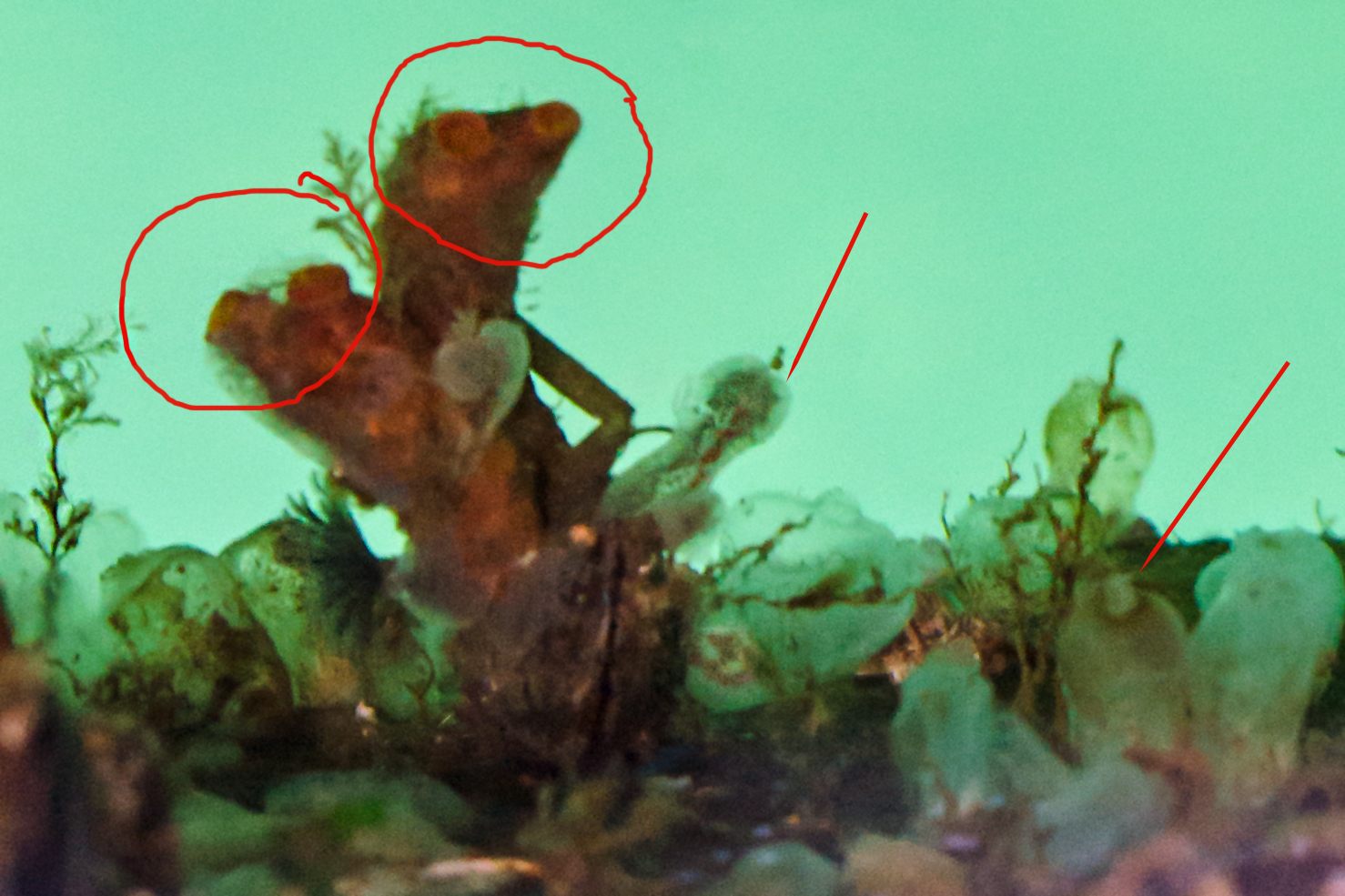
Tunicates, unidentified. (With intake, outflow siphons circled.)

As far as I can tell, the pale cyan blobs have siphons, as well, and would be another species of tunicate (aka sea squirt). The red line in the centre points to another animal that is so transparent that its internal organs, and its food are visible through the wall. I think the other red line points to a half-way shut down anemone. On the far left, there is a hydroid stalk, and on the left of the base of the big tunicates, the flowery shape is the feeding tentacles of a worm.

Tunicates, tunicates, worms, etc. And what are those two potato-like blobs?

And there's still that pink thingie:

I think it may be a compound ascidian. like the red ascidian, or maybe the mushroom compound tunicate. Or something else? What do you think?

Worms tomorrow.

Wednesday, February 27, 2013

Sea pork! Oodles of sea pork!

Purple sea pork! Big, whopping chunks of it! And a sea cucumber, a sand shark, possible sponges, and several mystery critters!

No, not here. Go on over to Dawn's Bloggy Blog, and see what the storm brought in.

They're promising us rain, rain, rain and more rain here for the next couple of weeks. We may end up on the beach in rain gear, if things don't improve.

Working tonight; see you tomorrow.


Thursday, April 19, 2012

Is this a tunicate?

I have spent hours in the last couple of days, trying to identify the last animals I found in the clamshell. All to no avail; I am still as confused as I was before I started.

After all the creeping and scrambling beasties had been washed out and transferred to the aquarium, what remained were the little acorn barnacles, and, in the bottom of the shell, a colony of little brown jugs.

They're shaped like those little brown glass whiskey bottles I find in antique stores.

One opening at the top, curved "wings". The small barnacles give an idea of their size; maybe up to 1 cm. tall.

These look to me like solitary or social tunicates, but I can't find any that look like this. And tunicates are basically a living filter system, with two siphons, an intake and an outlet; most of these seem to have only one siphon. Where is the other one?

Removed from the shell, they stand up on my foam base. In this photo, it looks like two of them have the outlet siphon, as well.

A single animal, on its jelly base.

In the second photo, one has a snail crawling near the siphon. Here it is, greatly magnified.

It looks like a trophon snail.

I keep thinking of another species of tunicate, and going off hopefully to investigate. Everything is similar; nothing matches. Help!

Sunday, April 10, 2011

Orange eyes, a flying crab, and eggs on stalks.

Although the wind was strong, last Thursday, the sun was bright and the tide was low. Beach-combing time! And spring has finally worked its magic; every rock, every pool on the White Rock beach was bursting with life. The flatworms were out in force. So were hordes of hairy hermit crabs, and scrambling masses of shore crabs, red and green and white. There were gunnels and sculpins, whelks and periwinkles, assorted long worms, and the crows and gulls searching for them among the stones. Kelp flies buzzed, beach hoppers hopped, and eagles squealed somewhere in the treetops. And the red mussels sat glowing among the blues and blacks. We could have stayed for hours, but the tide doesn't take time off; it was racing up the beach before we got to Kwomais Point.

We took too many photos and I'll be sorting for quite a while, but here are a few of my favourites.

Alternating stripes of light and dark; looking into the sun, over wind-ruffled water.

A two-inch, brown starfish. We found two like this.

And the usual purple starfish. About 6 inches.

I like the way the water breaks up the light. Eelgrass in ankle-deep water.

I turned over a large slab of rock, and found an entire community underneath. This sculpin was not too pleased, so after we took his photo, I upended a large clamshell over him for a hiding place. That scared the crab off his head, too.

Same photo, cropped so you can see the colour of the eyes. I don't remember seeing an orange-brown sculpin before, nor eyes like this.

Fuzzy photo of a tiny, tiny, tiny red crab. I could barely see it; just a red speck running down the rock. I put a finger below him, and he ran onto the tip and stopped there. I was holding my hand up for Laurie to take a photo, and the wind caught him and blew him away. 

A group of whelks laying their eggs. The little black shell holds a hermit crab.

Side view of whelk eggs, showing the stalks.

Another ascidian colony. Interesting pattern.

And back at the shore, dandelions in the semi-shade of newly-budded blackberry canes.

Wednesday, September 08, 2010

Chordate for a day

Take a cup of clean sea water from a handy shore. Shine a light through it from the side. Get a magnifying lens and look at it, cross-ways to the light. After a bit, your eyes adjust, and you start to see pin-points and streaks of light, swimming, crawling, jitter-bugging around. Many are assorted copepods and baby amphipods; you'll get to recognize them by their swimming styles. Some might be tiny shrimp, seemingly drifting until a whim takes them and they zip to another drifting spot. And some are probably free-swimming immature stages of animals you would recognize easily as adults, such as barnacles or oysters.

That may explain how new animals show up in my aquarium; I replenish the water with fresh supplies from Boundary Bay. The pink and red growth that encrusts much of my sea lettuce at the moment probably arrived as tadpole-like larvae, a couple of millimetres long.

I mentioned them a couple of weeks ago, but didn't really know what they were. Since then, I've been watching them daily, as they grew, and searching the web for a match.


Yesterday's photo: three patches of "little barrels".

At first, the new residents just looked like a smear of bumpy jelly, but as they grew, I began to see spots on top, then a rounded barrel shape, with a hole at the top. A few days ago, I noticed that the holes periodically closed and opened. In new photos, I could see a circle of ribs inside the holes.


Chain sea squirt, Violet Tunicate.

The largest mass had developed a number of larger bubbles, each with its hole at the top.


Red mass, with exit siphons.

That was a clue: I began looking at tunicates, or sea squirts. Tunicates are basically water pumps, with an intake siphon and an outflow, with a stomach in between, all contained in a tough wall, called a tunic, and encased in a layer of jelly. Some are free-swimming, but the class Ascidiacea live fixed to a base. Mine would be ascidians, then.

Ascidians may be solitaries, or live in communities; colonial ascidians. And among BC's colonials are the Botylloides violacea, which match mine. Yay!

B. violacea is an import from Japan which has established itself on both coasts of N. America, becoming a nuisance in some areas. It is sessile, growing
"... on a variety of surfaces, includ(ing) docks, boat hulls, buoys, ropes, pilings, the undersides of rocks, eelgrass (Zostera marina) blades and seaweeds. It often overgrows mussels, barnacles, encrusting bryozoans and solitary sea squirts." (Exotic Species of San Francisco Bay)
A colony is soft and smooth to the touch, like a jellyfish without the sting. Each separate colony is one colour, which may be anything from cream to red to violet to lavender; neighbouring colonies don't necessarily match.

It is a filter feeder; water passing through is strained to retain food particles.


Diagram of a typical ascidian. From U. of Manitoba. My labels and arrows.

Water enters the larynx and is filtered. Cleaned water goes directly to the outflow; anything trapped in the sieve goes to the stomach. Undigested particles enter the intestine and are removed through the outgoing siphon into the common area underneath the colony's jelly coating. From there, everything is expelled through the large "bubble" tubes.

Watching my critters through the microscope, I could see the individual animals (zooids) contract their sides every few minutes, expelling the contents of the siphon. Against a light, even with just the magnifying lens, a stream of tiny particles is visible leaving the surface of the colony; between puffs, larger crumbs flow inwards.

Out of the water, each individual collapses: there is no solid structure to hold it up.


Collapsed.

Colonial ascidians are hermaphrodites, having male and female organs in each individual, but they also reproduce asexually, by budding. The eggs of B. violaceus are retained in brood pouches, and fertilized by sperm released into the water surrounding the colony. Each egg produces a tadpole-like larva, about 2 mm. long. (Photo here.)

The larval stage, even though it lasts only a day, is fascinating. Consider: unlike most of the other invertebrates, it has the precursor of a spinal cord. But it will have no spine. Instead, like an embyro of any vertebrate (animals with backbones, including us), it has a notochord, a flexible, rod-shaped body that runs down the tail, and behind that, a neural tube, which in vertebrates becomes the central nervous system. These, together with the gill slits and a groove in the wall of the pharynx, makes it one of the Chordata. The tunicates are the sole members of the subphylum Urochordata, which means "tail chordates". (More detail - much more - here.)

The weirdest thing about this is that, after the larva finds a home and settles in, it digests its own tail, notochord and nervous system, leaving only a rudimentary clutch of nerves.

The larva is equipped to do one thing only: find a place to anchor itself for the rest of its life. It has an eye spot, which also disappears, a balance organ, the muscular tail for swimming, and about 30 "ampullae", (one biologist calls them "buds", another says "suckers") on the head. It does not eat; it has no mouth, nor siphons. It must find an appropriate location within a day, or it dies. It lands head down on the chosen spot, grabs on, and immediately begins the transformation into an adult.

I looked for larvae and didn't find any still swimming. I did find a few that were just settling in; the tail was gone, but they were still individuals; just the head of the "tadpole" and two visible buds. Under the microscope, I could see the hearts beating. This was strange, too. The blood flows one way for a while, then reverses and flows back.


Newly attached larva, and infant colony with first three zooids. Borrowed from Mike.


Young Botrylloides colony.

Once the larva is settled in, it starts to bud asexually, producing new individuals, arranged in circles or double rows. Each one is entirely self-sufficient; broken off the main colony, it can survive and continue to produce new zooids.

In the photo just above, there is a larva, recently attached. All that is visible is the central blob and a circle of ends of blood vessels. (Mike the Mad Biologist calls them "little hearts".) In the next new colony, now with six zooids, the ring of "hearts" is quite plain. (It's black because it's on the back side of the sea lettuce; all we see is its shadow.)

And below these, on the left, is a slightly larger colony, showing the basic arrangement: zooids around a central space, a circle of blood vessels around it. These zooids are now mature enough to show the central siphon, and the hint of a community cloaca (outlet tube).


A starter home. Another typical arrangement.


A crowded bit of mature colony on sea lettuce, 1 cm. across. Out of water, and therefore collapsed.

A few more curious facts about tunicates:
  • Tunicates are the only animals able to create cellulose. (Actually, tunicin, a polysaccharide similar to cellulose.) This is used to stiffen the tunic.
  • Tunicate blood contains high concentrations of vanadium, functioning as a pigment. Vanadium is toxic to most organisms. Some tunicates can concentrate vanadium up to a level one million times that of the surrounding seawater. 
  • "Various Ascidiacea are used as food. Sea pineapple (Halocynthia roretzi) is cultivated in Japan (hoya, maboya) and Korea (meongge) and, when eaten raw, has been described by Lonely Planet as tasting like "rubber dipped in ammonia". The peculiar flavor is attributed to an unsaturated alcohol called cynthiaol." From Wikipedia. I've lost my appetite. Besides, there's vanadium in them.
  • Some marine animals will eat tunicates, in spite of the vanadium. Sea stars, flatworms, and otters, among others, are mentioned as predators. In my tank, not so much. The hermit crabs ignore them completely, although they love to chew on the sea lettuce. Snails don't crawl over them. And when a stray piece falls into the tentacles of an anemone, it is promptly shaken off.
  • Most tunicates are thought to live about one year as adults, but the colony may endure for decades.

Powered By Blogger