Showing posts with label lifer. Show all posts

Saturday, August 01, 2026

Swimming egg?

 And me without my camera ...

I was in Brown's Bay this afternoon, and had rushed out without even a pocket camera. And there were harbour seals; a half-dozen or more, swimming lazily near the shore. As we watched them, a woman passing by told me there was a day-old pup among them, although I couldn't see it.

Out beyond the docks, fish were jumping; little ones, about a hand's-length long, and closer to the boats, tiny finger-length fish, barely breaking the surface, flashing silver as they turned downward again,

Then there were the anemones; they have repopulated the floats again. White plumose anemones, tan ones, and many smaller orange ones.

And finally, swept in the current between a boat and the office float, a yellow and white jellyfish, about 15 cm. across. Yellow centre, the exact colour of an egg yolk, whitish jelly and tentacles. I'd never seen one before. A lifer! And me without my camera.

The cell phone was acting up, but I got a couple of fuzzy photos.

Egg-yolk jellyfish, Phacellophora camtshatica and reflections of the stern of the boat.

Also called fried egg jellyfish.

And then the current carried it under the float and away.

Three anemones and two limpets, kelp, under a float.

~~~~~~~~~~~~

Y yo, sin cámara ...

Estaba esta tarde en Brown's Bay, pero había salido aprisa, y se me olvidó traer la cámara; ni siquiera llevaba la cámara de bolsillo. Y resultó que había un grupo de focas, media docena o más, todas descansando cerca de la playa. Mientras las observábamos, una señora que pasaba me informó que entre ellas había una foquita recién nacida el dia anterior, aunque yo no la pude ver.

Pasando los muelles, estaban saltando los peces; pescaditos chicos, de unos 10 cm. de largo. Cerca de los barcos había otros, unos pececitos de apenas 2 o 3 cm. de largo; estos nadaban cerca de la superficie, y al tocarla brillaban como si fueran hechos de plata.

Y las anémonas han vuelto a colonizar los flotadores. Anémonas Metridium senile; blancas y café claro y muchas anémonas pequeñas anaranjadas.

Y por fin, llevada por una corriente rápica entre un barco y la oficina flotante, había una medusa amarilla con blanco, midiendo unos 15 cm. de diámetro. El centro amarillo era el color preciso de una yema de huevo; la masa gelatinosa alrededor era blanca. Nunca antes había visto una de estas medusas. ¡Un "lifer"! Y yo sin cámara.

El celular andaba de malas, pero logré sacar dos fotos algo borrosas.

  1. La medusa "yema de huevo", Phacellophora camtshatica. Las lineas son reflejos del barco.
  2. También se conoce como la medusa "huevo frito". En seguida la corriente la escondió debajo de la oficina.
  3. Tres anémonas, dos lapas, y quelpos, en uno de los flotadores bajo el muelle.


Wednesday, September 10, 2025

Brief encounter

 I found this fly with a yellow face on pearly everlasting flowers at the beaver pond. I'd never seen one before.

Not sure of the species. Probably one of the Tachinid flies.

It has a yellow face, and orange patches at the inner end of the wings. And a very hairy butt.

A lucky shot; I took three fast photos and it flew away.

~~~~~~~~~~~~~~~~

Encontré esta mosca entre flores "eterna pelada",  Anaphalis margaritacea, en el camino que da a la laguna de los castores. Nunca la había visto antes.

No la pude identificar con alguna certeza, pero parece que pertenece al género de las moscas Tachina. Tiene la cara amarilla, manchas anaranjadas en la parte superior de las alas, y pelos largos al final del abdomen.


Wednesday, April 30, 2025

Bycatch

You just never know what's waiting around the next corner. The world, in all its richness and endless variety always has a new surprise waiting. You go looking for birds and find mushrooms. Go mushroom hunting, find elk scat. And then there's that road you've never been down, beckoning ...

Just parked, sitting in the car getting cameras out of bags, I see a red flying critter passing the windshield. So red, red as the reddest of the red dragonflies. But as small as a fat mosquito. It flies into the shadowy forest and is gone. Though I hang around looking for it, I never see it again.

Out looking to see if the elderberries are flowering yet, I find little yellow violets and windblown maple flowers. And a moth pretending to be a butterfly.

Here is a selection of some of those unlooked for treats. In no particular order.

Wild cherry tree, with bee. In the rest area at Roberts Lake, under firs.

Maple flowers hanging at an angle in a stiff breeze. Coming back from walking the beach.

Grey cross spider, Larinioides sclopetarius, I think. I've never seen one of these before. Brown's Bay, where I was looking for underwater critters.

Cat's tail moss, on a fallen branch, stuck in the ground beside where I sat on a mossy log.

Skunk cabbage leaves in a small, slow-flowing creek. I was told to look for mushrooms in this bit of forest.

A day-flying moth, Western White-Ribboned Carpet Moth, Mesoleuca gratulata, according to BugGuide. Fluttering around a huckleberry bush. Another lifer.

More tomorrow.

~~~~~~~~~~~~~~

Nunca sabes lo que te espera a la próxima curva en el camino. Tan rico este mundo, tan pródigo de sorpresas; siempre hay algo nuevo. Sales a buscar pájaros y encuentras hongos. Vas en busca de hongos, y ves huellas de alce. Y luego ves ese camino que nunca has explorado, y te llama ...

Recién estacionada, sentada en el coche sacando las cámaras de sus bolsas, veo un insecto rojo volando en frente del parabrisas. Tan rojo es, tan rojo como el rojo de la libélula más roja existente. Pero es del tamaño de un mosco gordo. Pasa, sale del rayo del sol, y desaparece entre las sombras del bosque. Aunque salgo a buscarlo, no lo vuelvo a ver.

Salgo a ver si ya estarán en flor los saúcos rojos, y encuentro violetas amarillas y flores del arce de hoja grande arrastradas por un viento fuerte. Y una palomilla (que son, por lo general, mariposas nocturnas, pero esta no) que más bien parece mariposa.

Esta es una selección de algunas de esas cosas inesperadas.

  1. Flores de un cerezo silvestre, con una abeja, en el área del descanso (bueno, sanitarios) cerca del lago Roberts.
  2. Esas flores de arce de hoja grande. Sin viento, cuelgan verticalmente. Regresaba de un paseo en la playa.
  3. Una araña Larinioides sclopetarius, creo. Es la primera que jamás he visto. Venía buscando animales bajo los muelles de Browns Bay.
  4. Musgo "cola de gato" en una rama caída que se implantó en el suelo donde yo me senté a descansar sobre un tronco acojinado.
  5. Hojas de linterna de pántano en un charco al fondo de un sitio donde me habían dicho que encontraría hongos.
  6. Esa palomilla que vuela de dia; Mesoleuca marginata, dicen en BugGuide. Revoloteaba alrededor de este arbusto de arándano rojo. Otra criatura nunca antes visto.
Dejo otras para mañana.


Monday, March 31, 2025

Definitely blue-black

Another lifer: the verdigris navel mushroom, Arrhenia chlorocyanea. I don't think I've seen these mushrooms before. They are growing in a patch of sandy soil in the Oyster Bay dunes; a large group of them, growing mostly in small, scattered clusters.

The mushrooms grow to about 3 cm. tall. The cap is dark blue, almost black, as is the stem. The gills, decurrent (angling down to the stem), are paler.

And the cap has a "navel".

I wondered about the mushroom's common name, verdigris, meaning green; these were definitely not green. The usual descriptions of this mushroom give its colour as dark green, but dark navy blue variants are also seen, E-Flora BC says, "at least in California". They should add BC; all of E-Flora BC's records are of these blue-black variants.

One more reason to return over and over to the same old places; you never know what's going to turn up!

~~~~~~~~~~~~~~

Otro hongo, visto por la primera vez: el hongo verdigris (verde) con "ombligo", Arrhenia chlorocyanea. Crecen en tierra arenosa en las dunas de Oyster Bay; un número bastante grande, pero creciendo esparcidos en pequeños grupos.

  1. Los hongos miden hasta 3 centímetros de altura. El sombrero es azul oscuro, casi negro, al igual que el tallo. Las laminillas decurrentes (que bajan diagonalmente hacia el tallo) son un poco más pálidas.
  2. Y el sombrero tiene su "ombligo".
Me pareció curioso el nombre común en inglés, verdigris, o sea, verde, pero estos hongos claramente no eran verdes. Descubrí que las descripciones oficiales dan el color como verde oscuro, pero que se ven variantes de azul marino oscuro, según nos informa E-Flora BC , "por lo menos en California". Deberían añadir BC; todos los ejemplares en E-Flora BC son de color azul marino oscuro.

Y aquí otra razón para volver muchas veces al mismo viejo paseo; nunca sabes que puede aparecer en la próxima visita.

Sunday, August 28, 2022

Of pearls and stars

Hanging out in a friend's garden on a pleasantly cool afternoon, we were examining her string of pearls plant. This is a small succulent, Curio rowleyanus, an import from southwest Africa; it forms long strings of round green leaves. To me, they look like peas, but green pearls describes them nicely.

The plant is African, but the spiderling is a local. And the mushrooms? Brought in with the potting soil, most likely. This could be called fusion gardening.

"Pearls" and the spider.

The largest of the leaves measured 1 cm. across, which makes the spider (do you see her?) about 4 mm. long, and under 2 mm. across the abdomen. She is a cross spider, Araneus diadematus, and as an adult will measure up to 2 cm.

The flower; it's a compound flower, one of the Asters. The hanging strings of pearls can grow to 90 cm. long.

And here's the spider, showing off her cross-spider pattern.

And among the pearls, these tiny mushrooms grow.

The largest is 5 mm. tall. It reminds me of a chess piece.

A couple more.

I have never seen mushrooms this shape before. They look like earthstars, but the smallest earthstar in my Audubon guide measures 4 cm. tall. And checking out iNaturalist, I find several the same shape, although again, somewhat larger. Here, and here, in eastern Canada, for example

Another lifer!

~~~~~~~~~~~~~~~~~~~~~~~~~~~

 Pasaba la tarde en el jardín de mi amiga, y mirábamos su plantita rosario, a la que aquí llamamos "cadena de perlas". Esta es una planta suculenta, Curio rowleyanus, originaria del sudoeste de África. Sus hojas, a lo largo de tallos pendientes, son completamente redondas; se parecen a guisantes (chícharos), o perlas verdes.

La planta viene de África, pero la arañita que vive entre las hojas es una especie local. ¿Y los honguitos? Probablemente llegaron en la tierra para macetas. A este tipo de cultivo, se le podría llamar jardinería fusión.

Fotos:

#1: "Perlas verdes" y la araña. La hoja más grande mide 1 cm de diámetro, lo que hace que la araña sea de unos 4 mm. Es una araña A. diadematus, y ya crecida, puede medir hasta 2 cm.

#2: La flor, o mejor dicho, las flores. Es una flor compuesta, una de los Aster.

#3: Y aquí está la arañita, mostrando su diseño típico.

#4 y 5: Y entre las perlas, crecen estos honguitos miniaturos.

Nunca antes he visto hongos de esta forma. Se parecen a las estrellas de tierra, pero la más chica que encuentro en mi guía Audubon mide 4 cm. de alto. Y buscando en iNaturalist, encuentro varios de esta forma, pero también son más grandes. Véase aquí y aquí. por ejemplo.

¡Siempre hay algo nuevo!

Friday, July 29, 2016

Pink gnomes

This past week's travels were full of surprises. Every day, in almost every place we stopped, I discovered things I'd never seen before. Some, I'd seen in books, pale ghosts of the real thing. These gnome plants were among them.

Gnome plant, Hemitomes congestum.

We were lucky; earlier, it would look like a "small, blackened cauliflower head" (Plants of Coastal BC); when it's dry, it would be brown. As we saw it, the cauliflower heads had opened up to show off the waxy pink flowers inside, still not fully developed. In a few, you can see the yellow stigma in the centre.

The leaves were not visible; the flower heads burst directly out of the wet moss and duff.

The plant is a parasite on fungi associated with trees. It has no chlorophyll, and can't make it's own food from sunlight. Down there in the duff, the sun rarely shines anyhow, but no matter; under the ground, where the sun never shines, fungi tap into the tree. The tree stands tall, reaching for the sunlight hundreds of feet above, and generously makes food for itself, the fungi, and the tiny pink flowers at its roots.

Opening head and buds.

Gnome plants are native to western North America, and grow in mature, wet coniferous forests. These ones were on the shore of Bull Lake, just west of Gold River. GPS coordinates: 49.81314, -126.24737.

No-one knows what insect pollinates these flowers. When they mature, they produce a whitish, fleshy berry. Again, no-one knows what animal will eat the berries and drop the seeds.

I think this map might be helpful as I hop back and forth along this road, posting photos from here and there.

The gnome plants were at Bull Lake.

Monday, June 20, 2016

Beggars and Thieves

I took another trip to Gold River and back, this time with my daughter and her husband. We were in no hurry; we drove down inviting side roads, dawdled along trails with interesting names, crawled over rocks and poked through the duff under evergreens.

Three connected lakes look, on Google maps, more like a fat river, rarely more than a couple of kilometres wide. They end up just out of Campbell River (the town, but also the river) coming from the west via Campbell Lake, then the southwest via Upper Campbell Lake. At the southwest tip of the Upper Campbell, it joins Buttle Lake, coming up from the south, making a total of about 70 kms or 45 miles in all. The highway to Gold River follows the first two lakes, crosses the narrows between the Upper Campbell and Buttle, and hies away to the west, following other rivers.

On our way home, the road down the shore of Buttle Lake called to us, and we had to follow. 3 kilometres down the road, there was a trailhead sign: Lupin Falls. In the parking lot, an informational poster sent me off into the bush, poking about in the dark.

"Beggars and Thieves" A faded, stained, damaged poster. I have repaired as much as I could, to make it readable.

Text of the poster: Beggars and Thieves.
Growing in shade and darkness are some most unusual plants! Lacking the green pigment clorophyll used for manufacturing food from sunlight, they must scrounge or steal.
Some, as parasites, steal food directly from a host plant upon which they are completely dependent. Others, as saprophytes, beg for left-overs (dead organic matter) using special fungi associated with their roots. Some even obtain food from these fungi who in turn have received it from a nearby tree!
Please "Let Them Be" for with your help, these "beggars and thieves" will continue to be an important part of this park's heritage.

The plants shown are Ground Cone, Spotted Coral Root, Western Coral Root, Indian Pipe, Pinesap, Pinedrops, Gnome Plant, and Candy Stick.

Of these, I had seen the Indian Pipe and maybe the Ground Cone. So while the others stuck to the trails, I searched the forest floor. And found Pinesaps!

Pinesaps, Monotropa hypopitys.

Another pair, nearby.

Clorophyll is the pigment that makes leaves green, and allows plants to get energy from sunlight. (And by extension, allows us to get energy from those plants. We're in the same boat as these pinesaps; no clorophyll of our own.) Pinesaps have no green pigment. The whole plant is in shades from a yellowish white to pink or red.

The plant is an epiparasite. A parasite feeds off another organism. An epiparasite gets its food from another parasite, one step removed from the original producer of nutrients. Pinesap roots tap into a fungus which attaches itself to the roots of a tree. The tree, far above, converts sunlight into sugars, while down in the earth, the fungus spreads itself through the soil, collecting water and nutrients for the tree. The pinesap takes the sugar and the nutrients, and does nothing but look pretty. But that's enough. isn't it?

The young flowers start off hanging downward, then gradually turn upright as they mature. The plants in the second photo, then, are older than the ones above.

A closer look at some of the flowers. The inner surface of the petals is very hairy.

Zooming in.

I didn't see any lupins, falling or not. Probably because they like the sunshine and I was prowling in deep, deep shade.

GPS coordiantes: 49.82082, -125.60267

Wednesday, October 28, 2015

Lifer! Probably for both of us.

Under the logs and lumber of any floating construction, down where the sun rarely reaches, the water level is constant, the currents weakened, myriads of animals and plants live their sheltered lives, away from the prying eyes of the humans who clomp along overhead. Unless there is a gap between the floats, the surface is mometarily still, the light turns down at the perfect angle, and a human just chances to look down that gap at that moment. And then, if the human happens to be of a curious bent, she flops down on her knees or belly, and peers down that gap. And sees eyes, staring back at her.

Spiny pink scallop, Chlamys hastata. She has dozens of eyes, lined up along her lips. She can't see as well as I do; all she saw of me (I think) was my shadow.

Another angle, showing a bit of her shell, and two anemones sheltering underneath. The blue "pillar" is a mussel shell.

I'll back off a bit, to show the mini underwater garden along the base of the float I was lying on.

Tunicates, purple stuff, more tunicates, mystery critters, worms, and hydroids. Yesterday's anemones were just to the left of this patch.

Moving to the right; more tunicates, and the scallop.

I cropped these photos down, to show the individual critters a bit better:

Tunicates, unidentified. (With intake, outflow siphons circled.)

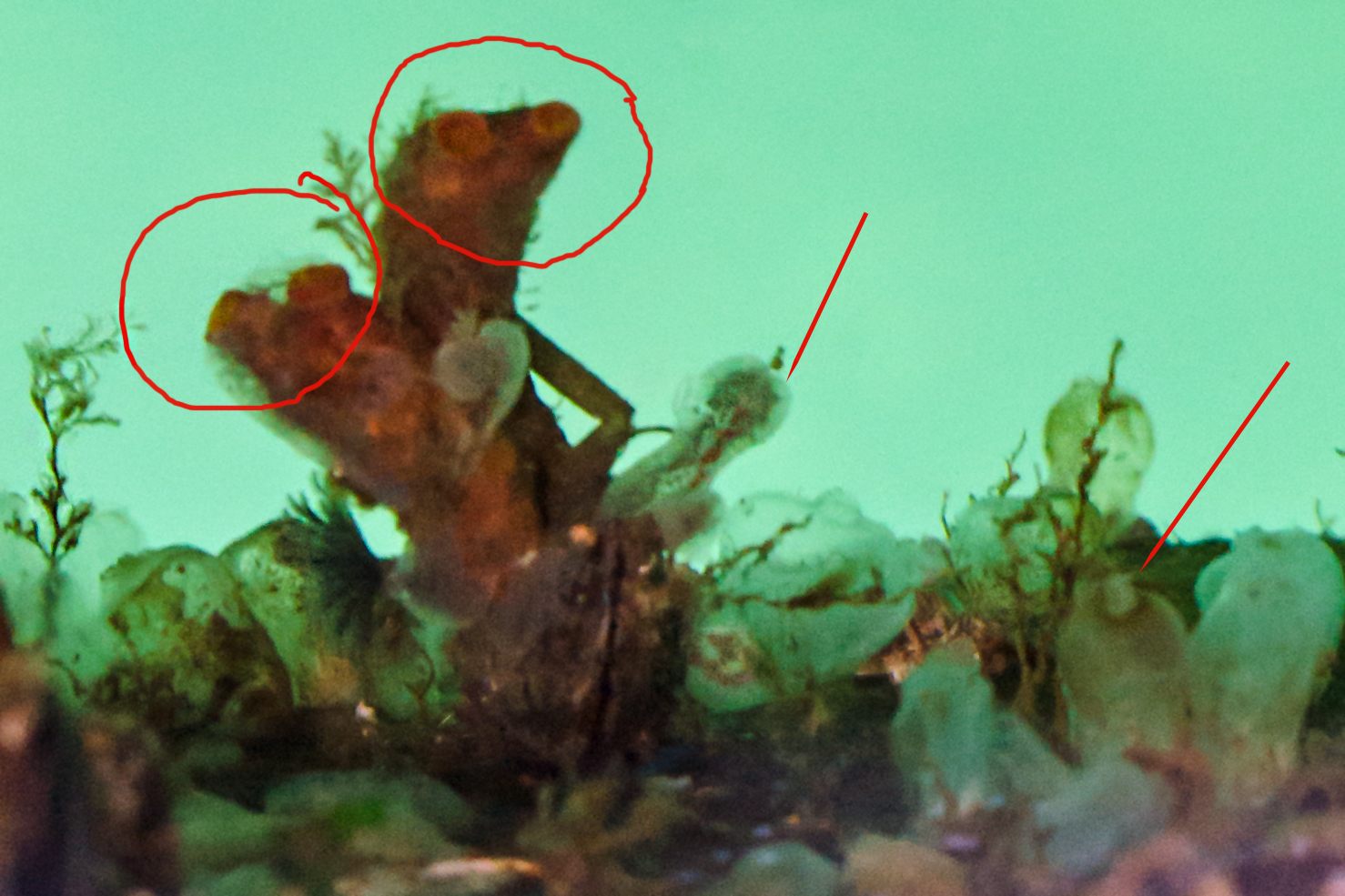
As far as I can tell, the pale cyan blobs have siphons, as well, and would be another species of tunicate (aka sea squirt). The red line in the centre points to another animal that is so transparent that its internal organs, and its food are visible through the wall. I think the other red line points to a half-way shut down anemone. On the far left, there is a hydroid stalk, and on the left of the base of the big tunicates, the flowery shape is the feeding tentacles of a worm.

Tunicates, tunicates, worms, etc. And what are those two potato-like blobs?

And there's still that pink thingie:

I think it may be a compound ascidian. like the red ascidian, or maybe the mushroom compound tunicate. Or something else? What do you think?

Worms tomorrow.

Saturday, August 02, 2014

Is there a lifer dance for a dance?

Sandhill cranes dance. As mature adults, they dance to attract and bond with a mate, but the rest of the time, they just dance, probably like we do, for the fun of it.

We had never seen a dance, though, until a couple of days ago, at Reifel Island Migratory Bird Sanctuary, where we met a group of 5 young adults on the pathway. They came, as usual, for their handout, but quickly lost interest and returned to the sunny patch they had chosen as a dance floor. And, not minding us, they danced and danced.

All of our photos turned out bad, unreparable, but I have to show you the least worst, anyhow; I'm so thrilled to have seen this display!

First, a not-so-terrible photo. Just finished the dance, catching his breath in the shade. He's an adult, by the red cap, but young, not fully grown yet.

The dance:

Limbering up.

Leaping!

The dance involves neck twisting, prodigious leaps straight upward, wing displays, leg stretches, prancing and other contortions. During mating dances, the cranes call to each other; these youngsters danced in silence.

The watcher will imitate him in a minute or two.

Choreography

Again, one watches, one leaps.

Fancy footwork

Two-step.

Five minutes later, it was over. We walked out into the sunshine (we had been half-hidden in deep shade while they danced), I went to feed the mallards in the lagoon, and turned to find a sandhill a foot away, asking for his tip. I up-ended my bag of goodies, and we left them to it.


Powered By Blogger