Showing posts with label pinesap. Show all posts

Saturday, August 06, 2022

Candy cane and pink elephants

 A year ago in June, I found candystick plants, pinesap, and coral roots at Lupin Falls, beside Buttle Lake. I wanted to look at them again, but I haven't been able to get out there this year until now, in August, well past their sell-by date. Yesterday, I climbed the trail towards the falls and found candystick and coral roots, and something I can't identify.

It was so dark there, under the evergreens, that I passed several blackish plants before the shape caught my attention. I had to use the flash, even to be sure what I was looking at.

The candystick has changed. Where the new leaves were almost white, now they're black with brown edges. But the stem is still candy-cane red and white.

Candystick, Allotropa virgata. The fruits are round, reddish capsules.

A whiter stalk, with one flower, only one fruit.

Just a stalk, to show its bright colours.

For comparison, here they are in June of last year.

The coral roots look about the same as they were in June, but paler. And a bit shabby.

Coralroot, Corallorhiza spp.

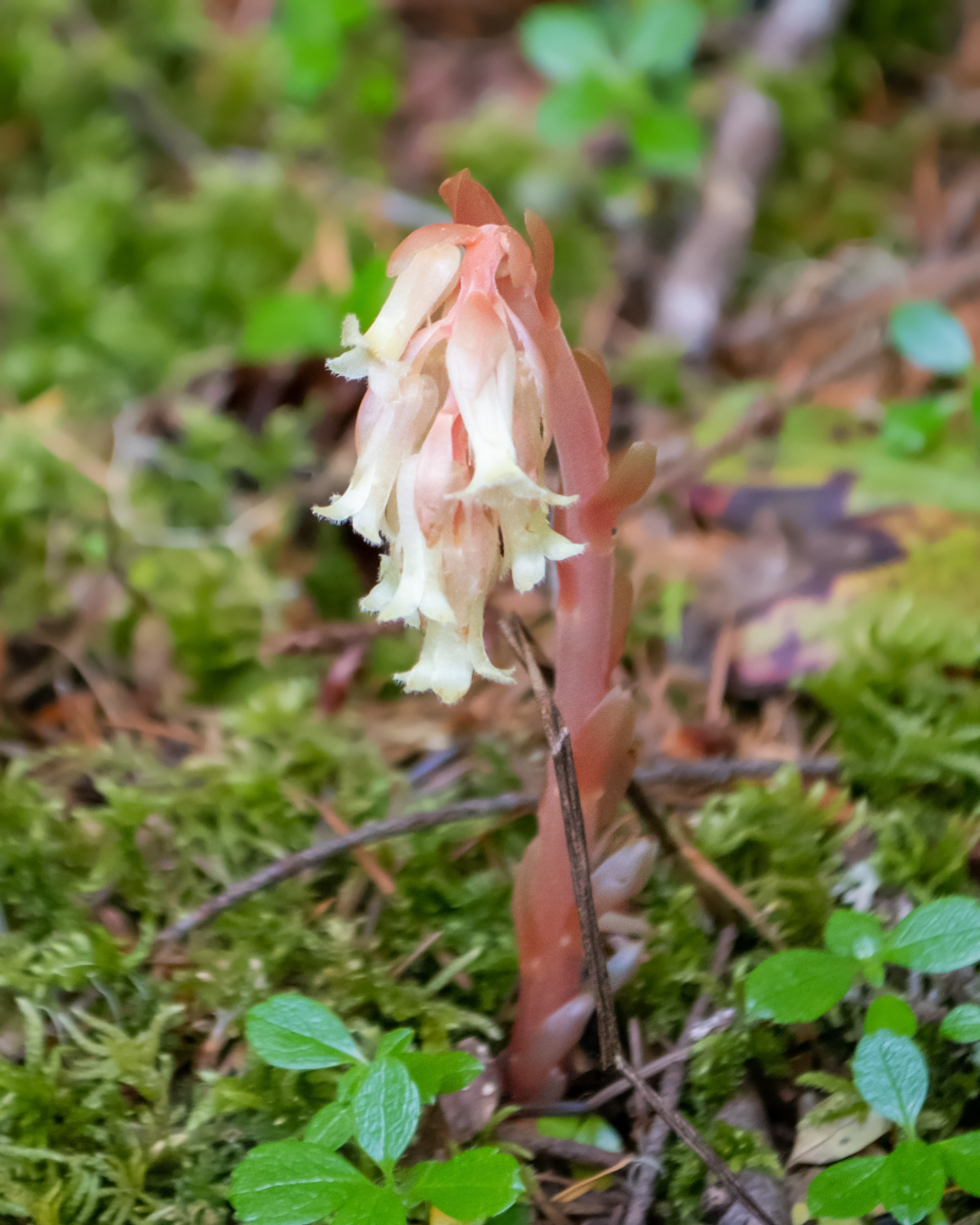
And I'm not sure what this one is. Looks like pink and cream elephants. My little pocket camera did a good job; the plant was too far up the side hill, in the dark, for the flash to reach or for me to see more than the round seed pods.

I think the black things are old leaves.

UPDATE: This has been identified as wintergreen, Pyrola spp., possibly green wintergreen, gone to seed.

I couldn't find any pinesap. I went to the same spots and poked around in the underbrush. Nothing. I'll try again next June.

~~~~~~~~~~~~~~~~~~~~~~~~~

Hace un año, en junio, fui a las cataratas Lupin, y encontré las plantas micoheterotróficas "bastón de caramelo", Allotropa virgata, y Hypopitys monotropa, y las orquídeas Corallorhiza spp. Quería verlas de nuevo, pero no pude ir hasta ahora, en agosto. Y las plantas ya pasaron el tiempo de flores. Pero ayer subí el cerro hacia las cataratas y encontré las dos plantas micoheterotróficas, además de algo que no pude identificar.

Estaba tan oscuro allí bajo los árboles que pasé varias plantas sin reconocerlas al principio por su forma. Tuve que usar el flash de la cámara para saber que es lo que miraba.

El "bastón de caramelo" ha cambiado. Donde las hojas nuevas eran casi blancas, ahora son negras con bordes cafés. Pero el tallo, con la luz del flash, sigue color de caramelo, rojo y blanco.

Fotos:

#1: Allotropa virgata. Las frutas son cápsulas redondas, rojizas.

#2: Una con el tallo casi blanco, solamente una flor y una fruta.

#3: Un tallo, para mostrar sus colores brillantes.

#4: Una foto del año pasado, en junio, para comparación.

Las orquídeas Corallorhiza spp. no han cambiado mucho, aparte de estar algo pálidas.

Foto #5: Corallorhiza

#6: No sé que planta es esta. Tiene un parecido de elefantes color de rosa con crema. Mi camarita de bolsillo sirvió aquí; las plantas estaban muy lejos en el cerro donde no se puede pasar, demasiado lejos para que les alcanzara el flash. Yo apenas podía ver las cápsulas de semillas. Ojalá alguien me pueda ayudar a identficarla.

Puesto al corriente: se ha identificado como Pyrola spp.

Y no encontré ninguna de las Hypopitys monotropa. Fui a los mismos sitios y busqué entre la hierba. Nada. Haré el intento otra vez en junio del año que entra.


Monday, July 12, 2021

Shade lovers (me. too!)

It was another hot day. Well, it only got to 28º, but that's hot for Vancouver Island. And when it's hot, there's nothing better than a shady walk under tall trees.

The trail to Moose Falls, Deer Fallls, Elk Falls, and points below.

The trail goes down, down, down. And steeply down again. (And up, up, up, coming home.) It's a bit challenging for my ancient knees, but it's overshadowed by these big evergreens. And there's a breeze and a roar from the waterfall below.

And under that green protection, shade-loving plants can grow.

A tiny pinesap, Hypopitys monotropa.

Clasping twisted stalk, Streptous amplexifolius.

It's called "clasping" because the leaves wrap around the stem. And "twisted stalk" because, look at the little stalks holding the single fruits. It is growing on a damp side hill, with moss and skunk cabbage.

And I'm not sure about this one, that I discovered when I sat down to rest halfway up that long hill.

Maybe it's pinedrops, Pterospora andromedea. But maybe not.

I'll send this one into inaturalist to see if they can identify it.

UPDATE:  It seems to be pink wintergreen, Pyrola asarifolia.

~~~~~~~~~~~~~~~~~~~~~~~~~~~~

Hizo calor otra vez. Bueno, no más llegó a 28ºC, pero aquí en la isla, eso cuenta como calor. Y en un dia caluroso, no hay nada mejor que un paseo bajo la sombra de grandes árboles.

Primera foto; el senderito que baja (y baja y baja. Y baja aún más) hacia las cataratas de Moose, de Deer, y de Elk. ("Moose' se refiere al alce, Alces alces, "Deer" es venado, y un  "Elk", Cervus canadensis, también se puede llamar uapití. Aquí en Canadá, por lo menos. Si vas a Europa, al moose, le llaman "elk", y al elk, le llaman wapiti. Los dos son grandes ejemplares de la familia mayor de los venados, y son nativos a Canadá y otros paises norteños.)

El camino es un poco difícil para mis rodillas ancianas, no tanto en la subida. Pero el sendero sigue en la sombra de estos árboles perennifolios. Y hay una brisa fresca y el clamor de las cataratas allá abajo.

Y bajo la protección de los árboles, crecen plantas amantes de la sombra.

Segunda foto: Hipopitys monotropa, "salvia de pino".

Tercera: Streptous amplexifolius; a esta planta le llamamos "sujetador con el tallo torcido", porque las hojas se forman alrededor del tallo, y porque: mira el tallito de donde cuelga el fruto único. Esta crece en una ladera húmeda, entre musgos y linterna de pantano.

Cuarta: esta no la conozco. La encontré cuando me senté a descansar a la mitad de la subida. Puede ser (o no) las gotas de pino, Pterospora andromedea. La voy a subir a inaturalist para ver si me la pueden identificar.


Thursday, June 24, 2021

Pink pinesap

And where the Candystick grows, pinesap thrives.

Pinesaps, Monotropa hypopitys. With twin flowers.

These were scattered along the trails from the water's edge at Buttle Lake, up past the highway and on to the Lupin Falls above, growing surrounded by clusters of twinflowers.

It's another myco-heterotroph, with no clorophyll, and associated with fungi that derive their nutrients from the roots of the trees above. The Latin name, Monotropa hypopitys, means: Mono = one, tropa = direction, (because all the flowers bend the same way) and hypo = under, pitys (altenate spelling, pithys) = pine, where it grows; in coniferous forests.

One inflorescence on its own. Most of the plant is underground.

The flowers have 4 or 5 petals, forming a tube. All the ones I was able to count had 4.

And because someone's going to ask, yes they are edible. Raw, they are tasteless, but cooked they taste something like asparagus. But why eat them? They're beautiful; isn't that enough?
~~~~~~~~~~~~~~~~~~~~~

Donde crece el "Palo de dulce", también está feliz esta planta, Monotropa hypopitys. Hay un buen número creciendo a lo largo del sendero que baja a la orilla del Lago Buttle, y sube el cerro hasta las cataratas Lupin, casi siempre rodeadas de flores gemelas.

Es otra planta micoheterotrófica, sin clorofila, y que obtiene sus nutrientes por medio de hongos que crecen con los árboles coníferos. El nombre científico significa: Mono = solo, tropa = orientación, (porque todas las flores miran hacia el mismo lado) y hypo = bajo, pitys = pinos: el lugar donde crece, en bosques con abetos Douglas y otros pinos.

Cada "planta" visible es solamente la inflorescencia; la mayor parte de la planta permanece bajo tierra.

Las flores, dicen, tienen 4 o 5 pétalos, que forman un tubo. Todas las flores que pude ver tenían solo 4 pétalos.

Y sí, porque me van a preguntar, se puede comer. Cruda, no sabe a nada, pero cocida tiene un sabor a espárragos. Pero más vale dejarlas crecer por su belleza.


Tuesday, August 11, 2020

Pinesaps!

Some are yellow, flowering in the spring. Some flower in late summer and are pink or red. They are never green.

I came across several clumps of pink stalks in the deep shade on the hillside.


Pinesap, Monotropa hypopitys, summer edition.

The flowers are white, shading to purplish, with four hairy petals and a long central column.

A closer look.

Pinesaps. Because they live under pines. (And feed off their sap? Indirectly, yes.)

They have no chlorophyll and don't convert sunlight to sugars. They get their nutrients third-hand, from the mushrooms that depend on the trees spreading their greenery far overhead.

Along the pathway I had seen several large mushrooms, broken and nibbled by slugs. These pinesaps are parasitic on the mushrooms. And the mushrooms live in a symbiotic relationship with the evergreens that do the work of reaching out to the sun.

The flowers start out bent over, and straighten up as they mature.

The plant consists of a perennial mass of roots which in season sends up a flower head; the pink stalk is considered to be a part of the flower raceme.

The fruits are round capsules, here pink, like the stems. (Flash used here.)


Ripe capsules. The stigma is yellow in new flowers, turning purple as it ripens.

The seed capsules dry to dark brown; I saw a few, but the photos were too dark to be useful.
One stalk had broken off: I brought it home, all rumpled and half dry, and looked at it under the microscope:

Dying flowers, one without petals, showing its ovary and stigma, and the stamens, already brown and dry. And hairy.

Two ripe seed capsules.

~~~~~~~~~~~~~~~~~~~

Algunas de estas plantas son amarillas, y florecen en la primavera. Las que florecen más tarde, en el verano, son color de rosa. Nunca son verdes.

Encontré varios grupos, siempre en sombra, siempre cerca de unos hongos blancos, y siempre bajo pinos.

Las plantas no contienen clorofila, y no producen sus propias sustancias nutritivas. Son parásitos, que toman su alimento de los hongos, los cuales son simbiontes que dependen de los árboles que convierten la luz del sol a energía.

Se llaman, en inglés, Pinesap, o sea savia de pinos y son la única especie en su género. Salen de una masa perenne de raices, produciendo los tallos con flores en la temporada, desapareciendo bajo la tierra hasta el próximo año.

Los frutos son unas cápsulas redondas, rojizas, que, secas, se vuelven color de café oscuro.

Una rama estaba tirada en el suelo, rota. Me la traje a casa y la miré bajo el microscopio.

Monday, June 20, 2016

Beggars and Thieves

I took another trip to Gold River and back, this time with my daughter and her husband. We were in no hurry; we drove down inviting side roads, dawdled along trails with interesting names, crawled over rocks and poked through the duff under evergreens.

Three connected lakes look, on Google maps, more like a fat river, rarely more than a couple of kilometres wide. They end up just out of Campbell River (the town, but also the river) coming from the west via Campbell Lake, then the southwest via Upper Campbell Lake. At the southwest tip of the Upper Campbell, it joins Buttle Lake, coming up from the south, making a total of about 70 kms or 45 miles in all. The highway to Gold River follows the first two lakes, crosses the narrows between the Upper Campbell and Buttle, and hies away to the west, following other rivers.

On our way home, the road down the shore of Buttle Lake called to us, and we had to follow. 3 kilometres down the road, there was a trailhead sign: Lupin Falls. In the parking lot, an informational poster sent me off into the bush, poking about in the dark.

"Beggars and Thieves" A faded, stained, damaged poster. I have repaired as much as I could, to make it readable.

Text of the poster: Beggars and Thieves.
Growing in shade and darkness are some most unusual plants! Lacking the green pigment clorophyll used for manufacturing food from sunlight, they must scrounge or steal.
Some, as parasites, steal food directly from a host plant upon which they are completely dependent. Others, as saprophytes, beg for left-overs (dead organic matter) using special fungi associated with their roots. Some even obtain food from these fungi who in turn have received it from a nearby tree!
Please "Let Them Be" for with your help, these "beggars and thieves" will continue to be an important part of this park's heritage.

The plants shown are Ground Cone, Spotted Coral Root, Western Coral Root, Indian Pipe, Pinesap, Pinedrops, Gnome Plant, and Candy Stick.

Of these, I had seen the Indian Pipe and maybe the Ground Cone. So while the others stuck to the trails, I searched the forest floor. And found Pinesaps!

Pinesaps, Monotropa hypopitys.

Another pair, nearby.

Clorophyll is the pigment that makes leaves green, and allows plants to get energy from sunlight. (And by extension, allows us to get energy from those plants. We're in the same boat as these pinesaps; no clorophyll of our own.) Pinesaps have no green pigment. The whole plant is in shades from a yellowish white to pink or red.

The plant is an epiparasite. A parasite feeds off another organism. An epiparasite gets its food from another parasite, one step removed from the original producer of nutrients. Pinesap roots tap into a fungus which attaches itself to the roots of a tree. The tree, far above, converts sunlight into sugars, while down in the earth, the fungus spreads itself through the soil, collecting water and nutrients for the tree. The pinesap takes the sugar and the nutrients, and does nothing but look pretty. But that's enough. isn't it?

The young flowers start off hanging downward, then gradually turn upright as they mature. The plants in the second photo, then, are older than the ones above.

A closer look at some of the flowers. The inner surface of the petals is very hairy.

Zooming in.

I didn't see any lupins, falling or not. Probably because they like the sunshine and I was prowling in deep, deep shade.

GPS coordiantes: 49.82082, -125.60267

Powered By Blogger