Showing posts with label Monotropa hypopitys. Show all posts

Thursday, June 24, 2021

Pink pinesap

And where the Candystick grows, pinesap thrives.

Pinesaps, Monotropa hypopitys. With twin flowers.

These were scattered along the trails from the water's edge at Buttle Lake, up past the highway and on to the Lupin Falls above, growing surrounded by clusters of twinflowers.

It's another myco-heterotroph, with no clorophyll, and associated with fungi that derive their nutrients from the roots of the trees above. The Latin name, Monotropa hypopitys, means: Mono = one, tropa = direction, (because all the flowers bend the same way) and hypo = under, pitys (altenate spelling, pithys) = pine, where it grows; in coniferous forests.
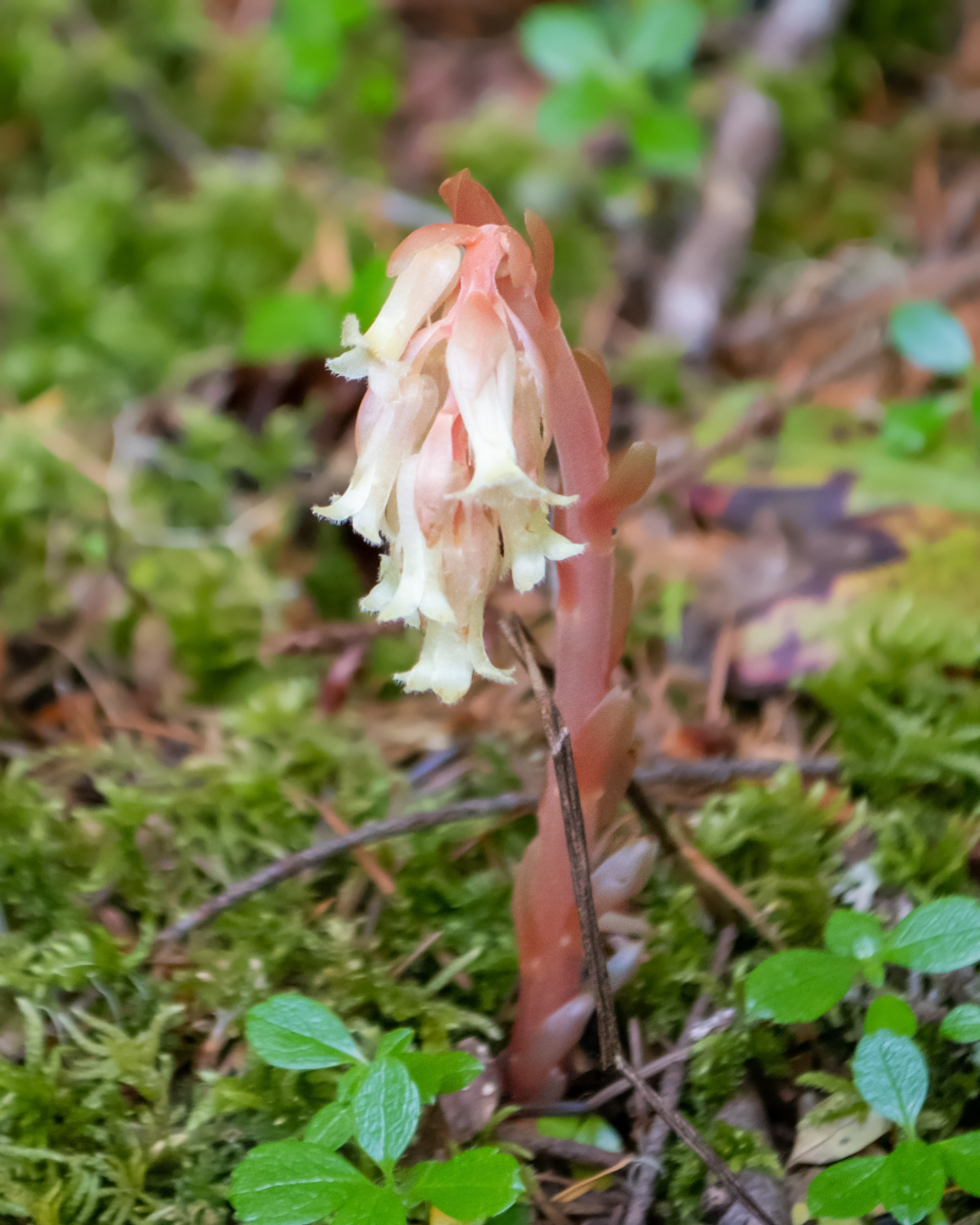
One inflorescence on its own. Most of the plant is underground.

The flowers have 4 or 5 petals, forming a tube. All the ones I was able to count had 4.

And because someone's going to ask, yes they are edible. Raw, they are tasteless, but cooked they taste something like asparagus. But why eat them? They're beautiful; isn't that enough?
~~~~~~~~~~~~~~~~~~~~~

Donde crece el "Palo de dulce", también está feliz esta planta, Monotropa hypopitys. Hay un buen número creciendo a lo largo del sendero que baja a la orilla del Lago Buttle, y sube el cerro hasta las cataratas Lupin, casi siempre rodeadas de flores gemelas.

Es otra planta micoheterotrófica, sin clorofila, y que obtiene sus nutrientes por medio de hongos que crecen con los árboles coníferos. El nombre científico significa: Mono = solo, tropa = orientación, (porque todas las flores miran hacia el mismo lado) y hypo = bajo, pitys = pinos: el lugar donde crece, en bosques con abetos Douglas y otros pinos.

Cada "planta" visible es solamente la inflorescencia; la mayor parte de la planta permanece bajo tierra.

Las flores, dicen, tienen 4 o 5 pétalos, que forman un tubo. Todas las flores que pude ver tenían solo 4 pétalos.

Y sí, porque me van a preguntar, se puede comer. Cruda, no sabe a nada, pero cocida tiene un sabor a espárragos. Pero más vale dejarlas crecer por su belleza.


Tuesday, August 11, 2020

Pinesaps!

Some are yellow, flowering in the spring. Some flower in late summer and are pink or red. They are never green.

I came across several clumps of pink stalks in the deep shade on the hillside.


Pinesap, Monotropa hypopitys, summer edition.

The flowers are white, shading to purplish, with four hairy petals and a long central column.

A closer look.

Pinesaps. Because they live under pines. (And feed off their sap? Indirectly, yes.)

They have no chlorophyll and don't convert sunlight to sugars. They get their nutrients third-hand, from the mushrooms that depend on the trees spreading their greenery far overhead.

Along the pathway I had seen several large mushrooms, broken and nibbled by slugs. These pinesaps are parasitic on the mushrooms. And the mushrooms live in a symbiotic relationship with the evergreens that do the work of reaching out to the sun.

The flowers start out bent over, and straighten up as they mature.

The plant consists of a perennial mass of roots which in season sends up a flower head; the pink stalk is considered to be a part of the flower raceme.

The fruits are round capsules, here pink, like the stems. (Flash used here.)


Ripe capsules. The stigma is yellow in new flowers, turning purple as it ripens.

The seed capsules dry to dark brown; I saw a few, but the photos were too dark to be useful.
One stalk had broken off: I brought it home, all rumpled and half dry, and looked at it under the microscope:

Dying flowers, one without petals, showing its ovary and stigma, and the stamens, already brown and dry. And hairy.

Two ripe seed capsules.

~~~~~~~~~~~~~~~~~~~

Algunas de estas plantas son amarillas, y florecen en la primavera. Las que florecen más tarde, en el verano, son color de rosa. Nunca son verdes.

Encontré varios grupos, siempre en sombra, siempre cerca de unos hongos blancos, y siempre bajo pinos.

Las plantas no contienen clorofila, y no producen sus propias sustancias nutritivas. Son parásitos, que toman su alimento de los hongos, los cuales son simbiontes que dependen de los árboles que convierten la luz del sol a energía.

Se llaman, en inglés, Pinesap, o sea savia de pinos y son la única especie en su género. Salen de una masa perenne de raices, produciendo los tallos con flores en la temporada, desapareciendo bajo la tierra hasta el próximo año.

Los frutos son unas cápsulas redondas, rojizas, que, secas, se vuelven color de café oscuro.

Una rama estaba tirada en el suelo, rota. Me la traje a casa y la miré bajo el microscopio.

Powered By Blogger