Showing posts with label Lupin Fallls. Show all posts

Thursday, June 24, 2021

Pink pinesap

And where the Candystick grows, pinesap thrives.

Pinesaps, Monotropa hypopitys. With twin flowers.

These were scattered along the trails from the water's edge at Buttle Lake, up past the highway and on to the Lupin Falls above, growing surrounded by clusters of twinflowers.

It's another myco-heterotroph, with no clorophyll, and associated with fungi that derive their nutrients from the roots of the trees above. The Latin name, Monotropa hypopitys, means: Mono = one, tropa = direction, (because all the flowers bend the same way) and hypo = under, pitys (altenate spelling, pithys) = pine, where it grows; in coniferous forests.
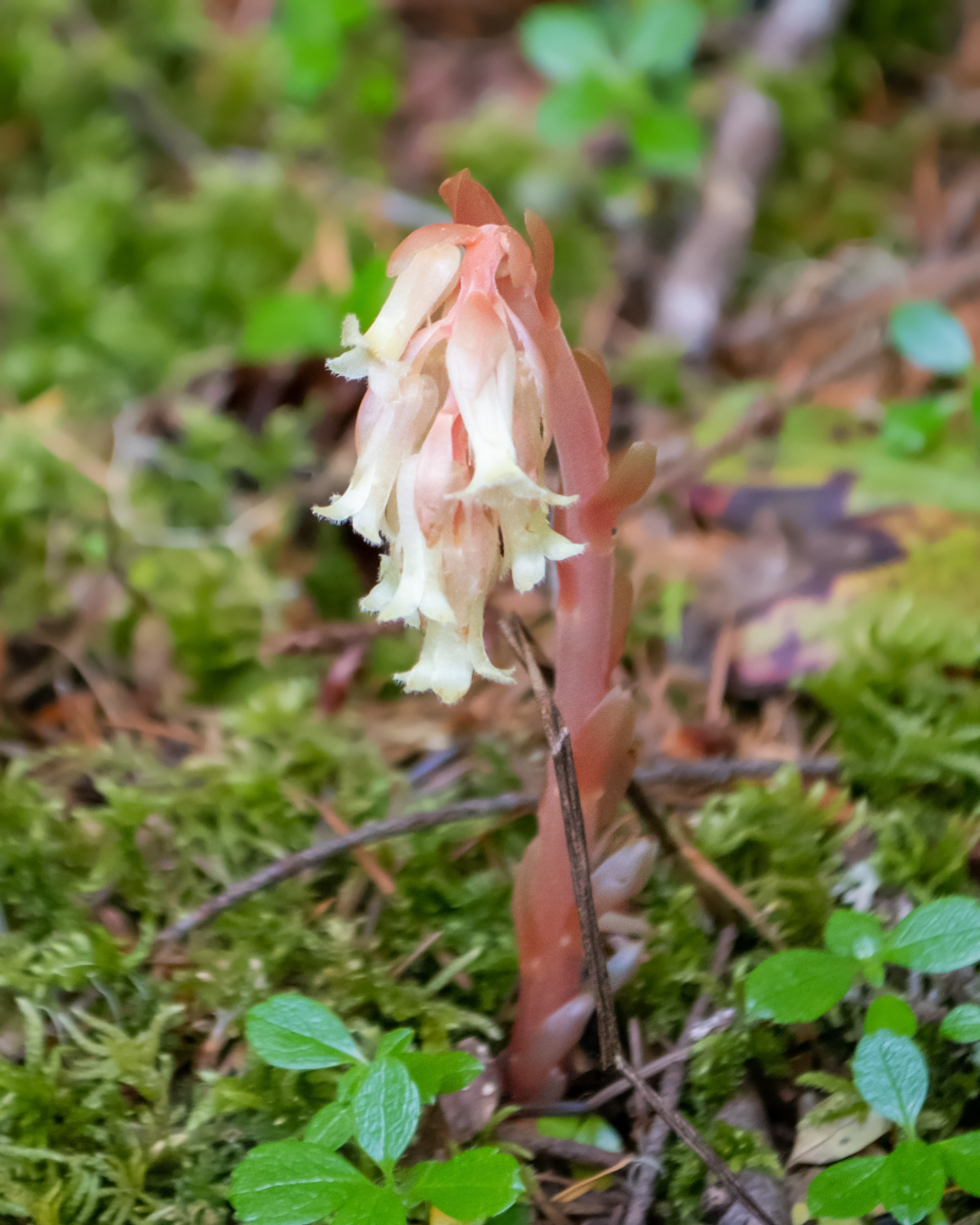
One inflorescence on its own. Most of the plant is underground.

The flowers have 4 or 5 petals, forming a tube. All the ones I was able to count had 4.

And because someone's going to ask, yes they are edible. Raw, they are tasteless, but cooked they taste something like asparagus. But why eat them? They're beautiful; isn't that enough?
~~~~~~~~~~~~~~~~~~~~~

Donde crece el "Palo de dulce", también está feliz esta planta, Monotropa hypopitys. Hay un buen número creciendo a lo largo del sendero que baja a la orilla del Lago Buttle, y sube el cerro hasta las cataratas Lupin, casi siempre rodeadas de flores gemelas.

Es otra planta micoheterotrófica, sin clorofila, y que obtiene sus nutrientes por medio de hongos que crecen con los árboles coníferos. El nombre científico significa: Mono = solo, tropa = orientación, (porque todas las flores miran hacia el mismo lado) y hypo = bajo, pitys = pinos: el lugar donde crece, en bosques con abetos Douglas y otros pinos.

Cada "planta" visible es solamente la inflorescencia; la mayor parte de la planta permanece bajo tierra.

Las flores, dicen, tienen 4 o 5 pétalos, que forman un tubo. Todas las flores que pude ver tenían solo 4 pétalos.

Y sí, porque me van a preguntar, se puede comer. Cruda, no sabe a nada, pero cocida tiene un sabor a espárragos. Pero más vale dejarlas crecer por su belleza.


Wednesday, June 23, 2021

Candystriper

In a dry, mostly brown, open Douglas fir forest, a bit of candystriping took me by surprise.

Candystick, Allotropa virgata, Lupin Falls trail.

Candystick, like the coralroot, has no clorophyll; it can't make food from sunlight like the green plants do. It is a mycoheterotroph. (Myco = fungus, hetero = other, different, troph = feeding.) It gets its food from an association with a mushroom that in turn, is attached to the root of a green plant.

Allotropa virgata feeds exclusively on Matsutake mushroom (Tricholoma matsutake) mycelium.(Wikipedia) (That's the delicious and expensive pine mushroom.)
I cropped the photo to show the candy-striping and the cherry-pie filling flowers.

Looks yummy!

Another view of the same plant.

It grows in association with stair-step moss or red-stem feathermoss, which I think is the moss on the rock beside the candystick.

~~~~~~~~~~~~~~~~~~~

En un bosque seco, casi todo del color café, entre abetos de Douglas, me sorprendió ver estos colores rojo y blanco.

Es una planta "palo de dulce", Allotropa virgata, y crece en el sendero hacia las cataratas Lupin.

Igual que la orquídea Corallorhiza, que he visto recientemente, esta planta no contiene clorofila, y no puede fabricar sus necesidades a base de luz solar, como lo hacen las plantas verdes. Es una planta micoheterotrófica; (mico = hongo, hetero = differente, trofico = nutrientes.) Obtiene su nutrición debido a su asociación con un hongo, el cual asimismo la obtiene por su contacto con la raiz de una planta verde.

Según Wikipedia, Allotropha virgata se alimenta exclusivamente a base del micelio del hongo Tricholoma matsutake. Este es el hongo de pino, delicioso, y muy caro. (Para nosotros, claro está.)

Crece cerca de los musgos "stair step", o el musgo de plumas con tallo rojo, el cual, creo, es el que cubre la roca al lado.


Tuesday, June 22, 2021

Lupin Falls

I took a quick trip to Buttle Lake today. Hiked up and down a few hills. Stared at overhanging rocks. There were orchids! Pillow lava! Pinesaps! Waterfalls! Mushrooms! Candystick saphropythes! Snowy peaks! Aching knees! (Ignore that; the cost of admission; a bargain!) Indian paintbrush and columbines and twin flowers and honeysuckle and more!

I'll be processing photos for a few days. For now, here's Lupin Falls.

From the viewpoint along the trail.

The drop here is 120 feet; 30 more than Elk Falls, but with a tiny fraction of the flow. It even dries up towards the end of summer.

And the creek goes on down the hill, about 200 metres, in small leaps.

Partway down. Still quite a ways to go to reach the lake far below.

I always check the waterfalls in the World Waterfall Database. About Lupin Falls, they comment:

This waterfall is likely to exist, but its exact location, stature, and attributes have not yet been determined or confirmed. (WWDatabase)

I had to laugh. It exists. And I found it just in front of the viewing platform in the centre of a 1 km. loop trail.

~~~~~~~~~~~~~~~~

Hoy visité el lago Buttle, me subí y bajé por varios senderos, me torcí el cuello mirando a precipicios que parecen listos para caer encima del viajero. ¡Y había orquídeas! ¡Lava acojinada! ¡Pinesaps (Monotropa hypopitys)! ¡Cataratas! ¡Hongos! ¡Saprofitos "Candystick"! ¡Montañas con sus cumbres nevadas! ¡Rodillas adoloridas! (Olvida eso, es el precio de la aventura, muy barata, por cierto.) ¡Flores; castillejas, aquilejgias, flores gemelas, loniceras, y más!

Voy a estar procesando fotos por unos dias. Por ahora, aquí hay fotos de las cataratas "Lupin".

La caída principal es de 37 metros, 10 más que nuestra catarata local, Elk Falls, pero con mucho menos agua; hasta llega a secarse al final del verano. Luego sigue bajando el cerro unos 200 metros, en saltos pequeños hasta llegar al lago.

Siempre busco las cataratas que encuentro en el registro de cataratas del mundo (WWDatabase). Acerca de esta catarata, Lupin Falls, hacen el comentario:

"Esta catarata es probable que exista, pero no se han confirmado ni su sitio exacto, ni su altura, ni sus características."

Me hizo reir. Sí que existe. Y la encontré justo en frente de la plataforma de observación, a la mitad de un senderito de 1 km. de largo.

Powered By Blogger