A year ago in June, I found candystick plants, pinesap, and coral roots at Lupin Falls, beside Buttle Lake. I wanted to look at them again, but I haven't been able to get out there this year until now, in August, well past their sell-by date. Yesterday, I climbed the trail towards the falls and found candystick and coral roots, and something I can't identify.
It was so dark there, under the evergreens, that I passed several blackish plants before the shape caught my attention. I had to use the flash, even to be sure what I was looking at.
The candystick has changed. Where the new leaves were almost white, now they're black with brown edges. But the stem is still candy-cane red and white.
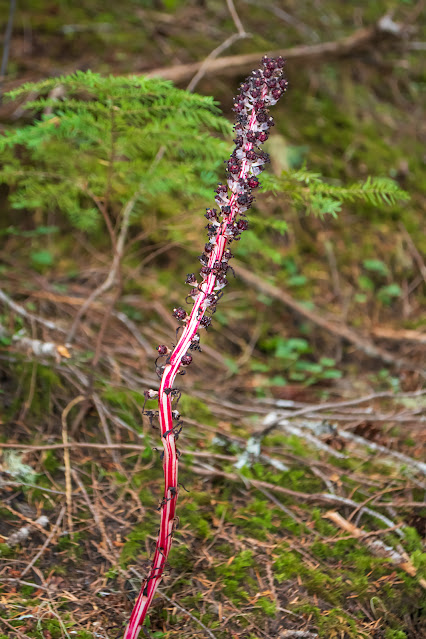 |
| Candystick, Allotropa virgata. The fruits are round, reddish capsules. |
 |
| A whiter stalk, with one flower, only one fruit. |
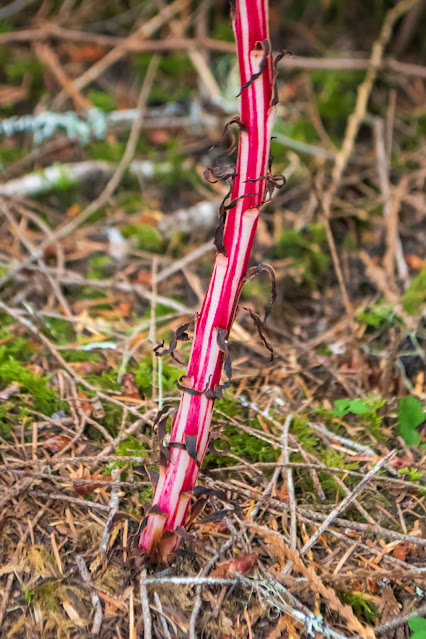 |
| Just a stalk, to show its bright colours. |
 |
| For comparison, here they are in June of last year. |
The coral roots look about the same as they were in June, but paler. And a bit shabby.
 |
| Coralroot, Corallorhiza spp. |
And I'm not sure what this one is. Looks like pink and cream elephants. My little pocket camera did a good job; the plant was too far up the side hill, in the dark, for the flash to reach or for me to see more than the round seed pods.
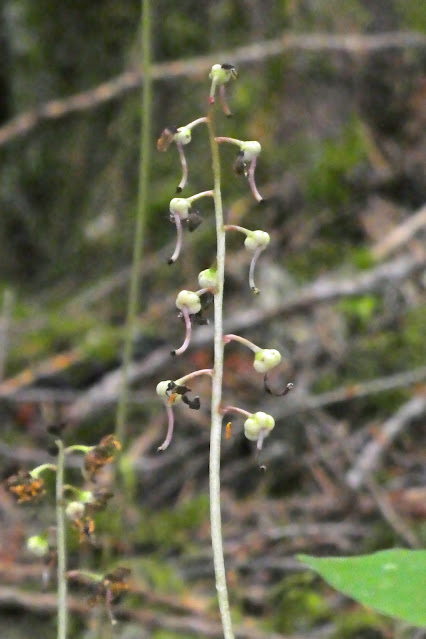 |
| I think the black things are old leaves. |
UPDATE: This has been identified as wintergreen,
Pyrola spp., possibly green wintergreen, gone to seed.
I couldn't find any pinesap. I went to the same spots and poked around in the underbrush. Nothing. I'll try again next June.
~~~~~~~~~~~~~~~~~~~~~~~~~
Hace un año, en junio, fui a las cataratas Lupin, y encontré las plantas micoheterotróficas "bastón de caramelo", Allotropa virgata, y Hypopitys monotropa, y las orquídeas Corallorhiza spp. Quería verlas de nuevo, pero no pude ir hasta ahora, en agosto. Y las plantas ya pasaron el tiempo de flores. Pero ayer subí el cerro hacia las cataratas y encontré las dos plantas micoheterotróficas, además de algo que no pude identificar.
Estaba tan oscuro allí bajo los árboles que pasé varias plantas sin reconocerlas al principio por su forma. Tuve que usar el flash de la cámara para saber que es lo que miraba.
El "bastón de caramelo" ha cambiado. Donde las hojas nuevas eran casi blancas, ahora son negras con bordes cafés. Pero el tallo, con la luz del flash, sigue color de caramelo, rojo y blanco.
Fotos:
#1: Allotropa virgata. Las frutas son cápsulas redondas, rojizas.
#2: Una con el tallo casi blanco, solamente una flor y una fruta.
#3: Un tallo, para mostrar sus colores brillantes.
#4: Una foto del año pasado, en junio, para comparación.
Las orquídeas Corallorhiza spp. no han cambiado mucho, aparte de estar algo pálidas.
Foto #5: Corallorhiza
#6: No sé que planta es esta. Tiene un parecido de elefantes color de rosa con crema. Mi camarita de bolsillo sirvió aquí; las plantas estaban muy lejos en el cerro donde no se puede pasar, demasiado lejos para que les alcanzara el flash. Yo apenas podía ver las cápsulas de semillas. Ojalá alguien me pueda ayudar a identficarla.
Puesto al corriente: se ha identificado como Pyrola spp.
Y no encontré ninguna de las Hypopitys monotropa. Fui a los mismos sitios y busqué entre la hierba. Nada. Haré el intento otra vez en junio del año que entra.


