Showing posts with label caprellids. Show all posts

Monday, July 06, 2015

Ride 'em, cowshrimp!

And here's yesterday's skeleton shrimp, riding the currents and hoping to catch a juicy copepod.


It was my birthday today, and I've had company, including a beautiful 6-year-old boy who helped me empty the tank and do inventory. He even managed to catch a shrimp in his hand, without hurting it!

And now I'm tired and feeling every single one of my mumblety years; I'm going to bed.

Pink algae, tomorrow.

Sunday, July 05, 2015

Almost a cartoon

I've been working on photos of a delicate pink algae, but it's infested with bouncy skeleton shrimp. This couple made me laugh.

Six-legged bully

I try not to anthropomorphize my critters, to remember that they have their own lives that don't necessarily mesh with ours. But sometimes the temptation is strong. I know the face on that poor victim is just a fluke of camera angles; she* doesn't really have a down-turned mouth and a pug nose. She's not really going to be forced to hand over her lunch money. It just looks that way.

But some things are almost universal, among humans, animals, and even plants: the struggle for place, for food, for sex or its equivalent. And these skeleton shrimp are fighters; they cross paths often, and when they do, they hit and bite at each other. Usually it ends quickly, as the smaller one backs away.

A few seconds later; fight ended, all is forgiven and forgotten.

These tiny beasties are usually standing upright on swaying seaweeds. Nothing seems to dislodge them, even when I pick up a handful of algae and swish it around in the water to shake out any muck or unsuspected hitchhikers. When I drop the algae back in the tank, there are all the skeleton shrimp, standing tall, as if nothing had happened.

When they move from one branch of seaweed to another, or travel down a blade of eelgrass, they bend over, grasp the path ahead with their big, hooked "hands" (gnathopods), then bring up the back legs, the way an inchworm moves. But as soon as they've reached their destination, they stand up again.

Those six prehensile legs explain how they maintain their footing.

*She's carrying young; see her swollen brood pouch? The larger one is probably a male.

Monday, May 04, 2015

Dancing jester

Nothing is ever as simple as it seems. Especially underwater. Everything is layered; things grow on shells, on seaweed, on rocks; other plants and animals grow on those, and are home, again, to another community of something else. And everything eats. Hydroids eat plankton; nudibranchs and hermit crabs eat hydroids; crabs eat hermits when they can catch them; gulls eat crabs. So do we, if they're big enough.

On one of the blades of the skinny eelgrass I brought home the other day, I noticed a fuzzy barnacle. And the fuzz, looking at it with a hand lens, was not the expected diatoms or algae.

Side view of the blade of eelgrass. The barnacle is about 3 mm high.

These look like some type of hydroid; there's a stalk, a polyp surrounded by tentacles, these ones with knobs on the tips. But I can't find them in any of the books or web pages I've searched, probably because they are too small to attract attention.

Our common Obelia hydroids are branched.

Small Obelia, on another blade of the same plant. The eelgrass blade is 4 mm. wide.

But the new ones are clubs with at the most two polyps at the top. And they're noticeably orange, rather than semi-transparent like the Obelias.

But wait a minute! Looking at that first photo again, what is that thing that looks like a little man in a jester's hat? That's no hydroid!

I watched for a while, and the jester began to dance.

See him there, on the centre left side of the eelgrass?

It's a Caprellid, a skeleton shrimp. I never expected to see one so small. But nothing else dances like they do.

Standing upright again, waving antennae and big pincers (the jesters hat).

I found three more skeleton shrimp, all about the same size, along the blade of eelgrass. Standing upright, with the pincers raised, they mimic the hydroids, possibly as protection from predators that will avoid the stinging tentacles of a hydroid, and otherwise would find a caprellid quite tasty.

Most species are predators that sit and wait like a praying mantis, with their gnathopods ready to snatch any smaller invertebrates which come along. They accentuate their adaptive form and colouration by assuming an angular pose, resembling that of the fronds among which they live. They remain motionless for long periods of time while waiting to ambush their prey, often protozoa or small worms. (From Wikipedia, Caprellidae)

Wikipedia adds that they are eaten, in turn, by anemones, nudibranchs, and fish. I think I would add hermit crabs to the list. The colonies of hydroids and skeleton shrimp lasted only a night, with a dozen hermits busy cleaning the eelgrass. All that was left in the morning was the barnacle.

....

And there's more! Empty doughnuts tomorrow.

Friday, February 08, 2013

Rescue operation

They line up along the shore, all these busy housing developments, piled higgledy-piggledy among the rotting remains of their gardens, their tenants struggling to cope with the sudden changes in the weather, the drafty walls, the loss of food sources. Some move out; others have no place to go. They're doomed. Once in a great while, they are rescued on time.

Laurie keeps finding me bull kelp holdfasts, full of stranded critters. I can only bring so many home; there's not enough time to examine them all, nor can I save more than a few of the dispossessed. Last week, I picked two of the freshest (but they were already disintegrating in my hands) and brought them home to see who was still living there.

Worms, of course; the almost microscopic snaky threads; a few polychaetes, already dead, which I fed to the hermit crabs, a special treat; and a purple ribbon worm, Paranemertes peregrina.

The underside is a paler brownish colour. The worm was about 4 inches long, although he wasn't too enthusiastic about untangling himself to be measured.

The species name, peregrina, means travelling, so this worm is also called the wandering worm, or the restless worm. It's a predator that wanders about hunting for smaller worms among rocks and mud.

There were several snails deep inside the maze, hard to dig out without dismantling the walls. A couple of dead barnacles. A very small clam, alive and active, now delving happily in my aquarium bottom. Circular patches of bryozoans. And amphipods, of several species; the common beach hoppers, squatters in the abandoned hallways, and some very large, brown amphipods, twice the size and more of the ones that live in the eelgrass.

And on the topside of one of the holdfasts, there were two fat, solid-looking, yellow, bagel-shaped things. Egg cases, probably, although it seems early for them. They were about 2 mm across. I left them in the aquarium while I tended to other things, then went back two days later to take their photos. Alas! All that was left was a large mass of transparent jelly, fraying and dissolving into the water even as I looked it over.

A couple of handfuls of eelgrass, roots and all, were more productive. On the blades themselves, I found many limpets, a couple of very small mussels (one survived), green amphipods, bryozoans and just a few little containers that seemed to be holding eggs.

Round, fat, crystal vases with scalloped rims, some still holding a few white egg masses. On rotting eelgrass. What will come of these? I'm holding them in their own little cup; so far, they seem to be alive.

I always check eelgrass roots for skeleton shrimp. There are usually a few, even in winter; this time, they included the largest one I have ever seen. They grow up to about an inch and a half; this one was half that.

A female, carrying young in her green brood pouches.

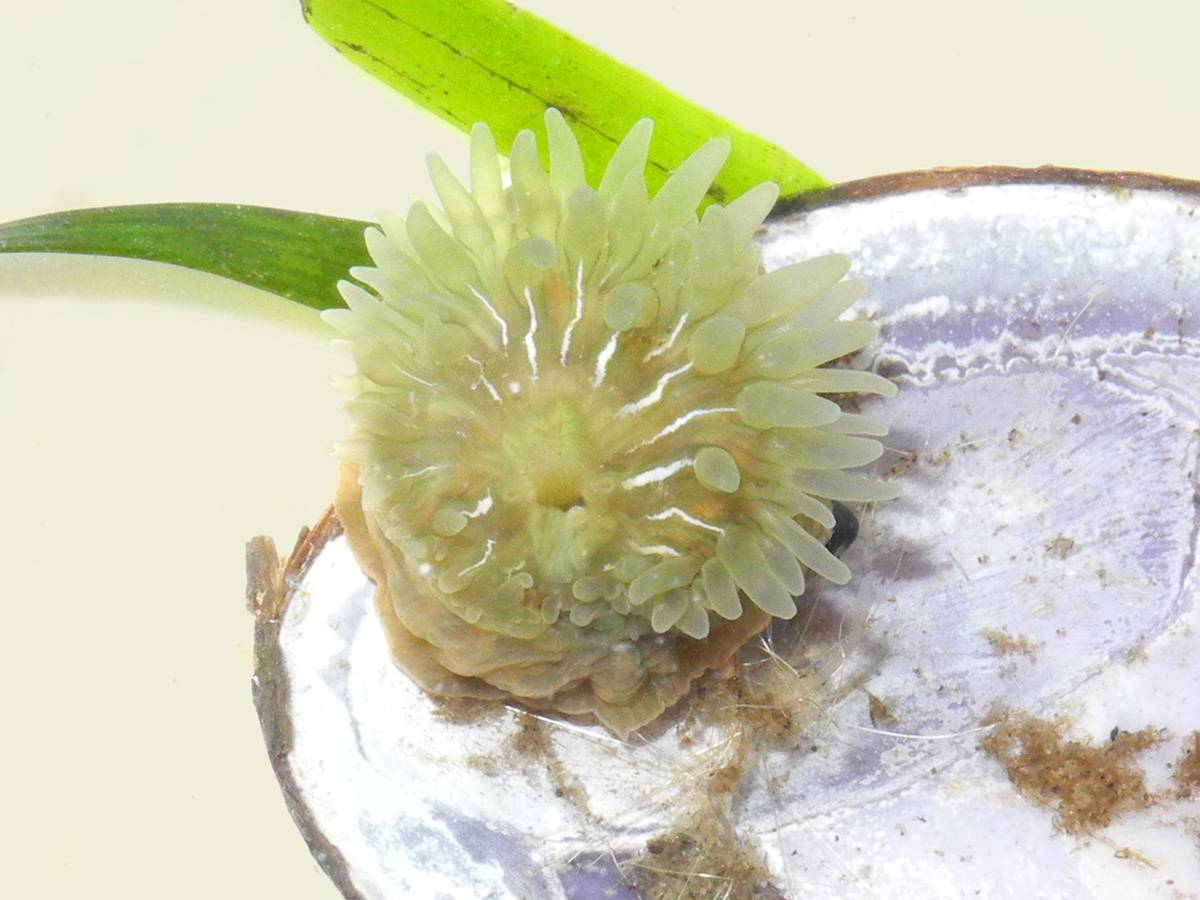
Anemones, when they don't approve of their surroundings, often up anchor and slide or even float away. My burrowing anemone has worked her way about a foot along the floor of the aquarium to a spot she likes. Other anemones just let the water carry them whither it will. So when I found three small, green anemones, probably the orange-striped anemone, in the bag of eelgrass and holdfasts, I couldn't be sure where they had been attached. These do like the upper intertidal zone, so they were probably on the eelgrass.

The largest one, found first. I settled him down on a clam shell, and he seemed pleased with that, but once in the tank, he left it and climbed up the wall to just under the water surface. There he remains, for the time being.

Bottom disc. The orange striping is visible. About half an inch across.

The other two were much smaller, and have been eelgrass hopping, not yet finding blades to their taste. They will, but it has to be their decision; for critters without a brain, amazingly, they still manage to have their own ideas.


Monday, March 15, 2010

Skeletons on a root trapeze. Skeleton shrimp, that is.

Last week, we found the tide 'way out at Centennial Beach, and walked almost to the water's edge. Out there, I picked up a tangle of eelgrass and roots to inspect at home, looking for critters attached to the leaves and roots. Amphipods, of course; snails maybe, worms. And maybe an isopod or an anemone.

At home, I dumped the lot into a bowl of seawater, removed the live eelgrass, and left the broken roots for later. When I went back to them, I saw movement in the water. Something tiny, vibrating, attached to all the roots. Here they are:


Skeleton shrimp, Caprellids

I had read about these; I never expected to see any. I find them fascinating, and I'll be looking for another batch next low tide.

There is more info on Caprellids, and clear photos,  at the Monterey Bay Aquarium site, on Intertidal MarineInvertebrates of the South Puget Sound, and at RaceRocks; Wikpedia has a brief note. And there's a whole page of photos in the Starfish collection.

I was so tired by the time I was done, what with Picasa scrambling the almost-finished video, so that I had to start from scratch, that I misspelled my own name at the end! And I identified the skeleton shrimp as Caprella equilibra, following Kozloff's diagram, but later I realized they could also be Caprella laeviuscula, which is also common here (Map). (And looks about the same to me.) And I think that the brood chamber is one, made of two leaves. but I'm not going to re-do the whole thing again. Not now, at least.
Powered By Blogger