Showing posts with label meiofauna. Show all posts

Saturday, December 26, 2015

Empty beach

Saratoga Beach, Christmas day; a rare moment when all the groups of walkers were behind me.

Fine, white sand (viewed under a light). And fine, new, white snow on the distant mountains.

Something very strange; I collected a good handful of sand from the very edge of the water, well below the upper intertidal limit. I took it home in a plastic bag, poured it into a tray and watched it under a lens, and then my hand microscope. Usually, within minutes I can see signs of activity; a grain of sand tumbling as a worm thrashes underneath it, a minute snail making his slow way among the "rocks", a string of copepods chasing each other through the ravines.

There was nothing happening here. Not the least hint of vibration. No corner-of-my-eye flashes, gone before I turned my attention that way. Viewed from an angle, no mini-bubbles.

I left the tray overnight, and then over the whole day, giving worms time to build their tubes to the surface. Nothing happened. I looked again, just now. There's nothing there but glassy sand grains and water. Not even remains of sea creatures, broken shells and bits of crab molt. Nothing but sand.

I have never seen anything similar, except in sun-baked sand found on top of logs. There should be something alive there!

Granted, my microscope only goes to 40x, so with a more powerful machine, I could probably find bacteria and diatoms. But it is still curious; there should be hundreds of worms in there, at least!

I must make a return trip, collect more sand, from different spots.

(I flipped a few stones on that spit in the distance. No crabs, no snails. I did find some barnacles.)

Saturday, December 07, 2013

Flowerpot mimic

Things are not always what they seem: I was chasing misbehaving hermits in the aquarium with the camera, (with little success) and happened across a desert plant. Or so it seemed, at first glance.

Small prickly pear plant in a flowerpot?

Rockweed grows right up to the high tide line on the south end of the Boundary Bay beach, just north of Point Roberts. But it's an unusual rockweed; small, brown, straggly plants, looking more dead than alive, each tiny plant attached to a stone small enough to be rolled around by any wave action. The curve of the shore must curb the energy of the currents here, for these to survive.

They survive well in the aquarium, too. Other rockweeds tend to disintegrate, probably because they've been torn from their moorings. These come home with the stone attached. They're not exactly beautiful, but the snails and hermits love them, for food and exercise both.

This turned out to be a branch tip of one of the weeds. To the naked eye, it looks brown, but the flash brings out other colours, red and green.

The blue "ball" is a periwinkle snail. One of its antennae is showing, to the bottom right.

And those white "cactus prickles"? Everything that's been in the aquarium for over a day, no matter how clean it was when I added it, (I scrub shells that I add, and the glass walls) develops a miniature forest of tiny algae and other organisms, hydroids, worm tubes, protozoa, with their resident mini-critters. Looking at any of them under a microscope, I always see scooting, busy copepods and transparent worms. Even smaller still are swarms of assorted diatoms. And over it, in the "atmosphere" over the "forest", larger copepods and baby amphipods dance.

At this magnification, maybe 4 times the actual size, and seen through algae-coated glass, the white spots would be copepods and amphipods. The fuzz on the circumference of the snail is probably made up of hydroids.


Tuesday, February 21, 2012

Between micro and macro

It's embarrassing when someone uses a word that I should have, should definitely have, known, but that draws a blank. Snail caught me with the word, "meiofauna". She wrote, "If you can find a good guide to meiofauna, ..." The "fauna" part was easy, but, "meio-"? I had to look it up.

This is how Wikipedia describes them:
Meiofauna are small benthic invertebrates that live in both marine and fresh water environments. The term Meiofauna loosely defines a group of organisms by their size, larger than microfauna but smaller than macrofauna, rather than a taxonomic grouping. One environment for meiofauna is between grains of damp sand (see Mystacocarida).
In practice these are metazoan animals that can pass unharmed through a 0.5 – 1 mm mesh but will be retained by a 30 – 45 μm mesh, but the exact dimensions will vary from researcher to researcher. Whether an organism passes through a 1 mm mesh also depends upon whether it is alive or dead.

And I always have to look up micrometres (μm), too. Was that 100 times, or 1,000? A millimetre (mm) is 1000 micrometres (μm). So a member of the meiofauna is from 45 μm to 500 μm long. Quite a range.

With that out of the way, I Googled "meiofauna" and found a few - too few - pages. I'll have to continue the search, but already I'm fascinated.

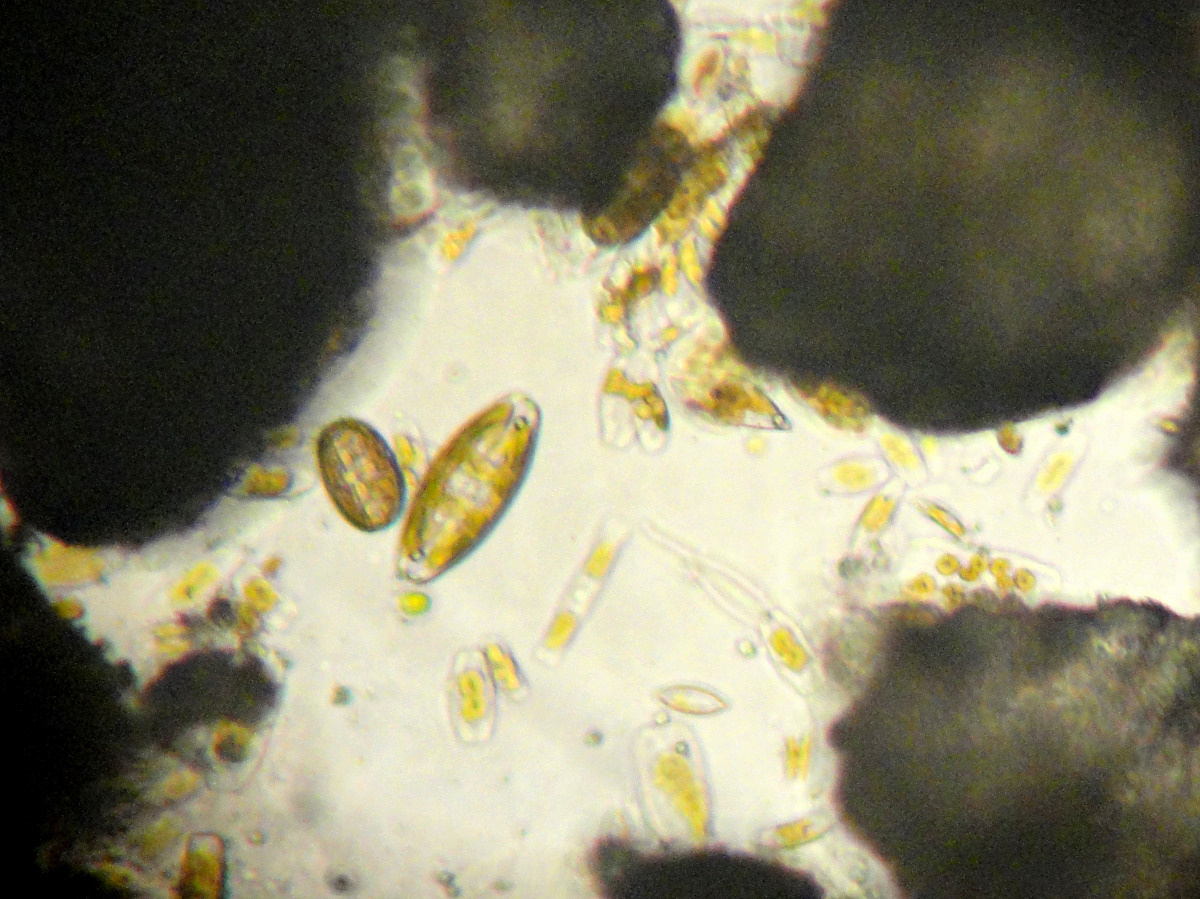
Some of my meiofauna. Taken by removing the eyepiece from the phase microscope and pointing the camera down the tube.
The marine meiofauna, defined as animals of microscopic size living in marine sediments, is one the earth’s richest and most diverse community extending from the shore to the deep sea. The marine meiofauna still contains numerous undescribed species and higher taxa. Special morphological adaptations evolved, especially in meiofauna living in the intertidal zone which is under a strong abiotic regime. Certain higher taxa evolved exclusively in the marine interstitial system. Evolutionary constraints caused elaborated life-cycles, migration patterns, special reproductive behaviours and structural adaptations. The interstitial system is also habitat for larvae and juveniles of certain macrofaunal species.
From Marbef.org (Marine Biodiversity and Ecosystem Functioning)

The majority of these organisms live in the top inch of the sand or mud. I sampled the top half inch. With Snail's help, I have more or less identified diatoms, (like those in the photo above, and more), ostracods (the jittery #8 from Sunday's post), hydroids, copepods, and worms. Hundreds of worms.
Most contaminants reside in sediments, and meiofauna are intimately associated with sediments over their entire life-cycle, thus they are increasingly being used as pollution sentinels. Because meiofauna have short lifecycles, the effects of a contaminant on the entire life-history can be assessed within a relatively short time. (Marbef)

Nematodes (worms) are relatively insensitive to man-made pollutants. I found in my samples several small, fat worms, a few polychaetes, identifiable by their red colour and their hysterical swimming style, and hundreds of long, sleek worms, from almost invisible at high magnification, to monsters a millimetre long or more. 

Mostly diatoms in various sizes and stages, probably a hydroid, and something making a chain. Taken with the low-power lens.

And while I was watching the diatoms, a worm snaked by, knocking away the sand grains in his path . This is his mid-section. At bottom left, one of the critters I was looking at.

My grandson has come for his microscope, leaving me in its place a less powerful direct light one that the camera can't cope with. Back to the drawing board ...

Stalked animals. I think the upper one is a hydroid.

The diatoms next, probably tomorrow.


Powered By Blogger