Showing posts with label diatoms. Show all posts

Wednesday, February 22, 2012

Boxes in the sand

I must go down to the seas again,
To the lonely sea and the sky,
And all I want is more diatoms
And a 'scope to see them by.
(With apologies to John Masefield)

I've looked at every grain of sand in my pill bottles, with the naked eye, the camera, a magnifying glass, and three microscopes. Tonight, the worms were still active, but the heat of the lamps has done for the rest. The diatoms are still there, but none are moving. I saw one roundish, lumpy beast tumbling around, as usual, and a large copepod was struggling feebly. This is the first time I've seen a copepod moving slowly enough to appreciate its beauty. And how that one red eye glows!

But I promised you diatoms.

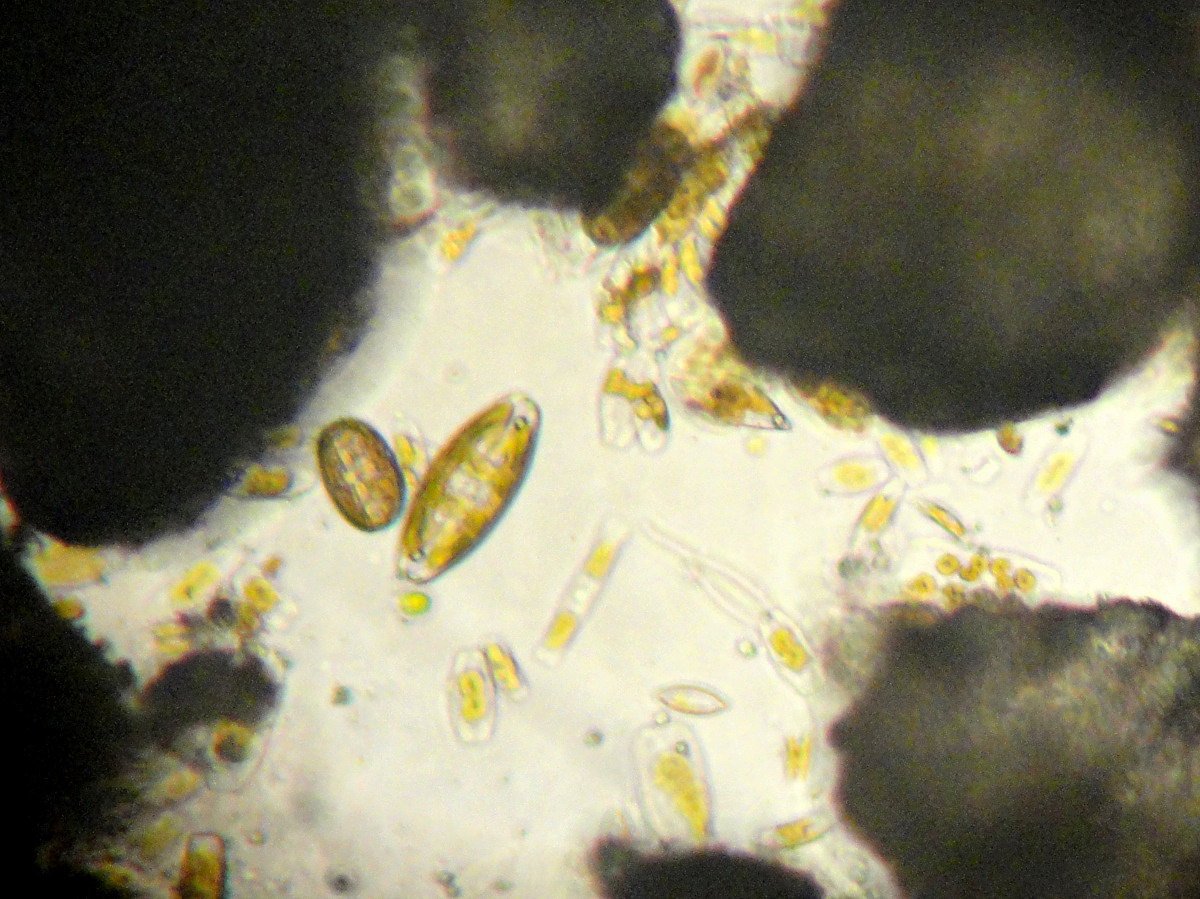
As my little camera sees diatoms (Navicula) and sand grains.

Beach sand is largely composed of silica, in the form of quartz and feldspar. Quartz makes a white beach; feldspar darkens it, or gives a slightly orange tint. Our local beaches are a composite. Under the scope, in a good light, much of the sand is glassy white; the other major colours are orange or dark grey, accented with the occasional green and brick-red stones.

In between these grains, one-celled algae float or swim encased in their own silica shell, as transparent as glass. The shells, called frustules or tests, are unique to each species, but usually consist of two similar sections, fitted together along a center line. (The name, "diatom", comes from the Greek "dia" and "tome", meaning "cut in two".)

We can think of the frustules as a little box with a lid slightly bigger than the base. Like the borrowed shells of hermit crabs, these boxes do not grow with the diatom; they are mostly mineral. So when the time comes to reproduce, several times daily, the cell divides down the middle and each new cell gets half of the frustule. It counts this as the bigger "lid", and builds a new one, a smaller version to fit. So half of each generation of the diatoms, the half that started out with the bottom of the "box", is a bit smaller than the previous one.

(Which explains the many different sizes I saw in my sample.)

Of course, if this continued, the diatoms would dwindle away to nothing, so when they're too tiny, they switch reproductive tactics, and become male or female. Their young build new boxes from scratch, back to full size again, and the process of shrinking starts over.

Ma Nature is endlessly inventive.

Some of the marine diatoms. Photo from Wikipedia.

Most diatoms do not move on their own, but float or are carried about. But some, like the Navicula lanceolata, have a groove (raphe) along the center line, where a moving band of cytoplasm serves as a motor. Some I saw in my sand samples moved fairly quickly; some diatoms can race along at a speedy 25 micrometers per second. (25/1000 mm.)

Tuesday, February 21, 2012

Between micro and macro

It's embarrassing when someone uses a word that I should have, should definitely have, known, but that draws a blank. Snail caught me with the word, "meiofauna". She wrote, "If you can find a good guide to meiofauna, ..." The "fauna" part was easy, but, "meio-"? I had to look it up.

This is how Wikipedia describes them:
Meiofauna are small benthic invertebrates that live in both marine and fresh water environments. The term Meiofauna loosely defines a group of organisms by their size, larger than microfauna but smaller than macrofauna, rather than a taxonomic grouping. One environment for meiofauna is between grains of damp sand (see Mystacocarida).
In practice these are metazoan animals that can pass unharmed through a 0.5 – 1 mm mesh but will be retained by a 30 – 45 μm mesh, but the exact dimensions will vary from researcher to researcher. Whether an organism passes through a 1 mm mesh also depends upon whether it is alive or dead.

And I always have to look up micrometres (μm), too. Was that 100 times, or 1,000? A millimetre (mm) is 1000 micrometres (μm). So a member of the meiofauna is from 45 μm to 500 μm long. Quite a range.

With that out of the way, I Googled "meiofauna" and found a few - too few - pages. I'll have to continue the search, but already I'm fascinated.

Some of my meiofauna. Taken by removing the eyepiece from the phase microscope and pointing the camera down the tube.
The marine meiofauna, defined as animals of microscopic size living in marine sediments, is one the earth’s richest and most diverse community extending from the shore to the deep sea. The marine meiofauna still contains numerous undescribed species and higher taxa. Special morphological adaptations evolved, especially in meiofauna living in the intertidal zone which is under a strong abiotic regime. Certain higher taxa evolved exclusively in the marine interstitial system. Evolutionary constraints caused elaborated life-cycles, migration patterns, special reproductive behaviours and structural adaptations. The interstitial system is also habitat for larvae and juveniles of certain macrofaunal species.
From Marbef.org (Marine Biodiversity and Ecosystem Functioning)

The majority of these organisms live in the top inch of the sand or mud. I sampled the top half inch. With Snail's help, I have more or less identified diatoms, (like those in the photo above, and more), ostracods (the jittery #8 from Sunday's post), hydroids, copepods, and worms. Hundreds of worms.
Most contaminants reside in sediments, and meiofauna are intimately associated with sediments over their entire life-cycle, thus they are increasingly being used as pollution sentinels. Because meiofauna have short lifecycles, the effects of a contaminant on the entire life-history can be assessed within a relatively short time. (Marbef)

Nematodes (worms) are relatively insensitive to man-made pollutants. I found in my samples several small, fat worms, a few polychaetes, identifiable by their red colour and their hysterical swimming style, and hundreds of long, sleek worms, from almost invisible at high magnification, to monsters a millimetre long or more. 

Mostly diatoms in various sizes and stages, probably a hydroid, and something making a chain. Taken with the low-power lens.

And while I was watching the diatoms, a worm snaked by, knocking away the sand grains in his path . This is his mid-section. At bottom left, one of the critters I was looking at.

My grandson has come for his microscope, leaving me in its place a less powerful direct light one that the camera can't cope with. Back to the drawing board ...

Stalked animals. I think the upper one is a hydroid.

The diatoms next, probably tomorrow.


Powered By Blogger