Showing posts with label sand. Show all posts

Thursday, November 27, 2014

The rotten egg zone

Boundary Bay is about 13 kilometres (8 miles) across at the base, and encompasses about 100 square kilometres. In the centre, there is deep water, but most of the northern end is a flat intertidal plain, filled with silt from two rivers and many creeks.

2009 Google map. The intertidal zone is shaped somewhat like an amphipod, looking towards the east.

The head and the spine of the amphipod are mud. Deep, maybe waist-deep, sticky, squelchy mud, continually replenished with run-off from the farms and bogs of the Delta brought in by the Serpentine and Nicomekl Rivers at the "head" end. It's bird and worm country; people can't walk there, don't even take their boats and paddle boards in that direction.

As the silt merges with the sand along the western shore, the mud develops a variety of disagreeable odours. Sometimes there are dead zones, where clams and crabs lie dead on the surface; the air smells of rotting flesh, choking and impregnating our clothes. At other times, everything smells fishy or of untamed compost heaps. These are often the result of human pollution; fertilizer and industrial contaminants, construction debris, oils and paints.

The more common rotten egg smell of hydrogen sulfide is almost pleasant in comparison. It is a sign of abundant organic matter, teeming with busy, happy life.

It all depends on the size of the mud particles. Where the sand is coarse, water flows through, carrying oxygen to the tiny critters living there. Mud worms in their burrows dance a slow, sinuous dance, pushing the water along; clams squirt water and sediment as they move about. We see it as clean sand. It's soft underfoot, but not sticky; we dig in it, walk on it, sunbathe on it. If we notice any odour, it is the fresh tang of salt water.

Where fine silt clogs the water passageways, the water becomes stagnant, and free oxygen is depleted. Life goes on, even in these conditions; after all, there's plenty of food. It just has to be metabolised differently. Some of the animals living here use hydrogen sulfide as an energy source. The sand, to us, looks mucky and off-colour. And smells of rotten eggs. We look for better places to play.

Sticky sand/mud. Lugworm heaven. 2008

Slightly wetter muck, with worm poop.

Where the oxygen levels are lowest (anaerobic or anoxic zones), the muddy sand forms a black layer, sometimes just below the surface of the tide flat, or in other spots some 6 inches down, depending on the ratio of sand to silt.

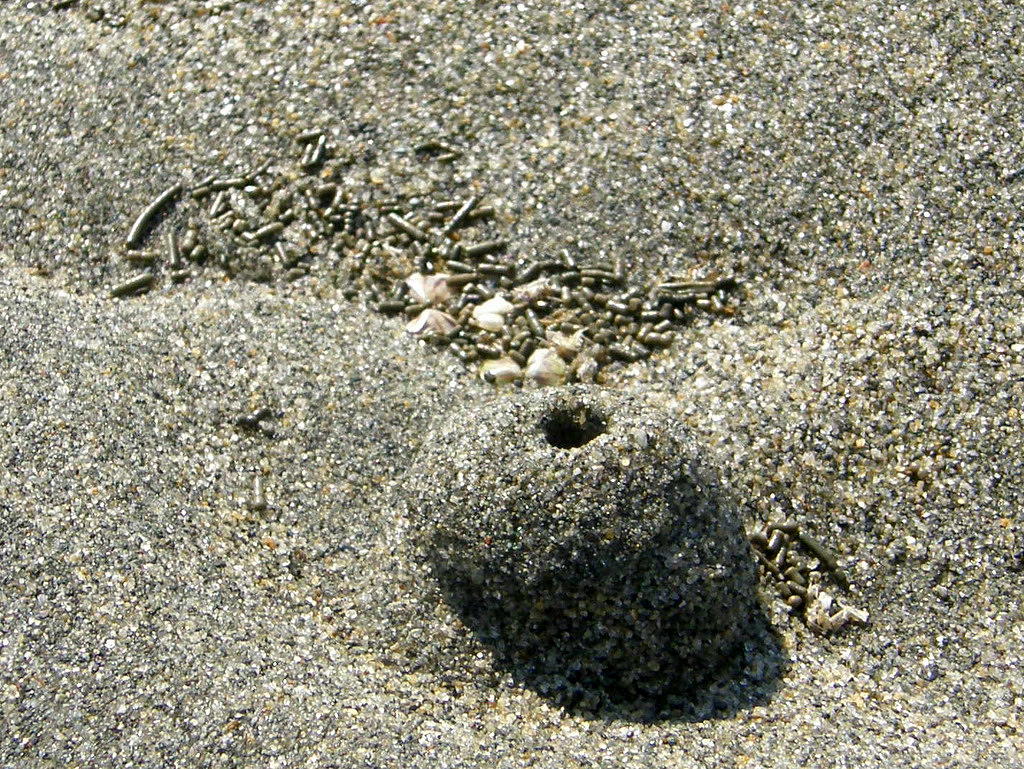
Further south along the shore of the Bay, although the silt doesn't reach quite this far, and we have acres of clean sand, there are still pockets of black sand underneath. Around the worm "mountains", there is often a circle of black sand that the worm has eaten and ejected to the surface.

If we grab a handful out of the black layer, it feels firmer than the sand around it, and, again, it smells of rotten eggs.

And this brings me to the mysterious network stuff I was wondering about a couple of months ago. Continued tomorrow.


Thursday, February 06, 2014

Who cares if it's freezing out there?

Not us, not when the peeps are feeding on the beach.

Looking southwest. Silvery sea and the beginnings of a sunset. The black lines on the water in the background are more birds.

Looking north; peeps not minding Laurie. He's just a step away, off camera to the right.

Ankle-deep water (to a dunlin's ankles, that is.)

Sand patterns, with a few dunlin tracks


Tuesday, January 07, 2014

It's all a matter of time. And water.

Mountains; all massive, jagged rocks:

Tall, sharp peaks, to our south, in Washington State.

Mount Baker

Which will eventually crumble to this:

Beach rocks, with barnacles and brown rockweed. Boundary Bay.

And then be ground down and smoothed out, by water and critters, to this:

Sand, still being ground down, this time by worms and snails. And water. (Other tracks; human, dog, sandpiper.)

Just give it time.

Friday, August 16, 2013

Quiet afternoon

The tide was high. It had been raining, just a sprinkle, but enough to clear the beach. With no wind to stir it up, the water was glassy, grey-blue like the sky. In the distance, an eagle called.


We walked along the high tide line, picking up bits of eelgrass for my critters. I turned a rock or two, and watched the crabs scuttle for cover. Turning back, we dawdled through the dunes. I sat on a log to look at the sand.

Sand from Beach Grove upper beach.

Each shore has its own distinctive mix of sand ingredients. This one, from our usual height, looks grey, but it's a mix of many colours and shapes. White quartz, in jagged, sharp-edged chunks. Mottled, chunky conglomerates, mostly black. Traslucent pale green stones, rounded lumps. Pale pink ditto. And a surprising number of deep pink, transparent beads, not quite polished. One dark, opaque red stone.

I expected to find shell fragments, but in this handful, there may be only a couple.

Sea rocket, Cakile edentula, gamely struggling to produce its seed in deep, shifting sand.

Grass grown from the remains of last year's sandbag, dried up now that the seeds are set.

In the weeds on the path back to the street, we found this plant. Someone had given it a protective driftwood "fence".

I don't recognize these flowers. Do you?

Update: Biobabbler recognizes them; they're four o'clocks.

A Skywatch post.

Friday, June 15, 2012

Harsh!

"Sand beaches are very harsh environments, ..."
So starts an article by NOAA, an overview of the animals living on and in the sand. It doesn't seem quite right, does it?

Boundary Bay, retreating tide. Harsh? Yes!

Flat sand, warm, shallow water, fresh air with a hint of salt in it, the cry of gulls, distant laughter, blue sky overhead. Perfect! Just being there gives us a new lease on life. But ... harsh,they say?

It depends on your situation; if we had to live there 24/7/52, we might see things in a different light.

 "... encompassing most of the rigors of the rocky intertidal (high wave action, wide temperature range, periodic tidal exposure) with the addition of high abrasion levels and lack of firm substrate for attachment. Beach fauna exhibit the characteristics of communities in harsh environments, namely low species diversity but large numbers of individuals of each species."

I would add the lack of hiding places, refuges from predation. And predators there are many; around here,  they're mostly of the two-legged variety, some with wings, others with shovels and buckets.

When we parked at Centennial Beach Monday afternoon, the tide was starting down; just the first few metres of sandy beach were exposed. We stopped at the edge to watch hordes of mud snails, exposed on the sand, and all streaming as fast as they could drag their stripy shells downstream, towards the retreating water. A doomed enterprise; the tide goes out faster than they slide, and they would end up having to wait out the dry spell all afternoon.

We waded in, meandering back and forth from one newly-risen sandbar to the next. The water was bathtub warm in spots already, where the current was slower.

Once we'd passed the snail zone, there wasn't much to see. Occasional patches of seaweed or eelgrass provided shelter to small critters. I captured a tiny greenmark hermit, watched it scramble around my hand; so tiny, it had a long walk to the edge. When it got there, I replaced it in the weeds.

Green ribbon seaweed harbours an abandoned clam shell, and probably a few multi-legged beasties.

Bleached seaweed remnants float out to sea.

A tangle of rockweed and eelgrass stranded on a sandbar. It reminds me of the tossing bouquet that a bride would carry.

Rockweed turns orange and yellow as it dries in the sun.

Apart from the bits of floating or stranded weed, the beach looks empty, because everything that can flee or dig or find a convenient patch of eelgrass has gone into hiding. Sometimes they leave signs of their passing, holes or humps in the sand. A smallish lump with a round hole in the centre may hide a clam, but most have dug themselves in deeper. Careless clams get offered free flying lessons by hungry gulls. A few hard landings, and they're lunch.

Assorted worms make larger hills, usually topped with a coiled poop decoration. 

I don't know what makes these.

Boundary Bay sand is on the muddy side. Further inland from our walk, the mud gets deeper and mushier; even going straight out from Centennial Beach, we cross spots where our feet sink deep into the sand long after the water has gone down. The finer grains of silt and clay retain water better than coarse sand and shell remnants.

In this area, the sand may contain up to 89% fine sediments (97% further inland, where it is almost impossible to walk). This means that, along with the water, the sand is rich in organic remnants, food for the residents. However, it also means that the space between the sand grains is packed with mud, reducing the space for small animal life. (Meiofauna; I haven't forgotten that good word!)

A few inches under the sand surface, there is a layer of blue-black sediment. This is an area starved of oxygen, which has been used by the animals above it, and is not replenished due to the density of the compacted silt. There, contaminants settle, giving the layer its black colour.

When a burrower digs past this layer, it shovels the anoxic mud up to the surface, leaving a black patch. I dug down into a few of these, looking for mud shrimp.

Mud shrimp burrow opening?

I couldn't dig fast enough. I was using my bare hand; I wouldn't want to risk damaging one with a digging tool. The sand was loose and easy to remove. A few inches down, I found the burrow; a hole about big enough for two fingers before the sand caved in, gushing water. I followed it down and down, around a corner and down again, tossing out handfuls of lumpy sand as I went. About eight inches down, the sand from above filled the hole as fast as I shovelled. I gave up.

A second burrow gave me the same result. But I ran my fingers through the excavated sand, to see what made the lumps.

One pink macoma clam, and many purple and brown clams, species undetermined.

I put the clams back in the hole, and filled it in again. No sense exposing the clams to the ever-hungry gulls!


Saturday, March 24, 2012

What animal made these tracks?

Do you know? If not, make a guess; let your imagination soar!

I'd never seen anything like these before. We found them halfway down the beach on Boundary Bay, at low tide. There were maybe a dozen separate trails, following the valleys between ripples in the sand.

Either the end or the start of one trail. Central groove, paired footprints or claw prints on either side.

In looser sand, the footprints were less defined, the central groove deeper.

The groove is almost non-existent here.


Here's a hint. The shell at the end of this trail is about 1/2 an inch long. It appears to be empty.

What do you think?

(I do know, because I found one track-maker. I'll post the answer tomorrow.)


Saturday, March 17, 2012

Sand, sky, and old wood

These are a few more photos from that so very windy day on Crescent Beach.

I never tire of this view, especially at low, low tide. And yes, those are shoes in the tree. They've been there for at least two years.

This is from the creek just before we reach the town. The horizon is concave, again.

Signs of spring; flowering trees. The wind was whipping these around so that even holding onto a twig, we couldn't stop the shaking. I took macros of those tiny flowers, but got only a yellow blur.

Logs don't tremble in the wind. This scar reminds me of an eye, but of what animal?

I love this old lichen-coated log. It's almost geographical; the depression could well be a terraced valley surrounded by ancient cliffs.

Another view of the same log. This reminds me of a slow-flowing glacier.
A Skywatch  post.

Wednesday, February 22, 2012

Boxes in the sand

I must go down to the seas again,
To the lonely sea and the sky,
And all I want is more diatoms
And a 'scope to see them by.
(With apologies to John Masefield)

I've looked at every grain of sand in my pill bottles, with the naked eye, the camera, a magnifying glass, and three microscopes. Tonight, the worms were still active, but the heat of the lamps has done for the rest. The diatoms are still there, but none are moving. I saw one roundish, lumpy beast tumbling around, as usual, and a large copepod was struggling feebly. This is the first time I've seen a copepod moving slowly enough to appreciate its beauty. And how that one red eye glows!

But I promised you diatoms.

As my little camera sees diatoms (Navicula) and sand grains.

Beach sand is largely composed of silica, in the form of quartz and feldspar. Quartz makes a white beach; feldspar darkens it, or gives a slightly orange tint. Our local beaches are a composite. Under the scope, in a good light, much of the sand is glassy white; the other major colours are orange or dark grey, accented with the occasional green and brick-red stones.

In between these grains, one-celled algae float or swim encased in their own silica shell, as transparent as glass. The shells, called frustules or tests, are unique to each species, but usually consist of two similar sections, fitted together along a center line. (The name, "diatom", comes from the Greek "dia" and "tome", meaning "cut in two".)

We can think of the frustules as a little box with a lid slightly bigger than the base. Like the borrowed shells of hermit crabs, these boxes do not grow with the diatom; they are mostly mineral. So when the time comes to reproduce, several times daily, the cell divides down the middle and each new cell gets half of the frustule. It counts this as the bigger "lid", and builds a new one, a smaller version to fit. So half of each generation of the diatoms, the half that started out with the bottom of the "box", is a bit smaller than the previous one.

(Which explains the many different sizes I saw in my sample.)

Of course, if this continued, the diatoms would dwindle away to nothing, so when they're too tiny, they switch reproductive tactics, and become male or female. Their young build new boxes from scratch, back to full size again, and the process of shrinking starts over.

Ma Nature is endlessly inventive.

Some of the marine diatoms. Photo from Wikipedia.

Most diatoms do not move on their own, but float or are carried about. But some, like the Navicula lanceolata, have a groove (raphe) along the center line, where a moving band of cytoplasm serves as a motor. Some I saw in my sand samples moved fairly quickly; some diatoms can race along at a speedy 25 micrometers per second. (25/1000 mm.)

Thursday, September 09, 2010

Abstract in sand

"... ephemeral art asks that we appreciate the art work now in the present moment, for it may not be there tomorrow." (Sheri Klein)
Or even when the tide comes in. And who's to say snails can't participate?


Snail art, Centennial Beach

The artists are resting along the bottom edge, except for the one putting finishing touches on the upper right corner.

(And, by the way, remember International Rock Flipping Day, this Sunday. All about it, here.)
Powered By Blogger