Showing posts with label sandpipers. Show all posts

Wednesday, August 12, 2026

Mostly blue

The last couple of weeks I've been busy, with visiting family. I've been on the road a lot. And saw a lot of blue water, some with birds.

Tiny island in the Campbell River estuary. Looking towards the salt chuck and Quadra Island.

Coril Air Cessna, landing off Tyee Spit. With a row of tiny buffleheads.

Coasting into the dock on the estuary.

Just a Pelagic cormorant drying his wings and showing off his green neck. Cormorant's feathers don't repel the water, which helps them dive deep after fish, but then they need to air-dry their wings.

The sad rock at Little Bear Bay.

Willow Point, Campbell River

Gulls and sandpipers at the tip of the Myrt Thompson trail.

Also seen, but there are no photos: an eagle carrying a writhing snake. And turkey vultures, black-headed Bonaparte's gulls, a young bear, and an orca. And some birds I've never seen before; swifts, probably Vaux's swifts, circling around their nests on the far side of a group of pilings on the Comox estuary. This was amazing; one dropped down to the pilings gently, floating down on the air, slowly, slowly, barely moving its wings. Imagine a balloon gradually losing air, or a floating bit of paper ash from a bonfire coming back down. As if the air were a thick soup,

And my camera was back in the car.

A Skywatch post.

~~~~~~~~~~~

En las últimas semanas, he tenido visitas de la familia. Y he pasado mucho tiempo en las carreteras. Y en las playas y los rios, viendo aguas azules. A veces con pájaros.
  1. Una islita en el estuario del rio Campbell. Aquí miramos hacia el estrecho y la isla Quadra al otro lado.
  2. Una avioneta Cessna de Coril Air, acuatizando fuera de Tyee Spit. Con una hilera de aves buceadoras, muy chiquitas.
  3. La misma avioneta en el estuario, acercándose a su muelle.
  4. Un cormorán pelágico estirando las alas para secarlas. Las plumas de los cormorantes no repelan bien el agua, lo que les permite bucear muy hondo tras los pescados que comen.
  5. La roca triste de Little Bear Bay. (Bahía del Osito)
  6. Willow Point, Campbell River.
  7. Gaviotas y correlimos en el extremo del sendero Myrt Thompson.
También vimos, pero no tengo fotos: un águila llevando una víbora que se retorcía tratando de escapar. Buitres cabecirrojos, gaviotas de Bonaparte con sus cabezas negras, un osito (la madre debía estar cerca, pero no la vimos), y una orca. Y unos pájaros que nunca antes había visto; vencejos, probablemente Chaetura vauxi, dando vueltas alrededor de sus nidos en el lado opuesto de un grupo de pilotes en el estuario del rio Comox. Algo sorprendente: vi uno que bajaba hacia los pilotes lentamente, como si flotara en el aire, bajando poco a poco, casi sin mover las alas extendidas. Imagínate un globo que va perdiendo el aire paulatinamente; o un fragmento de ceniza que se llevó el humo y que ahora va cayendo sin prisa. Como si el aire fuera un líquido espeso.

Y la cámara seguía en el coche. Ni modo.

Un poste para Skywatch.

Sunday, January 26, 2025

Mud lovers

Back to more local wanderings; a couple of photos of distant birds in Oyster Bay, those birds that to the naked eye squinting from the closest vantage point, on the dike overlooking the inner circle of the bay, are just tiny black shapes against silvery water. Or silvery mud; those will be peeps, also evident because they are all running, all the time, barely pausing to take a quick peck at the mud underfoot. The camera works better than binoculars; in the photos, the birds aren't moving, although they may be standing on their heads.

Wigeons, calmly paddling along, one eating seaweed. The males have the showy green stripe on the head. Pintails, mostly head down, tails up, beaks foraging in the mud below, males with the creamy bellies, females bedecked in patches of brown and cream. The water here is only a few inches deep.

Sandpipers, probably semipalmated. This was about 1/4 of the flock running along where the water turns to mud.

~~~~~~~~~~~~
Regresando a sitios más cerca de casa: aquí hay dos fotos de pájaros en la distancia, en Oyster Bay; esos pájaros que a mis ojos sin ayuda, viéndolos desde donde más me puedo acercar, encima del dique que bordea el círculo interior de la bahía, esos pájaros que parecen nada más que formas pequeñitas negras sobre el agua plateada. O sobre el lodo, también plateado; esos serán correlimos, creo, con más razón porque nunca dejan de correr; hasta para comer pican rápidamente en el lodo, entre paso y paso. 

La cámara me sirve mejor que los binoculares; en las fotos, los pájaros no se mueven, aunque a veces están parados de cabeza.
  1. Silbones, nadando tranquilamente; una está comiendo algas marinas. Los machos tienen la raya verde en la cabeza. Los otros patos son ánades rabudos, Anas acuta; casi todos con las colas en alto, los picos explorando el lodo al fondo. Los machos tienen el abdomen gris claro, y las hembras llevan un diseño de parches cafés sobre crema. El agua en este lugar tiene apenas unos pocos centímetros de profundidad.
  2. Correlimos, probablemente Calidris pusilla. Esto era aproximadamente un cuarto de la bandada que corrían a lo largo de la orilla, donde el agua se vuelve lodo.


Sunday, August 04, 2024

Peeping peeps

They scurry along, just at the edge of the incoming tide, feet in the water, stitching the sand under the waves with sharp bills, always in a hurry. I never see them swallow; their prey is tiny, even microscopic*. (Which accounts for the rush; it takes a lot of mouthfuls to make a meal.) They chatter contentedly among themselves as they go, "Peep, peep, peep!"  And then suddenly, they all leap into the air together, the flock circles a couple of times, flashing white and black as they turn, then they flit far down the shore, to land and repeat the performance. "Peep, peep, peep!"

And they all look more or less alike. Little brown birds with spindly legs, some yellow (at least those are easily recognized) some black. Some have short beaks, some long, maybe curved.

And they always seem to be between us and the light, sometimes mere silhouettes to our unaided eyes.

These were busy at Oyster Bay at near high tide.

A very small bird, foraging alone.

Sanderlings, maybe? Peeps, anyhow.

Dowitchers, maybe the long-billed dowitchers. (Short-billed dowitchers also have long bills.)

Not peeps. Bonaparte's gulls. Black heads, red legs. Just resting here; they eat mainly insects in breeding season.

Time to move along.

*From All About Birds: Western Sandpipers, like other peep, eat “biofilm,” a frothy, scumlike mixture of diatoms, microbes, organic detritus, and sediment.

Least Sandpipers have a typical sandpiper diet: they "eat small invertebrates such as amphipods, isopods, gastropods, horseshoe crab eggs, water fleas, midges and flies, beetles, and dragonflies. They peck at prey on the surface and probe damp mud for buried prey, using the surface tension of the water to transport the item quickly from their bill tips to their mouths."
~~~~~~~~~~~~~~
Corren a lo largo de la playa mientras sube la marea, con las patas en unos centímetros de agua, penetrando repetidamente la arena con sus picos agudos; como que siempre tienen prisa. Nunca los he visto tragarse nada; su presa es miniatura, hasta microscópica*, lo que explica el apuro; se requieren muchas bocadas para completar una comida. Discursan tranquilos mientras trabajan, un constante "Pío, pío, pío." Y de repente todos juntos se lanzan al aire, la bandada da una vuelta, mostrando plumas blancas y negras al cambiar de dirección, y rapidamente vuelan a un punto distante en la costa para volver a explorar la arena de la orilla. "¡Pío, pío, pío!"

Y es difícil distinguirlos; todas las especies de estas aves playeras se parecen. Pajaritos de color café con patas largas, unas amarillas (por lo menos, estos pájaros se pueden identificar), unas negras. Unas tienen picos largos, otras cortos, algunas tienen picos curvos. 

Y parece que siempre, o casi siempre, se nos presentan con la luz de fondo, haciéndolas aparecer ante nuestros ojos como siluetas en movimiento continuo.

Estas aves playeras buscaban su comida mientras subía la marea en Oyster Bay.
  1. Un pajarito, muy chico, solitario.
  2. Correlimos, posiblemente.
  3. Agujetas, posiblemente las de picos largos. (Pero las de picos cortos también tienen los picos largos.)
  4. Estas son gaviotas de Bonaparte. Tienen cabezas negras, patas rojas. Descansan aquí; en la época reproductiva comen principalmente los insectos.
  5. Hora de ir a la próxima sección de la playa.
*De AllAboutBirds: "Los correlimos de Alaska Western Sandpipers, como otros correlimos, comen "película biológica", una mezcla espumosa de diatomea, microbios, restos orgánicos, y sedimentos.

El correlimos menudillo "come invertebrados pequeños tales como anfípodos, isópodos, caracoles marinos, huevos de cangrejo, "piojos acuáticos", moscos y moscas, escarabajos y libélulas. Cogen presa en la superficie y buscan presa enterrada entre lodo húmedo, usando la tensión de superficie del agua para trasportar el material rapidamente desde la punta del pico hasta la boca."


Tuesday, April 30, 2024

Just birds

 Seen at Miracle Beach:

White-crowned sparrow on a log.

Sandpipers in toe-deep water.

And a gull overhead, wheeling, wheeling.
~~~~~~~~~~
Pájaros vistos en la playa, sin comentario.
  1. Gorrión corona blanca.
  2. "La menudilla, becacina, tinguís, patudo, correlimos enano​ o chichicuilote es una pequeña ave de la familia de los escolopácidos." (Wikipedia) Y en inglés, comunmente, "peeps", por su canto.
  3. Una gaviota.


Tuesday, January 10, 2017

Stones or Turnstones?

Walking along a rocky shore in the winter, I am often startled when the rocks ahead take flight. As they speed out over the water, they become peeps with flashing wings. Among the rocks and rotting eelgrass, they had been nearly invisible.

Black Turnstone, winter dress. Against blue water, he is easy to see.

Among the rocks, not so much. The colours match the white barnacle patches and the deep brown of old eelgrass.

And from a bit of distance, they blend in to the background. There are ten turnstones in this photo. Do you see them?

Monday, August 08, 2016

Wrapping up July

Kitchen sink post.

While I've been focusing on discoveries on the road to Tahsis, the "Other" file has been filling up. So here, in no particular order, are a selection from that box.

Greater yellowlegs. Caught at dusk (8:40 PM) on a grey, dingy landing across from Tyee Spit.

Two yellowlegs.

There were a few tiny peeps, probably the Least Sandpiper, foraging among the stones, but it was too dark for the pocket camera to find them. I'll go back another evening, a bit earlier.

Killdeer, looking worried. As usual.

Mossy trees, somewhere in the bush above the Campbell River.

Water parsley? On the Gold River to Tahsis highway.

Tansy. Tyee Spit.

Thistle. Head Bay Road.

Lighthouse, Quadra Island

Mushroom among dead leaves, bank of Campbell River mouth.

Water strider, Campbell River mouth

Cyanide millipede, dead and stiff. My son, who tends to do things like this, painstakingly balanced the millipede on a cable spanning the river.

"Tornado". Boat dock across from Tyee Spit, where the sun still shines.

And back at home, waiting for me by the door, a long-legged, bulky-pedipalped, semi-transparent spider.

I'll leave the tank critters and other intertidal beasties for tomorrow.

Tuesday, April 19, 2016

Intrepid!

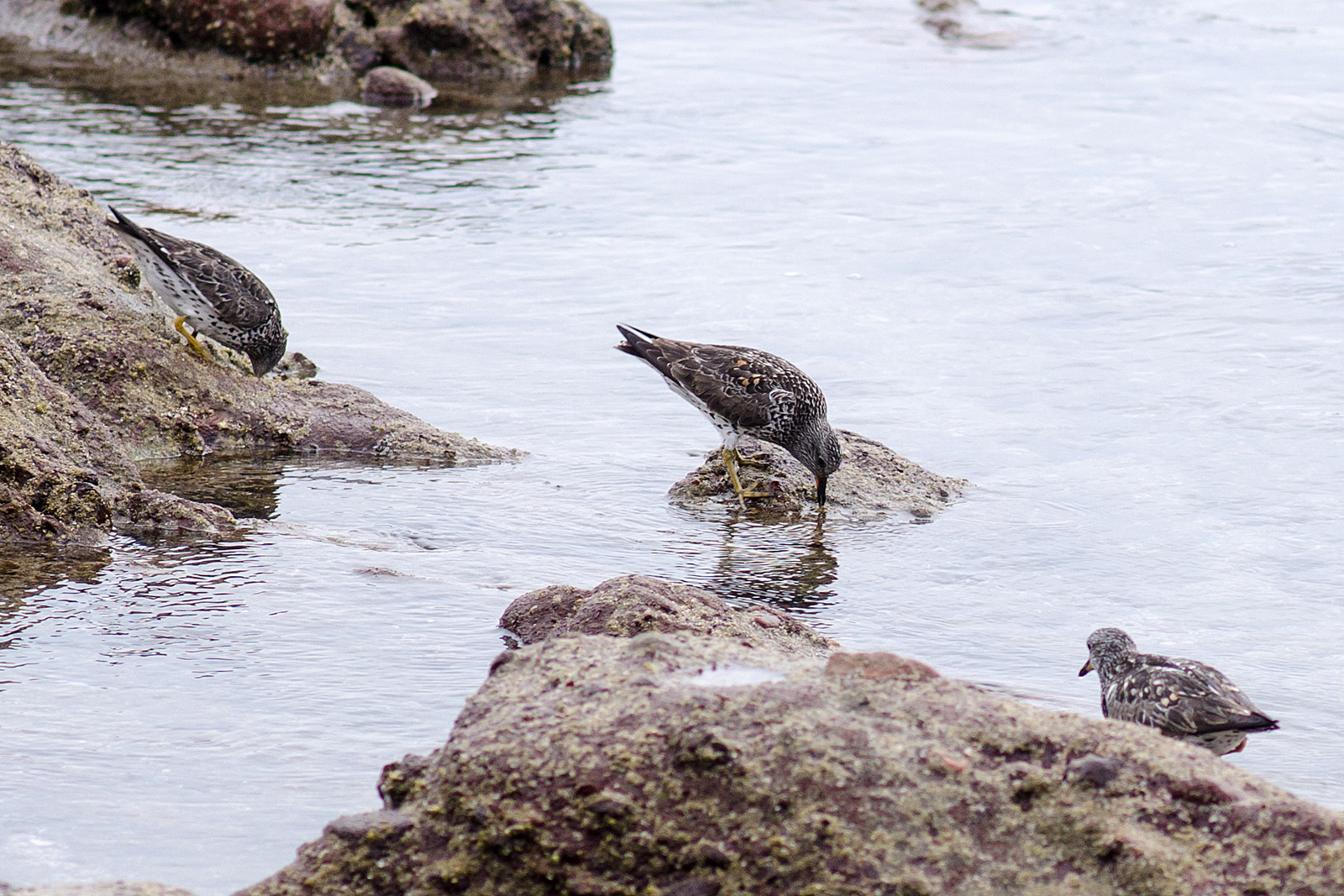
At low tide, I walked along the Mazatlan shoreline to a group of low rocks, most of them covered with each wave, but exposed in between. I skirted the perimeter, where the waves licked at my sandals and ran in channels beside me. Further out, a large flock of surfbirds descended with each retreating wave to feed on the draining rocks.

Hurry, hurry! Next wave's coming!

Eating on the run

Good thing they have wings!

10-second break

On to the next rock; this one's gone.

I managed to get close to a few of the birds.

Unidentified sandpipers.  Surfbirds, Calidris virgata*. Brown, black and white pattern on back, spotted bellies, yellow legs, straight, yellow and blackish beak.

They seem to be poking their beaks into small cracks in the rocks.

I looked carefully at the rocks I could reach, and fished in channels where the water was shallow enough between one wave and the next, to see what the surfbirds were catching. On the rock surfaces, I saw mostly barnacles, tiny ones. Down in the channels, bits of rockweed held tiny snails and hermit crabs. I saw a crab or two.

Tiny barnacles and a snail or two.

Rockweed, underwater. Some of those snails are hermit crabs.

Good eating here!

The tide came in. The rocks disappeared. So did the surfbirds. I went home for supper.

*Updated to correct species. Thanks, Clare!

Friday, October 23, 2015

Recycling can wait

I took a quick run inland today, searching for a recycling depot, which I never found. But somehow, I ended up back on the coast, getting gas, and from there, it was inevitable that I'd wind up on a beach, and spend an hour chasing sandpipers.

They love to stand in lines, usually facing the open water.

The sandpipers stood or foraged along the water's edge in small groups, always a fair distance away from me. I was only carrying the little pocket camera, so I zoomed as far as it would go, took a photo, took two steps, another photo, two steps ... And just when I would almost be in range, the whole flock would rise in a panic, and fly away, shouting, "Peet! Peet!" as they went.

But there were always more flocks, just a bit farther along. Zoom, step, click, repeat. And away they flew. Again and again. In the end, it was a long hike back to the car.

The same log. Three more trusting birds. For the moment.

Zooming 'way in. I don't know what he's finding to eat; I went to look, and it's all shredded seaweeds. And swarms of flies; that may be today's menu item.

These, I think, are semi-palmated sandpipers.* They winter farther south, but the weather is mild here on the inner channel; winter's a long way away and the living is easy still.

*Update: Fred Schueler suggests Turnstones. I think he's right; they're Black Turnstones.


Sunday, November 16, 2014

Wave catchers


Last week, I was walking along the shoreline at Boundary Bay, head bent, concentrating, hands full of bags for eelgrass and barnacled rocks, collecting goodies for my critters. Something made me look up, maybe a small sound, maybe a hint of movement, and there, on a rock barely three or four feet ahead, a half-dozen sandpipers were standing still, just, watching me.

I reached for the camera, and they all flew away, and kept on flying until they were almost out of sight.

I kept a lookout for them the rest of the afternoon, but never got so close again.

These were watching the waves near the boat launch, later, but kept moving north as I walked closer to them.

They seem so fragile, but the waves rolling in don't even make them wobble.

All facing the incoming water, except for the one watching me. Lookout duty, maybe?

And then I got too close.

Flying from sunlight into shade.

There don't seem to be as many birds on the water and beach as there have been in previous years. Mid-afternoon isn't the best time to see them, but even then, there should be hundreds, not dozens.

Powered By Blogger