Showing posts with label Mazatlan. Show all posts

Sunday, May 08, 2016

Hot and dry

Tidying up leftover photo files, I found these from the stay in Mazatlan.

On the stump of a palm tree, cut down to knee height, dead and dry; very dry, out in the blazing sunshine on the edge of a sidewalk, a few mushrooms were growing. Dry mushrooms, of course.

The stump was hot, dry, and as hard as the cobblestones around it.

The biggest mushroom is about 3 inches tall. They were hot to the touch, too.

There must be some moisture down deep inside the stump.

Friday, April 22, 2016

Wednesday, April 20, 2016

Staring into trees

When the birds in the trees see my camera and fly away, there's always still a tree to look at. In Mazatlan, the coconut and date palms, the banana trees, the mangos and mameys were old friends, but there were so many more, new to me, out in plain sight lining and sometimes invading the streets.

Coconut palm, with coconuts ready for the picking.

Green dates on a baby date palm, barely 6 feet tall.

Sidewalk tree.

Another coconut palm, in a vacant lot.

I stopped at many vacant lots, hoping to see birds, occasionally chasing a butterfly, but I had to limit myself to skirting around the streetside edges; usually the vegetation was too dense to penetrate. And usually towering overhead. This one was typical. The vine, I think, is a Monstera variety, and the tree at lower right is probably a banana tree.

Mimosa?

I have Googled and browsed for hours; I can't identify these long seed pods.

The trees I found that almost, but not quite, matched these had similar pods and different leaves and leaf growth patterns. Others had knobby or ridged pods; these were smooth on all the trees I examined. The leaves are individual, oval-shaped, opposite, at the end of a forked terminal branch.

Small citrus, probably kumquats.

I haven't been able to identify yesterday's tree, where the boat-billed flycatcher has her nest, either. Dense leaf cover, pale yellow, upright flowers.

Any help with identification of any of these is greatly appreciated.

In the green spaces, open grass and trees, not quite parks but more wide walkways between streets, fruit lies on the ground, split open, a fresh buffet for birds and small animals. I was surprised not to see many insects, apart from the butterflies. Maybe they're all nocturnal, or at least hiding from the heat of midday.

The mangos are still small and green in April; once they ripen and fall, they will add their perfume to the entire area.

Tuesday, April 19, 2016

And still more birds

Wherever we went in Mazatlan, there were birds. Lifers, as often as not. Sometimes I managed to take photos with whatever camera was on hand; sometimes, laden down with purchases, big floppy hat that kept blowing off, maps and sunglasses (on again, off again, depending on the shade I kept hiding in), by the time I'd scrabbled through my bags and dug out the camera, either the birds or my vehicle of the moment had moved on. The trials of a tourist!

And sometimes, even when I was prepared and had the time, I only heard the birds and couldn't see them. Picture an oldish lady in a wide-rimmed, black hat, roasting in blazing sunlight on a cobblestone street. See her, camera ready, staring up into a tree, dodging the occasional car, returning again to stare into the branches. And then, reluctantly, turning off the camera and trudging on. Picture the bemused or amused glances of residents passing by. Tourists!

Some birds I recognized, even with brief glances; violet-green swallows, sparrows, a goldfinch, common rock pigeons, the great-tailed grackle (like our crow, in behaviour and colour, but longer and bluer.) Some looked familiar at first glance, but then were subtly different from those I'm used to.

There was another bird hanging around the edge of the rocks with me while I watched surfbirds, a pale brown, almost featurless peep. The camera refused to focus, choosing rather the darker rocks right behind it. I think, from memory, that it was probably a willet.

House sparrows. Although, if the back one is a female, her beak should be yellowish.

The great-tailed grackle. Male; the females are smaller, and dark brown. 

When the light hits them just right, they shine in iridescent blues and purples.

Male grackles on a roof ridge, displaying for the females. Lots of competition here!

Territorial “ruff-out” displays of erected feathers, fanned tail, and bill held skyward may erupt into wrestling matches, with competing males locking talons and rolling on the ground. (Cornell)

This was another lifer: the boat-billed flycatcher.

Boat-billed flycatcher, Megarynchus pitangua, with nest. A shy bird; one camera click, and she ducked down out of sight.

The back and tail are brown. There is a yellow patch on top of the head, only visible at certain angles.

The great Kiskadee is an almost identical bird, also present in the area. But it has a reputation for being bold and noisy; these ones were wary of humans and quick to hide, so I think they're b-b flycatchers. As always, I could be wrong.

Another shy bird.

Some sort of woodpecker*. Photo lightened up considerably; she was hiding in deep shade. For the next photo, she ducked behind the branch and only showed the top of her head.
*Update: Gila Woodpecker Melanerpes uropygialis

Very bad photo of a brilliant little bird. I think he might be a male Vermilion Flycatcher.

And of course, there are always common city pigeons.

One on the beach

Hundreds in a tree. Zocalo, Antigua Mazatlan.

I want to go back.


Intrepid!

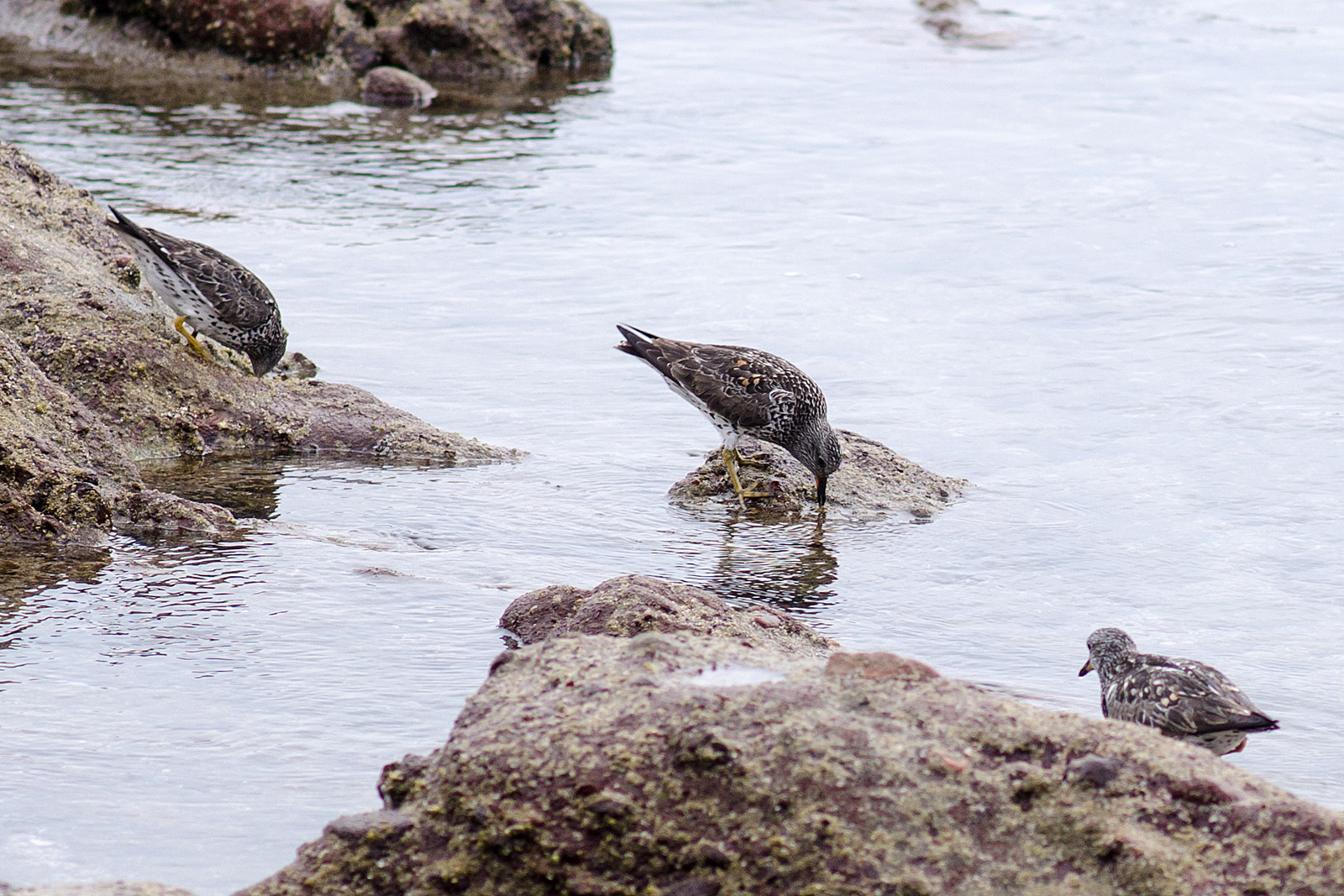
At low tide, I walked along the Mazatlan shoreline to a group of low rocks, most of them covered with each wave, but exposed in between. I skirted the perimeter, where the waves licked at my sandals and ran in channels beside me. Further out, a large flock of surfbirds descended with each retreating wave to feed on the draining rocks.

Hurry, hurry! Next wave's coming!

Eating on the run

Good thing they have wings!

10-second break

On to the next rock; this one's gone.

I managed to get close to a few of the birds.

Unidentified sandpipers.  Surfbirds, Calidris virgata*. Brown, black and white pattern on back, spotted bellies, yellow legs, straight, yellow and blackish beak.

They seem to be poking their beaks into small cracks in the rocks.

I looked carefully at the rocks I could reach, and fished in channels where the water was shallow enough between one wave and the next, to see what the surfbirds were catching. On the rock surfaces, I saw mostly barnacles, tiny ones. Down in the channels, bits of rockweed held tiny snails and hermit crabs. I saw a crab or two.

Tiny barnacles and a snail or two.

Rockweed, underwater. Some of those snails are hermit crabs.

Good eating here!

The tide came in. The rocks disappeared. So did the surfbirds. I went home for supper.

*Updated to correct species. Thanks, Clare!

Monday, April 18, 2016

Early birds

Each morning in Mazatlan, I was wakened by white-winged doves, calling out their version of the rooster's crow, "Koo-koo-roo-koo-koo-o*," a peaceful sound, but persistent, repeated at short intervals all morning, a background to my morning chores and the walk into town for breakfast. "Koo-koo-roo-koo-koo-o!"

Later in the day, the song changed; now their voices sounded more like common city pigeons with sore throats. Listen to them here: the second and third recordings.

The doves were ubiquitous, hanging out in trees, on wires, on roofs, pecking at things on the ground, and even occasionally on the beach. Tame enough, but they were quick to fly away if I approached too closely.

White-winged dove, Zenaida asiatica.

White-winged Doves are brown overall, with a dark line on the cheek. A white stripe at the edge of the folded wing becomes, as the bird takes flight, a bright flash in the middle of a dark wing. The tail is tipped in white and set off with black stripes from the gray underside. Their faces are ornately marked with a black streak on the cheek, and blue skin around the red eyes. (Cornell)

The white wing patches are conspicuous in flight, but I was rarely able to aim the camera before the dove settled and the wings folded down again.

Caught on the hop

Distant photo, pocket camera. The blue eye-shadow shows up clearly here.

A courting couple, showing off the white-tipped tail feathers.

*Someone at the Cornell Lab of Ornithology hears the call as, "whoo-OOO-oo, ooo-oo".  This could be a matter of different ears, or an example of regional dialects in bird languages.


Sunday, April 17, 2016

Saturated colours

A small collection of flowers, seen on my daily walk to the beach in Mazatlan, some in gardens, most growing out of the sidewalks.

Bougainvillea against a green wall.

The bougainvillea flowers are small and white; the brilliant colour is provided by the bracts surrounding the clusters, usually of three flowers.

Showy flowers and "squirt guns" of the African tulip tree, Spathodea campanulata

Small, white irises growing in a green belt between streets.

Papery.

Street corner volunteer.

In a small pool just inside a gate. Pink water-lily.

Plumeria, aka Frangipani. Native to Mexico. I like the unusually striped leaves.

Red-tipped grass, growing between slabs in a street square.

And this is in the dry, cold (ish) season!

Saturday, April 16, 2016

Supercritters

High above the rocks and surf, a diver waits for the right moment, the right wave. Repeatedly, he tenses as if to leap, then relaxes. Finally, the wave seems right; he's off!

Free fall.

Once down, he faces the next challenge; reaching the rocks he has to climb without being pounded to a pulp against them. Again and again, he turns and dives through the incoming wall of water; it's too high, too close, too solid. In a brief moment of calm as the ocean gathers itself for a fresh onslaught, he reaches the rock face and scrambles quickly up to safety.

It seems that nothing made of flesh could survive the relentless pounding of tons of water against immovable rocks.

Below the dive platform

Spraying, rushing, boisterous water.

But there is life, even in this tumult.

Seaweeds and maybe anemones in the surf.

At the far end of the beach, behind a breakwater, I waded out at low tide one day to look at some of the growing things on the rocks. The greenery on the rock above is a variety of rockweed; some of the darker things, at least on the breakwater, seemed to be tightly compacted anemones, a dark, spiky weed, and some sort of soft encrusting growth. A brighter green hair also grows on these rocks; short strands, probably kept trimmed by the rushing water.

Back to the rocks below the dive tower:

Rocks with assorted seaweeds.

But look what showed up when I zoomed the photos to full size!

Do you see the crab on the far right?

Zooming in even more. I don't know what those little critters are; there were others scattered around the seaweed areas.

A bit of sandstone sculpted by the waves among the stones at the base of the seawall. The waves reach this area, pounding downward, then draining quickly away; the current is swift and strong.

Zooming in. Long-legged crabs and tiny snails.

In another area of the beach, I collected some of those tiny snails; a fair number of them were hermit crabs. Some of these on the sandstone seem to be hermits, too. How they hold on as the water comes and goes, I can't imagine.

One of the hermits. About the size of a grain of rice.

And the next wave rushes in. The crabs and hermits and snails hold on; it's what they're used to.


Powered By Blogger