Showing posts with label polychaete. Show all posts

Thursday, January 05, 2023

More haste, less speed.

 Sometimes I'm in just too much of a hurry.

I was doing the routine aquarium cleanup. I hadn't brought in fresh seawater for a while, because of the rain, but the filter was doing its job, and I periodically tested the salinity and added filtered water as needed. And now it was time to clean the filter itself. While I was at it, I washed the sand on the floor of the aquarium and removed a bucket-load of mucky water, which I replaced with chilled, filtered water, and after checking the salinity again, added sea salt to bring it up to the level my critters like.

All routine. But it was late, and I was in a hurry, so I just added the salt to the tank and stirred it around. (Stirring doesn't bother the residents; they're intertidal beasties and they actually seem to like it. Feels like home.)

But really, I should have dissolved the salt in water before I added it. Some of the salt collected, undissolved, on the floor. And a few minutes later, my big polychaete worm crawled out of the sand and stretched out, reaching for the top. He seemed lethargic, too, and stiff; just getting out of the sand, but not attempting to swim.

Oops!

I took a few photos while I watched him; I'm always trying to get a face shot, showing his four eyes. And then, because he was barely moving, I carefully removed him from the tank and put him in a tray with some of the old, dirty water. And he perked right up.

Well, there are the eyes. Blurry because he was moving behind fogged-over glass. But all 4 are there.

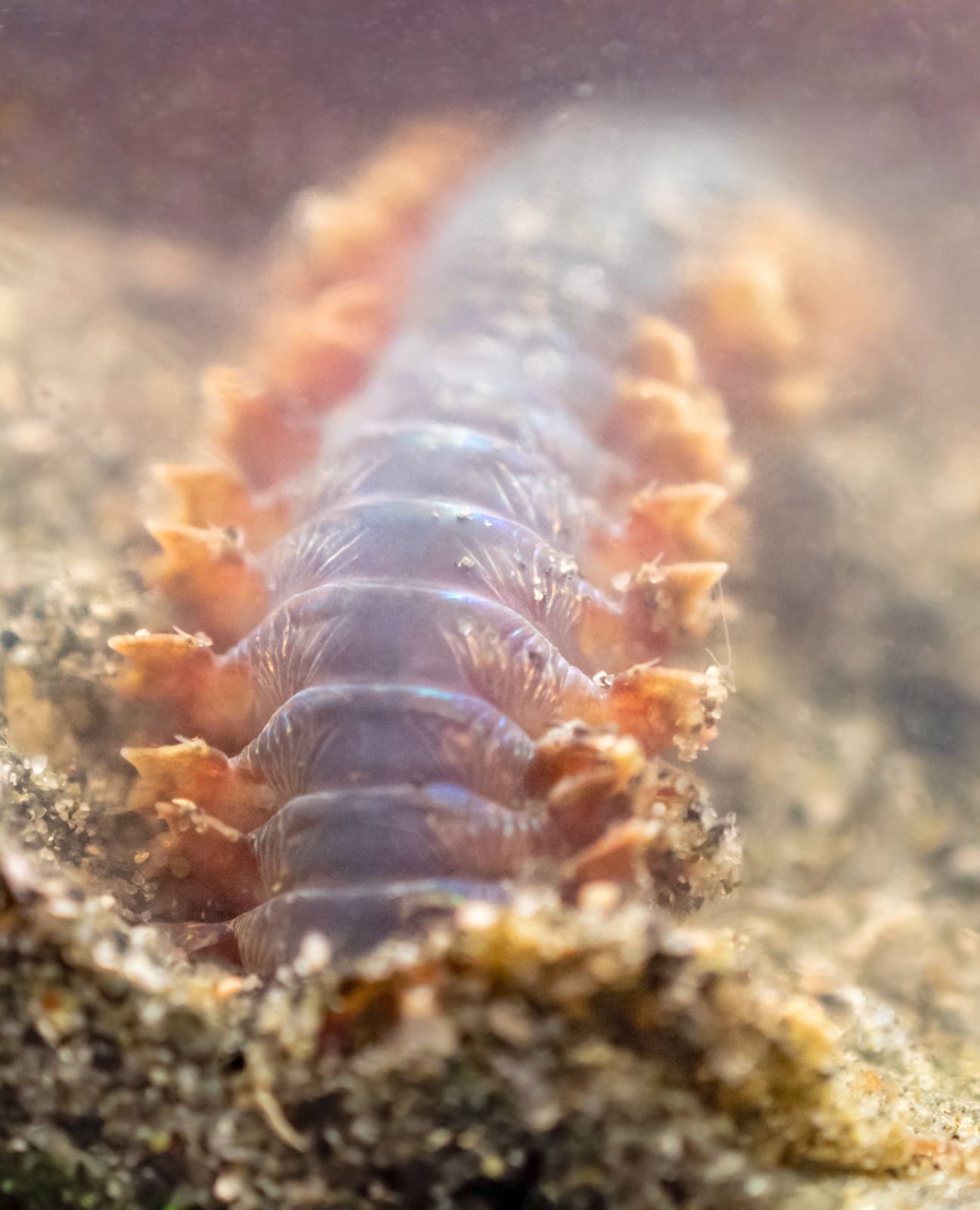
Mid-section view as he was leaving the sand.

And in the tray. It's 19 cm. across; that makes him about 45 cm. long. He's very active now.

He was fine in the old water, so I filtered out the muck and put him in the bucket. (Good thing I hadn't dumped it yet!) And left him overnight. In the morning, when all the rest of the tank critters looked happy and busy, I moved Mr. Worm back to the tank. And he was fine with it. Next time I checked, he was burrowing into the sand; only the last bit of his tail, waving about, was still visible.

~~~~~~~~~~~~~~~~~~~~~~~~~

Hay veces cuando por ahorrar tiempo, lo pierdo.

Estaba haciendo la limpieza normal del acuario. No había traído agua de mar nueva por un tiempo a causa de la lluvia, pero el filtro mantenía el agua limpia, y seguido yo medía la salinidad del agua y añadía agua filtrada según fuera necesario. Y ahora era hora de limpiar el filtro mismo. Al mismo tiempo, lavé la arena en el fondo, y saqué una cubeta de agua contaminada, la cual reemplacé con agua filtrada, y después de medir la salinidad, añadí sal marina para llegar a la solución más cómoda para mis criaturas.

Todo esto es cosa de rutina. Pero se me hacía tarde, y tenía prisa, así que añadí la sal directamente al acuario y la mezclé allí. (Ese movimiento de agua no causa molestias a mis animales; son invertebrados de la intramarea y parecen contentos con ello. Les parece que están en casa.)

Pero debía haber disuelto el agua en agua antes de añadirla. Parte de la sal quedó sin disolver sobre la arena. Y en unos pocos momentos, el polyqueto grande que vive en la arena, salió y se extendió para arriba, como si buscara escapar. Parecía un poco adormecido también, y tieso. Salía de la arena, pero no intentaba nadar como suele hacer.

Siempre estoy buscando oportunidades de sacarle una foto, esperando algún dia lograr una foto de sus cuatro ojos. Saqué la cámara mientras le observaba. Y entonces, ya que apenas se movía, le saqué del tanque con cuidado, y lo metí en un recipiente con algo del agua sucia. Y se recuperó de inmediato.

Fotos:

  1. La cara contra el vidrio. Se le ven los 4 ojos, si algo borrosos.
  2. Vista del cuerpo y las parapodias mientras salía de la arena.
  3. Todo el poliqueto en el recipiente. El recipiente mide 19 cm. por 29, lo que hace que el poliqueto mide aproximadamente 45 cm. Y ahora está muy activo, nadando.
Estaba tan bien en el agua sucia que pasé toda la cubeta por un filtro de café — ¡que bien que no la había tirado todavía! — y dejé el animal allí toda la noche. En la mañana, viendo que todos los otros residentes del acuario se veían contentos y activos, regresé el pobre Sr. Poliqueto al tanque. Y no tuvo problema; cuando miré pasado un rato, ya se había enterrado en la arena otra vez; lo único que quedaba fuera fue la colita, agitándose.

Wednesday, March 16, 2022

Gourmet worm food

 The last time I got a decent photo of the fat polychaete worm in my tank, 6 months ago, she* was about 8 to 10 inches long. Now she's over a foot long, still fat, still hungry.

Ragworm, aka king ragworm, Alitta virens, Nereis virens

She eats shrimp pellets, taking big gulps before she retreats under the sand. But she really loves delicate green algae. When I bring home sea lettuce, she comes out to get her fill. When I haven't found fresh greens, I give her a square of roasted seaweed; human food, containing only the seaweed, a hint of oil, and salt. And for this, she'll come out of hiding and even climb the wall to get it before it floats away.

"Do I smell green?"

I keep trying to get a photo of her four eyes. This time, an algae spot (not the kind she eats) on the glass hid her face. Maybe next time.

*She, because she's a polychaete, so I call her Polly. Which needs a feminine pronoun.

~~~~~~~~~~~~~~~~~~~~~~~~~~~~~
La última vez que pude sacar una buena foto del lombriz poliqueto que vive en mi acuario, hace 6 meses, medía aproximadamente 20 o 25 cm. de largo. Ahora, ya pasó los 30 cm. Sigue gordita, sigue hambrienta.

Fotos: poliqueto Alitta virens.

Come bocaditos de camarón, llenándose la boca antes de volver a esconderse bajo la arena. Pero lo que de veras le gusta es el alga marina verde. Cuando le traigo "lechuga marina" Ulva sp., sale y come hasta llenarse. Y cuando no encuentro algas frescas, pues le doy de esas algas que venden para humanos; alga marina verde, tostada con un poco de aceite y sal. Y para eso, "Polly" (así le llamo por ser poliqueto) es capaz de extenderse más y hasta trepar a la pared para comerla antes de que se la lleve la corriente.

Sigo tratando de sacar una foto de sus cuatro ojos. Esta vez, una mancha de alga amarilla que crece en la pared se interpuso. Será para la próxima.

Monday, September 13, 2021

Look at the camera, Polly!

I keep trying to get a face shot of my big ragworm, "Polly", with no luck. It's rare that she faces the glass, even when I sneakily put food right in the best location up against the glass. And when she does look my way, she immedidately opens up that big mouth to show me her "tonsils". I want the eyes, all four of them.

So. Side shots, with maybe one eye.

Two fat palps, two small palps, four antennae on each side of the head. The parapodia (the paddle "feet") on each segment have 4 or 5 fat "toes" and two needle-thin hairs.

One eye visible.

She likes eating algae, both red and green. Here she's grabbed an algae-covered blade of eelgrass. She dragged a couple of inches of it down into her burrow.

Looking down her throat.

That stripy chin! Almost looks like she's growing a beard.

I'll keep trying.

~~~~~~~~~~~~~~~~~~~~~~~~~~~~
Sigo tratando de sacar una foto de la cara de mi anélido poliqueto, "Polly", sin suerte. Es muy raro que se acerca de frente a la pared del acuario, aun cuando coloco sus alimentos favoritos justo en el sitio más favorable. Y cuando por casualidad se arrima, me abre su boca enorme para enseñar el fondo de su garganta. ¡Quiero ojos, los cuatro ojos!

Pues, aquí hay fotos otra vez de perfil.

  1. Dos palpos gordos, dos pequeños, y cuatro antenas de cada lado de la cabeza. Los parapodia (las "patas" o paletas) en cada segmento tienen 4 o 5 setas gordas (como si fueran dedos) y dos setas agudas.
  2. Aquí se ve un ojo.
  3. Le gusta comer algas, o rojas o verdes. Aquí agarra una hoja de hierba marina Zostera, cubierta de alga. Jaló unos cuatro centímetros de la hoja dentro de su túnel bajo la arena.
  4. Enseñándome la garganta.
  5. ¿Ese cuello! Casi parece que lleva barba.
Seguiré tratando de lograr una foto de frente.


Tuesday, August 24, 2021

At the sand/water interface

I've been lurking at sand level in the aquarium, trying to get a face shot of the big ragworm whose photo I posted a couple of weeks ago. She has an interesting collection of antennae and palps and four eyes, only visible head on.

No luck yet, but I've met a crowd of other sand-level dwellers, all tiny compared to "Polly". Here are some of them.


Here's the ragworm, and two amphipods looking down on him.

The brown stalks are the remains of dried rockweed; the crabs love this stuff! Shortly after I took the photo, the ragworm grabbed the base of the one on the right and retreated into the sand, dragging the whole stalk down with him until only the tip showed up.

The next day, I gave the hermits a sheet of dried green algae; they like this when there is no fresh stuff available. The worm found it and dragged the entire sheet, about 2 by 4 inches, down into his sand tunnel. Today a long, green worm poop showed up at the entrance.

Community shot: oyster mouth, anemones, hairy hermit, California rose algae.

Another community. Red worms in the sand, pink-tipped green anemone with its base under the sand, an orange-striped green anemone on the oyster, an amphipod under the snail shell.

This worm turned up hanging on the sticky edge material of the tank. I took his photo, then washed him down into the sand. About 1/2 cm. long.

The two tentacles of a two-tentacled tubeworm. Tiny, tiny.

A collection of amphipods. They seemed to like hiding under that fragment of a sea urchin shell; they kept going in and out.

A tiny round anemone.

More amphipods around an empty shell.

I was intrigued by that blue-green stuff and fished it out. Just a pinhead's worth; I looked at it under a lens and discovered that it was plastic. How did it get in my tank? Turns out it is a fragment of the scrubber I use to clean the tank. So easily plastic gets into everything! I threw out the scrubber.

~~~~~~~~~~~~~~~~~~~~~~~~~~~~

He estado esperando al nivel de la arena en la base de mi acuario, tratando de lograr una foto de la cara del anélido poliqueto, Alitta virens, "Polly". Su cara es interesante, con un grupo de antenas y palpos, y cuatro ojos, los cuales no se ven más que en plena cara.

No he tenido suerte todavía, pero he visto una gran comunidad de otras criaturas, todas miniaturas al lado de "Polly".

1. "Polly" con una pareja de anfípodos observándolo desde arriba.

Los tallos cafés son lo que queda de unas algas fucus secas; a los cangrejos les encanta esta alga. Un poco después, "Polly" agarró el tallo grande a la derecha y lo arrastró dentro de su túnel en la arena hasta que apenas se veía unos milímetros de alga.

El otro día les dí a los ermitaños un pedazo de alga verde seca; la comen con gusto cuando no hay alimentos frescos. "Polly" lo encontró y también se lo llevó todo, enterrándolo en su túnel. Hoy apareció en la boca del túnel un gran excremento verde.

2. Comunidad: boca de ostión, anémonas, ermitaño Pagurs hirsutiusculus, algas rosa de Californa.

3. Otro grupo; anélidos pequeños en la arena, una anémona de puntas color de rosa, con la base en la arena, una anémona de rayas anaranjadas en la concha del ostión, un anfípodo bajo la concha de un caracol marino.

4. Este gusanito apareció colgado en la esquina del tanque. Le saqué una foto y luego lo mandé a la arena, donde se podría esconder.

5. Los dos tentáculos de un gusano tubícola. Estos hacen sus tubos en la arena y solamente extienden los dos tentáculos, de unos 2 o 3 mm de largo, al agua para capturar su comida.

6. Un grupo de anfípodos. Entraban y salían de su escondite abajo de ese trozo del caparazón de un erizo de mar.

7. Una anémona muy pequeña.

8. Un grupo de anfípodos alrededor de una concha de caracol marino. No sabía qué era esa cosa de color turquesa, así que la saqué del tanque y la vi bajo una lente. (Ya que era apenas un puntito.) Eran fibras de plástico. ¿Y cómo llegó a mi tanque? Resulta que es una fibra del estropajo "Scotch Brite" con que limpio el tanque. ¡Tan fácil llega el plástico a todas partes! Tiré el estropajo a la basura.


Thursday, August 12, 2021

Polly want a shrimp pellet

Stuck at home with a gimpy knee, I've been trying to lure a long, fat polychaete worm out into the open, so as to get her* photo. I caught her the other day near the glass wall of the aquarium, gorging herself on shrimp pellets.

Ragworm, aka king ragworm, Alitta virens, Nereis virens

I don't know when she arrived in my tank; I posted her photo a year ago, when she was a bit smaller. I think now she's about 8 to 10, or maybe more inches long. And very hungry; she gulps down huge mouthfuls of shrimp pellets and nibbles on green algae.

She didn't use to extend herself out of the sand cover more than an inch or two, but now that she's grown, she commonly reaches out 4 or 5 inches, retracting instantaneously with any movement nearby.

Her face is bluish, has an assortment of tentacles and palps, and four eyes. I've been trying to get a clear shot at the face; I'll keep trying.

Another, still a youngster. The tank can support several as long as I feed them regularly.

And while I'm looking at tentacly critters, here are a couple more:

Tiny anemone, showing the stripes on her tentacles.

Orange-striped green anemone, Diadumene lineata

* I named her Polly last year, since she is a polychaete worm. And with the name, Polly, goes a female pronoun.


~~~~~~~~~~~~~~~~~~~~~

Condenada a permanecer en casa debido a una rodilla dañada, me he ocupado en tratar de atraer un anélido poliqueto para que salga de sus túneles debajo de la arena y presentarse cerca de la pared del acuario para que pueda sacarle una foto. La capturé el otro dia hartándose de pastillitas de camarón.

Primera foto: "Polly" (por su clasificación como poliqueto) Alitta virens, aka Nereis virens.

No sé cuando llegó al acuario: le saqué fotos hace un año cuando era todavía pequeña.Creo que ahora mide de 15 a 20 cm, o tal vez más. Y tiene mucha hambre. Abre la boca al diámetro completo del cuerpo para tragar pastillas de camarón; también come algas verdes.

Antes, no salía de la arena más que unos 2 cm, pero ahora se extiende hasta 10  cm o más, buscando comida. Si percibe algún movimiento, se retrae instantáneamente.

La cara es azul, con una variedad de tentáculos y palpos, y con cuatro ojos. Seguiré tratando de sacarle una foto de la cara.

Segunda foto: otro poliqueto; un joven. El tanque puede sostener varios, mientras les sigo dando de comer.

Y mientras estoy mirando a criaturas con tentáculos, aquí hay dos más:

Tercera foto: anémona con manchas blancas en los tentáculos.

Cuarta foto: anémona verde con rayas anaranjadas, Diadumene lineata.


Friday, October 23, 2020

All pink and shiny

In the sand at the bottom of my aquarium, there lives a worm. He's a shy critter, and I used to only see him when I cleaned the sand, sifting through it thoroughly. Even then, all I usually saw of him was his quickly disappearing curves. He moves fast, even in dense sand.

But he's been growing. The last time I caught him, he measured about 6 inches long; he can easily grow to four times that. And he's hungry. So hungry he's forgotten to be shy. When I drop shrimp pellets into the tank for the crabs and hermits, he comes out to get his share, quickly retreating into the sand once he's got a mouthful. But he comes back for more; it takes a lot of food for his long, fat body.

I tempted him with pellets right up against the glass.

Pileworm, aka clam worm. Probably Nereis brandti.

He's a segmented worm. Each segment has two sets of leafy "paddles" which help with movement, and also serve for respiration. On the head he has two fat palps and four sets of tentacles, two small antennae, a huge mouth, and four eyes. With all that sensory equipment, he responds instantly to any movement, or change in lighting. And he smells the food from far away, under the sand.

And his coat is shiny, pink, and iridescent. He glows!

Found a pellet, and opened that enormous mouth. One gulp, and it's gone.

~~~~~~~~~~~~~~~~~~~~~~

En la arena en el fondo de mi acuario, vive un anélido, un poliqueto Nereis. Es una criatura bastante tímida; acostumbraba verlo solamente cuando hacía una limpieza completa del tanque, removiendo y lavando la arena. Aún así, normalmente apenas lograba un vistazo mientras se enterraba con toda prisa. Hasta en arena apretada, se mueve rapidamente.

Pero ha estado creciendo. La última vez que lo saqué de la arena, medía más o menos 15 centímetros. (Puede crecer hasta cuatro veces ese tamaño.) Y tiene hambre. Tanta hambre le motiva a atreveserse a salir a la vista en busca de comida. Cuando les doy de comer a los cangrejos y ermitaños, que comen bolitas de camarón, el poliqueto las huele y sube a capturar su cena. Agarra una bolita, y se retira a su hoyo en la arena para tragarla, pero pronto sale a buscar más. Ese cuerpo largo y gordo requiere muchas calorías.

Es un anélido segmentado; en cada segmento del cuerpo lleva dos pares de patas en forma de hojas; estos le sirven para movilizarse, y además contienen su sistema respiratorio. En la cabeza lleva dos palpos, órganos de tacto, cuatro tentáculos, dos antenitas, cuatro ojos, y una boca enorme.

Y su piel es de un color rosa, brillosa, e iridiscente. ¡Resplandece!


Powered By Blogger