Showing posts with label periwinkle snail. Show all posts

Monday, October 26, 2026

Waiting for the tide

Another shore, another day. The tide was almost in, but one rock was still dry, except for a shallow pool on the flat top. A couple of centimetres deep, a double hands'-breadth across, under clear water. With tiny anemones and hundreds of shelly critters.

Pink-tipped green anemones, mussels, barnacles, limpets, and snails. And fragements of green and red algae.

More of the same. Something swam past; too tiny, too fast to see clearly.

Barnacles mostly closed against the sunlight. Or maybe having noticed my shadow.

The barnacles are small, and they have tiny, tiniest baby barnacles, too. Look at the lower edge of the one in the centre.

On top of the rock, out of the pool, periwinkle snails shelter from the heat in pits in the soft rock.

One double pit. Some of these snail shells may hold hermit crabs.

Birds, next.

~~~~~~~~~~~~~~~~~~~

Otra playa, otro dia ... La marea estaba casi a su nivel máximo, pero quedaba una roca fuera del agua, aparte de un pocito encima, un pocito con apenas unos dos centímetros de agua y tal vez 30 cm. de diámetro. En el agua se congregaban anémonas miniaturas y cientos de animalitos dentro de sus conchas protectoras.

  1. Anémonas Anthopleura elegantissima, con bálanos, lapas, mejillones, y caracolitos Littorina sp. Con algas rojas y verde.
  2. Más de las mismas criaturas.
  3. Los bálanos están todas casi cerradas, tal vez por el sol, tal vez al percebir mi sombra.
  4. Alrededor de estos bálanos pequeños se pueden ver balanitos que apenas se han formado; mira el que se arrima al bálano en el centro de la foto.
  5. Fuera del agua, en la roca seca, caracoles buscan pocitos para esconderse durante las horas secas.
  6. Un pocito doble. Algunos de estas conchas de caracol ahora pueden servir de casa para cangrejos ermitaños.

Monday, November 07, 2022

Periwinkles and dovesnails

I never tire of watching my intertidal snails going about their business. They're busy little critters, always on the move, up and down the walls, in and out of the water, over rocks and seaweeds and other animals. I've even seen them sliding along on the underside of the water surface itself.

These are among the tiniest in my aquarium:

Littorina scutulata, Checkered periwinkle, eating.

There are two species of tiny periwinkles found on our shores in the upper intertidal zone, the Sitka periwinkle, and this, the Checkered. They are very much alike at first glance; I may have some of each in the tank. But the Sitka periwinkle has a rounder shell, and its tentacles are black. And it spends a lot of its time out of the water and can even drown if it stays in too long. In my tank, they hang out just under the edge and when I drop them back in the water, they wake up and head for the air again.

The checkered periwinkle comes out of the water at night; on the shore, it follows the tide in and out. It eats algae (here cleaning it off the aquarium walls) and diatoms. And I was surprised to learn that they, as well as the Sitkas, eat the black lichen, the "sea tar", that grows along the upper edge of the intertidal zone as well.

And there's this: "The constant scraping of littorinid (periwinkle) radulas has been estimated to scrape as much as 1 cm off of intertidal rocks per 16 years." (WallaWalla.edu) That's the rocks themselves! So it should take them about 4 years to wear down my glass aquarium walls. If they stick to one small area, that is, and don't waste time on the shells and stones on the floor.
Periwinkle eating algae on the shell of a hermit crab.

And there are the dove snails:

Carinate dovesnail, Alia carinata

These are mostly about 8 mm. long, although they can grow to 1 cm. They are carnivores, eating worms and chewing through shells of other mollusks. I see them on the walls, but not scraping away as the periwinkles and limpets do, but waving about their siphons, searching for the scent of food.

These never leave the water. I often see them hanging out in couples.

I've never seen one stretch out and coil his foot like this before.

Dovesnail and amphipod.

And more critters, tomorrow.

~~~~~~~~~~~~~~~~~~~~~~~~~~~~~~~~
Nunca me canso de contemplar los caracoles intramareales en mi acuario. Son animalitos muy activos, siempre ocupados limpiando las paredes, paseando, saliendo al aire y regresando al agua, trepándose a las rocas y las algas y los otros animales. ¡Hasta los he visto boca arriba, deslizándose en la parte inferior de la superficie del agua!

Estos son unos de los más pequeños en mi acuario:

Foto #1: Un bígaro cuadriculado, Littorina scutulata, comiendo algas.

Hay dos especies de bígaros que se encuentran comunmente en nuestras zonas intramareales, el bígaro Sitkana, y éste, el bígaro cuadriculado. Son casi idénticos a primera vista, y puede ser que hay de las dos especies en mi acuario. Pero el "Sitka" tiene la concha más redonda, y sus tentáculos son negros. Y pasa la mayor parte de su vida fuera del agua; hasta se puede ahogar si se queda demasiado tiempo en el agua. En el acuario, se congregan en el borde. Cuando los dejo caer en el agua, se despiertan y empiezan el viaje al aire otra vez.

El bígaro cuadriculado sale del agua en la noche, y en la playa, sigue la marea mientras sube y baja. Come alga (y aquí me limpia las paredes del tanque) y diatomeas. Y me sorprendió aprender que ambas especies también comen líquenes, los líquenes negros (chapopote marino, los llamamos) que crecen el el borde superior de la zona intramareal.

Y pasa esto: "El raspado constante de la rádulas de las especies litorínidas (los bígaros) se ha estimado que quita hasta 1 cm. de las rocas intramareales cada 16 años." (de WallaWalla.edu) ¡Eso es de las mismas rocas! Calculando esto, les va a tomar como unos 4 años para hacer desaparecer las paredes de mi acuario. Bueno, si es que se limitan a raspar las paredes y no se distraen con las rocas y las conchas allá abajo.

Foto #2: Un bígaro comiendo algas en la concha de un ermitaño.

Y hay los caracoles "paloma", las Alia carinata:

Foto #3: Alia carinata.

Estos caracoles miden alrededor de 8 mm. de largo, aunque pueden llegar a 1 cm. Son carnívoros: comen gusanos y raspan las conchas de otros moluscos para llegar a la carne adentro. Los veo en las paredes, pero no están raspando las algas como lo hace los bígaros y las lapas, sino que se deslizan con el sifón extendido adelante, para discernir el olor de algo comestible.

Nunca salen del agua. Muchas veces los veo de dos en dos.

Foto #4: Nunca antes había visto que así extendieran y torcieran la pata.

#5: Un caracol "paloma" con un anfípodo.

Mañana, más fotos del acuario.


Sunday, November 06, 2022

It's a big world out there.

 It was raining steadily, and had been all day; clouds and fog hid the hills. A good day to stay home. A good day to visit the community in my little aquarium.

I wanted a photo of my big, beautiful worm. I'm still hoping to get a face shot, showing his 4 eyes. So I cleared away some of the seaweeds and laid down his favourite food, dried roasted seaweed. Meant for humans, but I don't mind sharing.

I sat there with the camera for an hour. Would the worm show his face? No. The hermits ate his seaweed.  And I took photos of any tiny critter that came close to the aquarium wall.

Sometimes it looks as if they were posing for me.

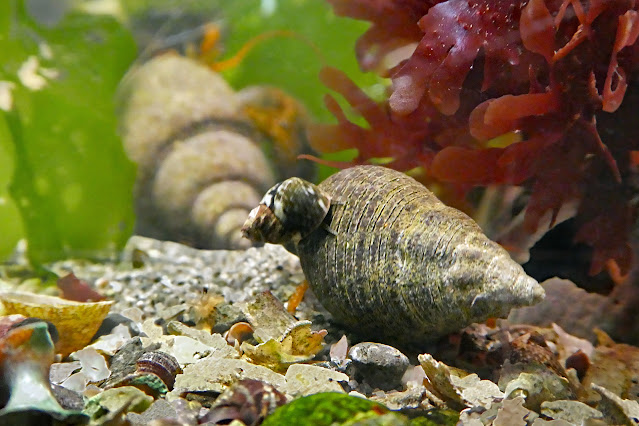
It's a big world out there. Periwinkle snail, checking out an empty snail shell.

One of the tiniest hermits. The smaller ones were elusive.

At the corners of the aquarium, a line of tape seals the join. It collects speckles of algae at the edges. And the smallest hermits climb up it, holding on to slight irregularities.

That same empty snail shell, now holding a small hairy hermit.

An amphipod, coming out from shelter underneath a mussel. Those white blobs are the anchor points on the glass of the mussel's byssal threads.

More aquarium photos tomorrow.

~~~~~~~~~~~~~~~~~~~~~~~~~~~~~~~~~~~~~~~~
Estaba lloviendo, había llovido todo el dia. Los bosques se escondían tras nubes y neblinas. Era un buen dia para quedarme en casa. Un buen dia para pasar el rato con la pequeña comunidad que vive en mi acuario.

Quería una foto del gran poliqueto que vive bajo la arena. Sigo con el propósito de sacarle una foto de la cara, con sus 4 ojos. Quité algo de las algas que tapaban la vista, y le ofrecí su comida favorita, algas secas tostadas. Comida de humanos, pero podemos compartir.

Me quedé allí sentada con la cámara en la mano por una hora. ¿Y se dignó el gusano a aceptar mi ofrenda? No. Ni siquiera se le ocurrió extender un tentáculo fuera de la arena. Los ermitaños se comieron sus algas. Y yo, pues, le saqué fotos a cualquier animalito que se acercara al vidrio.

A veces parece que se ponen en pose a propósito.

Fotos:
  1. Un caracol marino, un bígaro, viendo una concha de caracol vacía, enorme en comparación.
  2. Uno de los ermitaños más pequeños. Los muy muy chicos no se permitieron fotografiar.
  3. En las esquinas del acuario, una cinta sella la junta y se le pegan granitos de algas. Los ermitaños más pequeños se trepan a estas cintas, agarrándose de las arrugas.
  4. La misma concha vacía de la primera foto, ahora con un ermitaño.
  5. Un anfípodo sale de su escondite debajo de un mejillón. Las bolitas blancas son los puntos de adhesión de los bisos del mejillón.
Mañana subo más fotos de los residentes del acuario. 


Powered By Blogger