Showing posts with label antennae. Show all posts

Tuesday, January 25, 2022

Here's looking at you

I scrubbed the walls of the aquarium free of algae, leaving a tiny bit for the snails to eat while it grew back. And the hermits hurried over to watch me through the clean glass. One even startled when I walked across the room too quickly.
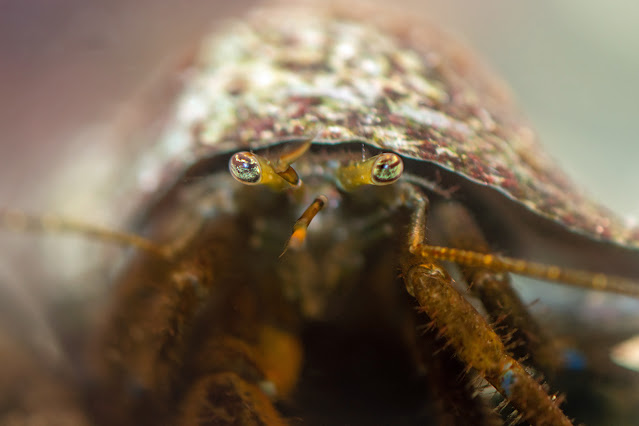
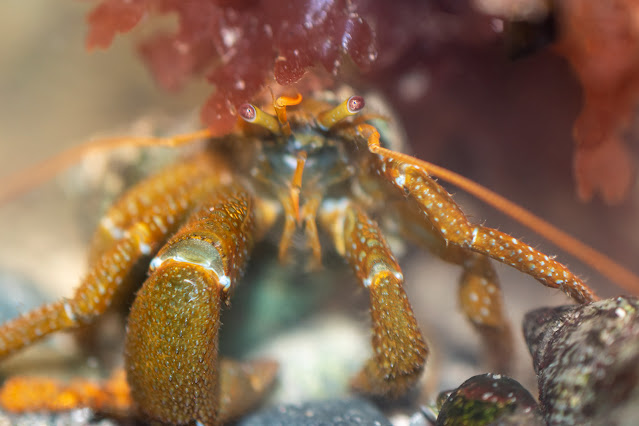
Hairy hermit, Pagurus hirsutiusculus. Their eyes are in shades of green and brown.

Grainy hand hermit, Pagurus granosimanus. Freshly molted. And they have red eyes.

As time goes on, their colours are dimmed, covered with algae and grunge caught on their hairy or bumpy legs. The shells turn dark. When they molt, they show up again fresh and bright. I bring them new, clean shells, and they accept them gladly.
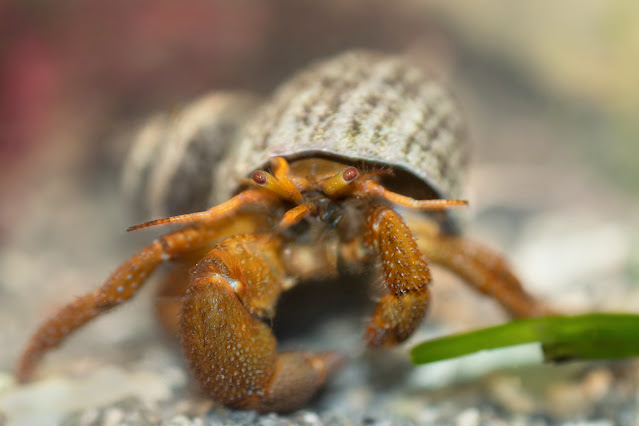
Another grainy hand hermit, also freshly molted.

This little guy has been in a fight, and lost all but the first segment of his antennae. It's a good thing he also has sensory organs in his feet; losing your antennae is almost like losing your sense of smell and taste. (As if you'd caught Covid.) With this recent molt, he's grown back a bit of antennae, but they're still really short. Full length, probably after the next molt, they will reach well beyond his leg width.

Andf also looking at me, but not as approvingly, here's Chia:
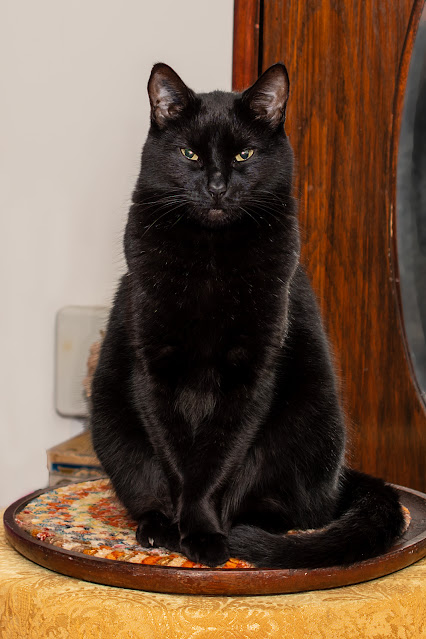
Because I'm sitting in her chair.

~~~~~~~~~~~~~~~~~~~~~~

Restregué las paredes del acuario, quitando toda la capa de algas, aparte de un poquito que dejé para los caracoles por mientras el alga vuelva a crecer. Y de inmediato, los cangrejos ermitaños se formaron frente al vidrio para mirarme. Uno hasta se sobresaltó cuando crucé la cocina rapidamente.

Primera foto: Ermitaño "peludo", Pagurus hirsutiusculus. Los ojos de estos vienen en diseños en verde y café.

Segunda foto: Ermitaño "de manos granosas", Pagurus granosimanus. Recén mudado. Y estos tienen ojos rojos.

Al pasar el tiempo, los colores de los ermitaños se oscurecen, se cubren de basuritas y de alga. Las conchas se ponen casi negras. Al mudarse, salen con todo nuevo, en los colores originales. Y yo les traigo conchas nuevas, limpias, las que aceptan muy contentos.

Tercera foto: Otro ermitaño de manos granosas, también recién mudado.

Este ermitañito se había peleado, y perdió casi todo de sus antenas, quedándose con solo los primeros segmentos. Por suerte, estos animales también tienen órganos sensorios en las patas, porque sin antenas, están como si hubieran perdido sus sentidos de olfato y sabor. (Como si les habría pegado el Covid.) Con esta muda reciente, ha recuperado parte de las antenas, pero siguen siendo muy cortas. Con la próxima muda, espero, llegarán a su largo normal, que se extiende más lejos que las patas.

Y otra también me miraba, pero no con el mismo entusiasmo.

Cuarta foto: Chia, enfadada porque yo estoy sentada en su silla.

Friday, July 03, 2015

Beetle sign language

About that ten-lined June beetle: I went out in the night to turn off the hose, which had been soaking the ground under a tree that has been losing leaves in all this heat, and found a big beetle drowning in the drip bucket.

Does he bite? Well, no, he's a June beetle, and they're inoffensive. But then, angry and half drowned; could I trust him? I collected a stiff rhododendron leaf, and slipped it under him. He clutched at it so desperately that I carried him home on the leaf, left it on my desk while I finished with the hose and got out the camera, and found him still holding on for dear life. And he wouldn't let go, even when I pulled at him.

Grappling hook feet. With 6 of these, he's staying put wherever he chooses. They don't work on plastic buckets.

He finally consented to move over to a handful of hydrangea leaves. where I could dry him off more easily.

Sopping wet, and unhappy. He's got bubbles all over his face.

How do you know if a June beetle is happy? He fans out those high-heeled shoe sole antennae.

Happy June beetle. Photo from BugGuide, by Lynette. Creative Commons license.

While he was on my desk, all wet and miserable, he kept the antennae tightly folded; beetle-style fists. Quite expressive fists, even so.

"I can clobber you with these!"

Or panicky; "Get me out of here!"

(Don't you want to just tickle his furry tummy, as if he were a kitten?)

Or just giving up, totally depressed.

I dried him off with a soft, thick paint brush, and carried his leaves outside, with him holding on tight again.

In the morning, he was gone. He probably fanned out those antennae as he flew away.

Tuesday, March 24, 2015

A Round Tuit

I've been holding onto this photo since last September, waiting till I got around to searching BugGuide for a match. It's a moth that I found on the wall by our door in late afternoon.

The wing pattern echoes the feathery antennae motif.

Enough procrastinating! I spent the evening on it tonight. And after scanning all the "white moths" (2933 moths) and all the moths with a mention of feathery antennae (only 52) on BugGuide, and umpteen more on Google, I gave up and submitted my photo.

Which I should have done to start with, long ago.

The feathery antennae mark this moth as a male. He uses them as a "nose"; they're loaded with olfactory receptors - up to 60,000 in some species. And what he's smelling is a female, emitting her alluring pheromones. Somewhere, maybe miles away.

So sensitive are these organs and so characteristic and powerful is the scent, that a female has been known to summon a male from eleven kilometres away. At such a distance there must be as little as one molecule of scent in a cubic yard of air, yet it is sufficient to cause the male to fly in pursuit of its source. (From AskNature)

UPDATE: The BugGuide people are so quick! The moth is a Phantom Hemlock Looper;  Nepytia phantasmaria. Here's a link to a female: note the straight antennae.

Sunday, July 14, 2013

Unwelcome visitor

I found this big mosquito resting on my plastic cutting board, drying behind the kitchen sink.

Male Culex pipiens, the Northern House mosquito.

Close-up of the head, antennae, and palps. The female doesn't carry all this gear.

The males don't bite. The females do. And BugGuide warns,
This is the most important vector of West Nile Virus and Eastern Equine Encaphalitis in the Northern United States and Southern Canada.
Yikes! I'm wearing Off to bed from now on until summer's over.

Sunday, June 02, 2013

Glow sticks!

There are so many beautiful places to visit in this area, we could be on the go all day every day, and still be missing out. Bear Creek Park is only a few minutes away, but we haven't been through the gardens for a couple of years. Our loss.

We spent a couple of hours in the garden this afternoon, coming back, as usual, with too many photos, some good, some so-so.

I have to share one that didn't work out, though; another Mourning Cloak butterfly. It was on the shrubbery beside our path, flitting from one spot to another. Laurie was closer, and managed one blurry head shot before it flew off to find another bush.

Mourning Cloak, Nymphalis antiopa

Just a dark butterfly, from the underside, in poor light, and dancing in the breeze. But what I wanted to show you were the yellow knobs on the end of the antennae. Cute!

I went to BugGuide and looked at their photos. Sure enough, the Mourning Cloak has its own glow light; it wasn't an effect of the sunshine. Here's one of BG's samples.

The rest of the story, later, after I've finished with the lupins and bees of Elgin Park. An embarrassment of riches!


Wednesday, April 24, 2013

Workaholic hair

Tonight I watched one of the large hermit crabs steal a partially-digested snail from the anemone's mouth, then dash away before his larger companions could snatch it from him. He ran, at top speed, the full length of the aquarium. Backwards.

I couldn't do that. Not without stumbling, not unless I had eyes in the back of my head.

In the morning, the hermits are quiescent, some apparently sleeping (with their eyes open) in the corners, some stacked on top of each other like sleepy kittens, some meditatively grooming their antennae, some picking at a morsel of seaweed or a barnacle. I drop the day's ration of shrimp pellets into the other end of the tank. The scene changes, even before the pellets have sunk to the tank floor; all the hermits are running, scrambling out from the bottom of a hermit pile, dropping from the seaweed. The crab appears from his hidey-hole behind the abalone shell, but he's already out-done by the hermits; they have collected their breakfast, and are hauling it out of reach. He has to mug a slower one for his meal.

How do they do that? They couldn't see the food; they barely had time to smell it, let alone identify and locate it.

Grainy hand hermit, waving assorted antennae and mouthparts.

Their senses are different than ours. Not better, not worse; just different. Their eyes are compound, on stalks, and arranged so that they look both forwards and backwards. One may be looking at me through the glass wall, but at the same time, he's watching his back, in case of a visit by the crab. Handy trait!

As for smell and taste, the hermit has all the bases covered. He has four antennae; the smaller pair, the antennules, is a sensitive "smeller". Besides that, his legs are covered with sensory hairs; he can smell things just by stepping on them. And this covers a deficiency in his sight. Although he can see backwards, he can't bend those stalks down, so he can't see under his own feet. Not a problem when you can smell the ground under you!

A hermit can identify, by smell, a useful snail shell buried in the sand; he can pick out the species that he likes best, also by smell or taste. The hairs on his legs and pincers are multipurpose sensors that also distinguish temperature, touch, and water current.

Do they hear? Yes; those four antennae do that. How well, I couldn't find out. (Should I play some music to mine, and see if they respond?)

Zooming in, to show facial detail.

And then there are those long, long antennae. In this hermit, they're orangey-red. They are feelers, the equivalent to our fingers. The shorter pair in between the eyes are called antennules. The hermit flicks them continuously, waving and spreading the hairs on the flagella (that blue "flag"), capturing scent and taste from the surrounding water.

In the photo above, two of the three pairs of mouthparts are visible. These are always difficult to see, since they're constantly moving. There is a lower pair, green with orange, hairy tips; these manipulate the food and move it into the mouth. Just above these are a set of long spines, also hairy. I can't see what's behind them.

I don't know if all these mouthparts are sensory organs. I would think so, but haven't found any real info.

The idea of hair in the mouth makes me shudder, but then, I'm not a hermit crab.


Powered By Blogger