Showing posts with label butterfly. Show all posts

Friday, May 22, 2026

Buggy

With the warmer weather, the bugs are finally waking up. Around home, I'm seeing crane flies, cabbage white butterflies, bees and wasps, some tiny moths, ants —  large ones with wings, tiny kitchen pests — a beetle or two, weevils and a carpet beetle. House flies, of course, pretty, shiny green ones. And many busy spiders, mostly hunters for now. And in my wanderings yesterday, these came within camera range.

I thought I was taking a photo of the Nootka roses, but then a jumping spider showed up. She wasn't there for the first photo; lucky I took 3 in a row.

Zooming in. Not close enough to id this one.

And here she is, 13 seconds later; she's already caught herself a tiny fly. The shiny wings reflect the pink of the rose petals.

This butterfly, a Pale Swallowtail, Papilio eurymedon, was flitting from basket to basket around the floating restaurant at Brown's Bay.

From a low bridge over a creek flowing into Lost Lake, I looked down at water striders in the golden sunlight.

Two layers; water strider and its reflection. The creek bottom, only a  few cm. away, shows up where leaves cast their shadows.

Web and spider in too-bright sunlight. Brown's Bay, over the water by the marina.

A mosquito found her way into one of my photos, but I cropped her out. (Her, because only the females bite, and that's what she was there for.) In one spot, when I stopped the car, they swarmed around it, searching for a way in. I decided not to take that trail. Not without repellent.

~~~~~~~~~~~~~~~
Ya que empieza a hacer calorcito, los insectos han despertado. Alrededor de la casa los veo: las típulas, las mariposas blancas de la col, algunas palomillas pequeñas, abejas y avispas, hormigas — grandes con alas, y hormiguitas miniaturas, plagas que han invadido mi cocina — uno que otro escarabajo, gorgojos,  y un escarabajo derméstido. Y las moscas comunes, claro, muy bonitas, verdes y relucientes. Y muchas arañas cazadores, cazando.

Y ayer, en mis peregrinaciones me tropecé con estos:
  1. Sacaba una foto de una rosa nutkana, y apareció una arañita saltarina. Por suerte, saqué tres fotos, una tras otra; en la primera, estaba escondida. En la segunda, allí estaba en una hoja.
  2. La misma foto, recortada. No se puede identificar esta araña con certeza.
  3. Y 13 segundos más tarde, en la tercera foto, ya se ha dado vuelta y ha capturado una mosca. Las alitas brillantes de la mosca reflejan el color de la rosa.
  4. Esta mariposa Papilio eurymedon visitaba todas las canastas de flores alrededor del restaurante flotante en Brown's Bay.
  5. Desde un puente que cruza un riachuelo cerca del Lago Perdido, miraba estos patinadores (guérridos) deslizándose en la superficie del agua.
  6. Un patinador y su reflejo, formando dos capas. Donde las hojas dan sombra, se ve el fondo del riachuelo.
  7. Esta araña ha extendido su telaraña sobre el agua de la marina en Brown's Bay. Ella está en pleno sol; el agua en sombra.
Una mosquito hembra salió en una de mis fotos, pero la recorté. (Sé que era hembra porque solamente las hembras pican, y para eso había venido.) En un sitio, cuando detuve el coche, los mosquitos lo atacaron, buscando como meterse adentro. Allí ni siquiera bajé la ventana, y dejé ese sendero para otro dia. O por lo menos un dia cuando traigo repelente.

Wednesday, May 17, 2023

Caught in transit

There are the tiny flowers; they're a welcome find along the trails. And then there are the tiny, tiny critters. These crossed my path recently, some here, some there. Mostly fleeting encounters; none are in perfect focus, but I had fun snapping their photos anyhow. And some have stories to tell.

Caught in transit. 1 cm. caterpillar.

This little cat was dropping from a tree above, dangling from an almost invisible silk thread. His trip interrupted by my hand, he crawled down my wrist and arm, and dropped again from my elbow. I imagine a life cycle that started in the cherry tree overhead, and would continue on (or in) the ground below, where he would pupate and start the conversion to a moth.

Brown butterfly. One shot wonder. Next click; bare leaves.

Spider in her web over the water, Brown's Bay.

Her web spanned the space between a dock and the ramp. To get the shot, I had to climb the outside of the ramp and risk a dunking, camera and all. A topside view was impossible without a boat to stand in. She's well positioned to catch any mosquitoes the swallows miss.

Damselfly at the beaver pond. (Pacific forktail?)

And another.

These, with umpteen of their kin, were darting over the lily pads at the beaver pond. I would track one; with the transparent wings, they looked like flying needles. And they would land and immediately become invisible. Two made the mistake of landing on a clear background, where they stayed for all of maybe 30 seconds.

Plume moth, on my bedroom wall.

More Saskatoon flowers. There's an ant on these.

And finally, a spider housing development. I couldn't find any spiders, though. They'll all be hiding in the cracks of the bark.

~~~~~~~~~~~~~~~~~
Ayer subí fotos de flores pequeñas halladas al borde de los senderos en el bosque. Hoy les toca a los bichitos; insectos y arañas que cruzaron mi camino en varios sitios. Encuentros pasajeros; ninguno se quedó a platicar. Las fotos no están perfectamente enfocadas, pero no importa, me divertí tratando de capdtar imágenes de estas criaturas. Y algunas tienen sus historias.

Fotos:
  1. Este gusanito bajaba de un cerezo, colgado de un hilo de seda casi invisible. Cuando interrumpí su viaje con mi mano, siguió sin detenerse, bajando por mi muñeca y el brazo, y dejándose caer, con el hilito anclado en mi codo. Me estoy imaginando un ciclo de vida que empezó allá arriba en el cerezo, y que ahora le lleva a buscar asilo en el suelo, donde se hará su pupa para empezar a trasformarse en mariposa nocturna.
  2. Una mariposa color café, sin identificación. Una sola oportunidad. Al hacer clic por segunda vez, solo salieron las hierbas.
  3. Un araña en su telaraña sobre el agua. La había extendido entre el muelle y la rampa; para sacar la foto, tuve que trepar por el lado exterior del pasamanos, arriesgando una caída al agua con todo y cámara. Ha escogido un buen sitio para atrapar los mosquitos que logren evadir las golondrinas.
  4. Un caballito de diablo, posiblemente Ischnura cervula.
  5. Y otro. Estos, con una multitud de sus familiares iban y venían sobre las hojas de los lirios acuáticos en la laguna de los castores. Los seguía con la vista, tratando de ver donde se paraban; volando, con las alas transparentes, parecen agujas delgadas. Y luego se detienen y de repente se vuelven invisibles. Estos dos se equivocaron, deteniéndose sobre fondos de color sólido. Por unos segundos, nada más, y luego se echaron a volar.
  6. Una polilla de pluma en la pared de mi recámara.
  7. Otras de las flores blancas de Saskatún. Estas con una hormiga.
  8. Y un condominio de arañas. No vi a ninguna araña; todas estarán escondidas entre la corteza del árbol.


Tuesday, May 14, 2019

Azure

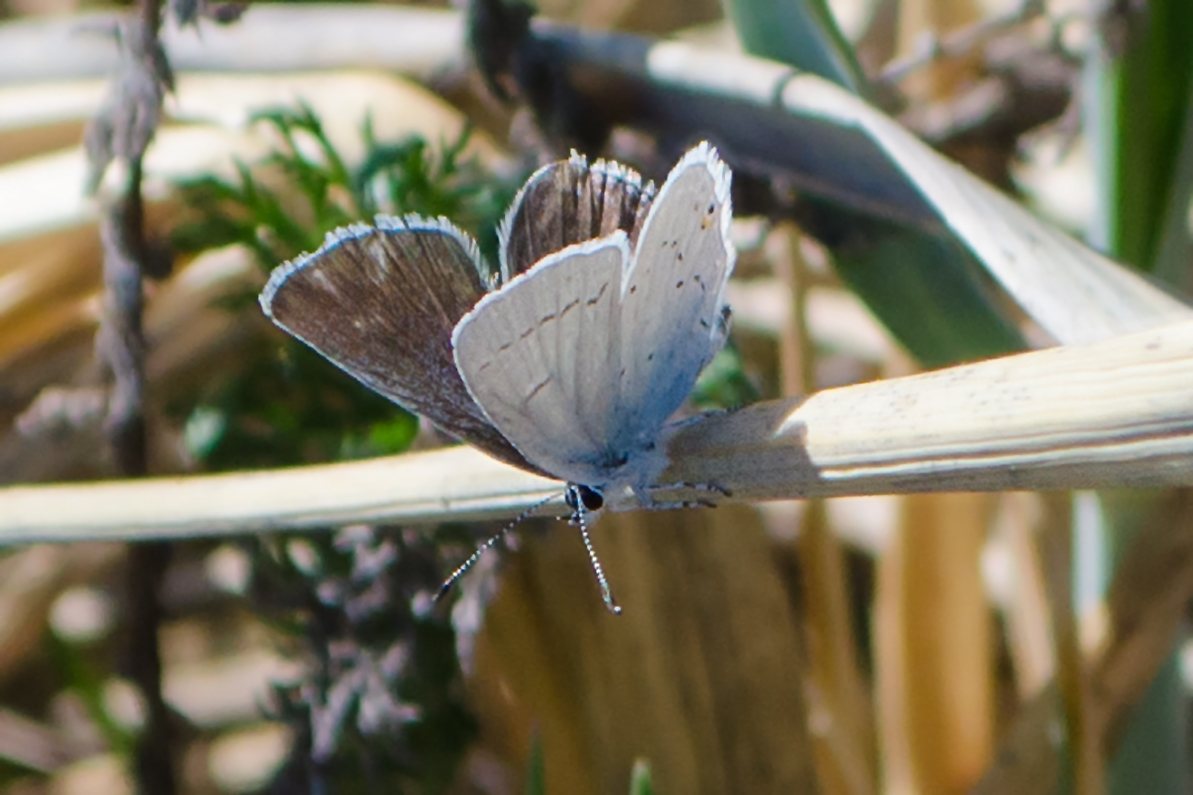
It's butterfly season again. Along the Oyster Bay dunes, these tiny, brilliant blue butterflies were dancing.

Spring azure butterfly, Celestrina ladon.

These are tiny butterflies, about half the size of the cabbage whites. They are very shy; they perch on a flower or leaf, resting, but as soon as I move, even though I'm several metres away, they take off. I tried pretending to be a stump, until my feet started to sprout roots; it didn't work. They knew better than to trust a stump with a camera. None came near me.

I hid behind a fence for this one. It looked brown, as in the photo, but as soon as it started to fly, the wings shone out blue again. She may be a female; their wings have a brown edge.

The legs are striped, like hairy hermit antennae.

Thursday, March 21, 2019

Green comma butterfly

First day of spring. I hiked up the Ridge Trail again. The ice was gone; now it was too hot, and I wished I had not worn a sweater.

Up top, the trees were busy. There were woodpeckers, tree creepers, robins, and I think I saw a grey jay. And down at the trail level, butterflies were dancing, two by two.

Green comma butterfly, Polygonia faunus

The Green Comma flies from early March to late September, with populations peaking April – May, and August. It is most often found along sun dappled forest roads, and trails, or in groves of trees in grasslands.(Nicola Naturalists)

An interesting little butterfly. Solitary butterflies didn't tolerate me coming too close; one step too many, and they took off, but then they circled around and came to rest again in the same spot. After I realized this, I just had to wait with the camera pointing at their parking spot.

When they paired up, though, they kept flying, fluttering madly a few inches apart, not resting anywhere that I could see.

When they close their wings, all the brilliant orange disappears.

Underside of the wings. And there's the comma that gives them the name.

The males have green spots on the underside of the wings. I couldn't see any on this one, but I was on the shadowed side and the colours aren't clear.

Monday, August 06, 2018

Thistles and critters

A patch of thistles between the blackberry bushes (with burdock alongside; it was a prickly field!) was a-buzz with flying and crawling critters.

Skipper, and a syrphid fly. I think the skipper is Ochlodes sylvanoides, the Woodland Skipper, very common here in BC.

The bees were busy, but in a great hurry, never parking on a flower long enough for me to focus on it. A lot of work to be done; there are blackberries and flyaway thistle fluff to be made, and it all falls on the bees' shoulders, or at least their leg buckets.

More thistles, more critters.

Most thistles are edible, but grazing animals, such as the deer that was browsing in the blackberry patch, usually ignore them. The leaves are spiny, and those spines are sharp, where the blackberry leaves are mostly thornless.

Friday, August 21, 2015

Orange and yellow

Woodland Skipper on tansy.

Comes with his own "bendy straw" for sipping tansy nectar.


Tuesday, August 05, 2014

Monday, November 11, 2013

The 'fly who came in from the cold

Such fun I've been having with one little critter!

It started 6 weeks ago, with a yodelling caterpillar. At the end of September, he lived, eating nasturtiums, on my desk for a few days, then he built himself a hammock and turned into a chrysalis. I set him outside in a glass case by the door, and kept an eye on him. The chrysalis gradually lost its bright green colour, fading to a yellowy white. Nothing else seemed to be happening, but of course it was, invisibly; all that rebuilding from the inside out.

I almost missed the next act; I was too late for the first scene. I checked his cage just after breakfast last Thursday, and there he was, out of the chrysalis. Barely out. His wings were still wrinkled, and he was slowly unfolding his legs.

I posted a photo of those legs, the only ones stretched out at the moment. (You commenters are pretty good; you knew it was a butterfly, just not what species.)

9:33 AM, on the inside of the glass case. Three legs

He seemed to discover more legs, as he untangled himself.

9:34 AM Six legs. Cabbage white butterfly, mostly yellow.

9:36 AM

While he stretched, I looked at the empty chrysalis:

The head end is down; the chrysalis is split from the "beak" to the "waist".

It was too cold outside, just above freezing. I left him there for a few hours, but he didn't want to move, so I brought him in and he perked up right away.

A warm corner on a vase by a light.

On a glass bottle.

On the back door. No, he didn't want to go out. I asked.

Next day, on the kitchen floor.

He was a male, as shown by the one black spot on his forewing, and should have been looking for a mate. But it was miserably cold out there, and his friends weren't flying, so I let him stay at home in the warmth. Unfortunately, a spider finally got him. Sometimes I could wish that spiders were vegetarian.

Tuesday, October 01, 2013

Making a caterpillar hammock

Cabbage white butterflies go through several generations each year. In warm weather, a complete cycle takes from one to two months. Over the winter, though, the caterpillar goes dormant in his chrysalis, stuck to a leaf or twig. A three-point attachment is all that holds him, through rain, snow, wind, and ice storms. And through all the shaking and jerking about he goes through as he sheds his old skin. There's a spot of glue at the tip of his tail, and a fragile-looking thread glued to the leaf on either side, and strung over his back. That seems to be enough.

Day-old chrysalis. The thread is visible across his mid-section.

I've been wondering how the caterpillar manages to tie a thread behind his own back, and managed to catch my latest visitor demonstrating the technique.

First, he selects his leaf. He was eating nasturtiums, but moved to maple for the winter.

He bends over backwards, and turns to one side.

Glues a strand of silk to the leaf on his left,

Swings back, stretching at right angles to his leaf,

continues the swing

to the right side,

and glues the thread down.

He repeated this action about a dozen times, then returned to his upright position and started the transformation.

Here he is, on video, in real time. It's a painstakingly slow process.


If you watch this at full size, it's easy to see the thread stretching over his back.

But he says, in the immortal words of the Cat in the Hat, "That's not all I can do!" More tomorrow.


Wednesday, September 04, 2013

Salt and pepper butterfly

Cabbage white butterflies are probably the first we see in the spring, and the last we'll see as winter approaches. This one has been around for a while. Her* wings are torn, and many of the feathers have been rubbed off.

I've never seen one so speckled before. Age spots, maybe?

*I think it's a female. Males have one black spot on each upper wing, females have two.

Saturday, July 20, 2013

Raggedy Swallowtail

Some too-impetuous bird got himself a mouthful of feathers. Maybe more than one bird, actually. Not to worry, says the feather provider; that's what they're for. Camouflage by misdirection.

Western swallowtail butterfly, Papilo rutulus, missing most of the swallow tails, and a lot of wing. Doing fine, sipping nectar from a generous abelia.

His wing once had a border of yellow dots, a hint of blue, and a red patch at the bottom.

There's still some blue on the underside of the hindwing. No red, though.

Happy foraging, and slowpoke birds, little one!

Sunday, June 02, 2013

Glow sticks!

There are so many beautiful places to visit in this area, we could be on the go all day every day, and still be missing out. Bear Creek Park is only a few minutes away, but we haven't been through the gardens for a couple of years. Our loss.

We spent a couple of hours in the garden this afternoon, coming back, as usual, with too many photos, some good, some so-so.

I have to share one that didn't work out, though; another Mourning Cloak butterfly. It was on the shrubbery beside our path, flitting from one spot to another. Laurie was closer, and managed one blurry head shot before it flew off to find another bush.

Mourning Cloak, Nymphalis antiopa

Just a dark butterfly, from the underside, in poor light, and dancing in the breeze. But what I wanted to show you were the yellow knobs on the end of the antennae. Cute!

I went to BugGuide and looked at their photos. Sure enough, the Mourning Cloak has its own glow light; it wasn't an effect of the sunshine. Here's one of BG's samples.

The rest of the story, later, after I've finished with the lupins and bees of Elgin Park. An embarrassment of riches!


Tuesday, August 30, 2011

Distilled sunlight

At Mud Bay, yesterday afternoon:

Birdsfoot trefoil. Orange and yellow flowers on the same stalk.

Red-tipped buds.

The plant. A legume, trailing and semi-erect, perennial.

Immature seed pods with strange pointy caps. Mature pods are fatter, and have dropped the cap.

Flowers and a visitor. Small orange butterfly, unidentified.

Powered By Blogger