Showing posts with label water striders. Show all posts

Friday, May 22, 2026

Buggy

With the warmer weather, the bugs are finally waking up. Around home, I'm seeing crane flies, cabbage white butterflies, bees and wasps, some tiny moths, ants —  large ones with wings, tiny kitchen pests — a beetle or two, weevils and a carpet beetle. House flies, of course, pretty, shiny green ones. And many busy spiders, mostly hunters for now. And in my wanderings yesterday, these came within camera range.

I thought I was taking a photo of the Nootka roses, but then a jumping spider showed up. She wasn't there for the first photo; lucky I took 3 in a row.

Zooming in. Not close enough to id this one.

And here she is, 13 seconds later; she's already caught herself a tiny fly. The shiny wings reflect the pink of the rose petals.

This butterfly, a Pale Swallowtail, Papilio eurymedon, was flitting from basket to basket around the floating restaurant at Brown's Bay.

From a low bridge over a creek flowing into Lost Lake, I looked down at water striders in the golden sunlight.

Two layers; water strider and its reflection. The creek bottom, only a  few cm. away, shows up where leaves cast their shadows.

Web and spider in too-bright sunlight. Brown's Bay, over the water by the marina.

A mosquito found her way into one of my photos, but I cropped her out. (Her, because only the females bite, and that's what she was there for.) In one spot, when I stopped the car, they swarmed around it, searching for a way in. I decided not to take that trail. Not without repellent.

~~~~~~~~~~~~~~~
Ya que empieza a hacer calorcito, los insectos han despertado. Alrededor de la casa los veo: las típulas, las mariposas blancas de la col, algunas palomillas pequeñas, abejas y avispas, hormigas — grandes con alas, y hormiguitas miniaturas, plagas que han invadido mi cocina — uno que otro escarabajo, gorgojos,  y un escarabajo derméstido. Y las moscas comunes, claro, muy bonitas, verdes y relucientes. Y muchas arañas cazadores, cazando.

Y ayer, en mis peregrinaciones me tropecé con estos:
  1. Sacaba una foto de una rosa nutkana, y apareció una arañita saltarina. Por suerte, saqué tres fotos, una tras otra; en la primera, estaba escondida. En la segunda, allí estaba en una hoja.
  2. La misma foto, recortada. No se puede identificar esta araña con certeza.
  3. Y 13 segundos más tarde, en la tercera foto, ya se ha dado vuelta y ha capturado una mosca. Las alitas brillantes de la mosca reflejan el color de la rosa.
  4. Esta mariposa Papilio eurymedon visitaba todas las canastas de flores alrededor del restaurante flotante en Brown's Bay.
  5. Desde un puente que cruza un riachuelo cerca del Lago Perdido, miraba estos patinadores (guérridos) deslizándose en la superficie del agua.
  6. Un patinador y su reflejo, formando dos capas. Donde las hojas dan sombra, se ve el fondo del riachuelo.
  7. Esta araña ha extendido su telaraña sobre el agua de la marina en Brown's Bay. Ella está en pleno sol; el agua en sombra.
Una mosquito hembra salió en una de mis fotos, pero la recorté. (Sé que era hembra porque solamente las hembras pican, y para eso había venido.) En un sitio, cuando detuve el coche, los mosquitos lo atacaron, buscando como meterse adentro. Allí ni siquiera bajé la ventana, y dejé ese sendero para otro dia. O por lo menos un dia cuando traigo repelente.

Thursday, August 08, 2024

The dimple makers

The woods were hot last Monday, even though the summer leaves filtered out the direct rays of sunlight. We came to a deep ravine, so steeply cut, and with the soil so dry and loose, that someone has tied a rope, knotted every 30 cm. or so, from a tree at the top to one beside the creek at the bottom, and then another up the other side.

Down there beside the little creek, it felt cooler. And some sunlight still percolated through.

Unnamed creek with a little bridge.

In sunlit water a few centimetres deep, water striders skated back and forth on the surface. I tried to catch one standing still, without much luck. They scoot at about 1 metre per second. (3.6 kph., a slow [human] walk, but in a space a couple of metres across, it means they're rarely where you aimed a camera.) 

Reflections. With two water striders. Can you find them?

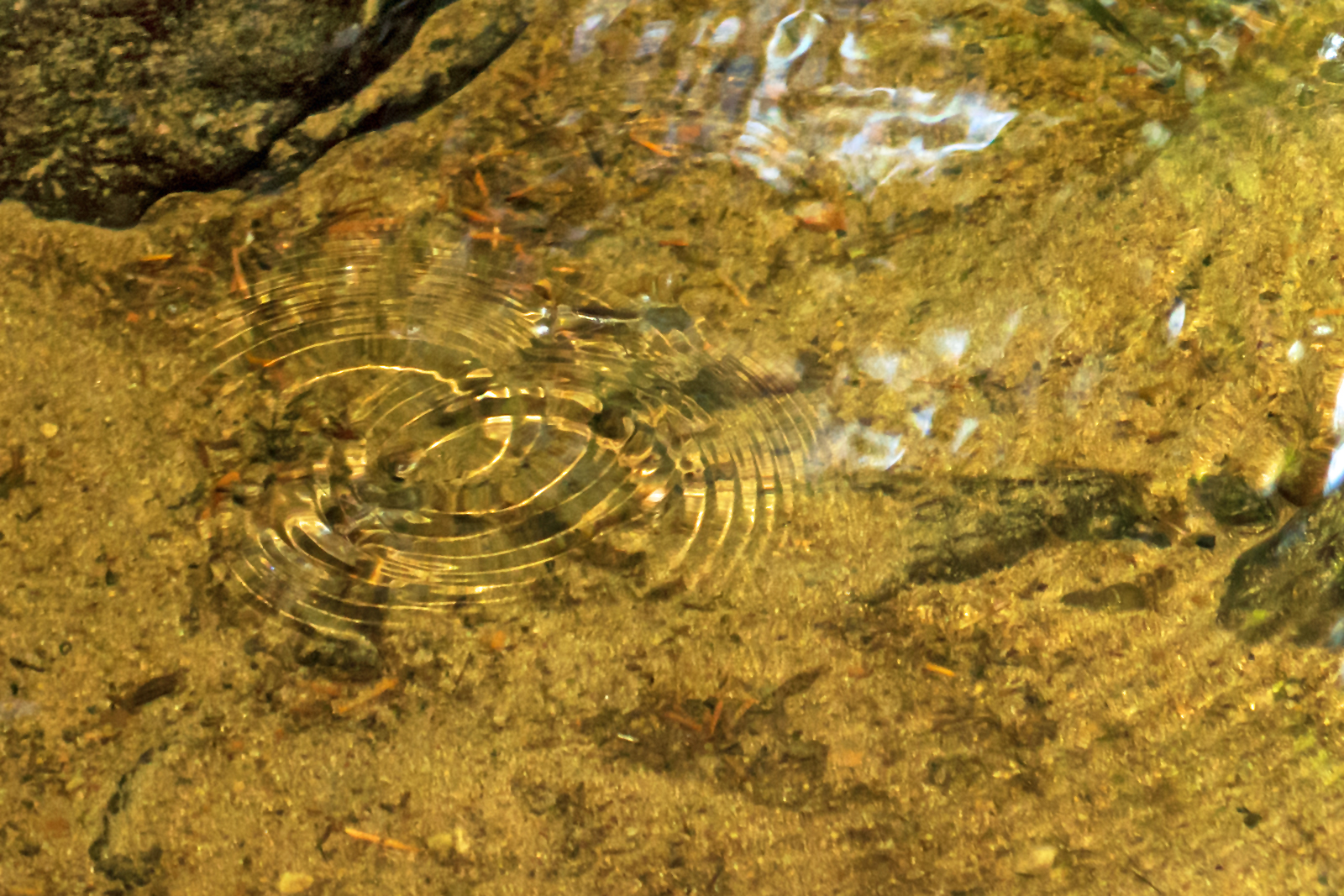
Water strider wave patterns. With one strider visible.

What we usually see, especially in still, shallow water, are the shadows of their feet, usually at some distance from the strider itself, depending on the angle of the light.

Two water striders, Woodhus Creek, 2017.

Though the feet are tiny, mere sticks covered with microscopic hairs (several thousand per sq. mm.), they produce these big shadows, which are actually the shadows of the dimples in the water. The hairs are water-repellent, so they don't penetrate the surface.

When the rowing stroke begins, the middle tarsi of gerrids are quickly pressed down and backwards to create a circular surface wave in which the crest can be used to propel a forward thrust. (Wikipedia)

In this creek, the water is in constant movement, so what can be seen are these wavelets caused by the pushing of the hairy feet against the surface tension.

The species found in this area, with hundreds of observations reported to iNaturalist on the island, is the North American common water strider, Aquarius remigis. They are predators, eating the aquatic larvae of mosquitos and dragonflies and any insect that falls into the water.

I once made water striders out of wire with a bunch of kids. Three lengths of wire, a bit of twisting, and they stand on water. Even without the microscopic hairs. Try it: here's a video that shows how.

~~~~~~~~~~~~~~~

Hacía calor en el bosque el lunes pasado, aunque las hojas de los árboles nos protegían de los rayos directos del sol. Llegamos a un barranquito algo profundo, con una pendiente tan pronunciada, y con el suelo tan movedizo y seco que alguien había proveido unas cuerdas con nudos a cada 30 cm., atándolas entre troncos arriba y al fondo, de ambos lados del barranco.

En el fondo hay un riachuelo; allí el aire era más fresco. Unos cuantos rayos del sol alumbraban el agua. 

Fotos:
  1. Riachuelo sin nombre.

    En agua de unos pocos centímetros de profundidad, patinadores de agua se deslizaban sobre la superficie. Traté de sacarles fotos, pero sin mucho éxito. Patinan a la velocidad de 1 metro por segundo, o sea 3,6 kph, un poco más lento de la de un humano caminando, pero en un espacio de unos dos metros de diámetro, raras veces están donde apuntaste la cámara.

  2. Reflejos en el agua. Con dos patinadores. ¿Los puedes encontrar?
  3. Haciendo ondas circulares. Con un patinador.

    Lo que vemos normalmente, sobre todo en agua tranquila y de poca profundidad, son las sombras de sus patas, que están casi siempre a alguna distancia del insecto, según la dirección de donde viene la luz.

  4. Dos patinadores. En Woodhus Creek, 2017.
Aunque las patas son apenas palitos delgados cubiertos de pelos microscópicos (varios miles de pelos por cada centímetro cuadrado) producen estas sombras grandes, lo que son en realidad, las sombras de las depresiones en el agua. Los pelos son hidrófobos; repelen el agua y no penetran la superficie.
Cuando comienza la brazada de remo, los tarsos medios de los gérridos se presionan rápidamente hacia abajo y hacia atrás para crear una onda superficial circular en la que la cresta puede utilizarse para impulsar un empuje hacia delante. (Wikipedia)

En este riachuelo, el agua está en movimiento continuo, así que lo que se puede ver son las onditas causadas por el empujón de las patas contra la tensión de la superficie.

La especie que se encuentra en esta región, con cientos de observaciones reportadas a iNaturalist en la isla, es el patinador común norteamericano, Aquarius remigis. Son predadores, comiendo las larvas acuáticas de mosquitos y de libélulas, además de cualquier insecto tiene la mala suerte de caerse en el agua.

Hace un tiempo, hice patinadores de agua con un grupo de niños, usando solamente unos trozos de alambre torcidos. Muy fácil, y de veras logran pararse sobre el agua. Hasta sin poseer pelos hidrófobos. Hay un video que muestra como se hace; haz la prueba


Monday, September 19, 2022

Critter assortment

 Arachtober starts in a couple of weeks. That's when a bunch of us crazies post our spider photos on Flickr, one a day to start, ending up with five on Hallowe'en. So I've been poking around here and there, at home and away, night and day, looking for spiders to photograph.

Got a good batch. And also a few other critters; here are some of them.

Night shot above my front door. Unidentified moth, photo stack 4 photos.

UPDATE: it's an Alfalfa looper moth, Autographa californica. I used Google image search and it came up with it right away! Good to remember.

Water strider, probably Limnoporus notabilis. Roberts Lake.

A smaller unidentified moth by my door.

Hopper, above Roberts Lake. These made clicking sounds when they flew away.

Leftover spider lunch. Golden Jewel Beetle, Buprestis aurulenta.

And a few intertidal critters. Orange and white dogwinkle, barnacles, and limpets.

Yes, there are spiders just above the intertidal zone, but they're all really fast runners.

~~~~~~~~~~~~~~~~~~~~~~~~~~~~~~~~
En unos cuantos dias empieza el mes de Arachtober, cuando un grupo de aficionados de los arácnidos subimos fotos de arañas a Flickr, uno por dia, aumentando hasta llegar a cinco el Dia de los Muertos. Y he estando buscando arañas en todas partes, noche y dia, para sacarles sus fotos.

Pues también me he cruzado con otros bichos. Aquí hay algunos de ellos.

Fotos:

  1. Una paloma, o mariposa nocturna. Esta la encontré de noche, arriba de mi puerta de entrada. Sin identificación. ACTUALIZANDO: es un Autographa californica. Subí la foto a Google Imagenes y me dió la respuesta instantáneamente.
  2. Un Patinador de agua, probablemente Limnoporus notabilis. En el lago Roberts.
  3. Otra palomita en mi puerta.
  4. Un saltamontes, en el cerro cerca del lago Roberts. Estos hacían un "clic" cuando volaban.
  5. Escarabajo Buprestis aurulenta, la joya de oro. Mala suerte; le agarró una araña.
  6. Y unos bichos intramareales. Un caracol marino, Nucella spp., con bálanos y lapas. Si hubo arañas por el rumbo, pero corren muy rápido.

Monday, August 21, 2017

Woodhus Creek after a dry summer

We discovered Woodhus Creek in 2010, after a rain. When we went back in 2010, (and again last summer) the sandstone bed was mostly dry. This year, 7 years and a day later, after this hot, rainless summer, it's even drier. Crispy, in parts.

Bare sandstone, and the bottom of the fish ladder.*

That same patch of stone, Aug. 16, 2012. The edge of the fish ladder is at the far left.

Shallow streams trickle down to the river below.

Alder leaf and evergreen needles, barely floating.

Near the edges of the creek, the stone wears moss This year, it's hard and crunchy. But down in holes worn through the sandstone, a few plants find moisture and shade.

And wherever there was water, there were water striders.

Two water striders. The shadows are always bigger than the insects, and usually a distance away, depending on how deep the water is and the angle of the sun.

One water strider, possibly an Aquarius remigis, on very shallow water. It has orange spots down the sides of its abdomen.

And another. Look closely at the feet; see how the water fans out into round or long feathery shapes? The legs have thousands of hairs to grab the surface.

Last July, I found many caddisfly larvae in these waters. I looked and looked for them this time; there was nary a one to be found. Too late? Too dry? I'll look again next year.

Still, the shallow puddles, even without larvae or water striders, were interesting.

Needles and a wing of an unidentified insect, floating over bubbly algae and pond scum.

More bubbly algae.

*And a grumble: in that first photo, there are two extraneous objects. One is my bag, which I brought in and hauled out, of course. The other is a two-litre orange juice container, emptied and left on the fish ladder. I found its plastic lid down in a pool. Why, people; why? Is it too much work to cart your leavings out?

I took it, and the lid, out with me. I'll even get a few cents for recycling it.

Friday, July 08, 2016

Beside the still waters

"There's a beaver pond just up the road a ways," I was told. "It overflows the road sometimes." I knew the place; the road had a gravel patch.

Reflections, beaver pond.

The pond runs along beside the road, looking more like an irregular ditch. I couldn't see a dam.

But the reflections were interesting.

Water striders skated across the surface, and a frog croaked; when I moved, there was a "Plop!" and then silence, except for the whine of hungry mosquitoes.

Further down the road, in the backwaters at Woodhus Creek, there were fewer mosquitoes, and the light was better for watching water striders.

Three water striders and a caddisfly larva underwater.


Another three. And two caddisfly larvae.

Caddisfly larvae build cases for themselves of different materials, such as pebbles, twigs, bits of leaves. These ones are using evergreen needles.

One seems to have lost his case.

Caddisflies are good indicators of river health. Most species have a low tolerance to water pollution, so a substantial caddisfly population indicates that the water is clean and has low levels of pollution. Finding caddisfly larvae indicates that the ecosystem is healthy and functioning, ... Trout feed on all stages of the caddisfly during its life cycle: larval, pupal, and adult stages. (WWF-Canada)


Tuesday, June 10, 2014

Spots, patches, circles along Cougar Creek

At the entrance to the Cougar Creek canyon, the creek flows over a sandy patch; there we could see small fishes swimming.

Fry, about 3 inches long in a gentle current.

These are probably first-year fish, aka fry. Cougar Creek is home to cutthroat trout, Coho and Chum salmon; I'm not sure which these little ones are. The spots along their sides may be a clue to those who know their fish. I don't.

Some trout, such as the rainbow trout, are salmon species; cutthroat trout is a salmonid, but not a salmon.

A bit further up the creek, where the shade is deeper and the current more variable, water striders chase each other over the surface.

This may be a male trying to capture a female.

Water strider females need to mate only once, whereas males mate as frequently as they can; the last male to mate is the one who passes on his DNA. The females, once they've mated, flee or fight other hopeful suitors. (More detail in The Case of the Reluctant Brides.)

I love the way their feet always make circular spots on the water, and when the water is clear, a half-dozen circular shadows some distance away.

And I just liked the pattern on this log:

Moss, bleeding heart leaves, spots of lichen, and peeling bark.


Saturday, March 15, 2014

A couple of water bugs

In the vacant lot across the street, the ground is hard-pan clay mixed with old construction debris. It is marked on old maps as the headwater of Cougar Creek, but the creek has long since disappeared; all that's left is a shallow pond that dries up by summer, leaving cracked, hardened mud. After the spring rains, though, much of the lot is under an inch or two of water, and for a couple of months it teems with swimming and diving life.

It's early days, still, but the temperature is rising, and a few ambitious bugs are patrolling the newly-drowned roots and debris.

Still testing the new lens, I examined the water, where I could reach it without sinking in the mud. I saw a few water tigers, the larvae of predaceous diving beetles, about 1/2 an inch long, the same colour as the mud and only visible when they moved. The camera couldn't find them; it's not programmed to notice biological movement, as our eyes are.

I was surprised to see a water strider; it's really early for these, but this was a very small strider, a youngster.

This, the camera could see even when I couldn't.

The surface of the water in some areas was covered with tiny, sparkly dots that I only saw when I downloaded the photos. I'm thinking they're probably more ostracods, like I found there a couple of years ago, in June. If there's another dry day soon, I'll go over with a magnifying glass to check them out.

And there were a couple of the small diving beetles, Acilius semisculatus. These swim smoothly and quite fast near the bottom (although in 2 inches of water, the bottom is near the top). Usually, I see them but don't get a photo; they're mostly gone by the time the camera focuses, so I was pleased that this new lens is so fast, even when I'm shooting from several feet away, through muddy water.

Quick shot before he disappeared under the roots.

Test shot. Nothing there, I think; nothing but gravel and old plants under two inches of water.


Monday, October 08, 2012

An idle afternoon

Laurie comes from Yorkshire, UK, and for a while as a boy, lived in York. So when we saw the York Road sign on the highway near our motel in Campbell River, we decided to follow it and see where it went. (Sure, that's a silly reason to pick a destination, but when you're exploring, any excuse counts.)

York Road heads off into open country, mostly flat, mostly empty of anything but abandoned development sites, cleared and growing back in alders and young evergreens. Here and there we passed a house or small farm, some selling eggs or veggies, some with greenhouses and flowers. 9 kilometres of two-lane, winding road, with not much else to see. A pleasant enough drive, if a bit boring.

We came to a dead end. There were three houses, nicely fenced and landscaped, then nothing. We parked; we were here, wherever here was, and we might as well make the best of it. A narrow trail led off into the bush; we abandoned the car and walked in.

The bush was just bush. Tall evergreens, huckleberries, vanilla leaf, ferns. The trail went on, like the road, winding, seemingly aimless, until we came out onto the bank of a wide creek.

Woodhus Creek*, looking upstream.

This was in 2010. It had rained recently, and the creek was full, and flowing fast. But the bed was sandstone slabs, some carved down to make winding channels, most near the surface, both above and below. We were able to walk up and down the creek, and across to the other side without getting our feet wet.

It was beautiful; so calm, yet so busy with rushing water, so enclosed, like a room with green curtained walls, so varied, with deep, still pools and hurrying falls, green and red-brown and yellow and reflected blues, against the background of smooth, beige sandstone.

We came back again this year, after a long, dry summer.

Wavy sandstone, a green and brown pool.

Clear water, turning the sandstone green.

Have I mentioned before that I love sandstone? Probably. One thing I like is that, unlike most other rock, it absorbs water like a sponge. The wetness seeps up above the water level, painting the rock, softening all the contours.

Laurie taking a photo of wet rock.

A tiny pool between two stones, reflecting the sky and trees above.

Waterfall

A thin sheet of water pours over a slanted slab. The little lines are individual plants, about an inch long.

Turbulence in a shallow, yellow pool.

Calm water, a brown growth on the bottom, and Water striders!

The pinpoint feet make big snowshoe reflections on the bottom. If you click on this to see it full size, you will notice that the water striders are not above the shadows. If you were a bird looking for a cool snack, you'd get a beak full of nothing. 

Reflections.

Laurie, out in the middle of the creek, deciding that, in spite of his injured leg, he could easily jump that channel.

Green and beige of the sandstone, yellow-ochre muck, glittering water.

We had been hot and tired (me) and sore (Laurie); now we were behaving like children. We floated leaves down the stream to see them drop over falls, then be caught by eddies and spin off into becalmed pools. We followed them as they wound back and forth, dropping every now and then to a new level. I threw that stick, above, into deep water and watched it get hung up in the shallows, then, no doubt because of the pep talk I was giving it, shaking itself free and finding a good current again.

Eventually, we remembered our dignity, calmed down and went home.

Near the edge, a fern finds a crack in the rock.

But not yet. There's more to see! But that will wait until tomorrow.

On the trail back, the trees stand tall.

*Woodhus Creek flows into the Oyster River, just a couple hundred metres beyond this point. The river is on the map, but not the creek.

Powered By Blogger