Showing posts with label wood patterns. Show all posts

Thursday, February 17, 2022

Just a log

The end of a log:

With Cladonia lichens and yellow fairy cups, Bisporella citrina. 

And the side of the same log:

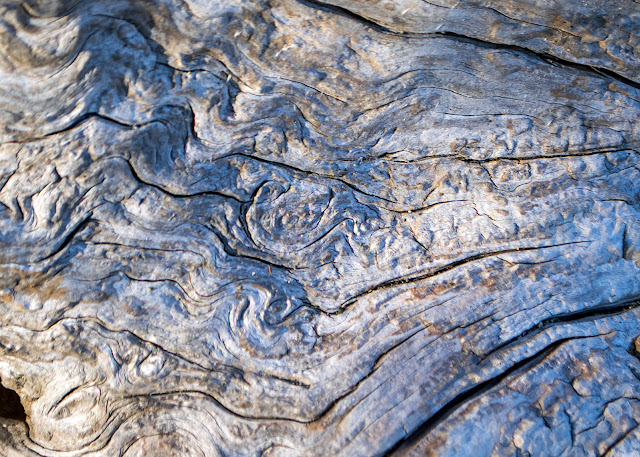
Swirly cracks and a hint of lichen

~~~~~~~~~~~~~~~~~~~~~~~
La superficie cortada de un troncón, con líquenes Cladonia y los honguitos Bisporella citrina.
Y luego, el mismo troncón, visto desde un lado.


Friday, October 30, 2020

Chicken and egg mushrooms

And more mushrooms. Mystery mushrooms; impossible to identify by sight alone. These are all growing on rotting (or very rotted) stumps, among Douglas-firs.

They look like fried eggs to me. Sunny side up. These are inside a disintegrating stump.

The stump itself is interesting. Here, just beside the mushroom's hole, are tracks of some largish bark borer, long gone.

Deep inside another small stump. The mushrooms look like soggy Turkey tail mushrooms. Very soggy, though, very soft. Blurry, even to the naked eye.

There are several species that cluster like this, in the same habitat: rotting wood, especially Douglas-fir.

Which came first, the mushroom that rotted the wood, or the rotted wood that fed the mushrooms?
~~~~~~~~~~~~~~~~~~~

Y más hongos. Hongos misterio, ya que no los pude identificar por la vista. Todos están creciendo en troncos podridos, algunos muy podridos, bajo árboles de abeto de Douglas.

Los primeros me parecen huevos fritos, sin voltear. Están dentro de un tronco ya listo para convertirse en polvo mojado. El tronco, de por si, también merece un vistazo; la segunda foto muestra las huellas de algún insecto que hace túneles bajo la corteza, que ya desapareció hace mucho.

Los hongos de la tercera foto estaban dentro de otro tronco bien podrido. Se parecen a los hongos comunes "cola de guajolote", pero remojados, aún en un dia de sol, suaves, borrosos a la vista.

Hay varios hongos que crecen en grupos apretados como los de la cuarta foto, todos en el mismo habitat: madera de coníferos podrida, especialmente en madera de abeto de Douglas.

El misterio del huevo y la gallina: ¿cuál vino primero; el hongo que pudrió la madera, o la madera podrida que alimentó al hongo?


Saturday, November 24, 2018

Shoreline logs

Stopping to look at the logs I usually try to climb over or thread my way through, on my way up or down to the shore:

Wet and slippery and all jumbled together. I doubt that that little yellow rope does anything to hold the log down; more likely the reverse.

On a wider stretch of beach, an old stump shows off its roots. It took a very high tide to strand this one.

Detail of a soaking wet log.

Tuesday, June 10, 2014

Spots, patches, circles along Cougar Creek

At the entrance to the Cougar Creek canyon, the creek flows over a sandy patch; there we could see small fishes swimming.

Fry, about 3 inches long in a gentle current.

These are probably first-year fish, aka fry. Cougar Creek is home to cutthroat trout, Coho and Chum salmon; I'm not sure which these little ones are. The spots along their sides may be a clue to those who know their fish. I don't.

Some trout, such as the rainbow trout, are salmon species; cutthroat trout is a salmonid, but not a salmon.

A bit further up the creek, where the shade is deeper and the current more variable, water striders chase each other over the surface.

This may be a male trying to capture a female.

Water strider females need to mate only once, whereas males mate as frequently as they can; the last male to mate is the one who passes on his DNA. The females, once they've mated, flee or fight other hopeful suitors. (More detail in The Case of the Reluctant Brides.)

I love the way their feet always make circular spots on the water, and when the water is clear, a half-dozen circular shadows some distance away.

And I just liked the pattern on this log:

Moss, bleeding heart leaves, spots of lichen, and peeling bark.


Monday, February 10, 2014

Does a bird see the man in the moon?

Pattern from the root end of a driftwood tree, cast up on Crescent Beach:

How many faces do you see here? How many species?

Our brains do funny things. From earliest infancy, we focussed on any two spots, looking for faces. And still, if there are two remotely similar spots in a pattern like this, they immediately become incorporated into yet another "face". Any markings below them become a mouth or maybe a beak.

I wonder; some butterflies, some caterpillars, and other critters wear two conspicuous spots, which serve as camouflage, making them look like a larger animal, or maybe fooling a predator into grabbing a disposable wing rather than the head. Is this another instance of pareidolia; like us seeing Jesus in our breakfast toast or the face on Mars?

Oh, and the last I looked, I saw 17 faces in that stump. Most were not human; quite a few are not even earthly.  I'm lucky there aren't any collections of 8 spots, or I'd be seeing spider faces, too.


Sunday, February 02, 2014

Hungry spider, playful lichen

A month ago, I was looking at a handful of tiny spiders on a mossy, licheny twig. Afterwards, I left the works outside on a potting shelf and forgot about it. This afternoon, curious as to what would still be living in the dry moss, I brought it in again.

Still alive, and loaded with sporophytes.

Zooming in on that heart-shaped* moss clump:

Almost ripe sporophytes, most still closed over the developing spores.

Here it is, last month, for comparison:


No orange capsules; just green moss leaves.

I found only one spider this time, and one springtail. The larger (but still tiny) spiders have moved on.

Spider hoping for fat springtail lunch. She wasn't fast enough, though.

The springtail, checking out my foam mat. I moved him back to the moss later on.

Interesting pattern of wood cells in the broken twig.

And my imagination often runs away with me; here's a happy green dog, playing some sort of net-ball game.

A tiny web, built by a tiny spider, holding a tiny drop of water.

*Makes a nice heart wreath for Clytie's Valentine post.


Saturday, December 29, 2012

Patterns in wood and stone

Between the water and the hill, between one raincloud and the next ...

It was raining as usual, and the tides are high all day these days, but we've been too long shut in. We went to Crescent Beach anyhow. And the rain stopped, just for us!

The sea was empty; no boats, no people, only one lone Bufflehead. But there's always something to look at. Like wet logs and stones, for example.

Empty sea around Kwomais Point, grey-green branches overhead.

Water rushing over stones in a creeklet.

The White Rock - Kwomais Point - Crescent Beach shore is home to an amazing variety of stones and rocks. I never get tired of looking at them.

Some have washed down from the cliffs above over many millennia; others have broken off the rock piles that support the railway, or the rough gravel on the rail bed itself, and have been barged down from the upper Fraser Valley, or possibly from the Sechelt area on the Sunshine Coast. Some are volcanic; most are granites or conglomerates. I find agates, many but of poor quality, green jade-like stones, fossils, a bit of sandstone, white marbling. There's pink, green, grey, blue-black, brown, creamy yellow, translucent white, solid white . . . Beach glass, too, mostly green or brown. A few stones even seem to be worn-out bricks. How they got there is anyone's guess.

I don't know my rocks and stones. So, in the absence of proper vocabulary, I give them my own names. Like so:

Pink, peach, and rust "Easter Egg" stones.

"Knitted" rock. It looks like a mass of thick threads.

Laurie says this one looks like a frog.

"Iced potato" stone. Some softer, coarse brick-like stone, covered top and bottom with drizzled marble.

Another beach face.

The stone is uniformly grey; all the pattern is in the etching or molding. And I see dozens of shapes in it. A couple of horses, a sculpin, an axe-head, an old grump, a Roman statue, a dinosaur head.

Grey-green stone, with narrow veins of harder rock. Many of the rocks are veined like this, or split apart along a vein, leaving a white, flat side.

Most of the logs come and go, hauled away by the winter storms, or by the clean-up crews that try to keep a path open along the shoreline.

This old stump has been here for several summers.

Cute "chick" sheltered under the stump's wing.

Head-height into an old shrubby tree, something (high tides, high winds) had tossed a peeled, red stick.

Neither a stone nor a branch. Kelp float, sporting a side-ways Mohawk haircut.

I'll save the lichens and fungi for the next post.

Powered By Blogger