Showing posts with label yellow fairy cups. Show all posts

Thursday, February 17, 2022

Just a log

The end of a log:

With Cladonia lichens and yellow fairy cups, Bisporella citrina. 

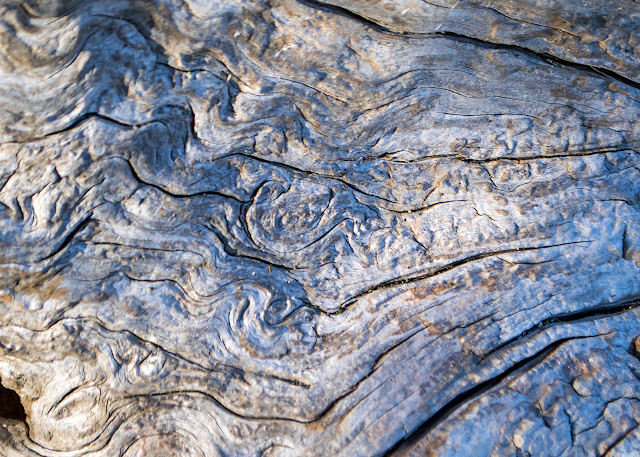
And the side of the same log:

Swirly cracks and a hint of lichen

~~~~~~~~~~~~~~~~~~~~~~~
La superficie cortada de un troncón, con líquenes Cladonia y los honguitos Bisporella citrina.
Y luego, el mismo troncón, visto desde un lado.


Saturday, February 05, 2022

Old log outbreaks

 Exploring the Oyster Bay dunes again; the old favourites and a mystery "shroom".

I love these little hairy shelves that grow on old logs. Rusty-gilled polypore, Gloeophyllum sepiarium, I think. I could be wrong.

Descriptions of these mushrooms say the tops are from smooth to hairy, and mention the glowing white to yellow growing margins. They measure from 2.5 cm to 10 cm across.

Yellow fairy cups, Bisporella citrina. Almost every old log on the dunes has a few of these.

And more, tied down with spider webs.

Every year I find one of these big, fleshy outbreaks on a log in the Oyster Bay woods. And every year, it's already torn apart, broken in chunks, so I don't take photos. I finally give up; I may never find a whole one. This one was about 20 cm. long; last year's was quite a bit bigger.

Remainders of this whitish fungus.

I wonder what it is that tears them apart: raccoons, maybe?

~~~~~~~~~~~~~~~~~~~~~~~~~~~~~~~~

Estuve visitando las dunas en Oyster Bay otra vez. Aquí hay algunos hongos favoritos, y uno que sigue siendo un misterio.

Fotos:
  1. Estos poliporos brotan de las grietas en troncones viejos en las dunas. Creo que son Gloeophyllum sepiarium. Las descripciones siempre mencionan los bordes brillantes en blanco a amarillo.
  2. Discos de limón, Bisporella citrina. Casi cada uno de los troncones en las dunas trae algunos o muchos de estos.
  3. Más discos, atados con telarañas.
  4. Cada año encuentro uno de estos hongos grandes y carnosos en el bosquecito, y cada vez están ya en pedazos. Y no les saco fotos, esperando luego encontrar uno entero. Que nunca aparece. Me rindo. Aquí está el de este año tal como lo encontré. Mide como unos 20 cm. de largo. Otros han sido más grandes. Me pregunto que animal sería el que los destroza. Mapaches boreales, tal vez.


Friday, February 12, 2021

Overlooked

Of all the mushrooms I see, this one is the one I see most frequently, and most specimens of; on a walk in the dunes along the shore, I pass dozens of clusters, sometimes hundreds of mushrooms per cluster. And yet it doesn't appear in my "Common Mushrooms of the Northwest" guidebook. Why? So common it blurs out and gets overlooked?

I do like to know the names of things; it even helps with seeing them, as if now I have a spot in the wetware filing cabinet for them.

It looks like specks of Witches' Butter or Orange Jelly, but never grows beyond the speck size, 1 to 3 mm. across, and disc-shaped or slightly cupped, bright lemon (hence citrina) yellow, turning orange as it dries.

I did find it in the Audubon field guide, which I don't use often because it covers the whole continent, and misses out many of our local 'shrooms. And with the Latin name, Bisporella citrina, on E-Flora BC.  And on Mushroom Expert, who says it's, "common but often (obviously) overlooked." The Wikipedia photo doesn't really look like these, but again, they use that word, "overlooked".

Bisporella citrina is commonly identified in the Pacific Northwest. It is found throughout North America, July to November. (E-Flora)

"July to November," they say, but in our mild climate, they're here year-round. I've found them on the mainland in March, here on the island every time I cross the dunes or even in the forest, on dead wood. And I probably overlook most of the ones I see, too.

Yellow fairy cups on a log. January.

They're not exactly cups; more like the saucers that go underneath teacups. In Spanish, they call them "discos de limón": lemon drops. The name seems to fit better.

~~~~~~~~~~~~~~~~~~~~~~~~~
De todos los hongos que veo, este es el que encuentro con más frecuencia, y en mayor números. Al cruzar entre los troncos amontonados a lo largo de la playa, siempre veo docenas de grupos, con hasta cien o más honguitos en cada grupo. Y sin embargo, no aparecen en mi libro guía, "Hongos Comunes del Noroeste". ¿Porqué será? ¿Tal vez porque son tan comunes que se vuelven invisibles, y son pasados por alto?

Me gusta siempre saber los nombres correctos para lo que encuentro. Me ayuda a verlos mejor. ¿Tal vez porque esto crea una carpeta en mi archivo "wetware"?

Se parecen a fragmentos de Mantequilla de Brujas, o de Jalea Anaranjada, pero nunca pasan del tamaño de unos 3mm. Tienen la forma de discos, o a veces tacitas, y son amarillos brillantes, llegando a volver anaranjados cuando se secan.

Sí, los encontré en el libro guía de Audubon, que raramente consulto porque incluye hongos de todo el continente, y le faltan muchos de los que crecen en nuestra localidad.  Con su nombre científico, Bisporella citrina, los encuentro en E-Flora BC., Y en Mushroom Expert, quien dice —es común, pero muchas veces (obviamente) pasado por alto.— Wikipedia también usa la misma palabra "overlooked", es decir pasado por alto.

Dice E-Flora BC —Bisporella citrina se identifica comunmente en el Noroeste Pacífico. Se encuentra en todo el continente Norteamericano desde julio hasta noviembre.—

Aquí, con nuestro clima templado, encuentro este hongo todo el año. Lo he encontrado en el valle del Fraser en marzo, y aquí cada vez que paso por las dunas, e incluso en el bosque, en maderas descompuestas. Y se me ocurre que tampoco yo veo la mayoría de los que paso por el camino.

En inglés se les llama "copas (o tazas) amarillas de hadas". Pero no parecen copas, ni tazas; más bien tienen la forma del platito que va debajo de una taza de té. En español encuentro el nombre "discos de limón. Este nombre parece más exacto.


Wednesday, February 06, 2019

Going dotty

I'm seeing spots before my eyes. Orange spots. I've been searching for a match to these miniature mushrooms:

Orange discs, 3 - 5 mm across, on fallen conifer branch.

Among hundreds of photos of orange and yellow blobs, plates, cups, discs, the ones that looked most like these were the Yellow Fairy Cups, Bisporella citrina. Except that the guide book, and Wikipedia, and E-Flora all said that they grow on hardwoods, deciduous trees. And this branch is definitely a conifer.

Small, slightly concave discs, bright orange, paler on the underside. There seems to be hints of a bit of stalk.

I looked again, read descriptions of anything that looked remotely similar, and came back to Yellow Fairy Cups. And found a few references to them on conifers.

E-Flora says they grow on dead hardwood, but they have one photo taken in a conifer forest. MushroomExpert.com says they're on hardwood and conifers. Central Coast Biodiversity puts them on both hardwood and conifers.

Except: nothing about fungi is ever easy. They are supposed to grow on rotting logs and stumps, not twigs. Maybe nobody told them. Or maybe they're something else altogether.

However, the search was not useless. I learned a new word. Erumpent.

bursting forth or through a surface.
"perithecia separately or collectively erumpent"

A better, more accurate word for the way fungi emerge from the wood they live in. And a reminder that these small or large "shrooms" and conks are just the fruiting bodies pushing their way out into the open, but only a small part of a large organism, sometimes spreading through a whole tree or even a whole forest.

(Also, it's a Harry Potter word: " ... a rhinoceros with a roundish body. It was a powerful creature, with a thick hide capable of repelling most curses and charms, a single long horn, and a thick tail. They were treated with great caution and respect by African wizards and witches.")


Powered By Blogger