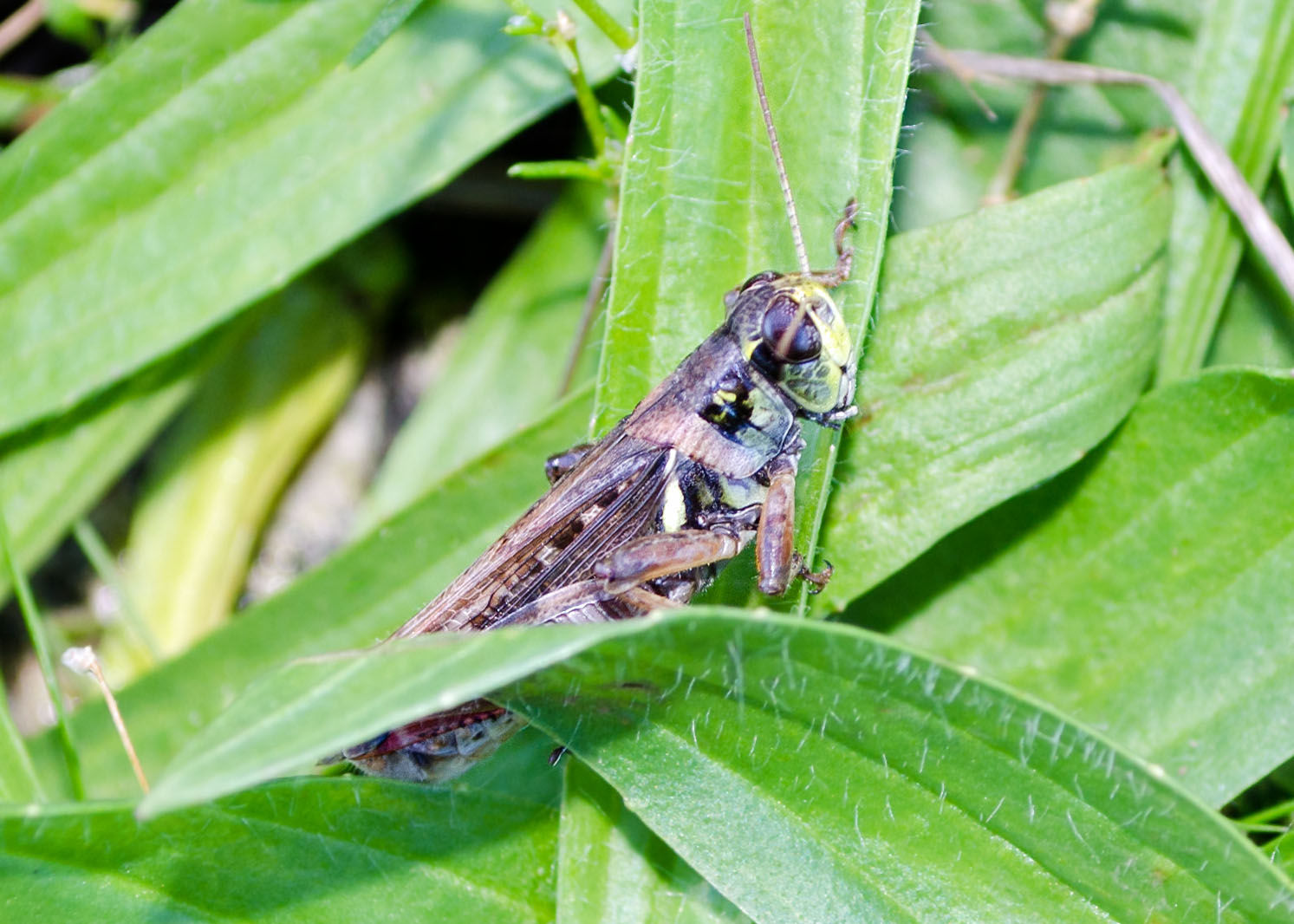
Showing posts with label grasshopper. Show all posts

Wednesday, September 17, 2025

Speeders and Settlers

I had company on my way up to the elk viewing platform. Speedy, elusive little beasties, zipping about, landing on the path and instantly becoming invisible. I took many photos of stones where I was sure I had seen one perch.

Got one, finally! A meadowhawk, Sympetrum illota.

Some things weren't in such a hurry.

Dehydrated stump. still clinging to the hillside, growing scraps of lichen.

A grasshopper dressed to disappear among the lichens and toasted mosses. When I got too close to these, they would take off with a loud "click".

A better look at its face. A short-horned grasshopper, Dissosteira sp

In the bit of shade under a hill, sunlight frames the rocks and glows through salal and Oregon grape leaves. And is that a face I see? An annoyed penguin, maybe?

Just another rock, out in the open, with lichen and dried moss, and leaf shadows.

~~~~~~~~~~~~~~~~
Me acompañaron mientras subía hacia la plataforma de observación de los alces; criaturas veloces, fugaces, que volaban o saltaban alrededor mio, se detenían en el sendero e inmediatamente se volvían invisibles. Saqué muchas fotos de lugares donde estaba segura de haberlas visto.
  1. ¡Por fin! Una se detuvo por un segundo. Es una libélula, Sympetrum sp.
  2. Algunos acompañantes no tenían tanta prisa. Este es un tronco viejísimo, totalmente seco, donde empiezan a crecer algunos líquenes.
  3. Un saltamontes, vestido de manera que puede desaparecer entre los líquenes y los musgos quemados. Estos, al saltar, hacían un fuerte chasquido con las alas.
  4. El mismo, ahora con la cara enfocada. Dissosteira sp.
  5. Donde hay un poco de sombra bajo un cerrito, la luz del sol brilla através de las hojas de Gaultheria shallon y Mahonia nervosa, y corona de oro las piedras. ¿Y es eso que veo una cara?  ¿Un pingüino enojado?
  6. Otra roca, en pleno sol, cubierto de líquenes y musgos secos, y con sombras de las hojas.

Monday, September 19, 2022

Critter assortment

 Arachtober starts in a couple of weeks. That's when a bunch of us crazies post our spider photos on Flickr, one a day to start, ending up with five on Hallowe'en. So I've been poking around here and there, at home and away, night and day, looking for spiders to photograph.

Got a good batch. And also a few other critters; here are some of them.

Night shot above my front door. Unidentified moth, photo stack 4 photos.

UPDATE: it's an Alfalfa looper moth, Autographa californica. I used Google image search and it came up with it right away! Good to remember.

Water strider, probably Limnoporus notabilis. Roberts Lake.

A smaller unidentified moth by my door.

Hopper, above Roberts Lake. These made clicking sounds when they flew away.

Leftover spider lunch. Golden Jewel Beetle, Buprestis aurulenta.

And a few intertidal critters. Orange and white dogwinkle, barnacles, and limpets.

Yes, there are spiders just above the intertidal zone, but they're all really fast runners.

~~~~~~~~~~~~~~~~~~~~~~~~~~~~~~~~
En unos cuantos dias empieza el mes de Arachtober, cuando un grupo de aficionados de los arácnidos subimos fotos de arañas a Flickr, uno por dia, aumentando hasta llegar a cinco el Dia de los Muertos. Y he estando buscando arañas en todas partes, noche y dia, para sacarles sus fotos.

Pues también me he cruzado con otros bichos. Aquí hay algunos de ellos.

Fotos:

  1. Una paloma, o mariposa nocturna. Esta la encontré de noche, arriba de mi puerta de entrada. Sin identificación. ACTUALIZANDO: es un Autographa californica. Subí la foto a Google Imagenes y me dió la respuesta instantáneamente.
  2. Un Patinador de agua, probablemente Limnoporus notabilis. En el lago Roberts.
  3. Otra palomita en mi puerta.
  4. Un saltamontes, en el cerro cerca del lago Roberts. Estos hacían un "clic" cuando volaban.
  5. Escarabajo Buprestis aurulenta, la joya de oro. Mala suerte; le agarró una araña.
  6. Y unos bichos intramareales. Un caracol marino, Nucella spp., con bálanos y lapas. Si hubo arañas por el rumbo, pero corren muy rápido.

Monday, September 14, 2020

Gumweed beasties

In the meadow at Oyster Bay, I stopped to look at gumweed. And the critters it harbours.

Big bee, little fly. Gumweed, Grindelia sp.

And a tiny jumping spider, keeping her eye on the big round eye above.

Isn't she cute?

Unidentified moth

I've spent hours trying to find this moth. It looks so familiar, but I can't remember where I've seen it before. It looks sort of like a hawk moth.

*UPDATE: It's a woodland skipper, a butterfly. Thanks, Sara!

And not on the gumweed; on the path nearby:

Grasshopper, watching me closely. One step more, and he was gone.

~~~~~~~~~~~~~~~~~~~~
En la pradera de Oyster Bay, me detuve a mirar las flores de Grindelia (hierba goma) y los animalitos que las frecuentan.

Una abeja, y una mosca. Una araña saltarín (¡Tan curiosa; daba vueltas para siempre estar mirando ese ojo grande!) y una mariposa nocturna que no pude identificar. Muy activa; botaba de flor en flor y por fin la perdí.

Y un saltamontes en el camino entre las flores.

Monday, September 09, 2019

Hoppers and a jumper below the dam

Last week, I was travelling with my granddaughter. She's as crazy as I am, and more energetic. (I seem to be slowing down as the years mount up. Funny how that works!)

In a simple day trip to Gold River and back, we stopped along the way to clamber through the bush to look at the back of the beaver lodge, to take photos of spiders in the hardhack and shelf fungi on the trees, to look at birds at Strathcona Park Lodge, to chase grasshoppers at Strathcona Dam, to climb a rock face beside a waterfall, to look at flamingos in Two Boat Pond, to try out newly-carved animal seats, and to chase crows at the Gold River docks. It was raining as we headed home; otherwise, I'm sure we would have stopped a couple more times.

I have tons* of photos to sort and process. These are from the campsite below Strathcona Dam.

Dam sign.

Text of sign:
You are standing below the largest hydroelectric dam on Vancouver Island. Strathcona Dam is part of the Campbell River Hydroelectric System which includes the Ladore and John Hart developments and the Salmon River, Heber River, and Quinsam River diversions.
Strathcona was the last dam completed on the Campbell River Development project. This 53 meter high earth-filled dam created Upper Campbell Lake, a 48 kilometer long reservoir for water storage. The water that flows through this dam will drop over 200 meters, passing through three generating stations, Strathcona, Ladore, and John Hart, before it reaches the ocean. As you drive towards Campbell River, you will pass near two other reservoirs, Lower Campbell Lake created by Ladore Dam, and John Hart Reservoir created by John Hart dam. This major project was started in 1945 and took  over 13 years to complete.

The campground, with the dam looming over it, has 11 overnight free campsites and large areas for day parking. When we arrived, there was almost no space left to park; cars and trailers and RVs were everywhere; it was the long weekend. It seems that no-one worries about the mass of water ready to drop on you. Signs warn visitors to clear the water and river banks if a siren sounds; water will be rushing down the spillway. The backwaters were alive with kids in rubber boats; the geese I've seen on other visits were in hiding.

We wandered around the weedy area between parking lots. First find: a humongous jumping spider. Or so it seems.

About 25 meters long. As advertised on the campground map.

And then there was the grasshopper. We chased him and his family for quite some time.

It's hard to sneak up on a grasshopper on bare gravel.
But we tried. Pop can half tab included to show size. (I moved it on the photo; it was a couple of inches away.)

Trying to blend in on a mossy rock. And still aware of us; with the next leap, we lost him.

Lichen and moss on a rock. At least it stays put.

More lichen and moss.

Bladder campion, Silene vulgaris, going to seed.

Nearly one o'clock, and we were hungry. Next stop, Strathcona Park Lodge.

*tons. Of photos. Digital. So not really tons. But you know what I mean.

Wednesday, July 26, 2017

Patterns and textures, critter version

It's critter season, finally! My camera is full of beasties, taken in and around my house. Out in the grass, as I work killing hawkweed, grasshoppers and spiders hop and scramble away from my vicious weed tool. In the evenings, the kittens practice their high jumps, trying to catch huge crane flies; mostly, they miss.*

And Sunday afternoon, in Oyster Bay, I chased another of those invisible grey grasshoppers across the sand. With each hop, he disappeared, and I searched until he saw me coming and leapt away again. I gave up, eventually.

This 'hopper was more forgiving.


Brown grasshopper on a rock face, Oyster Bay. Each body part, even the eyes, has its own pattern, from mottled, to striped, to stained glass, to herringbone, to the fern-leaf design on his head.

The snail had died and left his empty shell, pitted and bleached. I liked the texture.

He's more creamy than pink, but the colour bounces off my hand.

* I'm as bad as the kittens; I just abandoned this to stand on a dresser because a spider caught a fly on the ceiling above my desk. At least I don't try to eat the spiders, just take their photos.


Friday, October 14, 2016

Along the Myrt Thompson trail

The river:

Fall colours. If you look closely, (click) you can see the light streaming past the trees on the headland, and the rain of tiny falling leaves into the water.

Zooming in, a bit later, with ducks. the faint ripple at centre left is where a pair of harbour seals went under while the camera was busy focusing.

Water under the bridge, carrying leaves and detritus from the river bank.

Companions along the trail:

Running sparrow.

Grasshopper with a yellow face: Melanoplus sanguinipes.

The name, "sanguinipes", refers to the red legs (from the knee down) visible below the leaf in this photo.

Herb Robert. The leaves often turn red.

And a map:

Google Earth view, with my captions.

I still have to explore the Raven Channel trail. If When it ever stops raining.

Thursday, October 13, 2016

Optical confusions

The Campbell River estuary spreads out into a maze of back-channels and quiet pools, protected both from the sweep of the river and the storms and tides of the salt chuck downstream. For many decades, it was used as a storage site for log booms.

Screen grab of 1965 aerial photo, with enhanced contrast, from City of CR. The long, white rectangles are log booms.

The booms are gone now. The last photo where they appear is from 1980. The lagoons lie sleepily under the sun where the logs once rattled their chains.

Old boat, at anchor. Someone is fishing off the forward deck.

Walking the Myrt Thompson trail, I deviated from the official route to visit the abandoned log dumping site. These days, it is an empty space, still paved in spots, but gradually being reclaimed by broom and trees. At the edge of the water, massive steps, stairs for a giant, rusted and warped from long years in the rain and the river, lead down into the water, probably where logging trucks long ago tipped their loads. (On the aerial photo above, it's near the angle in the orange dotted line, at the bottom of the long line of log booms.)

Just inland of these steps, large logs are chained in a row, a barrier between the paved area and the drop into the river. They've been there for many decades now; the wood is silvery-grey and silky to the touch, and deeply carved into fist-deep depressions.

Section of log.

When I look at this photo, my eyes insist on turning the holes into hills, with steps up, like so many eroded Mexican pyramids. The steps go down; the lighter, flat spaces in between are the outer surface of the log.

Another log, with more holes. The shadows and the bits of gravel at the bottom of some holes keep this in perspective.

On the broken pavement beside the logs, a grasshopper led me a merry dance, waiting until I would be a couple of metres away, then leaping up and flitting away, never too far, so that I could see him land. But when I approached, staring at the spot so as not to lose it, he was just not there. One cautious step more, and yes, he'd been there all the time; now he was on his way to his next hiding place in plain sight.

Hills become holes: the grasshopper became sticks, became a grasshopper, became stones. My poor eyes!

Sunday, September 11, 2016

The neutrals

More from my collection of "someday" photos; a sampler of muted greens and browns. Designer colours, for some. Easy on the eye, but maybe too easy if you're trying to find an invisible grasshopper or a lurking spider.

Cross spider, Araneus diadematus, in her web over the water between the docks.

Grasshopper, Oyster Bay.

Lichen, Cladonia sp., Oyster Bay. Almost matches the grasshopper.

This lichen is in a log at Strathcona Lodge, on Upper Campbell Lake. The little scaly (or leafy?) cone-like buds are intriguing. (Click for full size.) I wish I'd seen them at the time. The camera's eye is better than mine.

"Eye" in a log. Strathcona Lodge. I'm pretty sure there's a spider in there.

Dippers on sandstone, Woodhus Creek. They kept running under the water in the calm spots, where the caddisfly larvae were.

Sparrows, Tyee Spit.

When the light is right, even the water is brown. Sandpipers, off Tyee Spit.

Here and there.


Thursday, July 14, 2016

Good camouflage

At the high tide line on Oyster Bay, the ground is mostly gravel or grey sand. Below, there's drying, and stinking, seaweed; above, a wide barrier of driftwood. This afternoon, I was walking along this bare stretch in the middle, and every now and then something flickered in the gravel. When I looked, there was nothing there.

Until the stone I happened to be looking at suddenly up and left, and then landed on a frazzled fir cone. And now I could see it.

Grey and green grasshopper, gravel coloured.

I took photos from where I was, then, moving slowly, sat down on the stones to get a closer view. Of course, it leapt away. And try as I might, knowing it was within a metre or so, I could not see any sign of it.

It was about an inch and a bit long. I haven't been able to identify it. GPS coordinates: 49.897914, -125.149469.

Thursday, September 17, 2015

Knee-high to a grasshopper

The Chilcotin, being mostly grassland, is grasshopper country. On my way back from Bella Coola, I stopped at Bull Canyon to look at the Chilcotin River, which here flows green* between steep cliffs. On top of the cliff, the grass was knee-deep, and as I walked - or waded - the grasshoppers leapt about me, almost as if I were running through water and they were the splashing droplets, flying up and sinking down again out of sight in the waving grass.

The grass was baked to a toasty brown; the grasshoppers were dressed in matching colours.

I found one resting on a stone and crawled up to him, inch by inch, taking photos between each cautious movement. I got a half-dozen close shots before he decided that was enough and joined his friends in the grass.

His wings seem frayed; too much leaping through stiff grass stalks?

*BC Parks says that the water is glacier blue, but I've never seen it but once when it wasn't green. And that once was when the whole area was on fire and they were dumping red fire retardant from helicopters. The water was red that day.

(This whole area is a volcanic plateau. More about that, later.)


Friday, October 24, 2014

Priorities

Grasshoppers are extremely frustrating beasties. They hop away from directly beneath your feet, you see them fly and land, you know exactly where they are. But they aren't, not any more. They're over there. Or behind you. Or further on. So you take a step in that direction, and they erupt from beneath your feet, from a spot you've just examined thoroughly without seeing any sign of them.

You see one sitting still on a patch of bare earth, and you sneak up on it gradually, barely sliding your feet along inch by inch, hardly breathing. It doesn't move, doesn't seem even to be looking your direction. You raise the camera to your eye, slowly, gently, and there's nothing there. It's watching you now from 10 feet away.

So when I saw a big 'hopper in the centre of a cement slab the other day, I was surprised when it stayed put as I walked over to it, even as I got down on my knees in the mud next to it. That close, I realized why; there were two of them, and they were busy.

I think these are Melanoplus grasshoppers. I'll send them in to BugGuide to be sure.

I was able to get within 6 inches for this shot, with the camera resting right on the cement slab. I eased in half an inch closer, and they hopped it.
Powered By Blogger