Showing posts with label meadowhawk. Show all posts

Wednesday, September 17, 2025

Speeders and Settlers

I had company on my way up to the elk viewing platform. Speedy, elusive little beasties, zipping about, landing on the path and instantly becoming invisible. I took many photos of stones where I was sure I had seen one perch.

Got one, finally! A meadowhawk, Sympetrum illota.

Some things weren't in such a hurry.

Dehydrated stump. still clinging to the hillside, growing scraps of lichen.

A grasshopper dressed to disappear among the lichens and toasted mosses. When I got too close to these, they would take off with a loud "click".

A better look at its face. A short-horned grasshopper, Dissosteira sp

In the bit of shade under a hill, sunlight frames the rocks and glows through salal and Oregon grape leaves. And is that a face I see? An annoyed penguin, maybe?

Just another rock, out in the open, with lichen and dried moss, and leaf shadows.

~~~~~~~~~~~~~~~~
Me acompañaron mientras subía hacia la plataforma de observación de los alces; criaturas veloces, fugaces, que volaban o saltaban alrededor mio, se detenían en el sendero e inmediatamente se volvían invisibles. Saqué muchas fotos de lugares donde estaba segura de haberlas visto.
  1. ¡Por fin! Una se detuvo por un segundo. Es una libélula, Sympetrum sp.
  2. Algunos acompañantes no tenían tanta prisa. Este es un tronco viejísimo, totalmente seco, donde empiezan a crecer algunos líquenes.
  3. Un saltamontes, vestido de manera que puede desaparecer entre los líquenes y los musgos quemados. Estos, al saltar, hacían un fuerte chasquido con las alas.
  4. El mismo, ahora con la cara enfocada. Dissosteira sp.
  5. Donde hay un poco de sombra bajo un cerrito, la luz del sol brilla através de las hojas de Gaultheria shallon y Mahonia nervosa, y corona de oro las piedras. ¿Y es eso que veo una cara?  ¿Un pingüino enojado?
  6. Otra roca, en pleno sol, cubierto de líquenes y musgos secos, y con sombras de las hojas.

Sunday, September 04, 2022

Private viewing

I have spent many hours chasing dragonflies with a camera. They zip past me, sometimes making repeated loops, as if daring me to be ready for them when they come around again, but always just a bit off, just a bit too fast for my reflexes. Sometimes they stand still, perched on a twig or a blade of grass, usually dashing off as soon as I take a step in their direction. So beautiful, so frustrating!

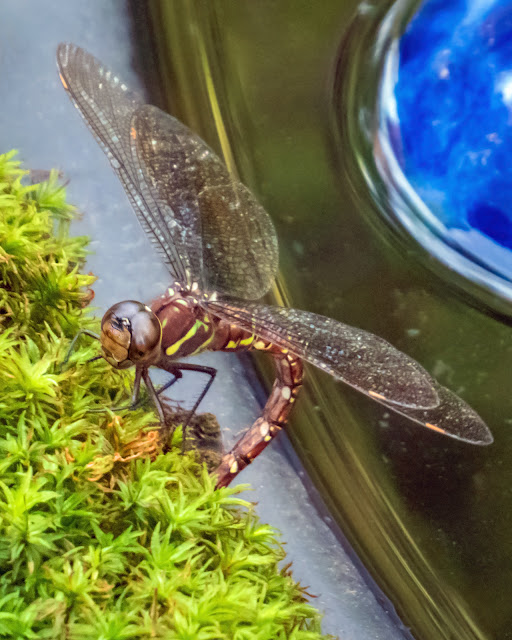
So this was a treat. A female meadowhawk busy around a small backyard pond, laying her eggs in the moss, taking her time.
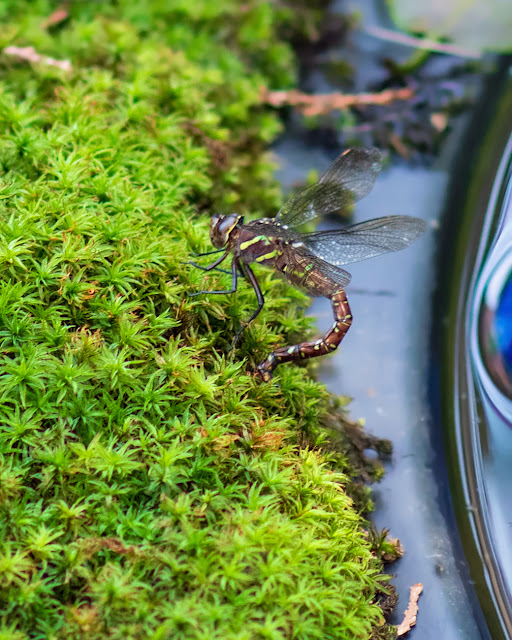
Sympetrum spp.?

She would stop in one spot for a while, curving her abdomen around to her chosen spot on the moss, then fly to another spot to lay more eggs. In no hurry, always picking out damp spots near the edge of the water. Another meadowhawk, probably her mate, hovered overhead or perched in the trees above.
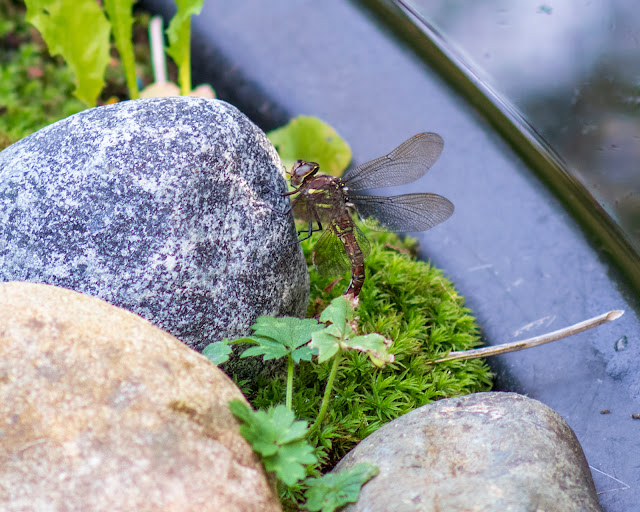
She has orange spots on the leading edges of her wings.

And big brown eyes.

" ... many odonate species scatter or place their eggs in several different places within suitable habitat to better hedge their reproductive bets." (Constant contact)
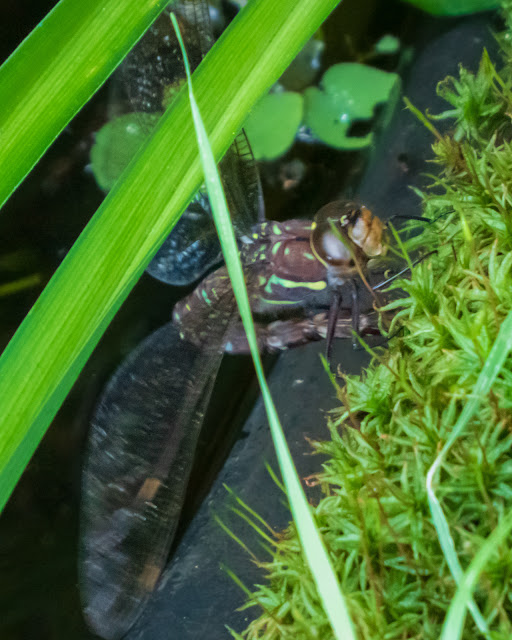
Her favourite spot, in the shelter of pond plants.

She had been at it for about half an hour when I arrived, and I watched for another half hour. She was still hard at work when I left.

~~~~~~~~~~~~~~~~~~~~~~~~~~~~~
He pasado muchas horas siguiendo libélulas con la cámara. Pasan volando, a veces haciendo círculos o figuras de ocho, como si me daban oportunidad para sacarles la foto, pero siempre un poco fuera de ritmo, siempre un poco demasiado rápido para mis reflejos. O se detienen en un palito o una hoja y en cuanto doy un paso para acercarme, se lanzan al aire a alta velocidad. ¡Tan bellas son, y tan frustrantes!

Así que esto fue un verdadero regalo. Una libélula hembra se ocupaba alrededor de un estanque de jardín poniendo sus huevos en el musgo a la orilla del agua, sin prisas.

Fotos: la libélula. Sympetrum spp. Tiene manchas anaranjadas en las alas, y ojos grandes cafés.

Se detenía en un sitio por un tiempo, doblando su abdomen hacia el musgo, después volaba a otro punto y repetía la acción. Tomaba su tiempo, siempre escogía musgo húmedo a unos centímetros del agua. Otra libélula, probablemente su pareja, daba vueltas arriba o descansaba en lo alto de los árboles alrededor.

"... muchas especies de los odonatos riegan o colocan sus huevos en varios lugares distintos en un habitat apropriado para mejor asegurar la reproducción." (Constant contact)

Había estado ocupado así por aproximadamente media hora antes de que yo llegara, y yo la observé por otra media hora. Seguía en la obra cuando yo me despedí.

Saturday, September 07, 2019

Orange huntress

I stopped by the old beaver pond last week, and hiked around to the far side. The sun was bright, almost blinding, and over the green wetland, meadowhawks hunted, creating a display of flashing lights as they wheeled.

The camera was too slow for them, but the meadowhawks show up as white specks on the bright green.

Plants here are hardhack, water lilies, a lot of horsetails, and sedges.

One orange meadowhawk stopped for a breather beside my path. Nice of her!

She's an autumn meadowhawk, aka yellow-legged meadowhawk, Sympetrum vicinum. The males are a darker red; females are pale.

Notice the two-tone eyes!

In mature males, the face, eyes, thorax and abdomen are shades of red to reddish brown; legs are yellow to reddish-brown. In females the face is light brown with brown and green eyes. The thorax is yellow to grey, the legs yellowish, and the abdomen brown. ... The pterostigma (coloured, thickened cell on the leading edge of each wing membrane near the tip), is reddish-brown. (South Coast Conservation Program [BC])

Wednesday, November 07, 2018

Spider search

It was the tail end of Arachtober, and I was running out of spider photos. Oyster Bay seemed a good place to look for a new candidate. I stopped first, to look at the trees in their glorious late fall outfits.

From the meadow, looking back at the parking lot.

Then on to snoop in the corners and crevices.

First find: a cherry-faced meadowhawk. On the parking lot fence.

Under the eaves of the public washroom (centre, top photo); a tightly-wrapped cocoon.

I found one of these cocoons on my doorstep four years ago. I kept it in a container for a month, and a wasp emerged. BugGuide identified it as a parasitoid wasp, but the cocoon would have belonged to the larva of a caterpillar. I couldn't reach this one to capture it; I may go back with some long-handled tool.

Also on the washroom: a house spider with her four egg cases. Too small, too high above my head for an Arachtober photo.

And finally, on the pilings by the shore, a running reddish and black spider. Mission accomplished.


Wednesday, July 10, 2013

The young and the restless of Cougar Creek

The dragonflies were out in force at Cougar Creek Park yesterday, mostly in couples. They were dressed in shimmering black and blue, or dazzling reds; some wore white, some brown. One had green eyes, and another was resplendent in silver and silky sheers.

We managed to catch a few of them at rest.

A common whitetail male, Libellula (Plathemis) lydia, with a blue tail.

The tail is not white, and I wondered about that. I found the explanation on BugGuide: he's a young male whose tail has not reached its full brilliance. I like the blue better, but then, I'm not a whitetail dragonfly, so my opinion doesn't count.

Another dragonfly that I saw and got only a couple of shots at (although the camera couldn't find it to focus), was almost invisible. A big dragonfly, but with transparent wings, and a shimmery, silvery, mirror-like pale body. The camera just looked straight through it, and it shows up as a shiny fog over the background. I looked everywhere for a transparent dragonfly, with no luck until I happened across it with the whitetails on BugGuide. It's a female whitetail, just hatched from its nymph stage.

This is the BugGuide photo; mine are hopeless.
It looks all weird and shimmering because it is teneral, which means that it has just emerged from the nymphal stage, and its parts haven't fully hardened yet. (Mark Fox)

The same male, but here he looks like he has 8 wings. The light was very bright, and he was on almost white clay, so the shadows are almost as vivid as the wings.

A tiny, green-eyed bluet resting on a branch.

There were other bluets, as well, dark-eyed ones with dotted-line abdomens. And many of those big black and blue darners. None of them stopped their mating frenzy long enough for us to get close.

A Cherry-faced Meadowhawk, Sympetrum internum.

A meadowhawk and a whitetail, caught in the same photo.

Powered By Blogger