Showing posts with label dragonfly. Show all posts

Sunday, July 12, 2026

Another drop-in

I found this dragonfly fluttering on my floor. The cat was following it, pouncing and batting it gently, without apparently damaging it. I warned her off, took a few photos, then captured the dragonfly by tossing a dishrag on top. Took it outside and released it. It rested a moment, then flew off, across the street and into the trees.

No harm done.

It's the Common Green Darner, Anax junius.

Side view.

It's probably a female or a youngster, by the reddish colour of the abdomen in the sunlight.

Just before takeoff.

~~~~~~~~~~~~~~~~

Encontré esta libélula haciendo pequeños saltos en mi cocina. La gata la seguía, brincando para tocarla delicadamente, pero aparentemente sin hacerle daño. Le dije que la dejara en paz, saqué unas fotos, y capturé la libélula, dejando caer un trapo de cocina encima. La llevé afuera y la solté. Descansó un momento, luego echó a volar, cruzó la calle y se perdió entre los árboles.

Es una libélula zurcidora verde, Anas junius, una hembra o juvenil, por el color rojo del abdomen cuando le llega la luz del sol.


Wednesday, July 09, 2025

Counting spots and lines

 Flying critters, long and skinny, short and fat:

Four-spotted skimmer, Libellula quadrimaculata. Beautiful stained-glass wings! With 2 black spots on the leading edges of each wing, making 8 spots. Plus 2 at the hinge of the rear wings. So, 10.

And here's the June beetle my cat brought me. A 10-lined June beetle, Polyphylla decemlineata.

She was in a bad mood, hissing her complaint about the cat, and I let her go without insisting on a clear antenna shot.

She's a female: the males have huge antennae that they spread out like fans to detect female pheromones.

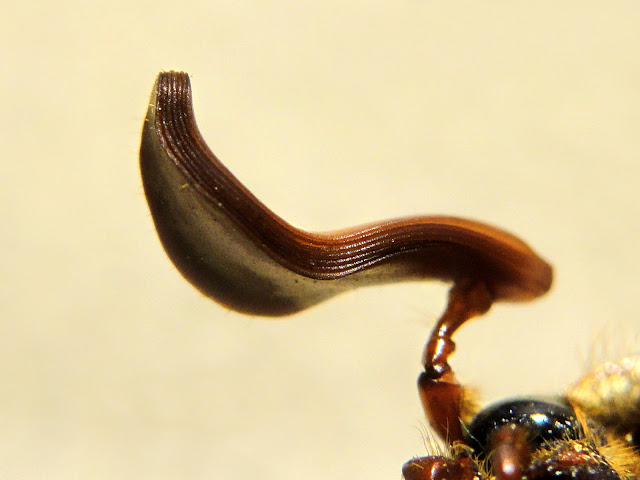
Male antenna, collapsed. Photo from 2011.

And another bluet. These have 4 black and blue wing spots, one on each.

~~~~~~~~~~~~~~~
Tres criaturas voladoras, largas y delgadas, o chaparritas y gordas:
  1. Una libélula de cuatro puntos, Libellula quadrimaculata. En el borde anterior de cada ala hay dos manchas negras, dándonos 8 en total. Y con las dos manchas cerca de la articulación de las alas posterioras, son 10 "puntos". Pero la llaman la quadrimaculata.
  2. Esta es la escarabajo rayado hembra que me trajo la gata. Una Polyphylla decemlineata, con 10 rayas negras en el dorso, 4 largas, 1 muy corta.
  3. Estaba de muy mal humor, quejándose del trato de la gata con su siseo, y la dejé irse sin sacar una foto buena de su antena. Es hembra; los machos tienen antenas grandes, que abren en forma de abanico para oler las feromonas de las hembras.
  4. Una antena de un macho, cerrada. Foto de 2011.
  5. Y otro caballito del diablo. Estos tienen 4 manchas, azules con negro, una en cada ala.

Saturday, September 15, 2018

Boxed in

My cat Chia, I think, is a pacifist. Or a naturalist.

She is allowed outside, because we have a mouse and field mouse problem in the woodsheds and storage sheds nestled into the edge of the woods behind the house. She spends much of her time there.

And occasionally, she comes in with something she's found. A mouse, sometimes a bird, sometimes an insect. Always alive, usually undamaged. She brings them in, parks them on the rug, and then sits watching them.

When I come to get them, she doesn't complain. I collect the latest visitor (with birds, I need to throw a cloth over them, because they've always flown to the window and fly away if I come too close. Mice are a bit harder; they lead me a merry chase until they're tired out.)

I get rid of the mice; sorry beasties, you're cute and all, but since I found a nest inside my car motor, I'm not too pleased with you. The birds get carried outside and released. They fly away.

Yesterday Chia brought me a dragonfly. I caught it in a glass box with a mirrored bottom, and took a few photos before I released it outside.

One wing is damaged. Not enough to cause problems with flight. She's female, I think.

"How did you get out there?"

Face to face

She's a darner, with green/blue markings on the abdomen, a yellowish face, and racing stripes on her thorax. The eyes are brown.

I deposited her in a flowerpot outside and she rested there for a few minutes before flying away. I took more photos, trying to get close to those amazing eyes. I'll process them tomorrow. Fingers crossed!

Sunday, July 22, 2018

In transit

I've been away. I'm back.

It has been a hot few days (for BC) and the weekend highways are jammed with cars and RVs speeding to get to the water, to the hills, to the islands. And anywhere we go on this coast, there are the ferries, and the long, long waits in the blazing sun.

This dragonfly entertained me while I waited in line. It wove figure eights around a handful of cars and RVs, and every so often "parked" in the air in front of my windshield.

On the ferry, finally. And there's a chilly wind! Wonderful! That's Vancouver, in the distance.

A tug and barges full of what looks like sawdust.

Another tug, and a log boom.


Sunday, August 03, 2014

Black and white

Dramatically marked dragonfly overhead, on Reifel Island.

I think this is the eight-spotted skimmer, Libellula forensis.

More dragonflies and other critters from Reifel, tomorrow.

Saturday, April 12, 2014

Grey-eyed dragonfly

Another lost photo: I must have put this dragonfly aside to send in to BugGuide, and filed it in the wrong folder, along with kitten and baby photos. It's from 'way back in May of 2008, found in Queen's Park, New Westminster, and taken with my little Canon point-and-shoot, then cropped close.

Interestingly patterned abdomen and cat-like backwards "nose".

I couldn't find this in my bug books, nor on BugGuide. Still can't, after a couple of hours of searching tonight. It's unusual, with those bright colours of the abdomen, and the pale grey eyes.

I'll have to follow through on my original plan, and send it to BugGuide. They'll know.


Wednesday, July 10, 2013

The young and the restless of Cougar Creek

The dragonflies were out in force at Cougar Creek Park yesterday, mostly in couples. They were dressed in shimmering black and blue, or dazzling reds; some wore white, some brown. One had green eyes, and another was resplendent in silver and silky sheers.

We managed to catch a few of them at rest.

A common whitetail male, Libellula (Plathemis) lydia, with a blue tail.

The tail is not white, and I wondered about that. I found the explanation on BugGuide: he's a young male whose tail has not reached its full brilliance. I like the blue better, but then, I'm not a whitetail dragonfly, so my opinion doesn't count.

Another dragonfly that I saw and got only a couple of shots at (although the camera couldn't find it to focus), was almost invisible. A big dragonfly, but with transparent wings, and a shimmery, silvery, mirror-like pale body. The camera just looked straight through it, and it shows up as a shiny fog over the background. I looked everywhere for a transparent dragonfly, with no luck until I happened across it with the whitetails on BugGuide. It's a female whitetail, just hatched from its nymph stage.

This is the BugGuide photo; mine are hopeless.
It looks all weird and shimmering because it is teneral, which means that it has just emerged from the nymphal stage, and its parts haven't fully hardened yet. (Mark Fox)

The same male, but here he looks like he has 8 wings. The light was very bright, and he was on almost white clay, so the shadows are almost as vivid as the wings.

A tiny, green-eyed bluet resting on a branch.

There were other bluets, as well, dark-eyed ones with dotted-line abdomens. And many of those big black and blue darners. None of them stopped their mating frenzy long enough for us to get close.

A Cherry-faced Meadowhawk, Sympetrum internum.

A meadowhawk and a whitetail, caught in the same photo.

Friday, November 16, 2012

Life's little mysteries

Some interesting links for you:

The Northwest Dragonflier answers the question, "How do dragonflies manage to fly and mate at the same time?" The Foot High Club. (Didn't you always wonder about that?)

What lives in your belly button? More than you would expect. Guest post in Scientific American by Rob Dunn.

And why is this good news? Carl Zimmer, writing for the NY Times, explains.
The project and other studies like it are revealing some of the ways in which our invisible residents shape our lives, from birth to death.
And what is a cormorant doing with a camera? CBC News, Saskatchewan (Canada).

Do worms have teeth? HuffPost Green.

And my own volunteer worm: this little critter has built himself a tube near the glass of the aquarium. He showed up two days ago, and that night the largest crab dug up his home site, right down to the floor. What one destroys, the other builds; the newest tube is longer than the previous one.

Two-tentacled tubeworm, Spiochaetopterus  costarum.

He's much larger than any I've seen feeding so far; the tentacles are about 1/2 inch long.

The first one to show up here, two years ago, was microscopic, too small for the camera; I had to draw it.

I have tentatively identified it as the three-sectioned tubeworm, which lives in this area, but I have my doubts. This little critter coats his tube with grains of sand; the photos of S. costarum show it with a sheath that looks like fabric with the seams (many seams) turned outwards. (Sample photo)

My own links: here's one, eating. And a worm genius.

So, another mystery. If I scrape off the sand, will I find a separate tube inside? Or is the sand glued on too tightly to be removed without killing the worm? I'll have to invent some way of checking that out.


Thursday, May 31, 2012

Dragonfly

I think this is a variegated meadowhawk.*

Libellula quadrimaculata

*And I was wrong. It's a four-spotted skimmer.

Thursday, September 22, 2011

Mini-marsh

On our way down the Sunshine Coast, we took a break at Pender Harbour. The last time we were there, we had only stopped long enough to check with the information booth about nearby lodging. This time we dawdled through town, exploring, until we saw a used bookstore. We can never resist one of those!

We would be browsing for a good while*, so I looked for a parking spot in heavy shade, and found it, right beside the entrance to a wetlands trail; something unexpected where the hills rush down to the sea. It was a small marshy area, half dry after a hot summer, with a board walk through the cattails. A pair of herons took off at our approach and went grumbling into the shadows at the far end; crows squabbled overhead in a tall arbutus.

And over the water, between the cattails, red and blue dragonflies zipped back and forth in the sunshine, pausing only briefly to rest on cattail leaves.

Male Western pondhawk, maybe.

Cardinal meadowhawk.

*We shopped for a good hour, and bought a bagful of books. Out-of-the-way bookstores often turn out to contain hidden treasure. This one certainly did. We'll be back! Besides, looking at the map later, I realize that we missed most of the sights of the area. There's a long, heavily indented coast bristling with boat ramps, islands and bays and marinas, a tiny lake, parks and campsites. Next time, we'll plan on spending the day.

Wednesday, June 29, 2011

Six wings over Cougar Creek

The afternoon was hot, but rain threatened. We risked a quick walk around the lagoon in Cougar Creek Park. It's been a while; we were last there in January, when the lagoon was frozen over. And as always, we found much to interest us, new and old.

The old, but well worth seeing again:

Yes, we see you!

The great blue heron is a beautiful bird ...

... with horrible feet. Needs a manicure.

Caught with his mouth open. He was making an odd squeaking sound, like a rusty door hinge. I've never heard a heron do that before.

He didn't like it when I imitated him. "Impertinent human!" I think he said.

And four more spectacular wings, a tad smaller:

Updated: Eight-spotted skimmer. Thank you, Sara!

We tracked a red meadowhawk through the tall grasses, but it was far too fast for us. It was the first time I'd seen one in Cougar Creek.

New doings, new finds at CC, next.

Monday, October 11, 2010

Brown-eyed dragon

We spent a sunny, summery, Sunday afternoon at Reifel Island, and came home with full cameras. I'll be sorting photos for a few days.

We followed this dragonfly to its resting place in the shrubbery. We would not have seen it otherwise; it blended so well into the background of sticks and bright green leaves that we kept having to look over our viewfinders to see if it was still there. A good half of our photos missed it altogether.


Canada darner, Aeshna canadensis, I think.


Side view

Most Canada darners, at least the ones on BugGuide, (or here) have blue stripes on the tail, but this one's were green all the way to the end.

Then, for tomorrow, there's a fly ... I know, Reifel is a bird sanctuary. But it's a good bug-watching place, too.

Monday, August 09, 2010

Company on the road

I'm home. I drove down Friday and Saturday, through fire, smoke, lightning, long waits for fire-fighters' go-aheads, road work and rain, with a cramped, damp night's sleep and a warming (heart-warming, too!) cup of coffee with E. of Cicero Sings, and feisty Mingus Saturday morning. I knew I was almost here when I hit a traffic stoppage at 200th Street, with 40 more blocks to go before my off ramp. After an average (I counted and did the math) of one vehicle every 4 minutes on the Bella Coola highway, it made quite a contrast.

I came home, said hello to Laurie, started to unpack, dropped it all and went to bed. I don't think I've been that tired for years. A good tired, though. A challenge taken; can I still drive that road alone, after all these years away? And won through; yes, I can.

It was a good trip, a great visit down in the Valley. I'll have photos and stories as soon as I get them all sorted. For now, here are a few critters I met at various places along the road.


Lacy-winged wasp? On the Coquihalla highway.


Inchworm on our picnic table, Bella Coola.


Red meadowhawk, Tatla Lake.


Another meadowhawk, a bit larger. Tatla Lake.


Brown ducks. One of the many shallow lakes or ponds between Tatla Lake and Alexis Creek.


The lake. The ducks are those brown spots just in front of the floating vegetation.

The insects seem to be very calm or even tame, along here. Most of the difficulty of photographing them was finding them on a plant that the wind wasn't whipping about. The inchworm wandered around our table, not at all worried about our glasses and map books. When I put down the camera, he climbed on it and went exploring. Only the dragonflies and grasshoppers flew away when my shadow fell on them.

The ducks were definitely not comfortable with humans, maybe because many of the local humans are hunters for the pot. They were close to the shore until I stopped the car. By the time I had stepped out, they were speeding out to the centre of the lake.

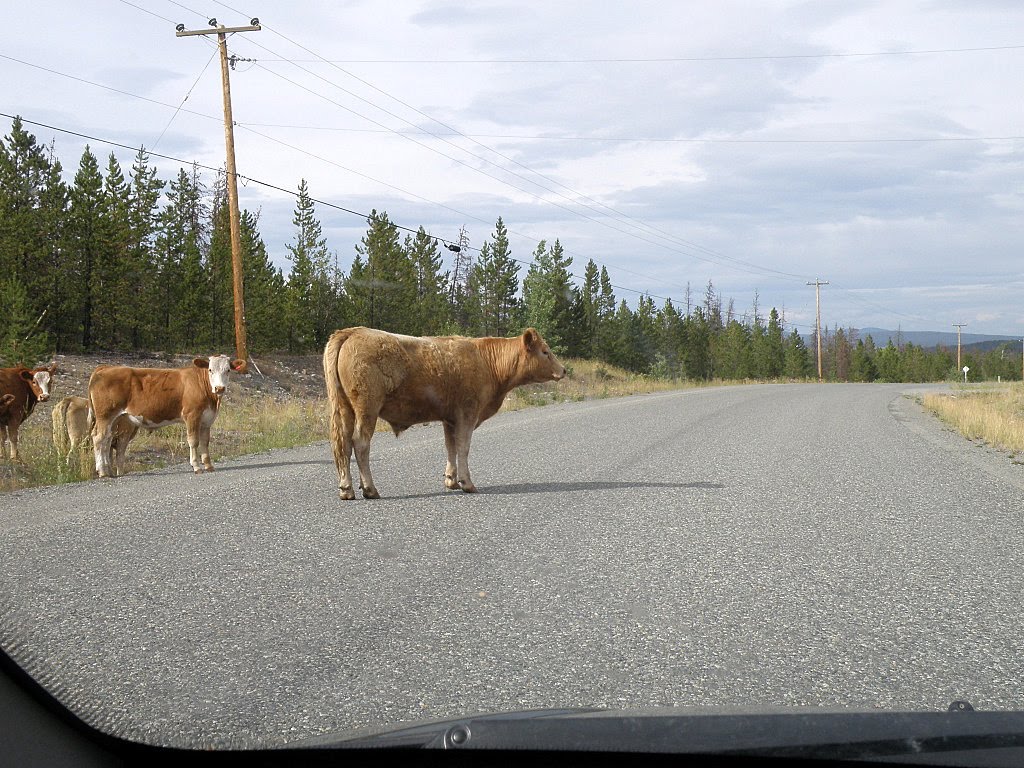
Range cattle, on the other hand ...


... like to stand in the road to get a good look at you before you inch past. I always slow down, because there's no telling when they'll decide to claim ownership of the pavement.

Every so often, there are cattleguards; grids of a dozen or so metal bars across the road, with gaps too wide for the small feet of a cow. With the fences, they are supposed to keep the herds in their home territory.

The cattle may be too smart for them. My son-in-law saw a herd come to a guard. One by one, they stopped at the edge, examined the grid for a minute, then hopped across. I never saw a cow hop before; very funny, that big bulk making a dainty "hop!" up, and over, coming down as neat as a ballerina. They all made it, even the calves. He has video; if he loads it to YouTube, I'll post a link.

My daughter and I saw two bear cubs in a pair of apple trees; they got away before I had the camera ready. I saw a stag with a large rack, far away in a field, many cute chipmunks crossing the road and something large and brown, but too small for a bear, slinking away into the bushes. I found moose droppings ...


... but no moose. (Meese?)

And I'd never seen a herd of range horses on the road before. There were a dozen standing in the centre, in a circle, heads in, butts out, like footballers in a huddle. Three stood on the side, waiting.


One is branded N/C, another AI.

On the way home, I found a dying moth in a campsite washroom:


Resting on my towel. Near 111 Mile House.


I went looking for bears, and didn't find any. That's another story, for another day.

I'm off to bed. Tomorrow, if it isn't raining, we're back to our usual haunts.

Friday, July 23, 2010

Friday, July 31, 2009

Following our noses. Northward, mostly.

We're home, we've unpacked, we've even cooled down after the hot drive. And we're already talking about going back. Soon.

Now where was I? Here: Day One, Leg Two: the Sunshine Coast.

The Sechelt Peninsula is known locally as the Sunshine Coast for a reason; it has the mildest climate to be found in BC., with 14 more days of sunshine than flowery Victoria, the merest sprinkling of snow in the winter (if that), and Vancouver Island on the west serving as a windbreak. At the Langdale ferry terminal, a palm tree grows unprotected, facing the sea.

The peninsula stretches from Gibson's Landing at the southern tip, through a narrow neck at Sechelt townsite, to Earl's Cove in the north, where another ferry (free, outbound) takes us to the Powell River area. Local industry majors in tourism, fishing, and logging. The Sechelt native band quarries gravel. And all along the road we see little signs, with arrows and the legend(s), "Artist - artisan -potter - carver ---"

We followed some of these arrows, with varying results.


Just south of Sechelt, we turned at the sign of the "Art Barn". At the end of a long drive down a winding gravel road, we found the driveway. And this closed door, leaning against a tree.

Behind the tree, in an open field, a battered table and two red chairs invited us to stop.


Imagine tea and scones, with plenty of fresh raspberries, served "al fresco".


Frayed silver fabric, flaking paint.


The Art Barn.


Invitation to rest.

The artist was obviously planning to return; the closure was temporary. We checked out the work displayed in the field and around the walls.


Detail of structure in yard: "Mardi", upside-down.

Two motifs predominated: rusty metal, cut and shaped into panels, possibly to be used as doors or gates. (One is attached to the wall at the top of the stairs.) And natural objects, painted silver. Even the bare tree in the yard was half silvered.


Silvered antlers, with cryptic markings on the skull.

Back on the road, some little ways on, we passed this mysterious carving.


Like a totem pole on acid.


Detail.

There was no sign identifying the work or the artist. It is what it is.

The town of Sechelt; it was too hot already, and we took ourselves to the beach.


Another mysterious construction, this one not intended as art.


Sechelt rockweed. Smaller than ours, at home.


Steep, pebbly beach. The bottom cuts off sharply; no wading here.

Onward, and upward! Or, at least, Northward.

The highway skirts a small, green and blue lake, possibly known as Trout Lake. We stopped to look.


Trout Lake, with dry tree.


Water lilies stand on tall stems.


Assorted water plants.


Alien wildlife.


And native wildlife.

The obelisk posture is a handstand-like position that some dragonflies and damselflies assume to prevent overheating on sunny days. The abdomen is raised until its tip points at the sun, minimizing the surface area exposed to solar radiation. When the sun is close to directly overhead, the vertical alignment of the insect's body suggests an obelisk.
...
When the sun is low but the air is still hot, dragonflies may adopt a modified obelisk position with the abdomen only partially raised (From Wikipedia.)

These blue dragonflies were hunting along the shoreline. Out over the water lilies, large black and white dragonflies darted back and forth, too quickly to photograph, too quickly even to see properly.


The lake looked cool, but the sun was still hot. We couldn't stand on our heads like dragonflies, so on we went.

Next: Stonewater at Garden Bay.

.

Powered By Blogger