Showing posts with label ten lined June beetle. Show all posts

Wednesday, July 09, 2025

Counting spots and lines

 Flying critters, long and skinny, short and fat:

Four-spotted skimmer, Libellula quadrimaculata. Beautiful stained-glass wings! With 2 black spots on the leading edges of each wing, making 8 spots. Plus 2 at the hinge of the rear wings. So, 10.

And here's the June beetle my cat brought me. A 10-lined June beetle, Polyphylla decemlineata.

She was in a bad mood, hissing her complaint about the cat, and I let her go without insisting on a clear antenna shot.

She's a female: the males have huge antennae that they spread out like fans to detect female pheromones.

Male antenna, collapsed. Photo from 2011.

And another bluet. These have 4 black and blue wing spots, one on each.

~~~~~~~~~~~~~~~
Tres criaturas voladoras, largas y delgadas, o chaparritas y gordas:
  1. Una libélula de cuatro puntos, Libellula quadrimaculata. En el borde anterior de cada ala hay dos manchas negras, dándonos 8 en total. Y con las dos manchas cerca de la articulación de las alas posterioras, son 10 "puntos". Pero la llaman la quadrimaculata.
  2. Esta es la escarabajo rayado hembra que me trajo la gata. Una Polyphylla decemlineata, con 10 rayas negras en el dorso, 4 largas, 1 muy corta.
  3. Estaba de muy mal humor, quejándose del trato de la gata con su siseo, y la dejé irse sin sacar una foto buena de su antena. Es hembra; los machos tienen antenas grandes, que abren en forma de abanico para oler las feromonas de las hembras.
  4. Una antena de un macho, cerrada. Foto de 2011.
  5. Y otro caballito del diablo. Estos tienen 4 manchas, azules con negro, una en cada ala.

Wednesday, July 25, 2018

The better to grab you with

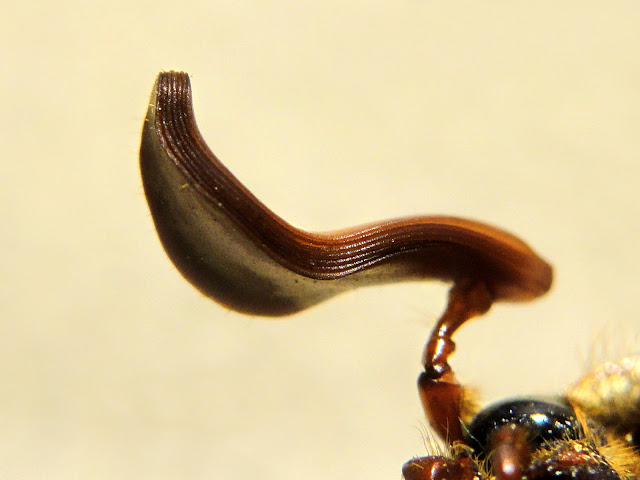
Even contained in a glass under bright light, a June beetle resists being photographed. Legs, complicated antennae, wing covers; everything is in constant movement. (It doesn't help when the cat keeps pushing the glass off the white background, either!) And I keep the photo sessions short, because it's a terrible imposition to take up so much of her short life being glared at. I got a few shots of those amazing grappling hooks and released their owner outside.

Look at those hooks! What he grabs, he holds.

He's a ten-lined beetle. To get the ten, you have to count the centre line as two, one for each wing cover. That gives you eight, but there are two very short lines between the outer two long lines (barely visible in this photo), making the total ten.

Such a nice furry vest! And more leg and foot detail. She's a female; the antennae of the males are much larger.


Friday, July 20, 2018

First dibs

Chia the cat was purring. And something was hissing*. I went to see what was going on, and found her rolling a ten-lined June beetle around the floor.

I grabbed the nearest glass (IKEA) and rescued the beetle. Upturned it on a sheet of paper on  my desk and got out the camera.

Chia did not approve.

"Mine! Mine! I saw it first!

I did get some photos, but it was a struggle.

*They can make a hissing sound when touched or otherwise disturbed, which can resemble the hissing of a bat. This sound is made by their wings pushing down, forcing the air out between their wings and back. (Wikipedia)

Monday, July 31, 2017

Ten-lined June beetle

Hard done by: first, I sprayed her with the hose, watering the garden, then I rolled her branch around and flashed lights in her face. But she was patient through it all, barely waving an antenna at me once in a while.

Ten-lined June beetle, all wet. Polyphilla decemlineata.

I know she's female, because her antennae are stubby and round. The male's are huge, layered, and shaped like a woman's high-heeled sandal, or opened up, like a stack of spoons.

Male antenna. From 2011.


In the morning, she was gone. She was not waiting until I watered her corner again.

Friday, July 03, 2015

Beetle sign language

About that ten-lined June beetle: I went out in the night to turn off the hose, which had been soaking the ground under a tree that has been losing leaves in all this heat, and found a big beetle drowning in the drip bucket.

Does he bite? Well, no, he's a June beetle, and they're inoffensive. But then, angry and half drowned; could I trust him? I collected a stiff rhododendron leaf, and slipped it under him. He clutched at it so desperately that I carried him home on the leaf, left it on my desk while I finished with the hose and got out the camera, and found him still holding on for dear life. And he wouldn't let go, even when I pulled at him.

Grappling hook feet. With 6 of these, he's staying put wherever he chooses. They don't work on plastic buckets.

He finally consented to move over to a handful of hydrangea leaves. where I could dry him off more easily.

Sopping wet, and unhappy. He's got bubbles all over his face.

How do you know if a June beetle is happy? He fans out those high-heeled shoe sole antennae.

Happy June beetle. Photo from BugGuide, by Lynette. Creative Commons license.

While he was on my desk, all wet and miserable, he kept the antennae tightly folded; beetle-style fists. Quite expressive fists, even so.

"I can clobber you with these!"

Or panicky; "Get me out of here!"

(Don't you want to just tickle his furry tummy, as if he were a kitten?)

Or just giving up, totally depressed.

I dried him off with a soft, thick paint brush, and carried his leaves outside, with him holding on tight again.

In the morning, he was gone. He probably fanned out those antennae as he flew away.

Powered By Blogger